






You’ve closed the round. The wire has hit. The team is celebrating.
Now comes the part most founders underestimate: telling the world about it in a way that actually does something for the business. A startup funding announcement isn’t just a formality. Done right, it’s one of the most valuable pieces of communication your company will ever put out. Done wrong, it’s a press release nobody reads, a LinkedIn post that gets a few likes, and a missed opportunity you can’t get back.
Here’s exactly how to write one that lands.
Why Your Funding Press Release Matters More Than You Think
A funding announcement reaches three audiences simultaneously, and each of them is reading it for different reasons.
- Investors are checking whether your narrative matches what they’ve heard in the room. They’re also watching how you communicate publicly for the first time.
- Enterprise buyers are using it to validate that you’re a serious company worth talking to. A well-covered raise tells procurement teams that others have already done their due diligence.
- Potential hires are deciding whether your company is going somewhere. Funding coverage is one of the first things strong candidates look at before applying.
One press release, three audiences, one shot. Getting the structure and the story right from the beginning is everything.
The Structure of a Press Release That Actually Gets Picked Up
Most startup funding press releases read like legal documents. Long, formal, loaded with jargon, and written for nobody in particular. Journalists bin them immediately.
Here’s what a press release that gets read and covered actually looks like:
1. Headline – Make the News Clear in One Line
Your headline should answer the most important question immediately: who raised it, how much, and from whom. Nothing clever. Nothing vague.
GOOD: [Company Name] Raises ₹50 Crore Series A Led by [Investor Name] to Expand Enterprise SaaS Platform
NOT GOOD: [Company Name] Announces Major Milestone in Its Journey Towards Growth
Journalists decide in three seconds whether to keep reading. Give them the news in the headline.
2. Dateline and Opening Paragraph
The first paragraph of a startup funding announcement press release should answer five questions: who, what, when, where, and why it matters. All in two to three sentences.
Example structure: [City, Date] — [Company Name], a [brief description of what the company does], today announced the close of a ₹[amount] [Series A/B/Seed] funding round led by [Lead Investor], with participation from [other investors]. The funds will be used to [specific use of funds—product, hiring, expansion].
No fluff. No “We are thrilled to announce.” Just the news.
3. The Founder Quote – Make It Say Something Real
This is where most press releases go completely wrong. The founder’s quote ends up being something like, “We are excited about this milestone and look forward to continuing our journey.”
That tells nobody anything. A good founder quote does one of three things:
- Explains why this raise matters for the market, not just the company
- Shares a specific belief about where the industry is going
- States something about the problem being solved that only someone inside the company would know
The quote is your voice. Use it.
4. Investor Quote – Credibility Transfer
If your lead investor is willing to give a quote, use it. An investor explaining why they backed you does more credibility work than anything you say about yourself. Keep it short, two to three sentences, and make sure it’s specific to your company, not generic investor-speak.
5. Company Background – Two Paragraphs Maximum
This is the boilerplate section. Founded when, what you do, who you serve, and any notable traction numbers you can share. Keep it factual and tight. Journalists use this section to verify basics; they don’t read it for the story.
6. Investor Background – One Paragraph
Who the lead investor is, what they’ve backed before, and why their participation means something. One paragraph. No more.
7. Boilerplate – Standard Closing
Every press release ends with a standard “About [Company]” paragraph. This is a fixed, pre-written description of your company that stays the same across all communications. Keep it to three to four sentences.
Common Mistakes That Kill a Funding Press Release
| Mistake | Why It Hurts |
|---|---|
| Burying the funding amount | Journalists scan for numbers—if they can’t find them fast, they move on |
| Vague use of funds | “Growth and expansion” tells nobody anything. Be specific |
| Generic founder quote | Sounds like every other press release. Gets ignored like every other press release |
| Too long | One page maximum. Two pages only if absolutely necessary |
| Sending without a media list | A great press release sent to the wrong journalists is still wasted |
| Announcing too late | Timing matters—coordinate embargo releases with your PR team for maximum impact |
What to Do Before You Send It
Writing the press release is half the job. The other half is everything that happens before it goes out:
- Agree on the embargo date with your investor. Both sides should announce simultaneously; a surprise announcement from either side before the agreed date can create unnecessary noise.
- Prepare your spokesperson: your founder needs to be ready for journalist follow-up questions the same day the release goes out.
- Have your media list ready: targeted pitching to journalists who cover your beat is far more effective than a mass blast.
- Coordinate your owned channels: LinkedIn posts, emails to your network, and website news sections should all go live at the same time as the press release.
- Prepare a longer story for interested journalists; some publications will want more than the press release. Have a deeper briefing document ready.
What Makes a Funding Announcement Actually Newsworthy
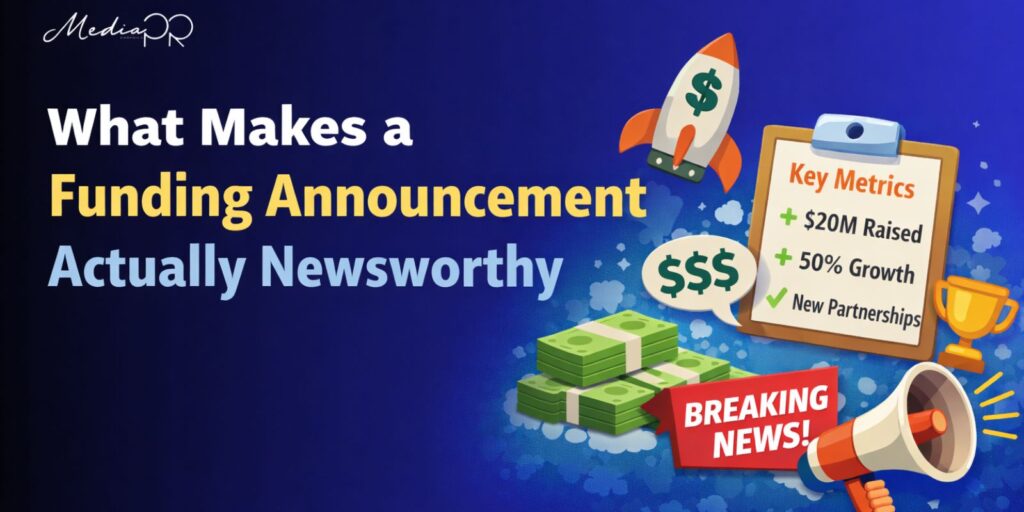
Not every raise gets covered. Here’s what makes journalists want to write about yours:
- Size: larger rounds get more attention, but sector context matters. A ₹10 crore raise in a niche deep tech category can be more interesting than a ₹50 crore raise in a crowded space.
- Investor name: a well-known lead investor transfers credibility immediately.
- The problem being solved: if the market timing is interesting, say so. Journalists cover trends, not just transactions.
- Traction numbers: customers, ARR, growth rate. Real numbers make a story. Vague claims don’t.
- The founder’s story: first-time founders from non-traditional backgrounds, repeat founders with a strong track record, domain experts solving problems they’ve lived—these angles get picked up.
How MediagraphicsPR Helps With Funding Announcements
A well-written press release is the starting point. What turns a startup funding announcement into a full media moment is the strategy behind it—the timing, the journalist relationships, the coordinated pitching, and the narrative that’s been built in the months before the release even goes out.
At MediagraphicsPR, PR for startups at funding stage is something we’ve handled many times. We know which journalists cover which rounds, what makes a funding story land in a national publication versus a trade outlet, and how to build the kind of pre-announcement credibility that makes the release itself land harder.
The startups that get the most out of their startup funding announcement aren’t the ones with the biggest rounds. They’re the ones whose story was already in the right places before the announcement went out. That’s the work we do.
Need help? Call us at +91-8448360900 or email us at info@mediagraphicspr.com
FAQs
Q: How long should a startup funding press release be?
One page is the standard. Roughly 400 to 500 words for the release itself. Anything longer and you’re writing for yourself, not for the journalist reading it at speed.
Q: Should we announce the valuation in the press release?
Only if both the company and investor are comfortable with it being public. Many startups choose to disclose the funding amount but not the valuation, which is completely normal and won’t affect coverage.
Q: How far in advance should we send the press release to journalists?
For embargo releases—where you share the news under embargo before the public announcement—two to three days gives journalists enough time to prepare a story. Same-day releases work for breaking news but give journalists less time to write something substantial.
Q: What if our raise is small, is it still worth announcing?
Yes, but frame it around the story, not the number. A ₹2 crore pre-seed raise in an interesting category with a compelling founder story can generate real coverage if it’s pitched to the right journalists with the right angle.
Q: Do we need a PR agency to announce our funding round?
You can do it without one, but the difference shows. A PR agency brings existing journalist relationships, knows the right timing, and can pitch your story in a way that increases the chance of meaningful coverage significantly. For a moment as important as a funding announcement, most founders find it worth the investment.