






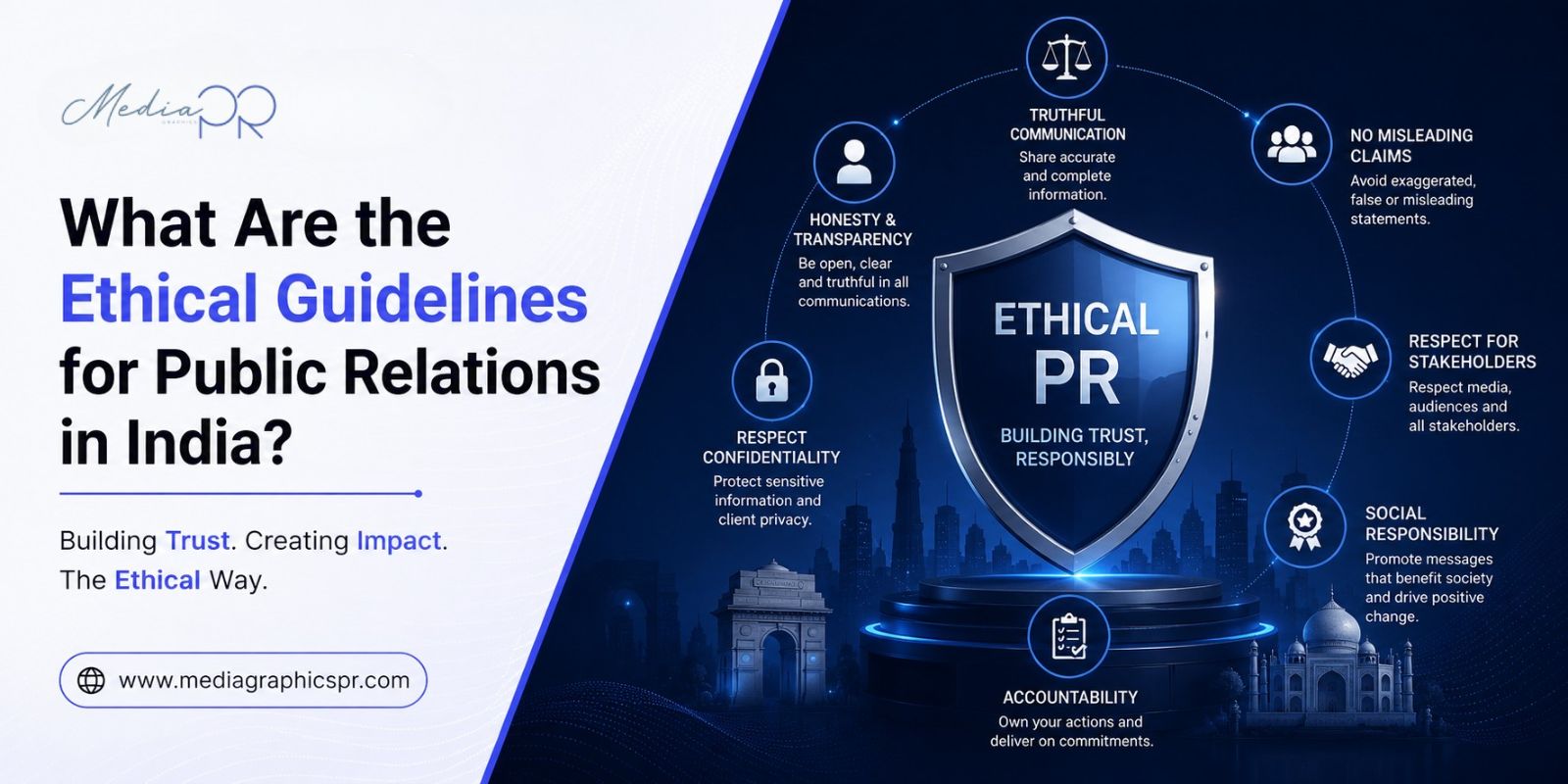
There is a version of PR that most people recognise — sharp press releases, friendly journalist relationships, and a brand story that cuts through the noise. Then there is the other version, the one that makes the industry uncomfortable to talk about — fabricated stories, undisclosed paid coverage, and manufactured public opinion that nobody commissioned but everyone reads.
The gap between those two versions is ethics.
India’s public relations industry has grown into one of the fastest-expanding communications sectors in Asia. According to PRCAI’s SPRINT 2024-25 survey, the Indian PR industry has crossed ₹2,500 crore in annual revenue, growing at nearly three times the global average. That scale brings scrutiny. And as the industry matures, the question of what constitutes responsible, ethical PR practice in India has become more relevant than it has ever been.
This blog is an attempt to answer that question clearly, without the usual platitudes.
What Does “Ethical PR” Actually Mean in India?
Ethics in public relations is not a philosophy exercise. It has very direct, practical implications for how agencies pitch stories, how clients are counselled, and how brands communicate with the public in moments of crisis or controversy.
When you strip away all the jargon, ethical PR comes down to one thing: you do not lie, and you do not help your client lie. That sounds obvious. But the pressure to deliver coverage, satisfy demanding clients, and operate within tight timelines can push agencies toward shortcuts nobody announces out loud — stretching a claim in a press release, burying a critical qualification, or describing a paid placement to a client as though it were earned editorial. Each of those is a breach. The fact that the industry has quietly tolerated all three does not change that.
Understanding what the guidelines actually say — and why they matter — is the starting point for any serious conversation about this.
The Governing Bodies and Their Codes
Two organisations set the formal ethical framework for PR practice in India.
The Public Relations Consultants Association of India (PRCAI), which came into existence in October 2001, is the apex body for PR consultancies in India. It is affiliated with the International Communications Consultancy Organisation (ICCO) and has built a Code of Conduct that agencies, clients, and corporate communications teams are all expected to follow. Where the Code gets specific — and it does get specific — it covers how practitioners must handle honesty, confidentiality, digital communications, and disclosure. PRCAI additionally adopted the Helsinki Declaration, a document that speaks directly to fake news, privacy in communications, the responsible use of AI tools in PR, and professional conduct across platforms.
The Public Relations Society of India (PRSI) has been around since 1958 — long before “ethical PR” became a conference topic — and its focus is on individual practitioners rather than agency firms. PRSI’s Code of Ethics was adopted formally at its first national conference in 1968, drawing from the International Code of Ethics for Public Relations. Its foundation has not changed: truth, integrity, and respect for the people affected by communications remain the core obligations for any practitioner who operates under it.
Both bodies overlap significantly in what they demand, and between them they cover the ground that matters most in day-to-day PR practice.
The Core Ethical Principles — What They Actually Require
Truth and Accuracy in All Communications
The first and oldest rule in every PR code — Indian or international — is that you do not pitch things you cannot back up. A funding number needs to be the real number. A product claim needs to be something the product actually does. An achievement needs to have happened. Journalists check. When they find a gap between what was pitched and what is true, it is not just that story that dies — it is the relationship, sometimes for years.
What makes this harder in practice is that clients sometimes push agencies to go further than the facts comfortably support. A pre-revenue startup wants to be positioned as a “category leader.” A product in beta wants launch-level coverage. The ask is usually framed as ambition, not dishonesty. An agency that goes along with it anyway — because saying no is uncomfortable — is not serving the client. It is setting them up for a credibility problem the moment a journalist starts digging.
Transparency About Who Is Paying for What
This is where the Indian PR industry has a genuine problem. The line between editorial coverage and paid placement has been systematically blurred over the years. Publications that accept fees to run “articles” that read like editorial, and agencies that present paid placements to clients as earned media, have made it difficult for audiences to trust what they read.
The Press Council of India’s Norms of Journalistic Conduct prohibit “paid news” — any coverage where the publication received payment and did not tell readers about it. The IT Rules 2021 pull digital media publishers into the same framework. What this means on the ground is simple: if money changed hands, the reader has a right to know. Dressing up a sponsored article as independent journalism is not a grey area — it is a violation of both the regulatory framework and the basic trust that makes PR coverage worth anything at all.
At MediagraphicsPR, we work exclusively with earned media. Every placement we secure is the result of genuine journalism — not a fee paid to a publication. That distinction matters enormously to the credibility of coverage.
Protecting Confidential Information
Think about what a PR agency actually knows about its clients at any given point — funding that has not been announced yet, a legal dispute that is still being settled, a product that did not perform the way anyone hoped, a leadership change that is three weeks away. That information sits with the agency team because the agency needs it to do the work. It does not travel further than that, not to other clients, not to journalists, not to anyone in the industry who might benefit from knowing it early.
The breaches that happen in practice are rarely dramatic. They are usually small — a team member mentioning something offhand at an industry event, or a pitch email that references confidential context to impress a journalist. The information was shared without thinking, not with intent to harm. But the damage to the client’s position can be significant regardless of how casually it happened. Agencies that take confidentiality seriously build systems to prevent these moments — not just policies that exist on paper.
No Astroturfing, No Fake News, No Manufactured Opinion
PRCAI’s guidelines are unusually direct on this point. Member organisations and practitioners are prohibited from engaging in astroturfing — the practice of creating the appearance of grassroots public support or opposition that does not genuinely exist. This includes planting fake reviews, orchestrating coordinated social media campaigns under false identities, or creating fake citizen groups to represent a client’s position.
The prohibition on fake news is equally clear. PR professionals must not create, knowingly circulate, or encourage the distribution of false information, regardless of how it is framed or what purpose it serves. In an environment where misinformation travels faster than corrections, this obligation carries significant weight.
India’s Standing Committee on Communications and Information Technology submitted a report in September 2025 specifically addressing the need to define fake news more precisely under law and establish an independent body to adjudicate cross-platform violations. The direction of regulation is toward tighter accountability, not looser. Agencies that have been casual about these lines should pay attention.
Responsible Use of Social Media and Digital Platforms
The Helsinki Declaration adopted by PRCAI specifically calls out social media as an area requiring heightened professional responsibility. The speed of digital communication means that an inaccurate story, a misleading tweet attributed to an executive, or a fabricated screenshot can cause reputational damage long before a correction reaches the same audience.
PR professionals working in digital environments are required to verify information before sharing it, disclose relationships and sponsorships transparently on social platforms, and avoid behaviour that exploits platform algorithms in misleading ways. Influencer marketing campaigns, in particular, must clearly disclose whether the relationship between a brand and a content creator is commercial — a requirement reinforced by the Advertising Standards Council of India (ASCI) and increasingly by SEBI regulations for financial services brands.
Disclosure of Conflicts of Interest
Most clients do not think to ask whether their agency represents a competitor. Most agencies do not volunteer the information unless pressed. That gap is where conflicts of interest quietly grow into problems.
The ethical standard here is disclosure — early, not after the fact. If an agency takes on a second client in the same sector, the existing client should hear about it. If a senior account manager has a personal financial stake in a client’s business, that needs to be on the table before it shapes the advice being given. This is not about assuming bad faith — it is about removing the conditions under which bias operates without anyone noticing.
The AI Dimension: A New Layer of Ethical Obligation
PRCAI now has a specific framework for AI use in communications — and it arrived because the risks became impossible to ignore. When generative AI tools started appearing in PR workflows, the temptation was to treat them like faster drafting software. The ethical reality is more complicated. An AI that produces a press release citing a statistic that does not exist, or a media pitch that misrepresents a client’s position because the prompt was vague, creates a problem that lands on the practitioner’s desk — not on the tool’s.
The framework calls for real human oversight of AI-generated content, not a final glance before sending. It calls for transparency about when and how AI is being used. And it flags the risk of algorithmic bias — particularly relevant in communications targeting specific communities or demographics. AI can save time in ethical PR practice. It cannot substitute for the judgment call that sits at the centre of every pitch, every story, every piece of counsel given to a client under pressure.
Why These Guidelines Matter Beyond Compliance
There is a practical case for ethics in PR that goes well beyond regulatory compliance.
Journalists have long memories. A journalist who pitched a fabricated story, or who discovers that “earned” coverage they ran was actually paid for, does not simply move on. That relationship is damaged, sometimes permanently, and the agency’s credibility with that publication suffers accordingly. Since media relationships are the single most valuable asset a PR agency has, protecting them through ethical conduct is not idealism — it is professional self-interest.
Trust from clients works the same way. Clients who discover that their agency has presented paid placements as editorial results, or have oversold relationships with journalists who do not actually respond to their pitches, do not renew contracts. The agencies that build lasting client relationships are the ones that tell clients the truth about what is achievable, what will take time, and why a proposed communication strategy might backfire.
Public trust, at scale, is the third dimension. India’s media ecosystem is under significant pressure from misinformation, commercial influence over editorial decisions, and audience cynicism about what they read. PR agencies that contribute to that erosion — by producing content that blurs fact and fiction, by manipulating search results through fabricated sources, or by generating fake social validation — make the entire communications environment less functional. The agencies that choose a different path help sustain an information ecosystem that can actually serve the public.
How to Evaluate Whether a PR Agency Operates Ethically
If you are evaluating PR agencies and want to understand whether they operate with integrity, these are the questions worth asking directly:
Do you distinguish clearly between earned media and paid placements, and how do you present that distinction to clients? Have you ever declined a client’s request because it conflicted with your ethical standards, and what happened? How do you handle a situation where a journalist asks you to confirm or deny something that is confidential? What is your approach to social media campaigns — do you use any tactics to manufacture reach or sentiment?
Agencies with clear ethical practices will answer these questions directly and specifically. Agencies that pivot to vague language about “industry standards” or “best practices” are likely telling you something important about how they operate.
MediaGraphicsPR’s Approach to Ethical PR
At MediagraphicsPR, ethics is not a section in a document. It shapes decisions made every day — which clients to take on, how to counsel clients whose communication instincts run ahead of the facts, how to handle relationships with journalists, and how to present results to clients honestly.
We work across fashion and beauty, book publishing, personal finance, art and culture, hotel and restaurant brands, VC and private equity firms, and many other sectors — and in every vertical, the same principles apply. Coverage is earned, not manufactured. Client counsel is honest, even when the honest answer is not what a client wants to hear. Media relationships are built over years of credibility, not compromised for a single placement.
You can read more about how we work on our industry expertise page and our blog section for further perspective on Indian PR and communications.
Frequently Asked Questions
What are the ethical guidelines for public relations in India?
The main frameworks are PRCAI’s Code of Conduct, the Helsinki Declaration that PRCAI adopted, and the PRSI Code of Ethics. In plain terms: be truthful, disclose when coverage is paid, protect client confidentiality, do not manufacture public opinion, use social media responsibly, and flag conflicts of interest before they become problems.
Is paid PR coverage ethical in India?
It depends entirely on disclosure. A sponsored article that is clearly labelled as such is not unethical — readers can make their own judgment. The problem is when paid content is dressed up to look like independent editorial. That crosses the line under Press Council of India norms, PRCAI guidelines, and basic standards of honesty with the audience.
What is astroturfing in PR and why is it prohibited?
Astroturfing is when an agency or brand manufactures the appearance of public interest that does not actually exist — fake reviews, coordinated social media posts from false accounts, fictitious citizen groups that represent a client’s interests. It is prohibited because it is deception. The public thinks they are seeing organic sentiment. They are not.
How does AI change ethical obligations in Indian PR?
It adds new layers without removing any of the old ones. PRCAI’s framework now covers AI specifically — requiring transparency about how it is used, human oversight of what it produces, and attention to bias in AI-generated content. The short version: using AI to speed up work is fine. Using AI to replace the human judgment that ethical PR requires is not.
How do I know if a PR agency follows ethical practices?
Ask them directly — earned media versus paid placements, how they handle confidential information, whether they have ever turned down business because of an ethical concern. Listen for specifics. Agencies that operate with integrity tend to have clear, concrete answers to these questions because they have actually thought them through.
Work With a PR Agency That Has Actually Thought About This
A lot of agencies will tell you they operate ethically. Fewer will be able to tell you specifically what that means in practice — which client requests they have said no to, how they handle the paid versus earned distinction with clients, what they do when a journalist asks something they cannot answer.
Those specifics matter. Ethics in PR is not a values statement on a website. It shows up in individual decisions, usually under pressure, usually when it would be easier to go the other way.
If you want a partner who operates that way, we should talk.
Visit MediagraphicsPR to learn how we approach PR.
Need help? Reach out directly:
📞 Call us: +91-8448360900 📧 Email us: info@mediagraphicspr.com
We respond within 24 hours.