






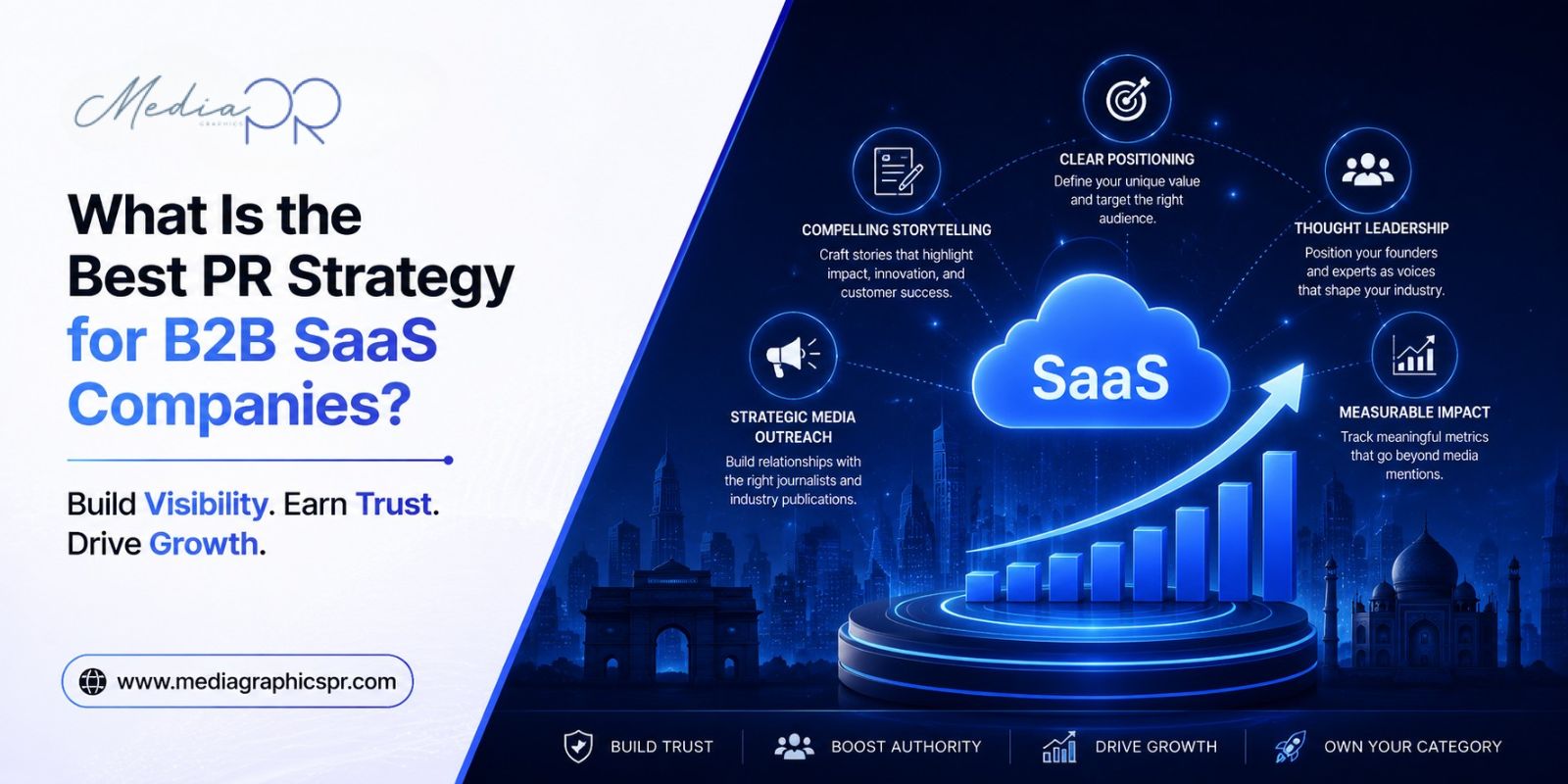
The best PR strategy for a B2B SaaS company focuses on three things: positioning your founders and product leaders as credible industry voices, securing coverage in the publications your buyers actually read before they contact sales, and using original data to give journalists a reason to write about you beyond a product announcement.
That is the short answer. The longer answer depends on what stage you are at, who your buyers are, and what problem you are trying to solve — pipeline, investor credibility, talent acquisition, or category ownership. Each of those goals requires a different emphasis, though the foundation stays the same.
Why B2B SaaS PR Works Differently From Consumer PR
Most general PR advice is written for consumer brands. B2B SaaS is a different game entirely, and applying consumer PR logic to it tends to produce expensive disappointment.
The core difference is the buyer. A B2C purchase is made by one person, often emotionally, sometimes in minutes. A B2B SaaS deal typically involves a buying committee of six to ten people — a CTO evaluating technical architecture, a CFO looking at total cost of ownership, a procurement team running vendor checks, and end users who will actually live with the product day to day. According to Gartner’s 2025 research, 80% of B2B buyers complete the majority of their research independently before they ever contact a vendor’s sales team.
That finding has a direct implication for PR. If your buyer is forming their opinion about your category — and your company’s place in it — before they talk to anyone on your team, then the publications they read, the reports they reference, and the executives they follow on LinkedIn matter enormously. PR is how you show up in that research process with credibility you did not pay for.
A B2B SaaS company featured in a respected trade publication or business media outlet sees something consumer brands rarely do: prospects mention the coverage during sales calls, not as casual awareness but as a validation signal. That shortens deal cycles in a way that paid advertising simply cannot replicate.
The Core Components of a B2B SaaS PR Strategy
Thought Leadership — The Engine of B2B PR
Thought leadership is the term the industry uses loosely for almost everything. In practice, it means one specific thing: your company’s senior people have a genuine, non-obvious point of view about where your industry is heading, and you are putting that view into the market consistently enough that journalists, analysts, and buyers start associating your brand with that perspective.
This does not happen from press releases. It happens from bylined articles in publications your buyers respect, from expert commentary when journalists are writing about your category, from speaking slots at the conferences where your customers make their evaluations, and from original research that gives people something new to think about.
The question to ask before building a thought leadership programme is not “what do we want to say about our product?” It is “what do we believe about our industry that most people would push back on?” That friction — a genuinely held, defensible contrarian position — is what makes a thought leader worth reading. Everything else is just content.
Original Data and Research
Journalists covering B2B technology are drowning in vendor pitches that offer opinions. What they cannot get enough of is proprietary data. If your platform processes enough transactions, user sessions, or workflow events to generate non-obvious insights, those insights are a story.
A project management SaaS that can say “remote teams using our platform increased automation workflows by 35% in Q1” has something a journalist can write about. A cybersecurity company that can say “mid-market enterprises see an average of 14 days between breach detection and response” has a story that will get picked up. The data does not need to be dramatic — it needs to be specific, verifiable, and tied to something your buyers care about.
This is one of the most underutilised PR assets in B2B SaaS. Most companies sit on data that would generate significant media coverage and never think to treat it as a PR asset.
Trade and Vertical Media — Not Just National Business Press
The instinct for most SaaS founders is to chase the big business publications — Economic Times, Forbes, Mint. Those placements matter for investor credibility and brand authority. But for pipeline impact, the publications that actually move the needle are often vertical trade outlets that your buyers read professionally.
An HR tech SaaS will find more qualified buyer attention in People Matters or HR Katha than in a general business publication that covers the company as one item in a startup funding roundup. A fintech SaaS serving NBFCs reaches its actual decision-makers through BFSI-focused publications more directly than through a national masthead that treats fintech as a general interest topic.
Both matter. The national coverage builds category authority and investor confidence. The vertical trade coverage reaches buyers at the moment they are actively researching solutions.
Analyst Relations — The Underestimated Lever
Most B2B SaaS companies think about PR as media relations. The companies that win enterprise deals think about it differently. Getting included in an analyst report from Gartner, Forrester, IDC, or India-specific research bodies can unlock procurement conversations that no amount of press coverage alone would achieve.
Enterprise buyers, particularly in regulated sectors like BFSI, healthcare, and government-adjacent technology, often use analyst reports as shortlists. If your company does not appear in the reports your buyers reference, you may not even be considered, regardless of how strong your product is.
Analyst relations is a long-term investment. It takes 12 to 18 months of consistent engagement before most companies see meaningful impact from it. But for SaaS companies targeting enterprise accounts, it belongs in the PR strategy from Series A onwards.
LinkedIn and Executive Visibility
In B2B SaaS specifically, the founder’s or CEO’s LinkedIn presence functions as an always-on thought leadership channel that media coverage alone cannot replicate. A well-written LinkedIn post from a credible founder reaches buyers, potential hires, and investors simultaneously — and the engagement it generates can be used to demonstrate audience reach when pitching journalists.
The companies that build the strongest B2B PR results treat LinkedIn not as a broadcasting channel for press release links but as a place where genuine industry thinking gets published first. The media coverage and the LinkedIn presence reinforce each other. Journalists find founders worth quoting through LinkedIn. Buyers see media coverage and then follow the founder on LinkedIn. The loop builds credibility compoundingly.
B2B SaaS PR vs B2C PR — Key Differences
| Factor | B2B SaaS PR | B2C PR |
| Primary Audience | Decision-making committee (CTO, CFO, Procurement) | Individual consumer |
| Sales Cycle Length | 6–18 months | Hours to days |
| Key Media Targets | Trade publications, business press, analyst reports | Lifestyle, national media, social media |
| Thought Leadership | Critical — buyers research independently | Less central |
| Data & Research | High value — journalists and analysts cite it | Moderate — occasional reports |
| Analyst Relations | Essential for enterprise deals | Rarely relevant |
| LinkedIn Visibility | Significant commercial impact | Brand awareness only |
| PR Impact Timeline | 6–12 months to see pipeline impact | Can see results in weeks |
| Coverage Goal | Credibility with specific buyer personas | Broad awareness |
B2B SaaS PR Strategy by Growth Stage
Where you are in your journey as a company changes what PR should be doing for you. The mistake most founders make is trying to run a Series C PR strategy at seed stage, or continuing to run seed-stage PR when they are trying to close enterprise deals.
| Growth Stage | PR Priority | Key Tactics |
| Pre-seed / Seed | Narrative and Voice | Founder LinkedIn, niche media, category positioning |
| Series A | Credibility with Investors and Early Buyers | National business media, funding announcement, thought leadership launch |
| Series B | Category Ownership | Trade media, original research, speaking at industry conferences |
| Series C and Beyond | Enterprise Credibility | Analyst relations, Tier-1 media consistently, executive profiling |
| Pre-IPO | Investor and Public Trust | Sustained national coverage, crisis preparedness, regulatory clarity |
What Makes a B2B SaaS Story Worth Covering
The honest answer is that most SaaS PR pitches are not worth covering, and journalists know it. A product update, a new feature release, or a minor partnership announcement is not news for a publication that has to justify every story to its readers.
The stories that get covered share a few characteristics. They are tied to something happening in the broader market — a regulatory change, an economic shift, a technology transition that your product is directly relevant to. They include specific numbers, either from your own platform data or from original research. They present a non-obvious perspective from someone who has thought seriously about the problem. And they are pitched to the right journalist, who covers this specific territory, not to a generic media list.
The companies that generate consistent B2B SaaS coverage have usually built something more valuable than a media list. They have built relationships with three to five journalists who cover their space; they have made those journalists look good by giving them exclusive data or early access to significant news, and they show up with genuine insight rather than thinly veiled product promotion.
Common B2B SaaS PR Mistakes
Most of these are not dramatic. They are quiet failures that drain PR budgets without producing results.
Treating press releases as the primary output is the most common one. A press release is a tool for distributing information journalists already want to write about. It is not a way of making uninteresting information interesting.
Measuring success in clip count rather than quality is the second. Fifty mentions in low-authority blogs reach fewer decision-makers than two features in publications your buyers actually read. The metric that matters for B2B SaaS is whether the coverage influences the research your buyers are doing, not whether a monitoring tool shows a high volume number.
Separating PR from sales is the third. The most effective B2B SaaS PR programmes are tightly connected to the sales team. Sales knows which publications prospects mention, which questions keep coming up, and which competitors are getting coverage their buyers reference. That intelligence should be feeding the PR strategy directly.
How MediagraphicsPR Approaches B2B SaaS PR
At MediagraphicsPR, we work with SaaS companies, fintech platforms, and B2B technology brands across India to build PR programmes that connect to actual business outcomes — not just coverage volumes.
Our approach starts with understanding the buyer’s research journey for your specific product, identifying the publications and platforms where that research happens, and then building a strategy that puts your company and your leaders into those conversations consistently.
We have placed B2B technology clients in The Economic Times, Business Standard, Mint, Forbes India, CNBC TV18, The Hindu BusinessLine, and relevant trade publications across sectors including fintech, climate tech, and SaaS. You can see the breadth of sectors we cover on our industry expertise page.
If you are evaluating PR for your B2B SaaS company and want to understand what a programme built around your growth stage and buyer journey would look like, the conversation starts here.
Frequently Asked Questions
What is the best PR strategy for B2B SaaS companies?
The most effective B2B SaaS PR strategy combines founder thought leadership, original data-driven pitching, trade and vertical media relations, and — for companies targeting enterprise accounts — analyst relations. The goal is to appear credibly in the research your buyers conduct before they contact your sales team.
How is B2B SaaS PR different from regular PR?
B2B SaaS PR targets a buying committee, not an individual consumer. Coverage in trade and business publications matters more than lifestyle media. Thought leadership and original research carry more weight than product announcements. And the impact on the pipeline typically takes longer to show — six to twelve months — because sales cycles are longer.
Does PR actually help B2B SaaS companies generate pipeline?
Yes, but indirectly. Gartner research from 2025 shows that 80% of B2B buyers complete most of their research before contacting vendors. Earned media coverage is part of that research. A study by Avaans Media found that companies with strong PR programmes generate three to five times more inbound leads than competitors relying solely on paid ads.
How much thought leadership is enough for a B2B SaaS company?
Consistency matters more than frequency. One genuinely insightful bylined article or LinkedIn post per week from a senior leader is more valuable than a flood of generic content. The test is whether your audience would miss it if it stopped — that is the bar worth working toward.
When should a B2B SaaS company start working with a PR agency?
Earlier than most founders think. Pre-Series A is a reasonable time to start building the narrative and media foundation, even if the programme is modest. Waiting until Series B or later means entering the media landscape without the credibility infrastructure that takes time to build — and having to build it while also trying to close enterprise deals.
Ready to Build a PR Strategy That Moves Your Pipeline?
B2B SaaS PR that actually works is not about getting your company name in print. It is about showing up in the research your buyers are already doing, with a perspective and a presence that earns their confidence before your sales team ever calls.
Visit MediagraphicsPR to see how we approach B2B technology PR.
Need to speak to someone now?
📞 Call us: +91-8448360900 📧 Email us: info@mediagraphicspr.com
We respond within 24 hours.