






Most tech companies ask the wrong question about PR.
They ask: How many press releases did we send? How many clips did we get? What was the estimated reach?
These numbers feel like progress. They rarely are.
The real question is whether your tech PR strategy is actually changing how your market sees you—with investors, with enterprise buyers, with the talent you’re trying to hire, and with the journalists who shape your industry’s narrative.
Here are 10 signs that it genuinely is.
Sign 1. Your Narrative Is Consistent Everywhere
This one sounds simple. It isn’t.
When your tech PR strategy is working, the story about your company is the same regardless of where someone finds you, whether it’s a journalist’s feature, a founder’s LinkedIn post, your website, a conference talk, or a product announcement. The language, the positioning, and the core message all reinforce each other.
When it’s not working, different publications say different things about you. Your website says one thing. A journalist wrote something slightly off. Your founder described the company differently in an interview. That inconsistency creates confusion, and confused audiences don’t convert into customers, investors, or hires.
Check: Google your company name. Does every result tell the same coherent story?
Sign 2. Journalists Are Coming to You
Early in a PR strategy, you’re doing all the outreach. Your team is pitching, following up, and building relationships from scratch.
When the strategy is working, the dynamic shifts. Journalists who’ve covered you before come back for comment on industry stories. Reporters covering your space start including you in their source lists. You get inbound requests you didn’t initiate.
This doesn’t happen overnight. It typically takes six to nine months of consistent tech PR work. But when it starts, it’s one of the clearest signs that your media presence is compounding.
Sign 3. Coverage Is in the Right Publications
Not all coverage is equal. A feature in a publication your enterprise buyers, investors, or target audience has never heard of is activity, not outcome.
When your tech PR strategy is working, coverage lands in the publications that actually matter to your business goals:
| Business Goal | Right Publications |
|---|---|
| Investor Attention | Economic Times, Mint, Business Standard, Inc42 |
| Enterprise Credibility | Sector-specific trade media, industry outlets |
| Customer Awareness | Mainstream digital and national print |
| Talent Attraction | LinkedIn, startup ecosystem publications |
| Category Leadership | Niche newsletters, analyst reports, podcasts |
If your coverage is consistently appearing in places your audience reads, that’s the sign.
Sign 4. Sales Conversations Are Starting Differently
This is one of the most underrated signals of a working tech PR strategy and one of the most valuable.
When enterprise buyers have already seen your company covered in a publication they respect, the first sales conversation starts at a different trust level. The credibility work has already been done by the media. Instead of spending the first meeting establishing who you are, you’re already past it.
Signs to look for:
- Prospects mentioning they read about you before the first call
- Sales cycles shortening for enterprise deals
- Fewer “we’ve never heard of you” responses to outbound pitches
- Inbound inquiries referencing specific media coverage
Sign 5. Your Founder Is Getting Quoted Without Pitching
When your founder or leadership team starts getting approached for quotes on industry stories, without the PR team initiating it, something important has happened. Journalists have put them on their mental source list.
This is what consistent thought leadership PR builds. A founder who shows up regularly in relevant publications, with genuine insight on industry trends, eventually becomes the person journalists call when they need an expert comment. That positioning is worth more than any individual placement, because it keeps generating value without proportional effort.
Sign 6. Hiring Is Getting Easier
Strong candidates research companies before applying. They Google founders, read coverage, and check LinkedIn. What they find, or don’t find, shapes whether they click apply or move on.
The signals of an effective tech PR strategy:
- More unsolicited applications from strong candidates
- Candidates mentioning specific coverage in interviews
- Fewer offer rejections to competitors with stronger brand recognition
- A shorter time-to-hire because your employer brand is already doing part of the work
In India’s competitive tech talent market, brand credibility built through PR is a real hiring advantage.
Sign 7. Your Digital Metrics Move After Coverage
PR and digital performance are more connected than most companies track. When a major placement goes live, especially with backlinks from high-authority publications, the downstream digital effects are measurable:
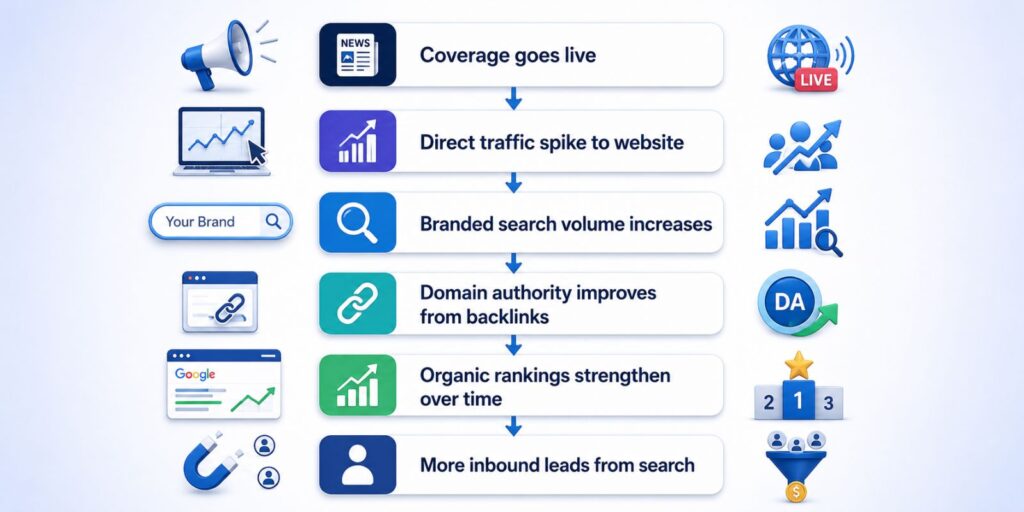
If you’re not tracking website traffic, branded search volume, and domain authority changes after major placements—you’re missing half the evidence that your PR is working.
Sign 8. Investors Reference Your Coverage
For funded startups and growth-stage companies, this is one of the most direct business signals a tech PR strategy can produce.
When investors mention in a first meeting that they’ve seen your coverage, when analysts reference your company in sector reports, when a VC associate says they’ve been following your founder’s work before the intro—that’s PR working at exactly the right level. The credibility conversation is partially done before the pitch begins.
Sign 9. Your Company Shows Up in Competitor Comparisons
When a journalist or analyst writing about your category includes your company in a comparison piece, without being pitched specifically for it, your market position has genuinely shifted.
This happens when consistent PR for tech companies has established your brand as a recognized player in the space. You’re on the shortlist journalists reach for when they need to represent the category. That positioning is very hard to build quickly and very hard to displace once established.
Sign 10. Your Team and Stakeholders Are Sharing Coverage Organically
Internal engagement with PR coverage is an underrated signal. When your team, investors, advisors, and partners are proactively sharing your media placements through forwarding links, posting on LinkedIn, and referencing articles in conversations. It means the coverage is genuinely landing in the right places.
It also creates a compounding amplification effect. Every stakeholder share extends the reach of each placement beyond its original audience and signals to your broader network that something worth paying attention to is happening at your company.
The Signs That Your Strategy ISN’T Working
Worth knowing the other side too:
✗ Coverage consistently appearing in publications your audience doesn’t read
✗ Clip count going up but no change in investor or buyer behavior
✗ Founder still unknown to journalists covering your space after six months
✗ Sales team never referencing media coverage in conversations
✗ No inbound journalist requests after months of consistent pitching
✗ Hiring difficulty unchanged despite PR activity
→ If several of these apply, the strategy needs to be reassessed, not just continued.
How MediagraphicsPR Measures What Actually Matters
Most tech companies spend months on PR without knowing whether it’s working because nobody defined what working looks like before they started.
At MediagraphicsPR, we work as the tech PR agency that sets those metrics before anything goes to a journalist, because coverage that can’t be connected to a business outcome isn’t a strategy; it’s activity.
As a PR agency in Delhi with over two decades of real media relationships across India’s most important publications, we build tech PR strategies around the signs above, not clip counts. Senior people on your account. Real journalist relationships. A strategy that measures what your business actually needs to move.
If you’re seeing these 10 signs, your PR is working. If you’re not seeing most of them, it’s worth a conversation about why.
Need help? Call us at +91-8448360900 or email us at info@mediagraphicspr.com
FAQs
Q: How long before a tech PR strategy starts showing these signs?
First signs—consistent narrative, initial coverage in right publications—usually appear within six to eight weeks. The deeper ones, like inbound journalist requests and sales conversations, take three to six months of consistent work.
Q: Which of these 10 signs matters most for an early stage startup?
Consistent narrative, right publications, and sales conversations shifting are the most immediately valuable for early-stage companies. The others build as the strategy matures.
Q: Can we track these signs without expensive PR monitoring tools?
Honestly yes. Google Alerts for brand mentions, checking website traffic manually after placements, and asking your sales team directly covers most of what you need early on.
Q: What if we’ve been doing PR for six months and still don’t see most of these signs?
Don’t extend the engagement before figuring out why. Usually it comes down to wrong media targets, a narrative that isn’t clear enough, or pitching without real journalist relationships behind it. All fixable, but doing more of the same won’t change the result.