






Short answer, yes. But not in the way most businesses think about it.
PR isn’t a cost line that produces coverage. It’s an investment that builds credibility, narrative control, and media presence that compounds over time and does work for your business long after any individual campaign ends. The brands that figured this out early in India’s current market cycle are pulling ahead. The ones still treating PR as optional are finding out the hard way what that silence is costing them.
Here’s the honest case for why PR investment in India in 2026 is not just worth it; it’s becoming one of the most strategically important decisions a growing business can make.
Why 2026 Is a Different Moment for PR in India
The context matters. Three things have shifted significantly:
1. Media credibility has become more valuable as content volume explodes
AI-generated content is everywhere. Every brand has a blog. Every founder has a LinkedIn post going out three times a week. In that noise, earned media—coverage in publications with real editorial standards—has become more trusted, not less. A feature in Economic Times or Mint carries more weight in 2026 than it did in 2020 precisely because everything else has been devalued.
2. Indian investors and enterprise buyers are doing more research
The due diligence bar has risen. Institutional investors research founders and companies across media before taking meetings. Enterprise procurement teams vet Google vendors before responding to pitches. What your brand looks like online—the coverage, the founder commentary, and the narrative consistency—is part of the evaluation now in a way it simply wasn’t five years ago.
3. The competitive landscape has compressed
More funded startups, more enterprise SaaS companies, and more D2C brands are competing for the same media, investor, and customer attention. In that environment, the brands with consistent public relations presence have a structural advantage that’s hard to close through product quality alone.
What PR Actually Delivers: The Real ROI
The mistake most businesses make when evaluating PR ROI is measuring the wrong things. Clip count, estimated reach, and PR value equivalents are easy to calculate and almost meaningless as business metrics.
Here’s what PR actually delivers when it’s working properly:
| What PR Builds | How It Shows Up in Business |
|---|---|
| Media credibility | Investors and buyers arrive with trust already established |
| Narrative control | Your brand story doesn’t get defined by someone else |
| Journalist relationships | Coverage compounds, each placement leads to the next |
| Founder authority | Leadership becomes a credible industry voice |
| Crisis resilience | Difficult moments don’t become lasting reputation damage |
| Talent attraction | Strong candidates research and find you before applying |
| Sales support | Enterprise buyers reference coverage in early conversations |
| SEO Value | High-authority backlinks improve organic search performance |
Every one of these has a direct business value. Most of them are invisible until you measure them properly, or until you don’t have them and feel the gap.
The Compounding Effect Nobody Accounts For
This is the part of PR investment that’s hardest to put in a spreadsheet and the most important to understand.
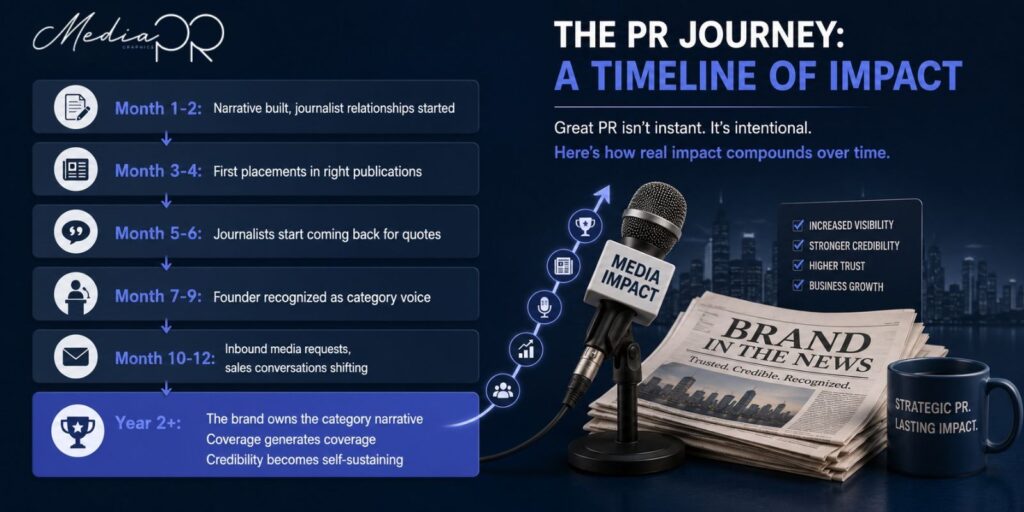
The brands that started this compounding cycle two years ago are now the ones journalists call first, investors recognize before the pitch, and enterprise buyers trust before the proposal lands. The brands starting now will be in that position in two years, but only if they start.
PR vs. Paid Media—The Honest Comparison
Most businesses understand paid media ROI intuitively: spend X, get Y impressions, generate Z leads. PR doesn’t work that way. That difference makes it harder to justify to a CFO but doesn’t make it less valuable.
| Factor | Paid Media | PR |
|---|---|---|
| Cost Model | Pay per impression/click | Investment in relationships and narrative |
| Credibility | Low, as the audience knows it’s paid | High due to third-party endorsement |
| Longevity | Stops when budget stops | Coverage stays online and compounds |
| Trust Factor | Declining because ad fatigue is real | Growing, earned media is increasingly trusted |
| Sales Impact | Direct but short-term | Indirect but longer lasting |
| Crisis Value | None | Significant — pre-built credibility absorbs hits |
The right answer for most Indian businesses isn’t PR instead of paid media. It’s PR and paid media, each doing what the other can’t.
What Happens When You Don’t Invest in PR
This is the conversation most brands avoid until it’s too late.
The Silent Cost of no PR:
✗ Investors form impressions from incomplete or outdated information
✗ Enterprise buyers choose a competitor they’ve read about over you
✗ A negative story lands with no credibility buffer to absorb it
✗ Strong candidates pick companies with visible, credible employer brands
✗ Your category narrative gets defined by competitors who are investing in PR
✗ Every fundraise, launch, and major announcement starts from zero on credibility
The cost of not doing PR isn’t visible on a P&L. But it shows up in harder fundraises, slower enterprise sales cycles, weaker talent pipelines, and market positions that are difficult to recover once a competitor has established them.
When PR Investment Makes the Most Sense
Not every business at every stage needs the same level of PR investment. Here’s a practical guide:
| Business Stage | PR Priority | Primary Focus |
|---|---|---|
| Pre-seed / Seed | Medium | Founder thought leadership, narrative building |
| Pre Series-A | High | Media credibility before investor conversations |
| Post-funding | Very High | Announcement momentum, category positioning |
| Growth stage | High | Consistent presence, thought leadership, talent |
| Enterprise / Pre-IPO | Critical | Consistent presence, thought leadership, talent |
| Crisis moment | Urgent | Narrative control, media management |
The pattern is consistent; the moments when PR matters most are almost always the moments when you wish you’d started earlier.
How to Measure PR ROI Properly
Stop measuring clips. Start measuring outcomes.
Questions that actually indicate PR ROI:
- Are investors mentioning coverage before your pitch meetings?
- Are enterprise buyers referencing your brand before the first sales call?
- Are strong candidates citing your media presence in interviews?
- Is your founder being approached for expert commentary without pitching for it?
- Are website traffic and branded search volume moving after major placements?
- Is your company showing up in competitor comparisons without being specifically pitched?
If the answer to most of these is yes, your PR investment is delivering real business value. If the answer is no after six months of consistent work, the strategy needs to be reassessed, not the investment itself.
How MediagraphicsPR Approaches PR Investment
The brands getting the most from their PR investment in India right now are the ones that started before they felt the pressure and worked with a team that connected every activity to real business outcomes from day one.
At MediagraphicsPR, we work as the PR agency in India that treats your PR budget as exactly what it is, a business investment that deserves the same rigor and accountability as any other. As a PR agency in Delhi with 23+ years of real media relationships across India’s most important publications, we build public relations strategies around where your brand is and where it needs to go—with senior people on your account from day one and metrics that actually connect to your business goals.
Is PR worth the investment in India in 2026? For the brands building something serious, the honest answer is that the question isn’t whether you can afford it. It’s whether you can afford not to.
Need help? Call us at +91-8448360900 or email us at info@mediagraphicspr.com
FAQs
Q: How much should an Indian startup budget for PR in 2026?
Depends on stage and goals, but most meaningful PR engagements start from ₹1.5 to 2 lakh per month. The more useful question is what outcomes you need and whether the investment produces them.
Q: Can PR replace digital marketing for an Indian brand?
No, they do different things. PR builds earned credibility. Digital marketing drives traffic and conversions. Both are needed, and both work better when they’re running together.
Q: How do we know if a PR agency is actually delivering ROI?
Track outcomes, like investor conversations shifting, enterprise buyers referencing coverage, hiring improvements, and branded search volume. Clip count alone tells you very little.
Q: Is PR more important at certain business stages in India?
Pre-fundraise and post-funding are the highest-value moments. But the brands that benefit most are the ones running PR consistently between those moments, not just switching it on when they need something.