






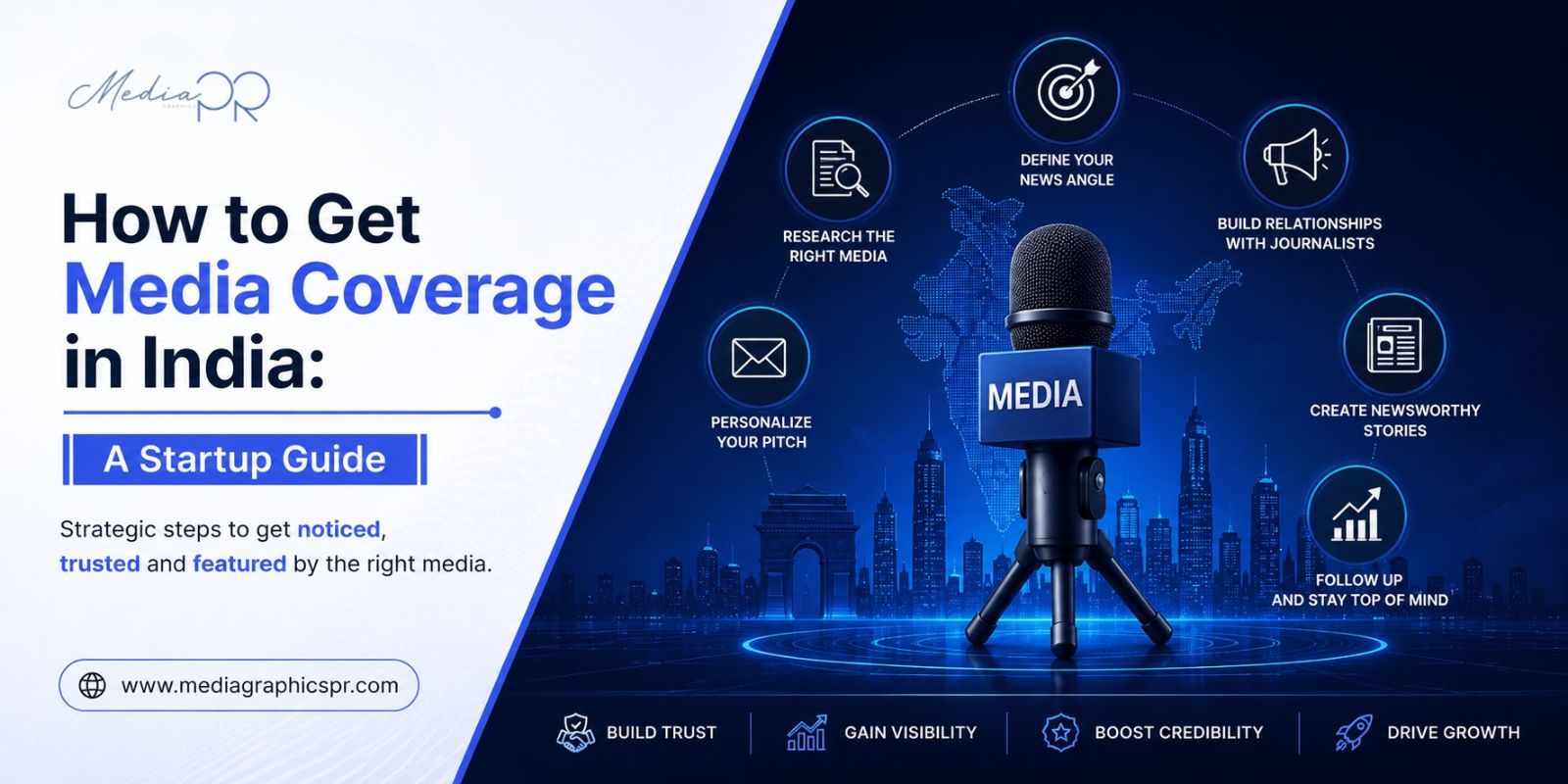
You sent the press release. You waited. Nothing happened.
Sound familiar? Most founders trying to get media coverage India startup style run into the same wall. They write something, send it somewhere, and then wonder why journalists aren’t picking it up. The frustrating part is that the story is usually genuinely interesting; the problem isn’t the company, it’s the approach.
Getting press coverage in India as a startup isn’t about having the biggest funding round or the flashiest product. It’s about knowing how Indian media actually works, which journalists cover what, and how to give them something they actually want to write about. This guide tells you exactly that.
Why Most Startup Press Outreach Fails
Before getting into what works, it’s worth being honest about what doesn’t.
| Common Mistake | Why It Fails |
|---|---|
| Sending a generic press release to a mass list | Journalists get hundreds of these, and most get deleted unread. |
| Pitching product features instead of stories | Journalists cover stories, not features. |
| Cold emailing journalists who’ve never heard of you | No relationship means no reason to open the email. |
| Pitching the wrong publication for your stage | Inc42 covers funded startups—pre-revenue pitches land differently. |
| Following up aggressively | Kills the relationship before it starts. |
| No news hook | “We exist” is not a story. |
Most startups make at least three of these mistakes simultaneously. Fixing them changes results faster than anything else.
Step 1. Understand What Journalists Actually Want
This is the foundation everything else builds on. Journalists are not PR distribution channels. They’re writers with editors, deadlines, and readers who have specific expectations.
A journalist at Mint covers the Indian business and startup ecosystem for an audience of investors, executives, and business decision-makers. They’re looking for stories that are:
- Timely—connected to something happening right now
- Relevant—meaningful to their specific readership
- Surprising—something their readers don’t already know
- Human—with a real person at the centre, not a product
Your startup’s funding round, product launch, or growth milestone is not inherently any of these things. Your job, and the job of good startup media outreach, is to connect your news to something that makes it genuinely interesting to that journalist’s specific audience.
Step 2. Build the Story Before You Build the Pitch
Most startups pitch announcements. The best media coverage India startup pitches lead with stories.
THE DIFFERENCE:
Announcement pitch:
“We raised ₹10 crore in Series A”
Story pitch:
“We raised ₹10 crore to solve a problem that’s costing Indian logistics companies ₹2,000 crore annually, here’s why nobody has fixed it until now”
The second pitch gives a journalist something to write about. The first gives them a fact they may or may not care about.
Before sending anything, answer these questions:
- What is the real story here, not the announcement, but what it means
- Who does this affect, and why should they care
- What’s the market context that makes this timely right now
- What’s surprising or counterintuitive about this
When you can answer all four, you have a pitch worth sending.
Step 3. Know Which Publications to Target
How to get press coverage India style starts with targeting the right publications for your specific stage and audience.
| Stage / Goal | Right Publications |
|---|---|
| Pre-seed / Seed | YourStory, Inc42, Entrackr, The Morning Context |
| Series A and Above | Mint, Economic Times, Business Standard |
| Customer Brand | Mainstream digital media, lifestyle publications |
| B2B Enterprise | Trade publications specific to your sector |
| Investor-facing | Inc42, Business Standard, Mint, Forbes India |
| Tech-specific | ET Tech, TechCircle, Analytics India Magazine |
Don’t pitch Economic Times for a pre-seed round; it won’t land. Don’t pitch only YourStory when you’re Series B; you’re leaving credibility on the table. Match the publication to the stage and the audience.
Step 4. Find the Right Journalist—Not Just the Right Publication
Publication targeting is only half the equation. Within every publication, different journalists cover different beats. Pitching the wrong journalist at the right publication is almost as ineffective as pitching the wrong publication entirely.
How to find the right journalist:
- Read bylines, who has written about companies like yours in the last three months?
- Follow them on LinkedIn and X, understand what angles interest them
- Check their recent stories—is your pitch adjacent to something they’re already covering?
- Look for journalists who’ve covered your specific sector, not just “startups” broadly
A pitch sent to a journalist who covers your exact space lands completely differently than a cold email to a general inbox.
Step 5. Build the Relationship Before the Pitch
The most effective startup media outreach in India happens between people who already know each other, at least a little.
You don’t need to be best friends with a journalist to get covered. But being a name they recognize changes everything about how your email gets treated.
How to build journalist relationships without being annoying:
- Engage genuinely with their work on LinkedIn—a real comment, not a generic one
- Share their articles when they’re relevant to your network
- Offer yourself as a source for stories they’re already writing, no pitch attached
- When you do pitch, reference something specific they’ve written recently
Start this process three to six months before you have something important to announce. The relationships built in advance are what make big moments land.
Step 6. Write a Pitch That Actually Gets Read
Most press pitches are too long, too formal, and too focused on what the founder wants to say instead of what the journalist needs to write a story.
A pitch that works:
- Subject line (one line, specific, no jargon): “₹10 Cr raise to fix India’s cold chain problem—founder available for interview”
- Opening (the story in two sentences, not your company background)
- Why now (one sentence on why this is timely)
- Why you (one sentence on why your team is credible on this)
- The ask, clear and simple: interview, comment, or full feature consideration
- Total length, under 200 words
Journalists read dozens of pitches daily. The ones that get responses are the ones that make the story obvious in thirty seconds.
Step 7. Use News Cycles to Stay Visible Between Announcements
Media coverage India startup isn’t only about your own news. Some of the most valuable coverage comes from inserting your founder’s perspective into conversations that are already happening.
When a major story breaks in your industry—a regulatory change, a competitor funding round, or a market shift—that’s an opportunity:
Industry news breaks
↓
Identify the angle relevant to your startup
↓
Founder perspective drafted quickly—specific, genuine
↓
Pitched to journalists already writing the story
↓
Your company quoted alongside bigger players
↓
Credibility builds without a press release
Do this consistently and journalists start filing your founder as a source which means they come to you when the next story breaks.
Step 8. Track What’s Working
Most startups send pitches and never analyse results. Simple tracking changes this fast.
What to track:
- Which journalist responded, and why did that pitch work?
- Which publication covered you? Was it the right audience?
- Did the coverage drive branded search, website traffic, or inbound conversations?
- Did any business outcome—investor interest, enterprise enquiry, hire—reference the coverage?
Even a simple spreadsheet tracking pitch, journalist, response, and outcome teaches you more about what works for your specific startup than any general advice.
How MediagraphicsPR Helps Startups Get the Right Coverage
Getting media coverage India startup style, the kind that actually moves investor conversations, enterprise sales cycles, and talent pipelines, requires more than a press release and a journalist email list.
At MediagraphicsPR, we work as the startup media outreach partner that Indian founders come to when they want coverage that compounds, not just announcements that disappear after 48 hours. As a PR agency in Delhi with over two decades of real relationships with the journalists covering India’s startup ecosystem, we know how to get press coverage India style—the right story, the right journalist, the right timing.
Senior people working on your account. Real journalist relationships. A pitch strategy built around what your specific audience actually reads.
Media coverage India startup done right doesn’t just get you noticed; it builds the credibility that makes every subsequent conversation easier.
Need help? Call us at +91-8448360900 or email us at info@mediagraphicspr.com
FAQs
Q: Do we need a PR agency to get media coverage as an Indian startup?
Not necessarily at an early stage, founder outreach with the right approach works. The ceiling is lower without agency relationships, but it’s a legitimate starting point before you’re ready for a full retainer.
Q: How long does it take to get first media coverage after starting outreach?
With the right story, the right journalist, and an existing relationship—days. Starting cold with no relationships, typically four to eight weeks before the first meaningful coverage lands.
Q: Should we pitch the same story to multiple journalists at once?
For exclusive features, no. For general news pitches, yes, but personalize each one. Mass-blasting the same email to twenty journalists simultaneously damages relationships and rarely produces results.
Q: What’s the single most important thing to get right in a press pitch?
The story angle. Everything else—length, format, follow-up timing—is secondary to having something genuinely worth writing about. Get the story right first.