







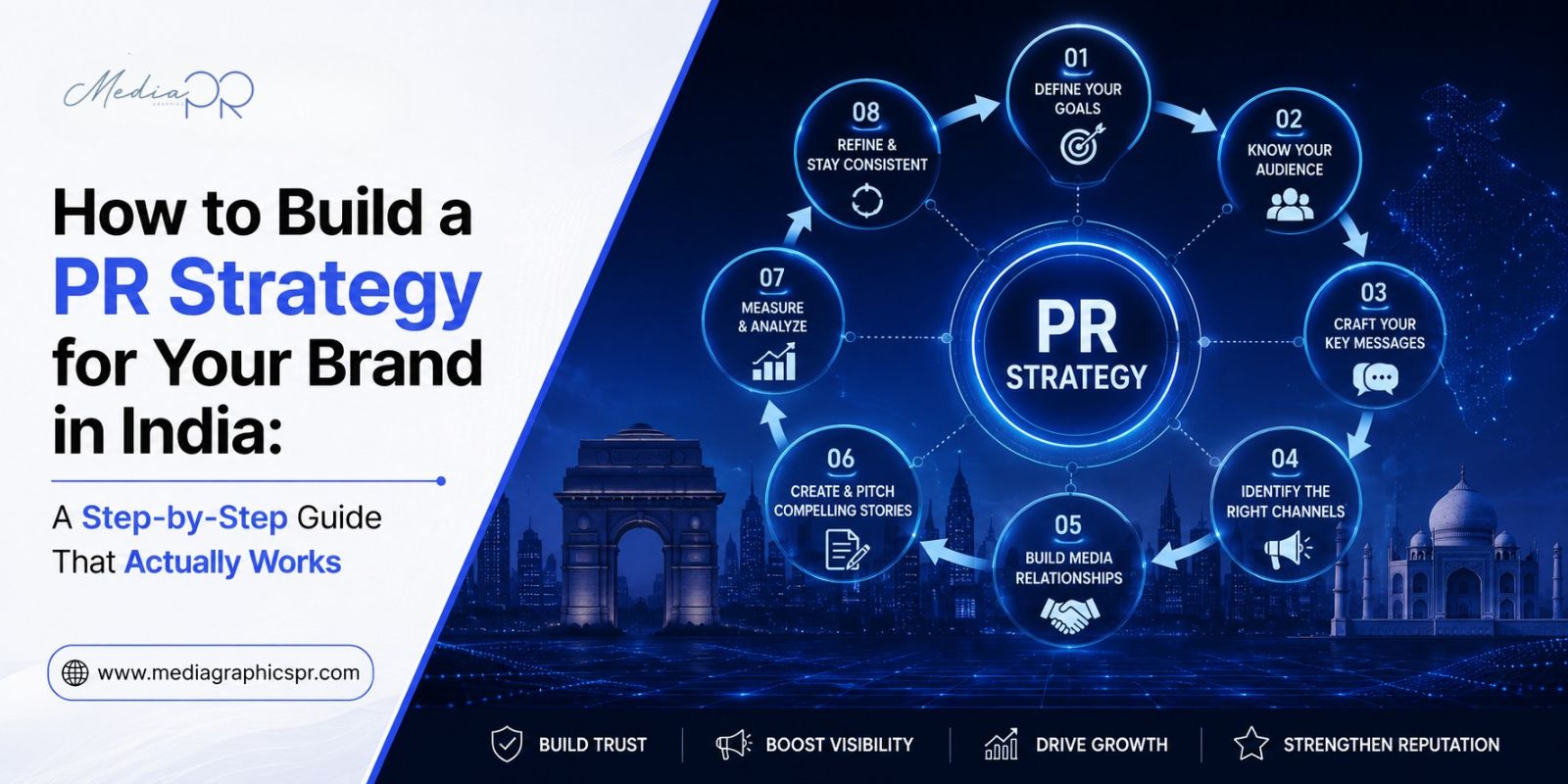
Most brands don’t have a PR problem. They have a PR strategy problem.
The press releases go out. A few placements land. The team celebrates. Then three weeks later, nothing has changed; investors still haven’t heard of the company, enterprise buyers are still choosing a competitor, and the founder is still introducing themself from scratch in every meeting.
That’s not bad PR. That’s no strategy behind the PR. And without a strategy, even great coverage adds up to nothing useful.
This guide is exactly what it says, a step-by-step PR strategy that actually works for Indian brands in 2026.
Step 1. Be Honest About Where You Are
Before building a PR strategy, you need an honest picture of where your brand stands right now.
Ask yourself:
- What does someone find when they Google your company name?
- Are your target investors, buyers, or talent encountering your brand anywhere?
- Is your narrative consistent?
- Have any journalists in your space ever heard of you?
Most brands that think they have a PR problem actually have a starting-from-zero problem. That’s fine, but knowing it changes how you build the strategy.
Step 2. Define One Clear Business Goal for PR
PR strategy fails most often because it tries to do everything at once. Investor credibility, enterprise sales support, talent attraction, consumer awareness—all in the same campaign, with the same budget, at the same time.
Pick one. The one that matters most to your business right now.
| Business Moment | Primary PR Goal |
|---|---|
| Approaching a fundraise | Investor credibility, so get into publications investors read |
| Entering enterprise sales | Buyer trust through trade media and thought leadership |
| Scaling hiring | Employer brand—startup ecosystem media, founder presence |
| Launching a new product | Market awareness, targeted announcement coverage |
| Entering a new city or market | Local credibility—regional business press |
Everything else can come later. The brands that try to reach everyone at once usually reach nobody properly.
Step 3. Build the Core Narrative
This is the step most brands rush and the one that determines whether everything else works.
Your PR strategy needs one clear, consistent narrative at its center. Not your product description. Not your mission statement. The story that answers three questions:
- What does your company do? (one sentence, zero jargon)
- Why does it matter right now? (the market context that makes you relevant today)
- Why you? (what makes your team or approach genuinely different)
When that narrative is consistent across every touchpoint, audiences start recognizing and trusting your brand. Inconsistency creates confusion. Clarity creates credibility.
Write the narrative down. Make sure every spokesperson can say it the same way.
Step 4. Identify Your Target Audience and Their Media
Once the narrative is clear, the next question is who needs to hear it, and where do they actually pay attention?
Target Audience → Where They Pay Attention
Institutional investors → Mint, Economic Times, Business Standard, Inc42
Enterprise CTOs → ETCIO, TechCircle, CIO Insider
D2C consumers → Mainstream digital, lifestyle media
HR and talent → LinkedIn, People Matters, startup ecosystem media
Sector-specific buyers → Industry trade publications
Early-stage angels → YourStory, startup community content
Build a list of 15 to 20 publications and journalists specifically relevant to your primary audience. Quality of targeting beats volume of outreach every time.
Step 5. Build Journalist Relationships Before You Pitch
This is the step most Indian brands skip entirely. They write a press release, find a journalist email, send it cold, and wonder why nothing happens.
Real media relations don’t work that way. Journalists who know your name before you pitch are significantly more likely to cover you than ones receiving a cold email from a company they’ve never heard of.
How to build relationships without being annoying:
- Follow journalists covering your space and engage genuinely with their work
- Offer yourself as a source for stories they’re already working on with no pitch attached
- Share their articles with a real comment, not a generic one
- When you do pitch, make it about something they actually cover
Start this three to six months before you need coverage for something important. Relationships built in advance are what make announcements land.
Step 6. Choose Your Tactics
Don’t default to press releases for everything. Pick what actually reaches your audience.
| Tactic | Best For |
|---|---|
| Press Releases | Real news—funding, launches, partnerships |
| Thought Leadership Articles | Building credibility with investors and buyers |
| Expert Commentary | Jumping into news cycles that are already moving |
| Founder LinkedIn Content | Reaching investors, buyers, and talent directly |
| Podcast Appearances | Building trust with niche audiences over time |
| Case Study Features | Giving enterprise sales teams something to use |
| Conference Speaking | Getting known in your category among peers |
Match the tactic to the audience. Not to what’s easiest to send out.
Step 7. Set a PR Calendar Around Real Moments
A PR strategy without a calendar is just good intentions. Map your business moments for the next twelve months—funding closes, product launches, market entries, and major partnerships—and build your PR activity around them.
Then fill the gaps. The months between big announcements are not quiet months. They’re the months for founder commentary on industry trends, reactive pitching on news cycles, and thought leadership that keeps your brand in the conversation continuously.
The brands with the strongest media presence aren’t the ones with the most news. They’re the ones that show up consistently between the news.
Step 8. Run Earned and Owned Media Simultaneously
One of the most common PR strategy mistakes in India is waiting for earned media coverage before starting owned content.
Both should run from day one.
Earned and owned running at the same time
↓
Journalist already knows the founder’s name
↓
Pitch lands, not binned like a cold email
↓
Coverage happens faster
↓
Founder shares it—owned amplifies earned
↓
More people see it; credibility grows
Each one makes the other more effective. Running them separately means both underperform.
Step 9. Measure What Actually Matters
Stop measuring clips. Start measuring outcomes.
What good PR measurement looks like:
- Are investors mentioning coverage before pitch meetings?
- Are enterprise buyers referencing your brand in early conversations?
- Is branded search volume moving after major placements?
- Are better candidates applying and citing your media presence?
- Is referral traffic from coverage converting on your website?
Set these metrics before the campaign starts, when the temptation is to justify whatever happened. An agency that can tell you what success looks like before the work begins is worth significantly more than one presenting clip counts at the month end.
Step 10. Stay Consistent Longer Than Feels Comfortable
This is the step where most Indian brands fall short, not because the strategy was wrong, but because they stopped too soon.
PR strategy compounds. The first three months are groundwork. Month four is where journalist familiarity starts building. Month six is where inbound starts—journalists calling your founder, investors recognizing the name, and buyers citing coverage in early conversations.
Most brands evaluate PR at month two and conclude it’s not working. The brands that stay consistent past month six are the ones that look back a year later and can’t imagine having stopped.
How MediagraphicsPR Builds PR Strategies for Indian Brands
A PR strategy that actually works isn’t complicated. But it requires clarity on goals, consistency in execution, real journalist relationships, and metrics that connect to business outcomes.
At MediagraphicsPR, we work as the PR strategy agency that Indian brands come to when they want PR built around where their business is going, not a press release calendar. As a PR agency in Delhi with two decades of real media relationships across India’s most important publications, we build PR strategies that start with your narrative, target the right audiences, and measure outcomes that actually matter.
If your PR isn’t building toward something, this is where that changes.
Need help? Call us at +91-8448360900 or email us at [email protected]
FAQs
Q: How long does it take to see results from a PR strategy in India?
First meaningful coverage usually lands within six to eight weeks. The compounding, where one placement leads to the next, starts from month three. Brands that stay consistent over the past six months are the ones that see the biggest shift.
Q: Can a brand build a PR strategy without hiring an agency?
Yes, especially at an early stage. The founder thought leadership and direct journalist relationship building can work with more time than money. The ceiling is lower without agency media relationships, but it’s a legitimate starting point.
Q: How many people need to be involved in building a PR strategy?
The founder or CEO needs to be involved in narrative development; nobody else can get that right. Beyond that, one focused person managing execution is enough at an early stage.
Q: What’s the first thing to do this week if we’ve never done PR before?
Write the narrative. One sentence on what the company does, one on why it matters now, one on why you. Get everyone who speaks publicly about the company saying the same thing. Everything else builds from there.

Vvihan Gulati is the Founder of MediagraphicsPR, a leading PR agency in India. With over 20 years of experience in public relations and digital storytelling, he has built a reputation for crafting powerful brand narratives that drive visibility and credibility. A strategist by passion and storyteller at heart, he has led campaigns for top global brands, startups, and industry changemakers.
