






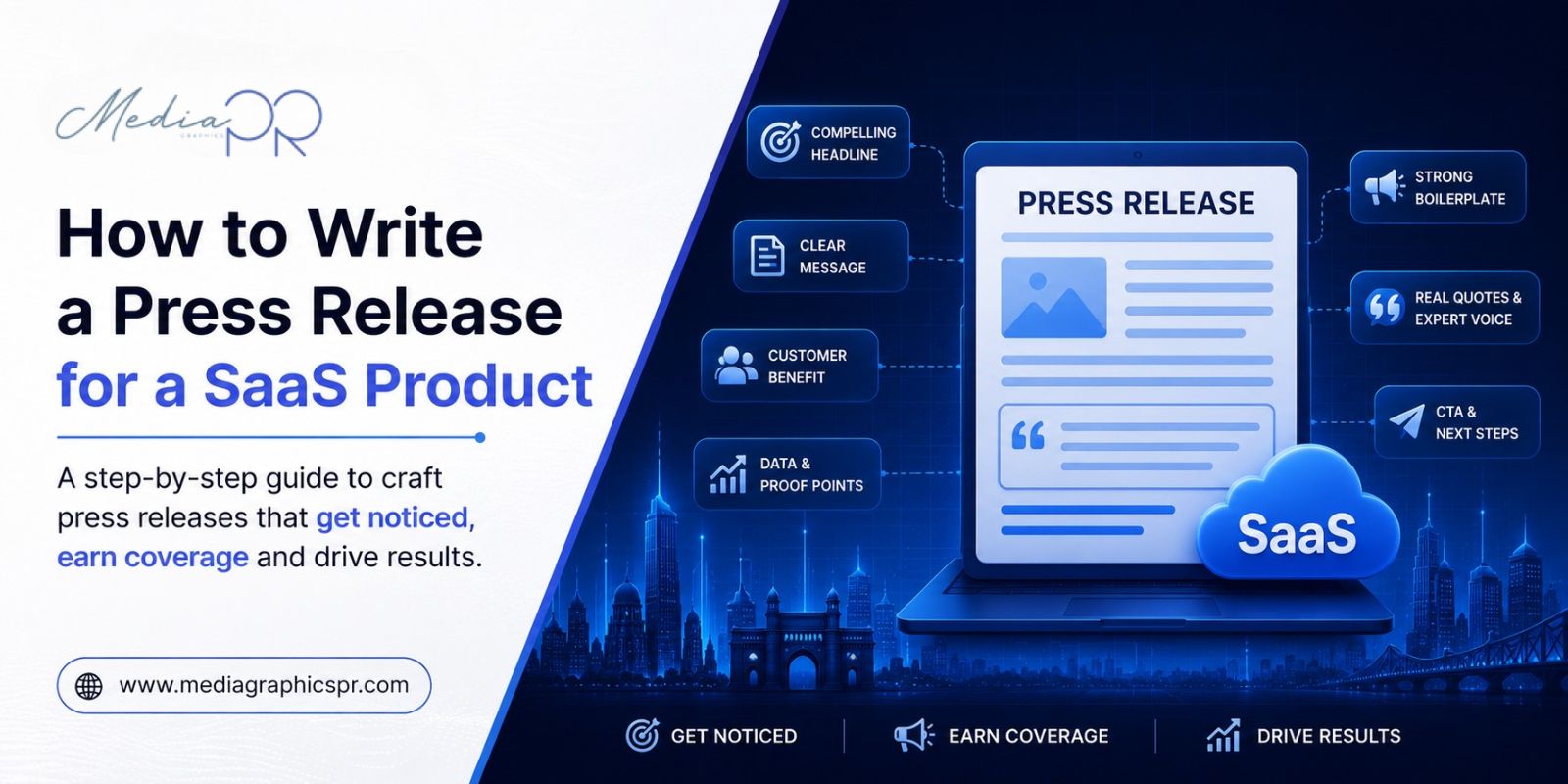
A SaaS press release that gets covered has a clear news hook in the first two lines, one strong quote from a founder or customer that a journalist can use without editing, and a specific metric that makes the story feel real rather than promotional. That is the difference between a release that gets filed and one that gets ignored.
Most SaaS press releases fail not because the news is weak — it usually is not — but because the release is written like a product brochure rather than a news story. Journalists receive between 200 and 500 pitches a day, according to Cision’s 2025 State of the Media Report. They spend less than three seconds deciding whether something is worth reading. If your lead sentence talks about your vision, your mission, or how excited you are, those three seconds are gone.
This guide covers the full structure of a SaaS product press release, what belongs in each section, where most companies go wrong, and how to pitch it once it is written.
When a SaaS Press Release Is Actually Worth Writing
Before the structure, there is a more important question: does this announcement warrant a press release at all?
A lot of SaaS companies send press releases for things that are not genuinely newsworthy outside their own user base — a minor feature update, a rebrand, a new integration with a tool nobody outside their customer list has heard of. Those releases do not get covered. They get deleted. Worse, they train journalists to ignore future pitches from the same company.
A SaaS press release earns its place when the announcement crosses at least one of these thresholds:
It changes something material about your market position — a funding round, a major product launch, a first enterprise client in a new vertical, a partnership that meaningfully expands what your product can do. Or it contains data that journalists in your space would find genuinely interesting — platform insights, user behaviour trends, adoption statistics that speak to something happening in the broader market, not just inside your company. Or it involves a named person a journalist’s audience would recognise — an investor, an advisor, an enterprise client willing to be quoted by name.
If your announcement does not cross at least one of those thresholds, a targeted blog post, an email to your customers, and a LinkedIn update from your founder will serve you better than a press release.
The Structure of a SaaS Press Release — Section by Section
The Headline
The headline does one job: get a journalist to read the first paragraph. It should be specific, factual, and written in plain English. It should contain the actual news, not a description of how big or exciting the news is.
What does not work: “[Company] Revolutionises the Future of B2B Collaboration with Groundbreaking AI-Powered Platform”
What does: “[Company] Raises ₹40 Crore Series A to Expand HR Automation SaaS Across South Asia” or “[Company] Launches Contract Intelligence Module Following 200% Growth in Enterprise Clients”
The second type of headline tells a journalist exactly what happened. They can decide in two seconds whether it is relevant to their beat. That is what you want.
The Dateline and Lead Paragraph
Immediately below the headline comes the dateline — city name and date of release. Then the lead paragraph, which is the most important paragraph in the release.
The lead answers: what happened, who it happened to, and why it matters. Not who is excited about it, not what it will eventually mean for the future — what happened, and why a journalist’s readers should care right now.
A strong SaaS product launch lead looks something like this: “[City, Date] — [Company], the B2B procurement automation platform used by over 300 enterprises across India and Southeast Asia, today announced the launch of [Product Feature], designed to cut vendor onboarding time by up to 60% for mid-market procurement teams.”
That lead contains: the company name and what it does, a credibility signal (300 enterprises), the announcement itself, and a specific benefit with a number. A journalist reading knows immediately whether this is a story for their readers.
The Second Paragraph — Market Context
The second paragraph is where you place the announcement in a broader context. Why does this matter beyond the company that built it? What is happening in the market that makes this relevant now?
This is where a data point from your own platform — or from a credible external source like Gartner, NASSCOM, or an industry report — earns its place. It is not about padding the release. It is about giving the journalist the market angle they need to write a story that goes beyond a product announcement.
The Founder or CEO Quote
Every SaaS press release needs at least one quote. The quote should not repeat what the previous paragraphs have already said. It should add a perspective that only a human voice can add — the strategic reasoning behind the decision, the problem the product is solving from the founder’s experience, or an honest observation about where the market is heading.
What a journalist cannot use: “We are thrilled and excited to launch this industry-leading solution that will transform how businesses operate.” That sentence is useless. No journalist will print it because it says nothing.
What a journalist can use: “Most enterprise procurement teams in India are still managing vendor contracts through email threads and spreadsheets. That is not a workflow problem — it is a risk exposure problem. We built this to change that.” That is quotable because it is specific, it has a point of view, and it sounds like a person, not a press release.
The Customer or Partner Quote (Where Available)
A named customer quote in a SaaS press release is worth more than almost anything else you can include. It validates the claim independently. It gives the journalist a second source. And it signals that real people are using your product and willing to publicly say so.
If you can get a decision-maker at a recognisable company to say something specific about the business impact of your product — not a generic endorsement, but an actual result — include it. If the customer is not well-known, a specific metric still carries weight: “Since deploying [Product] six months ago, our vendor approval cycle has dropped from 14 days to three.”
Supporting Data and Traction
After the quotes, include two or three sentences of traction data. Customer count if significant, growth rate if strong, enterprise logos if named, geographic expansion if relevant. Keep this factual and specific. Round numbers that are obviously rounded down (“over 500 customers”) carry less weight than precise figures that feel real (“538 active enterprise accounts as of Q1 2026”).
The Boilerplate
Every press release ends with a short “About the Company” paragraph — two to three sentences that describe who you are, what you do, and where you operate. This paragraph stays the same across all releases. Write it once, make it accurate, and do not change it unless your company description genuinely changes.
Contact Information
Name, email, and phone number of the press contact at your company or agency. This is not optional. A journalist who wants to follow up and cannot find a working contact number moves on.
SaaS Press Release Structure at a Glance
| Section | What It Contains | Length |
| Headline | Specific news hook in plain English | 1 line, under 100 characters |
| Dateline | City name and release date | 1 line |
| Lead Paragraph | What, who, and why it matters — with a metric | 3–4 sentences |
| Market Context | Industry backdrop, data, relevance beyond the company | 2–3 sentences |
| Founder/CEO Quote | POV, strategic reasoning, human voice | 2–3 sentences |
| Customer/Partner Quote | Named validation, specific impact | 2–3 sentences |
| Traction Data | Customer count, growth, geographic reach | 2–3 sentences |
| Supporting Details | Additional product specs, use cases, availability | 1 short paragraph |
| Boilerplate | Company description, founding year, market | 2–3 sentences |
| Contact Information | Press contact name, email, phone | 3 lines |
Total length: 400–600 words for most SaaS product announcements. For funding rounds at significant scale, 600–800 words is acceptable.
What Makes a SaaS Press Release Different From a General Product PR
SaaS products have a particular challenge that consumer products do not: the product is often invisible to anyone who is not using it. A new smartphone has something to photograph. A SaaS product is a workflow change — and workflow changes are hard to make visually or narratively compelling to a journalist who is not already familiar with the problem being solved.
The way around this is to make the problem visible rather than the product. Instead of describing what the software does, describe what happens to businesses that do not have it. That shift — from product features to business consequences — is what separates a SaaS press release that generates coverage from one that generates polite silence.
Gartner’s 2025 B2B Buying Survey found that 67% of software buyers research SaaS companies online before engaging any sales team. That makes press coverage part of the sales process, not a separate marketing activity. A release that reads like a brochure will not move either buyers or journalists. A release that reads like a story about a real problem being solved has a chance at both.
Common SaaS Press Release Mistakes — and What They Look Like
| Mistake | What It Looks Like | What to Do Instead |
| Leading with excitement rather than news | “We are thrilled to announce…” | Lead with what happened and why it matters. |
| Vague headlines | “Company launches innovative new solution” | Name the product, the market, and a specific outcome. |
| Generic CEO quote | “This is a game-changer for the industry” | Quote something specific: a problem, a stat, or a decision. |
| No metric in the lead | Product launch with no customer or performance data | Include at least one concrete number in the first paragraph. |
| Sending to a generic media list | 200 journalists across unrelated beats | Pitch 10–15 journalists who specifically cover your vertical. |
| Writing for the CEO, not the journalist | Long, jargon-heavy sentences about product vision | Write at a reading level that a smart non-technical reader can follow. |
| Missing or buried contact info | Contact details in the footer as small text | Name, direct email, and mobile number clearly visible. |
| No multimedia | Plain text release only | Attach a product screenshot, founder headshot, or logo at minimum. |
After the Release Is Written — How to Pitch It
Writing the release is one part of the job. Getting it covered is another.
The most effective approach for SaaS companies in India targeting national and tech media is a combination of two tactics. First, send a personalised email to three to five journalists who specifically cover your vertical — not the release itself, but a two-paragraph email that explains why this is a story for their readers, followed by the release pasted below. Second, have the release ready on your website in a dedicated media or press section, so that any journalist who finds the company independently can access the full background.
Distribution wire services — PR Newswire, BusinessWire, PRNewswire India — syndicate releases to hundreds of outlets. They are useful for building backlinks and for announcements that need broad simultaneous distribution, like funding rounds above a certain size. For most SaaS product launches, targeted journalist outreach produces better coverage quality than wire distribution alone.
Timing matters here too. Tuesday through Thursday, between 9:30 AM and 11:30 AM IST, is the window when most India-based tech journalists are actively reading pitches. Friday afternoon pitches consistently underperform regardless of how strong the release is.
What Journalists in India’s Tech Media Actually Want
This is something most press release guides skip. The journalists covering SaaS and B2B technology in India — at Inc42, YourStory, The Ken, Economic Times, Mint, Business Standard — are not looking for the same kind of story.
| Publication | What They Cover | Pitch Style |
| Inc42 | Startup funding, SaaS growth stories, founder profiles | Data-led, specific ARR or customer metrics |
| YourStory | Founder journeys, product launches, ecosystem stories | Narrative-driven, human angle on the founder |
| The Ken | Deep dives into business models and market dynamics | Contrarian angle, strong data, no hype |
| Economic Times Startup | Corporate tech adoption, enterprise deals, funding | Business impact, established company endorsement |
| Mint | Policy implications, market leadership, growth data | Market context, credible numbers, senior quotes |
| Business Standard | Enterprise credibility, significant milestones | Conservative, factual, investor-relevant |
Knowing which journalist at which publication covers SaaS in your vertical — and pitching them something relevant to what they have written recently — is more valuable than a polished press release sent to a generic list.
How MediagraphicsPR Helps SaaS Companies Get Coverage
Most SaaS companies that come to us have already sent a press release that did not land. Usually the problem is not the product or the news — it is that the release was written as an internal announcement rather than a media-ready story, and it was sent to the wrong journalists through a bulk distribution service.
At MediagraphicsPR, we work with SaaS and B2B technology companies across India to build press releases that are written for the publications we are pitching to, not for the executive team that approves them. We maintain working relationships with journalists at India’s leading business and tech publications, and we pitch selectively — which is why our placements tend to appear in the outlets that matter to your buyers, not in aggregators and content farms.
You can explore the sectors we work in on our industry expertise page, and read more about our approach on our blog. We have placed SaaS and technology clients in The Economic Times, Business Standard, Forbes India, CNBC TV18, The Hindu BusinessLine, Mint, and Inc42, across sectors including personal finance, climate tech, and VC and PE-backed companies.
Frequently Asked Questions
How do you write a press release for a SaaS product?
Start with a specific, factual headline that names the news. Write a lead paragraph that answers what happened, who it involves, and why it matters — with at least one metric. Follow with market context, a quotable founder quote, customer validation if available, and traction data. Keep the total length between 400 and 600 words. Write for the journalist, not for internal approval.
What should a SaaS press release include?
A strong SaaS press release includes a newsy headline, a lead paragraph with a concrete metric, market context data, a genuine founder or CEO quote with a specific point of view, a named customer quote where possible, traction data, a boilerplate company description, and direct press contact information.
How long should a SaaS product press release be?
Between 400 and 600 words for most product launches. Funding announcements for significant rounds can run to 600–800 words. Longer than that and you are including information a journalist does not need — which means it is taking up space that should not exist.
Should I use a press release distribution service for a SaaS product?
For funding rounds and major product launches, a wire service combined with targeted journalist outreach gives you both breadth and depth. For smaller product updates or feature launches, targeted pitching to 10–15 relevant journalists typically outperforms wire distribution alone, both in coverage quality and in the publications you actually land.
What makes a SaaS press release newsworthy?
A funding milestone, a major product launch, a named enterprise client in a new vertical, an original data insight from your platform, or a significant partnership. A feature update or a new pricing tier is not press release territory unless it is tied to something bigger — market expansion, a regulatory change your product addresses, or a measurable customer outcome you can quantify.
Ready to Get Your SaaS Product the Coverage It Deserves?
A well-written SaaS press release, pitched to the right journalists at the right time, can generate coverage that stays live and indexed for years. It builds the kind of credibility that your sales team cannot create through a cold email, and that your buyers find when they are researching solutions before they talk to anyone on your team.
If you want help building the press release and placing it in India’s leading tech and business publications, talk to us.
Visit MediagraphicsPR to see how we work with SaaS companies.
Need to speak to someone directly?
📞 Call us: +91-8448360900 📧 Email us: info@mediagraphicspr.com