MediagraphicsPR

MediaPR

What Is a PR Agency
MediaPR

Beginner’s Guide: What Is a PR Agency, PR Full Form & How It Works

In today’s fast-moving digital world, reputation is everything. Whether you are a startup, an established brand, a public figure, or an NGO, how the public perceives you can completely shape your success. That’s where PR comes into the picture. But if you’re just getting started, you might wonder: What is a PR agency? What is the PR agency full form? What does a PR agency do every day? This beginner-friendly guide explains everything you need to know, step by step. What Is a PR Agency? A PR agency, or Public Relations agency, is a professional firm that helps individuals and organisations build, maintain, and protect their public image. Unlike advertising, which is paid promotion, PR focuses on earned visibility—this means getting media coverage, gaining public trust, and shaping positive brand perception without paying for advertisement space. In simple terms, a PR agency works behind the scenes to make sure your brand is seen positively by the media, customers, and the public. Whether it’s crafting a compelling story, securing press coverage, handling social media conversations, or responding to a crisis, PR experts ensure your brand voice is always strong, credible, and trusted. PR Agency Full Form: What Does PR Stand For? The PR full form is Public Relations. Public Relations refers to how brands communicate with people—customers, investors, influencers, media, employees, and society. A PR agency acts as a bridge between a brand and the public, ensuring that all communication is clear, strategic, and reputation-focused. Why Public Relations Matters More Than Ever Before understanding what does a PR agency do, it’s important to know why PR matters today: This makes PR essential—not optional—for modern businesses. What Does a PR Agency Do? (Core Responsibilities) A professional PR agency performs a wide range of functions to help brands get visibility, build relationships, and maintain a strong public reputation. Here’s a closer look at the key responsibilities: 1. Media Relations This is one of the biggest roles in PR. PR teams connect with journalists, editors, TV channels, online publications, and influencers to share stories about your brand. The goal is to earn positive press coverage through: Good media relations can put your brand in top publications without paying for ads. 2. Reputation Management A positive reputation builds trust. PR agencies monitor brand sentiment, address negative mentions, and highlight achievements to shape how people perceive your brand. This includes: 3. Crisis Management Every brand faces unexpected challenges—negative press, customer complaints, product issues, legal cases, or viral controversies. A PR agency protects your image by: The aim is to reduce damage and restore trust as fast as possible. 4. Content Creation & Storytelling A PR agency helps brands become powerful storytellers. They create: These stories help position brands as experts in their industry. 5. Event Management & Brand Visibility PR agencies also organize events designed to bring attention to your brand, such as: They ensure media coverage and positive buzz around every event. 6. Influencer & Digital PR Digital PR is now as important as traditional PR. Agencies collaborate with: This helps expand your brand’s online presence and reach new audiences. What Do PR Consultants Do? Apart from agencies, many companies also hire PR consultants—independent experts who provide strategy, advice, and communication support. So, what do PR consultants do? They help with: PR consultants guide brands on how to communicate, while PR agencies often handle the execution. Both work together to ensure your brand maintains a strong voice and consistent message. How Does a PR Agency Work? Step-by-Step Process To fully understand what does a PR agency do, it helps to know how they operate. Here is a simple breakdown: 1. Understanding the Brand The PR team starts by learning about: They analyse your current reputation and communication style. 2. Creating a PR Strategy Based on the research, the agency builds a custom strategy that includes: This becomes the roadmap for all communication. 3. Creating and Distributing Content The PR team develops high-quality Content such as press releases, articles, interviews, and pitches. These are sent to relevant journalists and publications. 4. Media Outreach The agency continuously works with media houses to win coverage, interviews, and feature stories. This is where strong relationships play a huge role. 5. Monitoring & Reporting PR agencies track: They share monthly reports to show progress. 6. Crisis Handling (If Needed) If any negative publicity appears, the PR team steps in quickly to: This is one of the biggest advantages of hiring a professional PR agency. Benefits of Hiring a PR Agency Here’s why brands choose PR agencies: PR is not just about getting news coverage—it is about shaping how the world sees you. Who Needs a PR Agency? A PR agency is helpful for: If you have a brand, you need PR. Final Thoughts Understanding what is a PR agency, the PR agency full form, and what does a PR agency do is essential for any brand looking to build trust and visibility. PR is no longer a luxury—it is a necessity for long-term success. Strong Public Relations ensures your story reaches the right people, at the right time, with the right message. MediagraphicsPR is a top PR agency and PR firm in India with 20+ years of experience, helping manage company and individual reputation and public image.

Hospitality PR in India Why Storytelling Drives Bookings
MediaPR

Hospitality PR in India: Why Storytelling Drives Bookings

In today’s competitive travel and tourism landscape, hotel brands, resorts, homestays, and luxury hospitality chains must do more than offer rooms—they need to deliver experiences. With countless choices available to travelers, the real differentiator is not just amenities but the story a brand tells. This is where Hospitality PR emerges as one of the most powerful tools for shaping brand perception, driving awareness, and ultimately boosting bookings. In India’s fast-growing tourism and hospitality industry, PR has become essential for influencing how travelers discover, trust, and choose a hospitality brand. And among all PR techniques, storytelling stands out as the most impactful strategy. This blog explores why storytelling is the heart of modern hospitality communication and how the right Hospitality PR strategy can turn your hotel or resort into a preferred travel destination. What Is Hospitality PR and Why Is It Crucial Today? Hospitality PR refers to the strategic communication efforts designed to build reputation, attract guests, and enhance brand visibility for hospitality businesses such as: Unlike traditional marketing, which focuses on direct selling, Hospitality PR builds emotional connections and credibility through earned media, narratives, and brand advocacy. Key goals of Hospitality PR include: In the digital-first world, where experiences matter more than features, storytelling has become the foundation of Hospitality PR success. Why Storytelling Is the Heart of Hospitality PR Storytelling helps hotels move beyond transactional messaging to emotional influence. Here’s why it drives bookings: 1. Stories Create Emotional Connections Travel decisions are emotional. People choose hotels based on feelings of comfort, luxury, adventure, or inspiration. Story-driven Hospitality PR helps communicate these emotions through: Emotions convert better than features and storytelling triggers those emotions. 2. Stories Help Hospitality Brands Stand Out With thousands of accommodation options in India, from luxury resorts to boutique stays, differentiation is a major challenge. A well-crafted brand story: Hotels with strong narratives stay memorable long after guests have scrolled past dozens of competitors online. 3. Storytelling Builds Trust and Credibility Travelers rely heavily on trust before making bookings. A story-driven Hospitality PR strategy builds that trust through: These stories strengthen a hotel’s authority, making people feel confident about booking. 4. Storytelling Makes Your Brand “Shareable” In the age of Instagram, Reels, YouTube vlogs, and travel blogs, visual storytelling fuels virality. Hospitality PR uses: to encourage guests and influencers to talk about the property online. The more shareable the story, the more visibility and bookings your hotel earns organically. 5. Stories Enhance Your SEO and Digital Presence Content-driven PR has a massive impact on online visibility. Here’s how storytelling helps with digital growth: Together, these improve your brand’s SERP ranking making your hotel appear in more traveler searches. 6. Stories Help You Sell Experiences, Not Rooms Modern travelers don’t buy hotel rooms they buy experiences. Hospitality PR uses storytelling to highlight: By selling the experience, you increase perceived value and boost revenue. How Hospitality PR Uses Storytelling to Increase Bookings Let’s explore how a hotel or resort can practically use storytelling to improve booking rates. 1. Compelling Brand Narratives Every hospitality brand has a story heritage, founders, inspiration, craftsmanship, location, or purpose. PR professionals turn these real stories into powerful brand assets that: 2. Guest Experience Stories Every guest who stays at your property becomes part of your story. Hospitality PR amplifies: These narratives inspire new travelers to book. 3. Destination Storytelling Hotels do not just sell rooms they sell the destination. Hospitality PR promotes: Travelers are drawn to destinations that feel alive through storytelling. 4. Media Relations & Press Coverage Journalists and travel editors love good stories. PR ensures your brand gets featured in: Every media story boosts brand credibility and attracts guests. 5. Social Media Storytelling Platforms like Instagram, Facebook, and LinkedIn thrive on storytelling. Hospitality PR uses: to humanize the brand and create desire. 6. Influencer & Blogger Stories Influencers don’t just review hotels they craft stories that reflect: This improves brand trust and increases social proof, directly boosting bookings. 7. Reputation Management Through Stories Positive guest reviews are the strongest form of PR. Hospitality PR enhances online reputation by: This builds trust and helps convert hesitant travelers. Why Hospitality PR Matters More Than Ever in India India’s tourism industry is booming with rising domestic travel, luxury tourism, wellness tourism, and experiential stays. Competition is fierce, and Hotels must keep evolving. Hospitality PR provides: The result? Higher occupancy, stronger brand loyalty, and increased bookings. Final Thoughts In the hospitality industry, a great story is more than a narrative it is a business driver. Hospitality PR transforms hotels into desirable destinations by crafting meaningful stories that inspire travelers to book. Whether you’re a boutique homestay, a luxury resort, or a premium hotel chain, storytelling should be at the core of your communication strategy. With the right PR approach, your brand becomes more visible, more memorable, and ultimately more profitable.

LinkedIn Profile Writing Tips
MediaPR

10 LinkedIn Profile Writing Tips to Boost Your Visibility Instantly

Your LinkedIn profile is your digital handshake_ quiet, but powerful, unfolding your professional story one blink at a time. As hiring managers, clients, and collaborators scroll profiles like constellations, LinkedIn profile writing has become a vital skill. The right words can bring new opportunities, while profiles that are vague, boring, or incomplete float listlessly through the professional universe. If you’ve ever wondered how to write a LinkedIn profile that stands out and attracts attention, this guide will unpack 10 actionable, tried-and-true instant profile fixes. And if that sounds like too much work, the best LinkedIn profile writing service is available to craft your story and enhance your profile—more on that to come. Let’s add some visibility to your LinkedIn profile, one clever update at a time. 1. Start With a Magnetic Headline Your headline is the first spark people notice. Instead of settling for a job title, craft a headline that blends role, expertise, and value. Example: “Digital Marketer | Paid Ads Strategist | Helping Brands Scale with ROI-Focused Campaigns” A powerful headline signals clarity and direction—two qualities recruiters adore. 2. Craft a Compelling ‘About’ Section Your “About” section is your story-in-a-bottle. Make it warm, purposeful, and outcome-driven. Break it into: Avoid jargon that fogs understanding. Instead, narrate your journey with the crisp confidence of someone who knows their craft. 3. Use Keywords to Be Discoverable LinkedIn’s search algorithm behaves like a librarian—quiet, picky, and fond of keywords. Sprinkle role-specific phrases naturally throughout your headline, About section, and experience. Examples: Strong keyword presence dramatically increases your chances of appearing in recruiter searches. This is one of the most underrated LinkedIn profile writing tips—but one that pays off instantly. 4. Add a Professional Profile Photo Your profile photo is not a formality; it’s a trust-builder. Use: Profiles with polished photos get up to 21x more views—a visibility booster that requires only a few minutes of effort. 5. Customize Your LinkedIn URL A clean, customized URL is like a tidy signature. It shows intentionality and professionalism. Instead of: linkedin.com/in/user-9283jd93j29 Make it: linkedin.com/in/yourfullname This simple update helps with branding and makes resumes, email signatures, and portfolios look polished. 6. Showcase Experience With Achievements, Not Duties Recruiters don’t hunt for duties—they hunt for results. Replace “Responsible for managing campaigns” with: “Managed ad campaigns resulting in 40% higher conversions in 3 months.” Every bullet point should feel like a tiny victory, not a job description pasted from an old offer letter. 7. Highlight Skills Strategically LinkedIn allows you to feature up to 50 skills—but the first three matter the most. Think of them as your top three flags waving proudly. Choose skills that blend: Examples: Skills improve your search visibility dramatically, especially when endorsed by others. 8. Request Recommendations That Feel Genuine A recommendation is a spotlight shining on your strengths from someone else’s vantage point. Request recommendations from: Ask them to speak about a specific project or result. Authenticity beats generic praise every time. 9. Use Featured Section to Display Your Best Work Your Featured section is your billboard—use it boldly. Add: This transforms your profile from a static page into a dynamic, living professional showcase. 10. Stay Active: Engage, Share, Comment The algorithm favors movement. Like a garden, your visibility grows when you nurture it regularly. Post content such as: Remember: your voice is the heartbeat of your personal brand. Use it often, and you’ll never be invisible. How Professional Help Can Boost Your LinkedIn Presence Engaging specialists to help with your personal branding LinkedIn profile is the best option available. A professional writer begins with a strategy, then builds your LinkedIn presence with clarity and narrative skills, which profiles designed by a writer will have and which DIY profiles will lack. This is where the LinkedIn profile writing service will genuinely help you. With professional headline writing, summary writing, achievement writing, and content writing that is keyword-rich, your profile will become a magnet to recruiters instead of a profile page that simply sits on LinkedIn. Final Thoughts In LinkedIn profile optimization, the benefits of these ten actionable tips can be extensive. If you are intending to increase your authority in your industry, gain more clients, or even change jobs, revamping your LinkedIn profile will add more value to your professional life. If you want a professional team to help you elevate your personal profile branding with added finesse, strategy, and profile branding, this is the moment for you. MediaGraphicsPR can help you stand out, gain more authority, and help grow your professional profile branding through specialized LinkedIn profile writing, profile creation, and profile optimization.

What Is The Best PR Strategy For Luxury Travel And Tourism Brands
MediaPR

What Is The Best PR Strategy For Luxury Travel And Tourism Brands

The world of luxury travel has transformed dramatically in the last decade. Today’s affluent traveler no longer seeks just a lavish hotel room or a scenic destination they want meaningful experiences, personalized service, cultural immersion, privacy, sustainability, and exclusivity. As expectations rise, competition becomes fierce. Luxury hotels, boutique resorts, private islands, experiential travel companies, and premium tour operators must differentiate themselves in a saturated global market. This is where Luxury Travel PR becomes not just useful, but indispensable. Luxury Travel PR blends storytelling, brand positioning, media visibility, influencer partnerships, reputation management, and experiential campaigns to shape how a premium travel brand is perceived by elite travelers. When done right, it converts brand identity into aspiration and aspiration into bookings. In this blog, we explore how luxury travel PR works, why it is essential, and which strategies drive visibility, credibility, and demand for luxury travel and tourism brands. Understanding Luxury Travel PR in Today’s Market Luxury Travel PR is a specialized branch of public relations focused on elevating premium hospitality and tourism brands through high-quality storytelling, media placement, strategic partnerships, and curated experiences. Unlike traditional travel marketing, which focuses on mass audiences, Luxury Travel PR targets: Luxury travel PR doesn’t “sell rooms” or “promote destinations.” It sells status, exclusivity, and emotional value. Why Luxury Travel PR Matters More Than Ever A. The luxury traveler has evolved Today’s high-end traveler is highly selective and digitally informed. They seek: Luxury Travel PR helps brands articulate these promises clearly. B. Word-of-mouth is no longer enough Premium customers rely heavily on: PR ensures your brand is visible on the right screens and in the right publications. C. Competition in luxury tourism has skyrocketed Luxury hotels and experiential travel brands are launching rapidly. Without strong PR, even the best properties remain undiscovered. D. Trust is the new currency Luxury travelers prefer brands with authenticity, consistency, and strong storytelling. PR builds that trust. Core Components of Luxury Travel PR 1. High-End Media Relations The foundation of luxury travel PR lies in securing coverage in top-tier magazines, digital publications, lifestyle portals, and travel sections such as: Premium visibility drives premium perception. 2. Influencer & Creator Partnerships Luxury travel brands gain massive visibility through: Creators deliver both credibility and aspirational appeal. 3. Brand Storytelling & Narrative Building Every luxury travel brand must have a signature story.It may revolve around: Luxury Travel PR shapes a brand identity that resonates emotionally with elite travelers. 4. Experience-led PR Campaigns Luxury travel PR often includes press trips, immersive travel experiences, influencer retreats, and media previews. The goal is simple:Let media and influencers feel the luxury firsthand because those experiences generate the most compelling coverage. 5. Online Reputation & Review Management Luxury travelers rely on: PR ensures the brand narrative stays consistent and positive. 6. Strategic Partnerships Collaborations amplify luxury positioning.Example partnerships include: These partnerships strengthen brand desirability. Best PR Strategies for Luxury Travel and Tourism Brands A. Build a Signature Brand Identity A luxury travel brand must stand for something.It needs: Travel PR helps define and communicate these pillars through strong messaging. B. Craft a Compelling Narrative Your story should answer: Stories connect emotionally features alone do not. C. Leverage Premium Platforms PR teams ensure coverage in: Visibility in the right places attracts the right guests. D. Host Exclusive Influencer Retreats Invite top creators for: Curated experiences generate: This boosts awareness faster than traditional advertising. E. Highlight Sustainability & Responsible Luxury Modern luxury travelers value: PR ensures these sustainable efforts become part of the brand story. F. Use High-End Visual Storytelling Luxury travel thrives on aesthetics.PR teams create: Visual storytelling influences traveler decision-making. G. Build Thought Leadership A luxury travel brand must be seen as an industry leader.PR helps position: as authoritative voices. The Role of Digital PR in Luxury Travel Digital PR is essential for visibility in: It includes: Digital PR ensures luxury travel brands stay relevant in an online-first world. Crisis Management in Luxury Travel Luxury brands face crises like: Luxury Travel PR ensures: In the luxury segment, reputation is everything. Luxury Travel PR for Hotels, Resorts & Tourism Boards This PR approach benefits: Each requires a unique PR strategy tailored to its audience. Conclusion: Luxury travel is not sold through offers or discounts. It is sold through exclusivity, emotion, perception, experience, and storytelling. Travel PR is the bridge that connects a brand’s uniqueness to the global elite audience that seeks it. With strong storytelling, curated experiences, influencer advocacy, premium media coverage, and impeccable reputation management, luxury travel brands can transform themselves from hidden gems into global icons.

PR for SaaS Companies Turning Product Innovation into Market Leadership
MediaPR

PR for SaaS Companies: Turning Product Innovation into Market Leadership

In today’s software-driven world, SaaS brands compete in one of the most dynamic and fast-evolving industries. New products launch every week, customer expectations shift rapidly, and competitors innovate constantly. In this crowded landscape, even the most powerful SaaS product cannot succeed without visibility, credibility, and market trust. This is where PR for SaaS companies becomes a strategic growth accelerator. Public Relations is no longer just about press releases or media mentions. For SaaS brands, PR plays a deeper role educating the market, simplifying technology, establishing authority, shaping category narratives, and building relationships with customers, partners, investors, analysts, and media. In this detailed guide, we explore how PR transforms SaaS brands from smart products into market leaders. Why SaaS Companies Need PR More Than Ever SaaS businesses thrive on adoption, recurring revenue, and long-term customer trust. But with so many tools available in every category from CRM and automation to HR tech and cybersecurity buyers often feel overwhelmed. PR bridges the gap between innovation and market understanding. SaaS companies face unique challenges: Without strong PR, even a great SaaS product risks becoming invisible. With the right PR strategy, SaaS companies can build an authoritative presence, strong brand equity, and long-term customer loyalty. 1. PR Simplifies Complex SaaS Products for Non-Technical Audiences SaaS products often come with technical features like automation workflows, cloud architecture, AI integrations, APIs, analytics, and security layers. But business buyers are less interested in features they want clarity on value, impact, and outcomes. PR for SaaS companies translates complex technology into simple, compelling narratives. PR helps SaaS brands communicate: Messaging clarity helps SaaS products stand out in a crowded market and demonstrates leadership. 2. PR Builds Strong Brand Authority Through Thought Leadership In SaaS, thought leadership is currency. Decision-makers trust brands that shape industry conversations, not those that merely follow trends. PR elevates SaaS founders, CTOs, and product experts as industry voices. Thought leadership includes: When SaaS leaders consistently share insights, they become category-defining experts building credibility that directly influences customer decisions. 3. PR Boosts Visibility with High-Impact Media Coverage Media coverage is one of the strongest tools to build trust in the SaaS industry. Appearing in top publications signals legitimacy, innovation, and stability. PR helps SaaS companies secure: This helps SaaS brands: Visibility equals credibility and both drive user adoption. 4. PR Strengthens Investor Confidence for SaaS Startups Investor trust is essential for SaaS scaling especially when competing with well-funded incumbents. PR helps SaaS startups: When investors consistently see your brand in credible publications, and when your leadership is positioned as forward-thinking, it significantly increases confidence. For seed to Series B stages, this can be a game-changing advantage. 5. PR Shapes Market Perception and Defines Category Leadership Most SaaS companies aim to create or dominate a category. But category creation is not just a product play; it is a communication strategy. PR helps SaaS companies: For example: These categories were built not just by product innovation but by consistent PR efforts that shaped industry language. 6. PR Helps SaaS Companies Build Trust Through Case Studies & Social Proof In SaaS, customer trust is everything. Buyers rely heavily on proof—what others are saying and how the product performs in real-world scenarios. PR amplifies: Social proof lowers buyer hesitation and accelerates decision-making. 7. PR Supports SaaS Demand Generation & Marketing Goals While marketing focuses on lead generation, PR focuses on trust building. When both work together, SaaS companies see faster conversions. PR directly supports marketing by: Buyers convert faster when they recognize and trust the brand. 8. PR Helps SaaS Companies Manage Crisis & Reputation Risks SaaS companies face unique risks: PR ensures these issues are handled with transparency, speed, and strategic messaging. A well-managed crisis strengthens long-term reputation instead of damaging it. 9. PR Accelerates Global Expansion for SaaS Brands For SaaS companies targeting international markets, PR becomes essential for establishing local authority. PR supports global expansion by: This is crucial for SaaS brands scaling to the US, Europe, APAC, and the Middle East. 10. PR Helps SaaS Companies Build a Loyal Community Community-building is a major competitive advantage in SaaS. PR supports community growth through: Strong communities turn users into advocates, reducing churn and increasing lifetime value. How Mediagraphics PR Helps SaaS Companies Become Market Leaders Mediagraphics PR specializes in helping SaaS companies convert product innovation into brand authority. Our strategic PR programs include: We help SaaS brands stand out, get covered, get trusted and scale faster. Conclusion No matter how innovative a SaaS product is, it cannot succeed without trust, visibility, and credibility. With the right strategy, PR for SaaS companies turns unknown products into industry leaders, unknown founders into thought leaders, and unknown startups into trusted brands. PR is not a “good-to-have” for SaaS. It is a growth engine one that accelerates market leadership, customer adoption, and investor confidence.

What Is Media Training
MediaPR

What Is Media Training and Who Needs It? Complete Guide

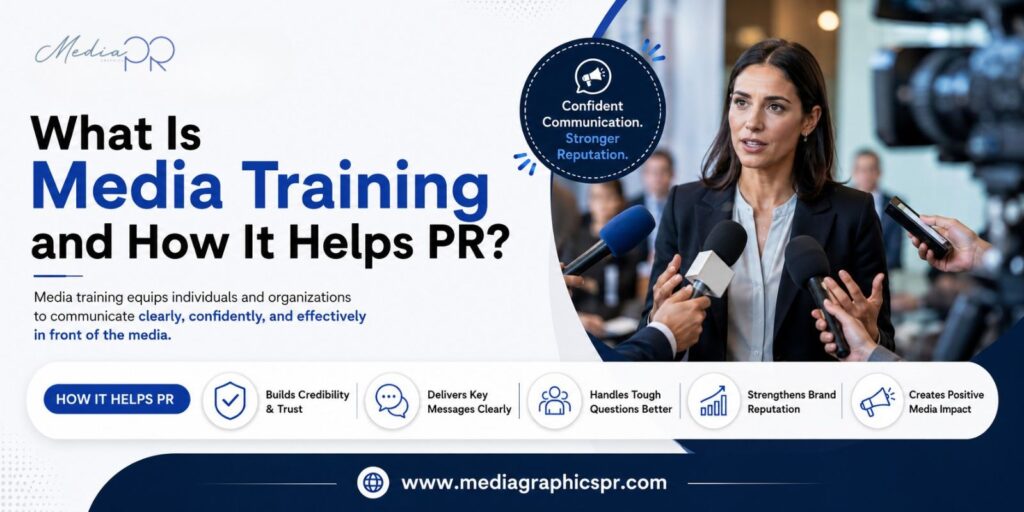
Media training is a specialised form of communication coaching that prepares you to speak with clarity, confidence, and control in interviews, press conferences, and any media-facing situation. It is now a core pillar of public relations (PR) strategy, helping brands and individuals protect reputation, handle tough questions, and deliver clear, memorable messages. What is Media Training? In simple terms, media training teaches you how to interact effectively with journalists and audiences across TV, radio, print, podcasts, and online platforms. You learn how to stay on message, avoid common interview mistakes, and communicate complex ideas in a way that is easy for the public to understand. Typical media training covers message development, interview techniques, body language, voice control, and strategies for handling challenging or hostile questions. Many programmes use mock interviews and video recordings so you can see yourself on screen, get feedback, and refine your performance in a safe environment before facing honest reporters. What is Media Training in PR? Public relations teams use media training to turn subject‑matter experts, leaders, and spokespeople into confident brand ambassadors. In PR, the goal is not only to answer questions but to drive key messages that support your organisation’s reputation, campaigns, and overall communication strategy. PR‑focused media training also prepares teams for crises, where one poorly handled interview can damage years of reputation-building. Trainees learn to communicate accountability, empathy, and transparency in sensitive situations, helping maintain trust with media, stakeholders, and the public. Why Media Training Matters Today The media landscape is 24/7, multi‑platform and unforgiving of mistakes, which means any slip can be clipped, shared and criticised within minutes. Media training helps you adapt your message and delivery across TV, live streams, podcasts, and social media, while staying consistent and on brand. Strong media skills also open doors to better coverage and more opportunities, because journalists prefer to work with spokespeople who are clear, concise, and reliable. Over time, this consistent performance builds authority, credibility, and visibility for both individuals and organisations. Key Benefits of Media Training Some of the most valuable benefits include: Who Needs Media Training? Anyone who might appear in the media or speak on behalf of an organisation can benefit from media training. This includes leaders, experts, and public‑facing professionals who want to influence opinion, build visibility, or manage sensitive issues. Common groups who need media training include: In short, if you speak to the press, appear on panels, join podcasts, or handle public communication during normal or crises, you are precisely the person who needs media training. What Happens in a Media Training Session? Media training sessions usually begin with an introduction to how the media works—deadlines, story angles, and what journalists are really looking for in an interview. You then move into message building, where you identify your key points, proof, and examples, and learn how to repeat and reinforce them naturally. Next, trainers run practice interviews on camera or audio, replicating real‑life scenarios such as live TV, press conferences, or phone interviews. After each practice, you receive detailed feedback on your content, clarity, body language, and overall presence so you can improve quickly. How Much to Charge for Media Training? Media training fees vary widely depending on geography, trainer experience, format (online vs. in‑person), and whether it is one‑to‑one or for a group. In markets like North America, half‑day executive media training can range from around $2,500 to $5,000, with full‑day sessions often between $4,000 and $8,000 for individuals. Group media training programmes for several participants can cost between $5,000 and $12,000 per day, with virtual half‑day sessions typically priced lower than in‑person workshops. Ongoing retainers or multi‑month programmes, which include several sessions plus follow‑up support, can run from roughly $15,000 to $50,000 or more for large organisations. If you are deciding how much to charge for media training in your own market, benchmark these international ranges, then adjust for local purchasing power, session length, your experience, and the level of customisation you provide. How to Know If You’re Ready for Media Training Some clear signs you or your team are ready for media training include upcoming product launches, funding announcements, policy roll‑outs, or events that will attract media attention. It is also crucial if your organisation operates in a high‑risk or highly regulated sector where any miscommunication could trigger public backlash or regulatory scrutiny. Even if you do not have immediate interviews scheduled, early training helps you build skills before a crisis or big opportunity arrives, so you are not learning under pressure. Many organisations now treat media training as a core part of leadership development, alongside presentation and stakeholder communication skills. Why Choose MediaGraphicsPR for Media Training? MediagraphicsPR specialises in practical, results‑driven media training that connects the realities of modern newsrooms with your brand’s communication goals. Programmes are designed to be hands‑on, scenario‑based, and tailored to your industry, so you leave with messages, techniques, and confidence you can immediately apply in real interviews. MediaGraphicsPR provides media training services to help individuals and organizations improve their communication skills for media events such as interviews and press conferences. This includes coaching on messaging, on‑camera performance, crisis response, and PR‑aligned storytelling so every appearance supports your broader reputation and business objectives. If you want to understand what media training is, how it fits into PR, how much to charge for media training, or simply who in your organisation needs media training, partnering with MediagraphicsPR ensures you get expert guidance at every step.

How PR Drives Visibility and Investor Trust for AI Startups
MediaPR

How PR Drives Visibility and Investor Trust for AI Startups

Artificial Intelligence is reshaping industries, disrupting legacy systems, and creating entirely new markets. But despite the innovation and intelligence that define AI startups, many struggle with one major challenge visibility. With thousands of AI tools, platforms, and models entering the market every month, standing out requires more than cutting-edge algorithms. It requires strategic communication, credible storytelling, and a strong reputation strategy. This is where PR for AI startups becomes mission-critical. Public Relations is not just press coverage; it is a structured pathway that helps AI companies build authority, simplify complex technology, educate stakeholders, attract customers, and most importantly win the trust of investors. In this long-form guide, we explore how PR empowers AI startups to scale, secure funding, and position themselves as industry leaders. Why PR Matters More for AI Startups Than Any Other Industry AI is often misunderstood, overhyped, or surrounded by skepticism. Many investors and users lack clarity about core concepts like LLMs, NLP, AGI, machine learning workflows, or ethical AI governance. Because of this, AI startups face unique challenges: PR solves all of these by presenting AI innovation in a way that builds confidence, clarity, and credibility. 1. PR Simplifies Complex AI Technology Through Storytelling One of the biggest barriers AI startups face is communicating what they actually do. Whether it’s an AI analytics tool, a generative AI platform, a computer vision model, or an automation system if customers and investors can’t understand it, they won’t trust it. PR turns technical complexity into clear value propositions. PR helps AI startups by: For example, instead of saying:“We use transformer-based architectures for contextual embeddings,”PR reframes it as:“We help enterprises make faster, more accurate decisions using next-generation AI models.” Clear communication is the key to adoption and PR makes it possible. 2. PR Positions AI Startups as Thought Leaders in Their Domain To survive in the competitive AI landscape, startups must demonstrate expertise not just innovation. Thought leadership is one of the most effective PR strategies for AI startups, helping them earn trust from customers, partners, and investors. Effective thought leadership includes: When founders or CTOs consistently share valuable insights, they become industry authorities. This authority quickly translates into investor confidence and user trust. 3. Media Coverage Helps AI Startups Gain Visibility in a Crowded Market AI is one of the fastest-growing startup categories, making visibility extremely competitive. Strong PR for AI startups ensures the brand gets featured in: Media coverage builds social proof. The more a startup appears in trusted publications, the more credible it becomes. Types of media coverage that benefit AI startups: Editorial visibility helps AI brands stand out even in a saturated landscape. 4. PR Builds Investor Trust Through Strategic Narrative Building AI startups often rely heavily on venture capital, angel investors, or strategic funding rounds. Investors don’t fund products.Investors fund stories, confidence, and long-term vision. A strong PR strategy ensures the startup communicates: Investor-focused PR includes: Good PR increases investor visibility. Great PR increases investor trust. 5. PR Helps AI Startups Establish Ethical & Responsible AI Positioning One of the biggest concerns around AI technologies is ethics. Investors, customers, policymakers, and regulators want clarity on: PR proactively addresses these concerns by helping startups communicate their: This not only builds trust it makes startups more appealing to enterprise buyers and investors who prioritize compliance. 6. PR Strengthens Branding & Differentiation Most AI companies pitch similar ideas automation, efficiency, speed, intelligence, insights. PR helps a startup find and amplify what truly makes it unique. PR helps define: A well-positioned AI startup becomes memorable. A poorly positioned one disappears in the noise. 7. PR Drives Customer Trust & Accelerates Product Adoption AI is still intimidating for many users. They need repeated reassurance that the product is: PR achieves this by amplifying: When customers see consistent validation, adoption increases. 8. PR Gives AI Startups a Competitive Edge in Funding Rounds, Partnerships & Enterprise Deals For AI startups raising capital or signing enterprise contracts, strong PR becomes a major differentiator. PR gives startups an edge by: In competitive evaluations, perception often equals power. PR shapes that perception. Conclusion: PR is the Growth Engine AI Startups Can’t Ignore For an AI startup, innovation alone isn’t enough. Visibility, credibility, and trust determine who scales and who fades away. By investing in PR for AI startups, companies unlock: AI is the future but visibility is the fuel. Startups that combine strong tech with strong PR will lead the market, attract better investment, and build lasting impact.

Advertising and Public Relations
MediaPR

Key Differences Between Advertising and Public Relations

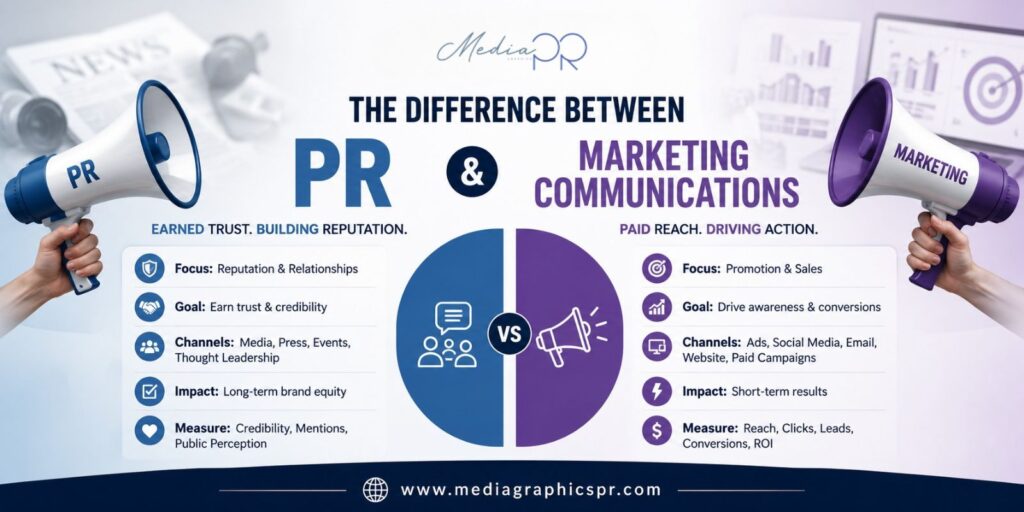
For anyone looking to promote a brand or a business, knowing what advertising and public relations entail and the differences is important. Within the realm of advertising and public relations (PR), both are important components of marketing strategy, but differ in their goals, methods, and results. Let this blog address the questions of “What is the difference between PR and advertising?” and PR vs advertising so that you are better equipped to make marketing decisions for your business. What Is Advertising? Advertising is considered a one-way, paid form of communication that allows companies to display their messages. They can have their messages displayed via television, social media, search engines, digital billboards, etc. The objective of advertising is clear: to promote a company’s products or services. One of the defining aspects of advertising is control. Advertising gives the brand the freedom to control the message and direction of its strategy. However, since advertising is a paid approach, consumers are likely to be more critical of the message. What Are The Functions Of Public Relations? Public relations concentrates on and strengthens a brand’s connections with the public. PR does not pay for advertising. Rather, it obtains advertising through third-party media, including newspapers, blogs, and television shows, which cover brand stories. The purpose of Public Relations is to foster trust and credibility by cultivating favorable perceptions of a company or product. Public relations entails activities such as managing media relations, crisis management, coordinating corporate communication, engaging the community, and, foremost, reputation management. It is about building a reputation over time, not making immediate sales. What Is The Main Difference Between Advertising And Public Relations? At its simplest, the key difference between advertising and public relations is shown in the following comparative framework. Importance Of Distinguishing Public Relations And Advertising In a business setting, advertising and public relations are often used in tandem and, in fact, complement each other. Advertising can communicate precise, highly directive messages in a short span of time, while PR provides the reputation and trust needed to ensure those messages resonate. Take, for example, a product launching campaign. The campaign uses advertising for product introduction and PR for media stories and influencer endorsements to establish credibility. Understanding the distinction between PR and advertising is essential for allocating marketing budgets and developing plans tailored to achieve the desired objectives. The Difference Between PR and Advertising An example of advertising is a sponsored Facebook ad offering a discount or promotion. An example of public relations would be drafting a press release for journalists discussing a company’s new sustainability initiatives. Advertising is specifically aimed at promotion; PR goes beyond to include relationship management. Choosing Between Advertising and PR If the end goal is quick sales and/or increased brand awareness, advertising is the way to go, but if the goal is brand reputation management, crisis management, or establishing thought leadership, then PR is the way to go. The ideal marketing strategy would combine the two—advertising for attention and PR for relationship management. If the goal is to improve brand visibility and reputation, the term “public relations agency” would provide the necessary options. MediagraphicsPR is a leading PR firm in Delhi for media relations, strategic communications, brand development, and reputation management. With MediagraphicsPR, your brand will gain media attention and public trust.

How Does PR Help AI Companies Gain Visibility And Funding
MediaPR

How Does PR Help AI Companies Gain Visibility And Funding?

Artificial intelligence is transforming every industry from healthcare and retail to fintech and enterprise SaaS. But while cutting-edge technology can give AI companies a competitive edge, technology alone is not enough. In a crowded and hype-driven market, the true challenge is visibility, credibility, and trust. This is exactly where PR for AI companies becomes a strategic growth driver. Public relations helps AI startups stand out, communicate innovation clearly, attract investors, and build market authority without relying solely on paid marketing channels. In this blog, we’ll break down how PR empowers AI companies to gain visibility, strengthen brand trust, and accelerate funding opportunities. Why AI Companies Need PR More Than Ever AI has exploded into mainstream conversation but so has skepticism. Questions around ethics, data usage, privacy, job displacement, deepfakes, and model accuracy dominate public discussions. For AI startups, this creates both opportunity and risk. Here’s why PR is essential for AI companies today: With the right PR strategy, an AI company can move from “just another startup” to a credible innovator shaping the future. How PR for AI Companies Improves Market Visibility Visibility is the first step toward customer acquisition and investor interest. PR gives AI companies the platform to showcase innovations in trusted, high-authority spaces. 1. Strong Media Coverage & Press Mentions The AI space moves quickly new startups, new funding rounds, new product breakthroughs. Without PR, even the most groundbreaking AI solutions risk going unnoticed. An AI-focused PR strategy ensures: This type of visibility builds credibility instantly. 2. Thought Leadership for Founders & Technical Leaders AI founders are often technical experts with brilliant ideas but complex language doesn’t engage the media or investors. PR converts technical knowledge into: When founders develop a strong public voice, the company becomes recognizable and respected. Thought leadership = long-term brand authority. 3. Differentiating Your AI Company in a Crowded Market Most AI companies say similar things automation, accuracy, intelligence, efficiency, speed. The market is saturated with the same promises. PR helps AI brands: A strong story separates hype from real innovation. PR for AI Companies Helps Build Investor Credibility Funding is the lifeblood of AI startups. The right PR strategy significantly improves investor interest. 1. Attracting Investor Interest Through Visibility Investors don’t just want a great product they want proof of: PR creates this credibility.Coverage in high-authority publications instantly signals trustworthiness. A startup with consistent PR visibility stands out in investor deal pipelines. 2. Communicating Ethics, Transparency & Safety Investors take ethical AI seriously. Trust issues can destroy valuation overnight. PR helps AI companies communicate: This is crucial for investor due diligence. 3. Crafting the Right Messaging for Funding Announcements A well-crafted funding announcement can: PR teams know exactly how to position milestones for maximum impact. How PR Helps AI Companies Build Market Trust AI adoption depends heavily on trust. Users need to believe that AI will solve problems not create new risks. Here’s how PR helps AI companies build trust: 1. Simplifying Complex Technology for Mass Understanding AI is complex, but your audience shouldn’t need a PhD to understand your value. PR translates: into relatable, human-language messaging that resonates. Instead of “we use a multi-layer transformer model”, PR reframes it as “we help reduce manual work by 40%.” 2. Addressing Public Perception Issues Early PR helps AI companies answer critical questions: Proactive communication builds transparency and confidence. 3. Managing Reputation & Crisis Response AI companies face higher risk of: PR teams anticipate these risks and prepare crisis responses that protect brand reputation. 4. Using PR to Support Customer Acquisition & Partnerships AI companies also benefit from PR in terms of growth. PR Helps Attract: Visibility builds legitimacy and legitimacy brings deals. 5. Content & PR for AI Companies: A Powerful Combination Modern PR goes beyond media relations. AI brands need a robust content ecosystem: Content + PR = Maximum authority in the AI space. 6. Events, Webinars & Conferences Boost AI Brand Presence Speaking engagements at: Position founders as credible innovators.PR teams help secure these opportunities. Future of PR for AI Companies: What’s Next? As AI evolves, PR will become even more critical. Key trends include: AI companies that invest early in PR will lead the next decade of innovation. Conclusion: In a rapidly evolving AI landscape, visibility, credibility, and trust are the real competitive advantages. PR for AI companies helps you: If you’re an AI company aiming to scale, PR is not a luxury it’s your strategic edge.

The Real Difference Between PR Companies and Marketing Agencies
MediaPR

The Real Difference Between PR Companies and Marketing Agencies

In a world where visibility, reputation, and growth determine business success, two major players drive brand communication PR agencies and marketing agencies. But despite how commonly the terms are used, most businesses still struggle to understand the real difference between the two. Some assume PR and marketing are interchangeable. Others believe PR is only about media coverage, while marketing is only about ads. But the truth is more nuanced. They may share similar goals visibility, engagement, and growth but the way they achieve these goals is completely different. If you’re trying to decide whether your brand needs a PR agency, a marketing agency, or a combination of both, this guide will break it down clearly. What Does a PR Agency Do? A PR (Public Relations) agency focuses on building and managing a brand’s reputation, not just its promotion. Their work revolves around creating trust, credibility, and positive public perception. Key responsibilities of a PR agency: 1. Media Relations & Press Coverage PR agencies help brands secure: Their job is to ensure your brand is seen as newsworthy and authoritative. 2. Crisis Communication Management When a brand faces backlash, negative reviews, product issues, or public controversies, PR agencies: Marketing does not handle crisis communication PR does. 3. Thought Leadership & Brand Reputation PR agencies position founders and companies as: This is done through: 4. Corporate Communication PR supports: They ensure every message aligns with brand values and public expectations. What Does a Marketing Agency Do? A marketing agency focuses on promoting products and driving measurable results like sales, leads, and conversions. Key responsibilities of a marketing agency: 1. Digital Advertising (Paid Ads) They plan and execute: Marketing focuses on immediate ROI and conversions. 2. Social Media and Content Marketing Marketing agencies create: Their goal is to attract and nurture customers through content. 3. Brand Awareness & Sales Funnels Marketing agencies build end-to-end funnels: They ensure a user moves from ad → engagement → purchase. 4. Market Research & Strategy Marketing teams study: Then they create strategies that deliver growth and profitability. PR Agency vs Marketing Agency: The Core Difference This is where most people get confused, so let’s simplify it. Here’s a quick comparison: Aspect PR Agency Marketing Agency Primary Focus Public perception & credibility Sales, leads & conversions Approach Earned media Paid media Outcome Trust & authority Measurable ROI Tools Press releases, media outreach, crisis PR Ads, content, SEO, social media Timeframe Long-term Short-term Measures Success Sentiment, brand visibility Clicks, leads, conversions Audience Public, media, stakeholders Customers & buyers This is exactly why choosing between a PR agency and a marketing agency depends on your business goals. When Do You Need a PR Agency? Choose PR when your goal is to: If trust matters more than transactions, PR is your best partner. When Do You Need a Marketing Agency? Choose a marketing agency when your goal is to: Marketing is essential for: If you want faster results and measurable KPIs, marketing should be your priority. Can a Brand Work With Both? Absolutely. The most successful companies in the world combine PR and marketing strategies. Here’s why: ✦ Marketing tells people what you sell. ✦ PR tells people why they should trust you. When combined: Together, both create a powerful brand ecosystem. PR Agency vs Marketing Agency: Which One Should You Choose? Consider these questions: 1. Are you struggling with trust or visibility? → Choose a PR agency. 2. Are you struggling with sales or leads? → Choose a marketing agency. 3. Are you launching a new product or making a big announcement? → PR will amplify your story. 4. Are you planning performance campaigns or paid ads? → Marketing will give faster results. 5. Do you want both credibility and conversions? → Choose a hybrid PR + marketing model for maximum impact. Final Thoughts The debate between PR Agency vs Marketing Agency is not about which one is better. It’s about understanding that each serves a different purpose. Brands that use both together outperform brands that choose only one. If you want visibility, credibility, and measurable results you need an ecosystem where PR and marketing work hand in hand.

Scroll to Top
logo

Get In Touch

Please enable JavaScript in your browser to complete this form.