
MediaPR

PR for Startups
MediaPR

PR for Startups: Strategies, Benefits & How to Build Brand Visibility

Most startup founders think about PR too late. And most of the ones who think about it early get it wrong. The “too late” group waits until they are mid-fundraise, or until a competitor starts showing up in publications that should be covering them, or until a difficult story appears that they have no communications infrastructure to respond to. The “early but wrong” group sends a press release to a list of 200 journalists, gets two brief mentions, and concludes that PR does not work. PR for startups is neither of those things. It is a deliberate, sustained program of earned credibility building that serves the three things every startup is always working on simultaneously: raising capital, acquiring customers, and attracting talent. Done right, it changes how investor conversations start, how enterprise procurement teams encounter the brand before any sales contact, and how senior candidates think about the company before they apply. MediagraphicsPR is the best PR agency for startups that has spent 25 years building the kind of media presence that actually moves these conversations for Indian founders. They work with startups from pre-Series A through the growth stage, building earned credibility that compounds over time rather than producing coverage reports nobody acts on. Quick Answer: PR for startups is the practice of building earned media presence, thought leadership, and narrative credibility that supports fundraising, enterprise sales, and talent acquisition simultaneously. It works by placing the startup in the publications that investors, buyers, and candidates trust, before those audiences encounter the brand in any direct business context. Startups that invest in PR before they feel the pressure to have it consistently outperform those that start during a raise or after a crisis. Why PR for Startups Is Different From PR for Established Companies Public relations for startups faces a specific challenge that established companies do not: there is no prior coverage to reference, no established credibility to build on, and no existing journalist familiarity to activate. An established company running PR is managing and building on a reputation that already exists. A startup running PR is building a reputation from zero, usually under time pressure, usually with limited budget, and usually while the founders are simultaneously doing everything else the business requires. This changes what the work looks like. PR for startups has to: Build name recognition with specific audiences that have never heard of the company, through publications those audiences already trust. Establish the founder as a credible voice in the market before the company has the scale to speak for itself. Create a media archive that investor due diligence can find and that provides context when the brand encounters a new stakeholder for the first time. Serve multiple audiences simultaneously: investors, enterprise buyers, potential hires, and the ecosystem that generates partnerships and referrals. Established companies can afford to optimize for one audience at a time. Startups almost never have that luxury. The Three Business Goals That PR for Startups Serves PR startups founders talk about tends to be vague: “we want to build visibility,” “we want to get our name out there,” “we want media coverage.” These are not bad goals. They are just not specific enough to build a programme around. The business goals that PR for startups actually serves, when it is working properly: ➤ Goal 1: Investor credibility Institutional investors in India research founders and companies before agreeing to meetings. A founder who has been quoted in Mint or Economic Times as a credible market expert, whose company has been covered in Inc42, whose product has been referenced in a sector analysis in The Ken, arrives at the pitch meeting differently than one who has no media presence at all. The credibility conversation is shorter because it has already been partially done through media. The most important thing to understand about this: the media presence that influences investor due diligence is built in the months before the raise, not during it. Starting PR when the fundraise has already begun means compressing months of work into weeks, which consistently produces weaker results. ➤ Goal 2: Enterprise sales support Enterprise procurement teams research vendors before responding to any outreach. A startup that appears in the trade publications its target buyers read professionally has passed an initial credibility filter before any sales contact happens. The first conversation starts at a higher trust level, which compresses the evaluation cycle. For PR for tech startups specifically, this means appearing in ETCIO, TechCircle, sector-specific trade publications, and the analyst reports that enterprise procurement teams use as vendor shortlists. ➤ Goal 3: Talent acquisition Senior engineers, product managers, and operators research companies before applying. A startup with visible, credible media presence, where the founder is clearly building something serious and the company’s work is being written about by journalists they respect, attracts stronger candidates than one with no public profile regardless of the compensation offered. Building the Foundation: Narrative Before Media The most expensive PR mistake a startup can make is pitching journalists before the narrative is ready. Every startup that consistently gets covered in the right media has a clear, honest answer to three questions that every journalist and investor asks, explicitly or implicitly: › What does this startup actually do, in one sentence without jargon? Most startups struggle more with this than they expect. Not because the product is complicated but because the people closest to it have stopped seeing it from the outside. The answer needs to be specific enough to be memorable and clear enough to work for someone encountering the brand for the first time. › Why does it matter right now? The timing dimension is what makes a story worth covering rather than interesting to know about. What has changed in the market, the technology, the regulation, or the consumer behavior that makes this the right moment for this solution? The more precisely a startup can answer this, the more easily journalists can frame the coverage as timely rather than just novel. › Why


Medical PR
MediaPR

Medical PR: Services, Benefits & How to Choose an Agency

Medicine is one of the few fields where how you communicate can matter as much as what you actually do. A hospital that delivers exceptional clinical outcomes but communicates poorly will lose patient trust to a competitor that communicates well. A medical device company with genuinely superior technology that cannot make its clinical evidence legible to procurement heads will lose contracts to a competitor that can. A health-tech startup with a product that actually improves diagnostic accuracy will lose its funding round to a competitor whose founder has been consistently visible in the right publications for six months. This is the reality of medical PR in India. The quality of care, the quality of technology, and the quality of research all matter. But they only translate into the business outcomes that hospitals, healthcare companies, and medical startups need if the right people know about them, understand them, and trust the source. Medical PR is the practice of building that credibility through earned media, clinical thought leadership, patient community communications, and the regulatory-aligned communications that the healthcare sector specifically requires. It is a specialist discipline, not a generic communications program with healthcare clients. MediagraphicsPR is a medical PR agency that has spent 25 years building earned credibility for healthcare and medical brands across India. They work with hospitals, medical device companies, pharmaceutical brands, healthtech platforms, and clinical research organizations to build the kind of institutional trust that the medical sector demands and generic PR agencies rarely deliver. Quick Answer: Medical PR is a specialized public relations practice that builds credibility for hospitals, healthcare companies, medical device brands, pharmaceutical companies, and health-tech platforms through earned media, clinical thought leadership, patient community communications, and regulatory-aligned public communications. It differs from general PR because it must navigate clinical communication ethics, regulatory frameworks including CDSCO and MCI guidelines, and the specific trust dynamics of an audience that makes decisions affecting patient health and safety. Why Medical PR Is a Specialist Discipline Most companies can afford to have a generic PR agency learn their sector on the job. Medical organizations cannot. The reasons are specific: › Clinical communication is ethically and legally constrained. What a hospital or pharmaceutical company can say publicly about clinical outcomes, treatment efficacy, and product capabilities is governed by regulatory frameworks that generic agencies typically do not know exist. MCI ethics guidelines govern how medical professionals and institutions can represent clinical expertise in public communications. CDSCO frameworks govern how medical devices and pharmaceutical products can be described. A communication that overclaims clinical outcomes is not just a reputation risk. It is a patient safety risk and a regulatory risk simultaneously. › The audiences are more technically sophisticated. Physicians, hospital procurement heads, clinical researchers, and the medical media that reach them evaluate health claims with a rigor that consumer PR audiences do not. A vague claim that would pass with a consumer audience will be scrutinized and questioned by a medical professional audience. Medical PR that serves these audiences has to be specific, evidence-based, and accurate in a way that generic consumer communications does not require. › The trust dynamics are different. A consumer who buys a product they do not like switches brands. A patient who makes a healthcare decision based on inaccurate information faces consequences that are categorically more serious. The weight of that responsibility shapes how medical PR companies approach every communication. It is not a marketing exercise. It is a credibility-building program with real human stakes. What Medical PR Services Include The services that a medical PR firm delivers for healthcare and medical clients cover a wider range than most clients initially expect: ➤ Clinical thought leadership Positioning physicians, researchers, clinical directors, and medical founders as credible expert voices in their specialties. This means authored pieces in medical and health publications, expert commentary in journalist stories covering clinical developments, speaking opportunities at medical conferences, and the kind of sustained presence that makes a specialist the person journalists and procurement heads think of first when they need a credible voice on a specific clinical area. ➤ Hospital and institutional reputation management Building and protecting the reputational profile of hospitals, clinic networks, and healthcare institutions through earned editorial coverage in mainstream health media, patient-facing publications, and the healthcare trade press that procurement professionals and institutional buyers read. This covers planned coverage around service launches, infrastructure announcements, and clinical milestone moments, alongside the proactive reputation work that happens between big announcements. ➤ Medical device and equipment PR Communicating the clinical evidence behind medical devices and diagnostic equipment to the procurement heads, clinical committees, and hospital administrators who make purchasing decisions. This requires translating technical clinical data into clear, accurate, non-promotional language that the non-clinical procurement audience can evaluate. ➤ Pharmaceutical and clinical communications Building credibility for pharmaceutical companies through clinical evidence communication, pipeline transparency, and the kind of regulatory-aligned public communications that builds trust with both the medical community and the investment community simultaneously. ➤ Patient community communications Building the kind of accessible, accurate, empathetic communications that reach patients and patient advocates through consumer health media, online patient communities, and the mainstream publications that health-conscious consumers read for medical guidance. ➤ Crisis communication for medical organizations Managing the communications response to adverse clinical events, regulatory inquiries, product safety issues, and the reputation challenges that medical organizations face and that require a different approach from standard corporate crisis PR. ➤ Healthcare investor relations For healthtech startups and pharmaceutical companies raising capital, building the investor-facing media presence in business and healthcare investment publications that makes investor due diligence conversations start from a position of established credibility. The Benefits of Medical PR for Different Healthcare Organizations Medical PR benefits by organization type Organization Type Primary Medical PR Benefit Key Publications Hospitals and clinical institutions Patient trust, procurement credibility, physician recruitment ETHealthWorld, Times of India Health, Express Healthcare Medical device companies Procurement head credibility, clinical committee trust Health Management, Express Healthcare, Medscape India Pharmaceutical companies Investor credibility, prescriber confidence, regulatory positioning Pharmabiz, ETHealthWorld, Business Standard

tech PR
MediaPR

Tech PR: Strategies, Benefits, and How to Choose a Tech PR Agency

The best technology companies in India have a problem that nobody talks about at pitch competitions. They build genuinely impressive products. They hire strong teams. They solve real problems in ways that deserve serious attention. And then they walk into investor meetings, enterprise sales conversations, and hiring rounds where nobody has heard of them. The product is ready. The credibility is not. That is a tech PR problem. And it is one of the most fixable problems in the technology business, when you understand what it actually requires. Tech PR is the practice of building the earned media presence, thought leadership, and narrative architecture that makes technology companies credible to the specific audiences their business depends on: institutional investors who back founders they have already encountered in the press, enterprise procurement teams who shortlist vendors they have seen in trade publications, senior engineers who research employers before accepting offers. Getting this right does not happen from a press release. It happens from a sustained, strategic communications program built around the specific business outcomes the technology company is trying to achieve. MediagraphicsPR is a tech PR agency that has spent 25 years building earned credibility for technology companies across India, from pre-Series A startups building their first investor-facing narrative to growth-stage enterprises managing category authority in competitive markets. Quick Answer: Tech PR is the practice of building media presence, thought leadership, and narrative credibility for technology companies through earned media rather than paid advertising. It serves multiple business goals simultaneously: investor credibility before fundraising, enterprise buyer trust before sales conversations, employer brand for talent acquisition, and category authority against competitors. The technology companies that do it well start earlier than they think they need to and stay more consistent than they feel is necessary. Why Technology Companies Need a Different Kind of PR Technology PR has specific requirements that most generalist PR approaches miss. The audiences are different, the publications are different, the credibility signals are different, and the timeline for results is different. A consumer brand PR program is primarily about reach: getting the brand in front of as many relevant consumers as possible through the media they pay attention to. Tech PR is primarily about precision: getting the brand in front of a very specific set of decision-makers, through the very specific publications those decision-makers trust professionally, with messages calibrated to the specific criteria they use to evaluate technology companies. The CTO evaluating a B2B software vendor reads ETCIO and specific trade publications relevant to their sector. They do not form vendor opinions from lifestyle media. The institutional investor tracking Indian SaaS companies reads Mint, The Ken, and sector-specific investment media. They form opinions about founders through the quality of public thinking those founders demonstrate in the business press. The senior engineer deciding between two job offers researches both companies on YourStory, LinkedIn, and Glassdoor. Tech public relations that does not account for these specific audience behaviors, specific publication targets, and specific credibility signals is not really tech PR. It is generic communications with a technology wrapper. The Core Benefits of Tech PR for Indian Technology Companies Technology PR delivers business outcomes that go well beyond coverage volume. Here is where the impact is most concrete: ❯ Fundraising conversations start from a different position. Institutional investors in India, whether domestic VCs or international funds doing India diligence, research founders and companies before agreeing to meetings. A founder who has been consistently quoted in business and technology media as a credible market expert arrives at the pitch meeting with trust already established. The credibility conversation is shorter because it has already been partially done through media. ❯ Enterprise sales cycles shorten. B2B procurement is research-intensive. Procurement heads who encounter a vendor in trade publications they read professionally have already passed an initial credibility assessment before any sales contact happens. The first conversation starts at a higher trust level, which compresses the cycle. ❯ Talent acquisition improves. Senior engineers, product managers, and operators research companies before applying. A technology company with visible, credible media presence, where the founder is clearly building something serious, attracts better candidates than one with no public profile regardless of the compensation offered. ❯ Category authority creates a competitive moat. The technology company that gets there first in terms of defining how journalists, analysts, and buyers understand a category builds a competitive position that is genuinely hard to dislodge. This is the most durable benefit of sustained tech PR and the most underappreciated. What Good Tech PR Strategies Look Like Tech PR strategy is built around a sequence of decisions that determine everything that follows: ➞ Decision 1: What is the business trying to achieve with PR? A pre-Series A startup building investor recognition needs a different program from a Series B company building enterprise buyer credibility. A healthtech company entering hospital procurement conversations needs different tactics from a consumer tech brand trying to drive product discovery. The strategy that works is the one built around the specific business goal, not a generic technology PR program. ➞ Decision 2: Who specifically needs to encounter the brand in media? Not “investors” in general. Which specific type of investors, reading which specific publications, forming opinions through which specific channels? Not “enterprise buyers” in general. Which specific roles in which specific industries read which specific trade publications? The more precisely the target audience is defined, the more precisely the publication strategy can be built. ➞ Decision 3: What is the narrative that makes this company worth covering? Most technology companies pitch products. Journalists cover markets. The technology company that can connect its story to a market development, a regulatory change, a technology shift, or a trend that journalists are already covering has a fundamentally easier time securing coverage than one whose pitch is primarily about product features. ➞ Decision 4: Which tactics serve those goals, for those audiences, with that narrative? Tech PR goals and the right tactics Goal Right Tactics Investor credibility Financial press pitching, founder thought leadership,

PR Tactics
MediaPR

PR Tactics: 15 Effective Public Relations Tactics With Real Examples

Most brands confuse PR strategy with PR tactics. And that confusion costs them. Strategy is the what and why: what the brand is trying to achieve, who it needs to reach, and what narrative it needs to build. Tactics are the how: the specific activities that deliver on that strategy. A brand that has strong tactics but no strategy produces a lot of activity that does not add up to anything. A brand that has a clear strategy but no understanding of which tactics serve it best produces good thinking with poor execution. Understanding PR tactics at a practical level, knowing which ones work for which goals, which audiences, and which stages of business growth, is what separates communications that compound over time from communications that generate occasional coverage and then disappear. MediagraphicsPR is a public relations agency that has spent 25 years deploying the full range of PR tactics for Indian businesses across fintech, technology, healthcare, enterprise, and consumer sectors. They know which tactics actually move investor conversations, shorten enterprise sales cycles, and build the kind of category authority that is genuinely hard for competitors to take once it is established. Quick Answer: PR tactics are the specific activities that a public relations strategy is executed through. That covers things like media pitching, thought leadership, press releases, running events, stories built around data, working with influencers and analysts, handling a crisis, and plenty more besides. The most effective PR programs combine multiple tactics coordinated around a single narrative strategy, with each tactic serving a specific audience and a specific business outcome. Using tactics without strategy produces activity. Using strategy with the right tactics produces outcomes. Why Choosing the Right PR Tactics Matters Not all public relations tactics work equally well for every brand, every stage, or every goal. A funded startup approaching a Series B needs different tactics from a consumer D2C brand trying to build national awareness. A fintech company building investor credibility needs different tactics from a healthcare brand building clinical authority with hospital procurement teams. A B2B SaaS company needs different tactics from a luxury brand building cultural cachet with affluent consumers. The 15 effective PR tactics below are organized around what they do best. Understanding that organization is what makes it possible to choose the right combination for a specific situation rather than defaulting to the most familiar options. The 15 Most Effective PR Tactics With Real Indian Examples Tactic 1: Targeted Media Pitching The foundation of almost every PR program. A well-crafted pitch to a specific journalist who covers the brand’s sector, offering a story angle that genuinely serves their editorial needs and their audience. What makes it work: The pitch is written for that one journalist specifically, ties the brand’s story to something they’re already covering or clearly interested in, and gives them something real to work with, whether that’s a founder willing to talk, some original data, or simply an angle worth their time. Real example: A fintech startup out of Delhi reaches out to the Mint journalist who covers digital payments, tying their product back to a recent RBI circular. The whole pitch runs three sentences. The journalist writes back that same day. When to use it: Consistently, as the primary driver of earned media coverage throughout any PR program. Tactic 2: Thought Leadership Articles Authored pieces published in the founder’s or executive’s name in publications the target audience reads. The point here isn’t to pitch the company directly, it’s to build real expertise and authority in the market under the founder’s or executive’s own name. What makes it work: The piece takes a specific, defensible position on where the market is heading or what most people are getting wrong about a specific problem. It is genuinely useful to the reader independent of any commercial intent. Real example: A healthtech founder puts out a piece for ETHealthWorld arguing that India’s telemedicine regulation needs to move faster. Three hospital procurement heads get in touch after reading it. When to use it: From month two or three of a PR program, consistently throughout. Tactic 3: The Strategic Press Release A press release is not a PR strategy. It is one tactic for announcing genuinely newsworthy developments to a targeted set of journalists. What makes it work: The release has a specific news hook, a concrete founder quote that takes a real position, and is sent to journalists for whom this specific story is actually relevant. Real example: A Bangalore SaaS company closes its Series A. The press release is sent to eight specific journalists with personalized pitch emails. Five cover it. The release sent cold to a list of 200 gets two brief mentions. When to use it: For hard news moments only: funding, significant product launches, major partnerships, leadership appointments. Tactic 4: Embargo Strategy This is about giving key journalists a major story ahead of time, with an understanding they’ll hold off publishing until an agreed date, so they have room to write something fuller than a quick mention. What makes it work: Getting the story early gives journalists room to dig in, speak to other sources, and put together something with real substance. What comes out of it is feature-length coverage landing right alongside the announcement itself. Real example: A consumer health brand embargoes its product launch with four journalists 72 hours before launch day. All four run features. The announcement has momentum that lasts a week rather than 24 hours. When to use it: Major announcements where feature-length coverage is the goal. Tactic 5: Reactive Commentary Inserting the founder or executive into an existing news story as an expert commentator, when a development in the sector creates an opportunity to add genuine perspective. What makes it work: Responding quickly, speaking directly to what the journalist is actually working on, and adding real value to the piece instead of just pushing the brand. Real example: A regulatory change in digital lending is announced. Within two hours, a fintech CEO has

what does pr stand for
MediaPR

What Does PR Stand For? Meaning, Definition, and Real-World Examples

Three letters. Endless confusion. Most people have heard PR used in a sentence. Many have a rough sense of what it means. But ask ten different people what PR actually involves and you will get ten different answers. Some will say it is about press releases. Some will say it is about managing a brand’s image. Some will say it is what celebrities hire when they get into trouble. Some will say it is just fancy marketing with a different name. None of these are quite right. And the confusion is not just semantic. When businesses misunderstand what PR actually is, they use it incorrectly, measure it against the wrong outcomes, and end up concluding that it did not work when the real problem was that they never understood what they were buying in the first place. So let us settle this properly. What does PR stands for, what it actually does, how it is different from marketing, advertising, and publicity, and what it looks like when it is working correctly for a real business. PR stands for Public Relations. And MediagraphicsPR is a public relations agency that has spent 25 years demonstrating what that actually means in practice, for Indian businesses across fintech, technology, healthcare, enterprise, and consumer sectors. Quick Answer: PR stands for Public Relations. In short, it’s the discipline built around managing how an organization talks to, and is seen by, the people whose opinions actually matter to its success, investors, customers, employees, regulators, the media, and the public at large. Most of that work happens through earned media, coverage and validation that comes from independent sources rather than anything paid for. Over time, that’s what builds real credibility, real trust, and a narrative that stays consistent in a way no paid placement ever quite manages. What Does PR Stand For: The Full Definition Public Relations. Two words that together describe one of the most misunderstood disciplines in business. What does PR stands for in its most complete sense is the management of relationships between an organization and the various publics whose perceptions, opinions, and decisions affect its ability to operate and grow. The word “public” in Public Relations is plural in intent. A business does not have one public. It has many: the investors who fund it, the customers who buy from it, the employees who work for it, the regulators who oversee it, the journalists who write about it, and the communities it operates within. Public Relations is the practice of managing how an organization is perceived by all of these groups, through a combination of earned media, narrative strategy, stakeholder communications, crisis management, and thought leadership. The word “earned” is important here. PR works primarily through coverage and endorsement that the organization did not pay for and does not directly control. When a journalist at the Economic Times decides a company’s story is worth telling, when an analyst includes a brand in a sector report, when a customer advocates for a product in a community they are part of, these are PR outcomes. They carry a trust signal that paid advertising cannot replicate because they come from independent sources with no financial stake in saying positive things about the brand. What Does PR Stand For in Marketing? What does PR stand for in marketing is a question that comes up because marketing and PR are related disciplines that are often confused with each other. In a marketing context, PR refers to the earned media component of a brand’s broader communications mix. Marketing usually leans on paid channels, owned content, and performance campaigns, while PR is busy getting coverage in publications, earning endorsements from people with no stake in the outcome, and building the kind of independent validation that makes everything else land better. The relationship between PR and marketing is best understood this way: marketing reaches people who are already looking or who can be targeted based on behavioral and demographic signals. PR reaches people through the media they already trust, before they are actively looking, and in a way that shapes their perception of the brand before any direct interaction. A consumer who sees an advertisement for a fintech product sees it as advertising. A consumer who reads an editorial feature about the same fintech product in Mint sees it as news. The trust level is categorically different, and it affects how the brand is remembered, whether it is researched further, and ultimately whether it is bought. PR in marketing terms is the discipline responsible for building that editorial credibility alongside the paid and owned channels that drive direct response. What Does PR Stand For in Business? What does PR stand for in business is a broader question than the marketing-specific version. In a business context, PR encompasses the full range of communications that shape how a company is perceived by every stakeholder whose opinion affects its growth. For businesses, this means: › Investor relations communications. How the business communicates with investors, both through the media those investors read and through direct investor communications. A startup whose founder is consistently quoted in Mint and Business Standard arrives at investor meetings with pre-established credibility. A corporate brand managing its reputation through consistent, accurate public communications maintains the investor confidence that supports its market position. › Enterprise sales support. Enterprise buyers research vendors thoroughly before engaging. A business with consistent editorial coverage in the trade publications its buyers read passes an initial credibility filter before any sales contact happens. › Talent and employer brand. The company’s public profile shapes who applies, who accepts offers, and who stays. PR that builds a positive, credible employer narrative contributes to talent acquisition in ways that job advertisements alone cannot achieve. › Regulatory and government relations. For businesses in regulated sectors, how they communicate publicly affects how regulatory bodies perceive and engage with them. Consistent, accurate, transparent public communication builds regulatory goodwill that protected businesses rarely have to build from scratch when a difficult regulatory moment arrives. ›

Pharma PR Agencies in India
MediaPR

Top 10 Pharma PR Agencies in India

Pharma PR is one of the most demanding communication disciplines in India. And most companies in this sector are still treating it like generic corporate communications. That is a problem. The pharmaceutical industry in India operates under one of the most scrutinized regulatory environments in the world. The CDSCO, the MCI, SEBI for listed entities, and increasingly international regulatory bodies all shape what a pharma company can say publicly, how it can describe its products, and what claims it can make about clinical outcomes. Get any of this wrong and the communication problem becomes a compliance problem, which quickly becomes a business problem. Pharma PR agencies that genuinely understand this sector know something that generalist agencies do not: the communication constraints are not obstacles to good PR. They are the parameters within which credibility gets built. A pharmaceutical company that communicates accurately, specifically, and within regulatory boundaries builds the kind of institutional trust that no amount of promotional language can manufacture. MediagraphicsPR is a pharma public relations agency with 25 years of experience building earned credibility for healthcare and pharmaceutical brands across India. They understand the regulatory frameworks that shape pharma communication, have real journalist relationships in healthcare and business media, and bring the senior-led execution model that complex, high-stakes pharma communication requires. Quick Answer: If you’re looking at the top pharma PR agencies in India, what sets them apart is pairing real regulatory communication know-how with genuine relationships in healthcare journalism and the ability to handle multiple stakeholders at once. The best ones serve pharma companies across investor-facing business media, clinical credibility in practitioner publications, consumer health media, and regulatory communications simultaneously. Choosing the wrong agency in this sector creates compliance risk alongside reputational risk, which is why sector-specific expertise matters more here than in almost any other industry. What Makes Pharma PR Genuinely Different Pharmaceutical PR agencies face a communication challenge that has no equivalent in most other sectors. The product being communicated about is regulated at multiple levels. The audiences are simultaneously the most technically informed and the most emotionally invested of any consumer category. And the consequences of communication errors, clinical overclaiming, regulatory non-compliance, or patient safety miscommunication can be severe in ways that go well beyond reputation. Here is what pharma PR agencies in India need to understand that generic agencies typically do not: Pharma PR requirements and why they matter Pharma PR Requirement Why It Matters What Happens Without It CDSCO communication guidelines Drug and device claims are regulated Non-compliant claims trigger regulatory action MCI and clinical ethics guidelines Medical professional communications are constrained Ethics violations damage institutional relationships SEBI communication rules for listed entities Financial communications about clinical pipelines are regulated Material disclosure violations create legal exposure Clinical data translation Efficacy claims require specific evidence standards Overclaiming creates both regulatory and reputational risk Patient community sensitivity Pharma communications affect real health decisions Insensitive or inaccurate communications cause genuine harm International regulatory awareness Many Indian pharma companies operate globally Global communications must meet multiple regulatory standards The Top Pharma PR Agencies in India: What Each One Does Well MediagraphicsPR Best for: Pharma companies, healthcare brands, biotech startups, medical device companies, hospital groups, health-tech platforms, and pharmaceutical companies managing both domestic and investor-facing communications simultaneously. MediagraphicsPR’s 25-year track record in healthcare and pharmaceutical communications in India means their understanding of the regulatory communication landscape is not learned on the job. They know what the CDSCO framework means for product communications. They understand how clinical claims are treated differently in patient-facing media versus investor-facing business press. And they know which journalists covering India’s pharmaceutical sector have the technical literacy to cover clinical stories accurately. Their pharma PR agencies practice covers the full range of what pharmaceutical companies need: investor-facing financial media through Mint, Economic Times, and Business Standard for listed and fundraising pharma companies; clinical credibility building through practitioner-facing publications and health media; consumer health coverage through mainstream publications that reach patients; regulatory credibility communications; and crisis infrastructure for the product safety and regulatory moments that pharma companies inevitably face. Their senior-led model matters especially in pharma, where a junior team misunderstanding a clinical claim or a regulatory framework can create consequences that go well beyond a bad press release. Office: Delhi NCR, national coverage across Mumbai, Bangalore, Hyderabad, and Chennai. Adfactors PR Best for: Large pharmaceutical corporations, listed pharma companies, corporate affairs at enterprise scale. Adfactors has developed genuine depth in corporate and financial communications for large enterprises, including pharmaceutical companies that have scaled to institutional size. Their experience managing complex multi-stakeholder communications for listed entities and large corporate groups is relevant for established pharma brands managing investor relations alongside public communications. Their scale serves large institutional clients well. Smaller pharma companies and biotech startups sometimes find the account structure creates a gap between pitch-room seniority and day-to-day execution quality. Specialties: Large listed pharma corporations, corporate affairs, investor relations communications. Genesis BCW Best for: Pharma policy advocacy, regulatory affairs communications, government-facing pharmaceutical brands. Genesis BCW’s public affairs depth makes them specifically relevant for pharmaceutical companies where regulatory relationship management is as important as media relations. For pharma brands navigating CDSCO consultations, health ministry relationships, or policy advocacy around drug approval processes, their integrated media and public affairs approach is relevant. Specialties: Pharma policy advocacy, government relations, regulatory affairs communications. Edelman India Best for: Multinational pharmaceutical companies, corporate trust programs, large-scale health communications. What sets Edelman apart here is the research backing them, their global Trust Barometer work gives the India team a solid, structured way to think about trust, which matters a lot for pharma companies where being seen as credible is basically non-negotiable. For multinational pharma brands juggling India-specific messaging alongside what’s happening with global regulations, having that international track record actually helps. Specialties: Multinational pharma corporate communications, trust-building programs, large-scale health campaigns. 20:20 MSL Best for: Consumer health brands, OTC pharma, integrated healthcare campaigns. Their background in regulated consumer categories carries over well to pharmaceutical companies working in the OTC space, where

PR Agencies in Pune
MediaPR

Top 10 PR Agencies in Pune for IT, Manufacturing and Startups (2026)

Quick Answer: The best PR agency in Pune depends on what you sell. IT and manufacturing firms need an agency with trade-media depth and a plain-spoken leadership voice; startups need one that can turn funding and product news into coverage on a lean budget. This guide lists ten PR agencies that serve Pune, says what each one does based on its own website, and shows how to pick between them. We publish this list, and one of the ten is us, so read it with that in mind. Searching for PR agencies in Pune returns long lists with the same claims: “number one”, “award-winning”, “guaranteed coverage”. Few say who the agency really works with or where its team sits. This guide takes a more careful route. Each entry below sticks to what the agency says on its own site, and where we could not check a fact, we say so. How Did We Pick These PR Agencies in Pune? We started from the agencies that appear in published Pune roundups, including Trivium Public Relations’ list of top PR agencies in Pune, and then opened each agency’s own website. Entries were then written from that site only. We dropped a firm from the list when its own site showed it was not a PR agency, and replaced it with one that was. Three things to keep in mind before reading: This is not a ranking. The order is for readability, not merit. Like most agency-published lists, including the one above, ours puts the publisher first, and you should discount that. Pune office is not the same as Pune service. Many national PR companies in Pune serve clients from Mumbai, Delhi or Bengaluru. We note where an office is confirmed and where it is not. Self-descriptions are not proof. Phrases such as “top agency” are the firm’s own words. Ask for references. Which Are the Top PR Firms in Pune at a Glance? PR agencies in Pune compared Agency Base (from own site) Stated focus Pune office confirmed? MediagraphicsPR New Delhi IT, education, automotive, manufacturing, startups, funding PR No, serves Pune from Delhi Samsarra Public Relations Pune Hospitality, F&B, EV, startups, auto, events Yes, headquartered in Pune Adfactors PR Mumbai Full-service corporate PR across 40 cities Not listed Value 360 (Lewis Value360) No PR, brand campaigns, influencer platform, 20+ industries Not listed Trivium Public Relations India, Gulf and London Real estate, hospitality, fashion, lifestyle, telecom and technology Not named on site Creativizt Communications New Delhi PR across many sectors incl. IT and manufacturing Pune listed as a media access city Genesis BCW No Corporate, technology, consumer (per Trivium list) Not checked Perfect Relations No Brand and stakeholder communication (per Trivium list) Not checked V3 Communications No Integrated PR and digital (per Trivium list) Not checked Teamwork Communications Group No Technology and enterprise clients (per Trivium list) Not checked What Does Each PR Company in Pune Offer? 1. MediagraphicsPR: IT, manufacturing and startup PR from Delhi MediagraphicsPR is a PR agency in India that serves Pune clients from its New Delhi corporate office; it does not list a Pune office address. Its Pune page names IT, education, automotive, manufacturing and startups as focus sectors, with services across media relations, media training, thought leadership, press releases and funding PR. A relevant example is its Hy-Vee GCC case study, which reports 23+ placements for a Bengaluru expansion. Best for: technology, manufacturing and funded startups that want a remote-first team with national media reach. Check: the lack of a Pune office, if you want in-person meetings. 2. Samsarra Public Relations: boutique, Pune-headquartered Samsarra Public Relations describes itself as a boutique agency headquartered in Pune, with an address in Shivajinagar. Its stated services are public relations, media relations, influencer marketing, strategic communications, reputation management and crisis communication. Industries named include hospitality, F&B, EV, startups, auto and events. The site states that founder Heena Grover Menon has over 18 years of experience in media and communications. Best for: consumer, hospitality and lifestyle brands in Pune that want a local boutique team. Check: sector fit if you are in heavy IT or industrial B2B. 3. Adfactors PR: large corporate PR with national reach Adfactors PR says it was founded in 1997, serves clients across 40 cities and has more than 700 retained clients. It lists country pages for India, Sri Lanka and Singapore, and its footer base is Mumbai. Pune is not listed as an office. It describes itself as a multi-specialist full-service firm. Best for: large corporates and financial institutions wanting a big network. Check: how a Pune account would be staffed and who your day-to-day contact is. 4. Value 360 (Lewis Value360): PR with digital and influencer arms Value 360 lists PR and integrated communications, data-backed brand campaigns, an influencer platform called ClanConnect and a creative arm called popkorn. It says it serves 20+ industries and names MG Motor, Paytm and Angel One among clients. No offices are listed on the page we read. Best for: brands that want PR alongside digital and influencer work. Check: where the team that handles Pune accounts sits. 5. Trivium Public Relations: real estate, hospitality and lifestyle Trivium Public Relations lists media strategy, brand communications, leadership PR, digital PR, partnerships, podcasts and reputation management. Its sectors include architecture, hotels, real estate, fashion, lifestyle, textiles, telecom and technology. Its offices are listed as India, Dubai, Abu Dhabi, Qatar and London; Pune is not named on its site, although its own Pune roundup puts it first. Best for: real estate, hospitality and lifestyle brands. Check: Pune presence and IT or manufacturing experience. 6. Creativizt Communications: broad PR with in-house services Creativizt Communications says it started in 2003 and is headquartered in New Delhi. It lists PR across many types, including online, financial, technology and healthcare, plus political consulting and SEO. Sectors include IT and manufacturing. Pune appears as one of the cities where it says it has media access, not as an office. Best for: clients wanting PR with SEO and digital

PR Calendar India
MediaPR

PR Calendar India 2027: Key Dates, Events and News Hooks

Quick Answer: A PR calendar India teams can use in 2027 combines three kinds of dates: fixed national dates (Republic Day on 26 January, the Union Budget expected on 1 February, Independence Day on 15 August), business-cycle dates (the financial year starting 1 April and SEBI result deadlines) and festivals (Holi on 22 March, Ganesh Chaturthi on 4 September, Diwali on 29 October). Pick the dates that fit your brand, attach a real story to each, and plan pitches weeks before the date, not on it. Most brands decide their PR plan one campaign at a time and then scramble when Diwali, the Budget or Women’s Day arrives. A PR calendar India teams actually use fixes that. It lists the dates that matter, the news hooks attached to them and the stories you need ready, so your annual PR plan is built in advance and not in a panic. This guide gives the 2027 dates, shows how to turn them into pitches and explains where a calendar can go wrong. What Is a PR Calendar in India? A PR calendar is a month-by-month plan that maps dates, events and business milestones to the stories you want to tell. A PR editorial calendar goes one step further: it also names the spokesperson, the format (press note, byline, interview), the target outlets and the pitch date for each story. Indian news cycles are very date-driven. The Budget, quarterly results, festivals, exam seasons and awareness days all create predictable demand for expert comment and fresh data. Journalists plan around them too, so a brand that is ready early has a better chance of being used. What is the difference between a PR calendar and a content calendar? A content calendar plans what you publish on your own channels. A PR calendar plans what you pitch to others. Both can share dates, but PR needs earlier timelines because reporters need time to assign, verify and schedule a story. How Do You Build an Annual PR Plan Using This Calendar? An annual PR plan works when it starts from your business, not from the date list. Follow these steps. List your own milestones. Product launches, funding rounds, new offices, hires, reports and results are your strongest hooks. Dates on a calendar only support them. Add external dates that match your audience. A fintech fits the Budget; a retailer fits Diwali; a healthcare brand fits World Health Day. Decide the angle for each date. Write one sentence on what you will say that nobody else will. Assign a spokesperson and proof. Every angle needs a named person and a data point, case or experience behind it. Set pitch dates. For fixed-date hooks, start outreach two to four weeks earlier; for the Budget, prepare comment in advance and respond on the day. Review each quarter. Drop dates that did not work, and add new ones as the business changes. Our guide on how to measure PR success covers what to track. If you want help turning this into a plan, a PR agency in India can build the PR editorial calendar with you, and our PR consulting and strategy team works on annual plans with brands across sectors. Which Dates Matter in 2027? The table below lists the dates most brands plan around. Fixed dates are the same each year; festival dates move with the lunar calendar, and a few Islamic dates are marked tentative because they depend on moon sighting. Always confirm against official notifications before locking campaigns. 2027 PR calendar dates Date (2027) Occasion News hook idea Best suited to 16 Jan (Sat) National Startup Day Founder stories, startup milestones, funding data Startups, SaaS, fintech 26 Jan (Tue) Republic Day Made-in-India angle, employee and community stories Manufacturing, technology 1 Feb (Mon) Union Budget (expected) Expert comment on tax, MSME and sector measures BFSI, real estate, startups 8 Mar (Mon) International Women’s Day Women leaders, hiring and workplace programmes All sectors, HR 10 Mar (Wed) Eid al-Fitr (tentative) Festive offers, community stories Retail, consumer brands 22 Mar (Mon) Holi Seasonal launches, safe-celebration messages FMCG, retail, hospitality 1 Apr (Thu) Start of financial year New-year outlooks, hiring plans, investment themes BFSI, B2B 7 Apr (Wed) World Health Day Health data, screening drives, patient stories Healthcare, pharma 22 Apr (Thu) Earth Day Sustainability progress, with evidence Manufacturing, real estate 30 May (Sun) Annual results deadline for listed firms Results stories, investor communication Listed companies 5 Jun (Sat) World Environment Day Green initiatives, measured outcomes All sectors 21 Jun (Mon) International Yoga Day Wellness and workplace programmes Wellness, corporate 14 Aug (Sat) Quarter 1 results deadline Results and outlook commentary Listed companies 15 Aug (Sun) Independence Day Brand and India stories, employee campaigns All sectors 17 Aug (Tue) Raksha Bandhan Gifting, retail and family angles Retail, e-commerce 25 Aug (Wed) Janmashtami Festive retail and regional stories Consumer brands 4 Sep (Sat) Ganesh Chaturthi Regional celebration and eco-friendly angles Consumer, hospitality 5 Sep (Sun) Teachers’ Day Skilling, education and mentorship Education, edtech 30 Sep (Thu) Navratri begins Festive launches and seasonal demand Retail, fashion 9 Oct (Sat) Dussehra Festive sales and corporate wishes Retail, auto, real estate 29 Oct (Fri) Diwali Peak gifting, festive trends, consumer data Retail, luxury, FMCG 14 Nov (Sun) Quarter 2 results deadline and Children’s Day Results commentary, child-focused programmes Listed companies, education 25 Dec (Sat) Christmas Year-end outlook and festive stories Hospitality, retail Public holiday and festival dates come from a 2027 India holiday list. The Budget date is reported as “likely” by the Free Press Journal, which says pre-budget meetings run from 12 October to 13 November 2026, so treat 1 February as expected until it is announced. Which Business Cycles Create the Best News Hooks? Business-cycle dates give more repeatable hooks than festivals, because they relate to money, jobs and decisions. Four are worth planning for. How does the Union Budget help your PR plan? The Budget day produces a rush of questions: what changes for taxpayers, MSMEs, startups, housing or healthcare?

GCC PR India
MediaPR

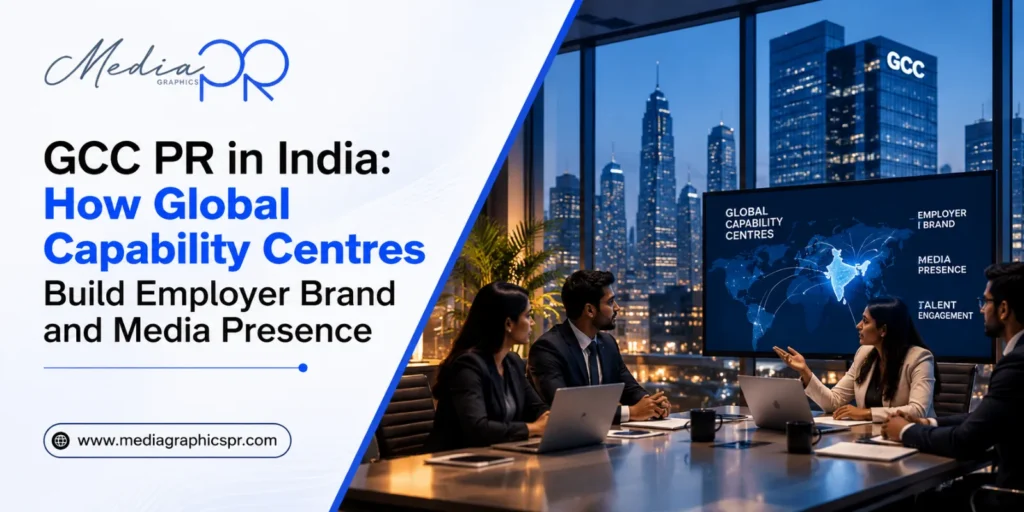
GCC PR in India: How Global Capability Centres Build Employer Brand and Media Presence

Quick Answer: GCC PR India is the work of making a global capability centre visible and credible in the country where it operates. It combines three things: a clear story about what the centre does, a GCC employer brand that talent trusts, and steady GCC media presence in business, technology and city-level outlets. Start with the India leadership team, back every claim with something real, and keep the message consistent across press, LinkedIn and hiring pages. A global capability centre (GCC) can run engineering, analytics, finance and product work for a parent company, yet many of them stay almost invisible in India. Candidates cannot tell what the centre does, journalists cannot find a spokesperson, and the head office hears about the centre only through internal reports. This guide explains how GCC PR India works, where it fits in a hiring plan and how to build it step by step. India now hosts a very large number of these centres. A Press Information Bureau release on GCCs says the country has over 1,700 of them employing over 19 lakh people, and a ThePrint report on the NASSCOM-Zinnov study gives a similar picture for FY2024. With that many centres competing for the same talent, being known is a practical advantage, not vanity. What Is GCC PR in India? GCC PR is public relations built for the specific position of a global capability centre. A normal corporate PR plan speaks for the whole company. A GCC has a different problem: it is part of a global brand, yet it hires, operates and competes locally, often under a parent name that Indian candidates know only partly. That is why a dedicated approach matters. Our GCC PR services page lists the usual building blocks: media relations, leadership positioning, employer branding, innovation storytelling, stakeholder communication and event visibility. A good plan picks the two or three that match the centre’s stage, instead of doing everything at once. How is GCC PR different from regular corporate PR? Three differences stand out. The audience is mostly local talent, local partners and the parent company’s leadership, not end customers. The story is about capability and people, not a product. And the proof is people-based too: team growth, mandates won, problems solved. A product-led plan, such as technology PR for a software company, starts from a product; a GCC plan starts from the centre. Why Does Global Capability Centre Branding Matter in India? Global capability centre branding answers a simple question: why should a strong candidate, a journalist or a state official care about this centre? Without an answer, the centre competes on salary alone. Talent: candidates research a centre before applying. If search results show nothing beyond a careers page, trust is low. Leadership: senior hires want to know the India mandate is real and that the head office backs it. Parent company: visible local recognition helps the India team argue for bigger mandates. Partners and policy: state agencies, universities and vendors prefer working with centres they can see and describe. Foreign companies setting up in India face the same visibility gap on a larger scale, which is why India market entry PR often starts before the first hire. How Do You Build a GCC Employer Brand? A GCC employer brand is the reputation a centre holds among people who might work there. It is built from what employees say, what leaders say publicly and what outsiders can verify. Advertising adds little if those three disagree. What should the employer brand story include? Start with facts the centre can prove: the work it owns, the technologies and tools its teams use, the career paths on offer and how decisions are made between India and the head office. Avoid vague lines such as “innovation hub” unless a specific example sits next to them. Who should be the voice of the centre? People trust people. The India head, a few team leads and a handful of long-serving employees make better spokespeople than a brand page. Support them with executive profiling and help them build credible LinkedIn profiles, because candidates usually check the leader before the company. For sector hiring teams, HR tech PR shows how people-focused stories earn coverage. How do hiring campaigns and PR work together? Hiring campaigns bring short bursts of attention; PR keeps the reputation steady between them. Use a hiring drive as a news hook, for example a new team opening or a larger site, and tell the story of why the work is being done in India. Add internal culture stories that employees are happy to see shared outside. How Do You Build GCC Media Presence? GCC media presence means appearing in the right outlets with something worth reading. One well-placed feature that a candidate can find is worth more than a long list of weak mentions. The basics of media relations apply: know the reporter, bring a real angle and be available on time. Which angles do journalists actually use? A new centre, a site expansion or a significant leadership hire (see our guide to announcing a GCC leadership hire). A mandate the India team now owns for the parent company. A point of view from a leader on talent, technology or the sector. Collaboration with a university, startup or state body. Recognition, event speaking slots and panel appearances. Support these with well-written press releases, not reworded brochures. If you are new to this, our explainer on how media relations works is a good starting point. How do thought leadership and events help? Opinion articles from the India head, bylined pieces and conference talks show how the centre thinks. A steady thought leadership programme gives journalists a reliable source, and event PR puts leaders on stages where talent and partners are already listening. Which Cities Should a GCC Focus On, and Does Location Change the PR Plan? Yes, a little. National business media matters everywhere, but local outlets, state-level events and city talent communities differ. Match the plan to where your people sit and

PR Agency Brief
MediaPR

How to Write a PR Agency Brief (Free Template)

Most PR agency relationships go wrong in the first week, and the cause is usually the brief. A vague brief gets vague ideas, a long list of expectations and a fuzzy report at the end. A clear PR agency brief gets better questions, sharper proposals and results you can measure. This guide shows how to write a PR agency brief, explains how to brief a PR agency step by step, and gives you a free PR brief template you can copy. It also covers the PR RFP, so you know when to send a short brief and when to run a formal process. Quick Answer: A PR agency brief is a short document that tells an agency who you are, what you want PR to achieve, who you need to reach, what success looks like, and what the budget, timeline and limits are. Keep it to two or three pages, be honest about your starting point, and name one person who owns the relationship. A clear brief leads to better proposals and fewer surprises. What Is a PR Agency Brief? A PR agency brief is a written summary of what you need from a PR agency. It gives the agency enough context to propose a plan, price it and tell you honestly whether it is the right fit. It is not a contract and it is not a wish list. It is a starting point for a conversation. If you are still learning how agencies work, read what a PR agency is and what PR companies do first. Why Does a Good PR Brief Matter? Because the agency can only solve the problem you describe. A strong brief saves time on both sides and sets the tone for the relationship. Better proposals: agencies spend time on ideas, not guessing Fair pricing: clear scope leads to clearer quotes Aligned expectations: you agree what PR can and cannot do Faster start: the team does not wait for basic information Easier reporting: success is defined before work begins What Should a PR Agency Brief Include? A good brief covers ten points. The table shows each one and the question it answers. What a PR agency brief should include Section What to include Question it answers Company background What you do, size, markets and history Who are you? Business goal The business outcome PR should support Why do you need PR now? PR objectives Two or three specific, measurable aims What should PR achieve? Audiences Investors, customers, talent, regulators or others Who must be reached? Key messages The few things you want people to remember What do you want said? Starting point Past coverage, current reputation, known problems Where are you today? Competitors Two to four brands you are compared with Who is around you? Budget and timeline Monthly or project budget, start date, review dates What can you commit? Approvals and spokespeople Who signs off and who speaks How will work run? Success measures How you will judge results How will you know it worked? What Is a Free PR Brief Template You Can Copy? Here is a simple PR brief template. Replace each bracket with your details, delete what does not apply and keep the whole document to two or three pages. PR AGENCY BRIEF: [Company name] 1. About us [What we do, who we serve, where we operate, team size, website] 2. Why we need PR now [Funding, launch, expansion, reputation issue, leadership change] 3. Objectives (maximum three) [Objective 1, for example: build recognition among [audience] in [city or sector]] [Objective 2] [Objective 3] 4. Target audiences [Primary audience] | [Secondary audience] 5. Key messages [Message 1] | [Message 2] | [Message 3] 6. Where we are today [Existing coverage, spokespeople, assets, known issues] 7. Competitors and peers [Brand 1] | [Brand 2] | [Brand 3] 8. Budget and timeline [Monthly or project budget] | [Start date] | [Review dates] 9. Working model [Main contact] | [Approver] | [Spokespeople and availability] 10. How we will measure success [Coverage quality, enquiries, search interest, investor or customer feedback] 11. Limits and sensitivities [Topics to avoid, legal or compliance rules, confidential information] Send it as a short document or email attachment, and offer a call to answer questions. How to Brief a PR Agency: Step by Step Writing the document is only half the job. Here is how to brief a PR agency so the work starts well. Step 1: Agree the goal inside your team Ask leaders what the business needs in the next twelve months. If the founder, the head of sales and the head of marketing give three different answers, fix that first. Our guide to creating a PR strategy can help. Step 2: Collect the facts Gather past coverage, key numbers you can share, spokesperson details and your approvals process. Be honest about weaknesses, because agencies find them anyway. Step 3: Write the brief Use the template above. Keep sentences short and specific, and avoid vague aims such as “be everywhere”. Step 4: Shortlist agencies Choose three to five agencies that work with your sector or stage. Read our guides on hiring a PR agency and the top PR agencies in India, or use our city guides for Delhi NCR and Bangalore. Step 5: Hold a briefing call Walk through the document, answer questions and listen to the agency’s questions. Good agencies ask hard ones. See also how to choose the right B2B tech PR agency if you sell to businesses. Step 6: Compare proposals fairly Ask every agency to answer the same questions, so you can compare like with like. Look at the thinking, the team and the measures, not only the price. What Is a PR RFP and When Do You Need One? A PR RFP is a formal request for proposal sent to agencies to compare them in a structured way. Wikipedia describes an RFP as a document that an organisation uses to solicit business proposals from potential suppliers. Use a short brief when you need

Scroll to Top
logo

Get In Touch

Please enable JavaScript in your browser to complete this form.