






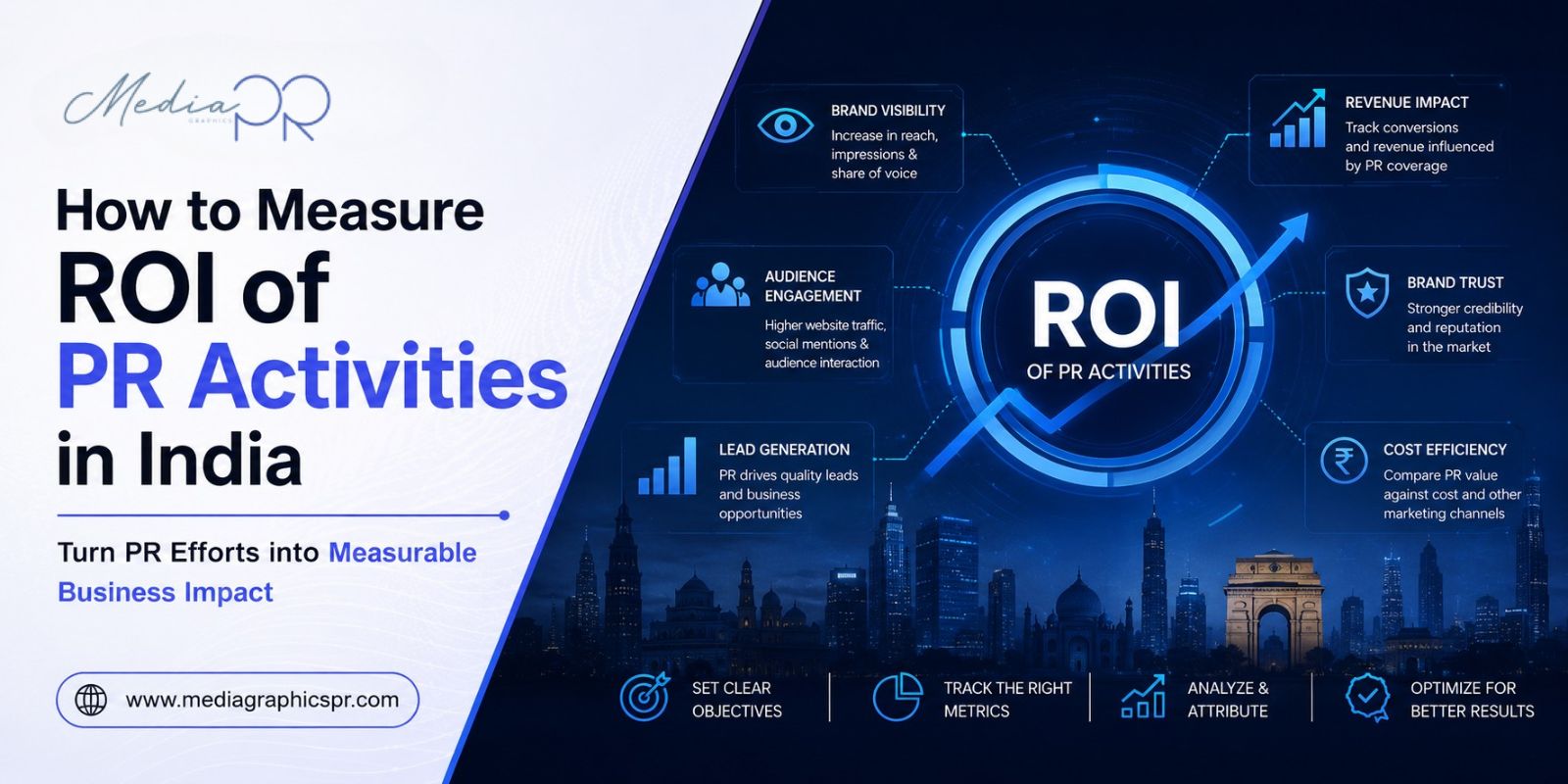
Your PR agency sends the monthly report. Forty-two mentions. Estimated reach of 3.1 million. PR value equivalent of ₹22 lakhs.
You read it. Nod. File it. And then go back to wondering whether any of it is actually doing anything for the business.
This is the most common experience Indian brands have with PR measurement: numbers that look impressive in a presentation and mean almost nothing in practice. The problem isn’t that PR ROI India can’t be measured. It’s that most brands are measuring the wrong things entirely.
Here’s how to fix that and build a measurement approach that actually tells you whether your PR spend is working.
Why Traditional PR Metrics Are Failing Indian Brands
The Indian PR industry has relied on three metrics for decades. All three have serious problems.
| Traditional Metric | The Real Problem |
|---|---|
| Clip Count | A mention in a publication nobody reads counts the same as in Economic Times. |
| Estimated Reach | Assumes everyone who could see the coverage actually saw it. |
| PR Value Equivalent (AVE) | Converts editorial coverage into advertising rates—a methodology widely considered unreliable. |
| Share of Voice | Shows how often you’re mentioned compared to competitors, but not whether the coverage generated any business impact. |
These metrics measure activity. What businesses need to measure is outcome. Until that shift happens, PR ROI India conversations will keep producing impressive-looking reports that don’t connect to anything the CFO or founder actually cares about.
The Right Framework—Four Levels of PR Measurement
Good PR metrics India works at four levels. Each one is closer to real business impact than the last.
➤ Level 1: OUTPUT
⬩ What was produced and distributed
⬩ Press releases sent, pitches made, coverage secured
➤ Level 2: OUTTAKE
⬩ Whether the right audience actually received the message
⬩ Publication quality, audience relevance, message accuracy
➤ Level 3: OUTCOME
Whether coverage changed awareness, perception, or behavior
Branded search, sales conversation quality, investor recognition
➤ Level 4: IMPACT
⬩ Whether PR contributed to a real business result
⬩ Deals closed, rounds raised, hires made, crises managed
Most Indian brands measure Level 1 and stop. The ones getting genuine value from PR measure Levels 3 and 4, and set those targets before the campaign starts, not after.
The Metrics That Actually Tell You Whether PR ROI India Is Real
1. Publication Quality—Not Quantity
Before anything else, stop counting clips and start scoring them.
A placement in Mint or Economic Times that your investors read is not the same as a mention in a publication your target audience has never opened. Build a simple scoring system:
- Does this publication reach our specific audience—investors, buyers, talent?
- Is it a feature or a brief mention?
- Does it include a backlink to our website?
- Can our sales team actually use this in a conversation?
Three high-quality placements in the right publications beat fifteen mentions in irrelevant ones, every single time.
2. Branded Search Volume
Every significant piece of coverage should produce a measurable spike in people searching your company name directly. This is one of the clearest PR ROI India signals available and one of the most ignored.
Set up Google Search Console before your campaign starts so you have a baseline. After every major placement, check whether branded search moved. If it didn’t, the coverage didn’t reach anyone who didn’t already know you. That’s important information about publication relevance.
3. Referral Traffic From Coverage
Every online placement is a potential traffic source. Track how many people come to your website directly from media coverage, what pages they visit, and whether any of them take meaningful action.
This tells you two things: whether the publication’s audience is genuinely engaged and whether your website is converting the traffic PR sends it. Both are worth knowing.
4. Sales Conversation Quality
This is the measure PR activities results metric most brands never track and one of the most valuable.
Talk to your sales team regularly:
- Are prospects mentioning coverage before the first call?
- Are deals moving faster with prospects who’ve seen the brand in the media?
- Is the credibility conversation taking less time?
- Are enterprise buyers referencing specific articles?
When a prospect says, “I saw you in Economic Times last month” before the sales pitch starts—that’s PR ROI that no AVE calculation captures.
5. Investor Recognition
For startups and growth-stage companies, this is one of the highest-value PR metrics India available.
Track whether investors mention your coverage before pitch meetings. Ask your investment relations contacts whether they’ve encountered your brand in the media. Notice whether inbound investor interest increases after significant placements.
When an investor says “I’ve been following your company in Inc42” before you’ve introduced yourself, that’s your PR working at exactly the level it should be.
6. Talent Pipeline Quality
Strong candidates research companies before applying. If your employer brand isn’t showing up in the media, you’re losing offers to competitors with stronger public profiles—regardless of which company has the better culture.
How to track this:
- Ask candidates in interviews where they heard about the company
- Track whether application quality shifts after significant coverage
- Note whether senior candidates reference specific articles in conversations
If nobody has ever mentioned PR coverage in a hiring conversation, either the coverage isn’t reaching candidates, or you’re not asking the right questions.
7. Domain Authority and SEO Impact
High-authority media placements with backlinks to your website improve your domain authority over time. Better authority means better organic search rankings. Better rankings mean more inbound traffic without paid spend.
Track domain authority monthly using Ahrefs or Moz. Map changes against PR activity. Over six to twelve months of consistent coverage, the SEO impact becomes measurable and meaningful.
Building Your PR Measurement Dashboard
Here’s what a practical PR ROI India measurement setup looks like:
| Metric | How to Track | When to Review |
|---|---|---|
| Publication Quality Score | Manual scoring against audience criteria | Monthly |
| Branded Search Volume | Google Search Console | After every major placement |
| Referral Traffic | Google Analytics – Referral Source | Monthly |
| Sales Conversation Quality | Sales Team Feedback | Monthly |
| Investor Recognition | Direct feedback from investor conversations | Per raise cycle |
| Talent Pipeline Quality | Candidate source tracking | Quarterly |
| Domain Authority | Ahrefs or Moz | Monthly |
None of these require expensive monitoring tools. Most require conversations between teams that should be having them anyway.
The Conversation to Have Before the Campaign Starts
Measure PR activities results properly by agreeing on what those results look like before anything goes to a journalist.
The conversation worth having with your PR agency at the start of every campaign:
- What specific business outcome are we trying to support?
- What metric tells us whether we achieved it?
- What does good look like at three, six, and twelve months?
An agency that answers these questions clearly before the work starts is worth significantly more than one presenting a clip count at month end and calling it measurement.
If your current PR reporting ends with “here are this month’s coverage highlights”—you’re not measuring ROI. You’re measuring activity.
How MediagraphicsPR Measures What Actually Matters
The Indian brands getting genuine value from their PR investment are the ones that set outcome metrics before anything goes to a journalist and hold their agency accountable to those metrics throughout the engagement.
At MediagraphicsPR, we work as the PR ROI India-focused agency that builds PR metrics frameworks around real business outcomes from the very first conversation. As a PR agency in Delhi with 25 years of experience connecting PR activity to business results across India’s most competitive sectors, we know what strong PR results look like and what it takes to deliver them consistently.
Clip counts are easy. Results are harder. We measure the harder thing.
Need help? Call us at +91-8448360900 or email us at info@mediagraphicspr.com
Also Read – 5 Signs Your Brand Needs to Hire a PR Agency Right Now
FAQs
Q: How do we start measuring PR better if we’ve only tracked clips until now?
Start with branded search volume and sales team feedback—both are free, both are immediate, and both tell you significantly more than clip count ever will.
Q: Should we completely stop tracking media mentions?
No, track quality, not quantity. A mention in the right publication matters. Twenty wrong ones don’t add up to the same value as one well-placed feature.
Q: How often should PR metrics be reviewed with the agency?
Monthly for activity metrics. Quarterly for business outcome metrics, that’s the conversation where you assess whether PR is actually moving the needle on things that matter.
Q: What’s the single most important PR metric for a startup approaching a fundraise?
Investor recognition, whether investors are encountering your brand in the media before pitch meetings. Everything else is secondary during a raise cycle.