






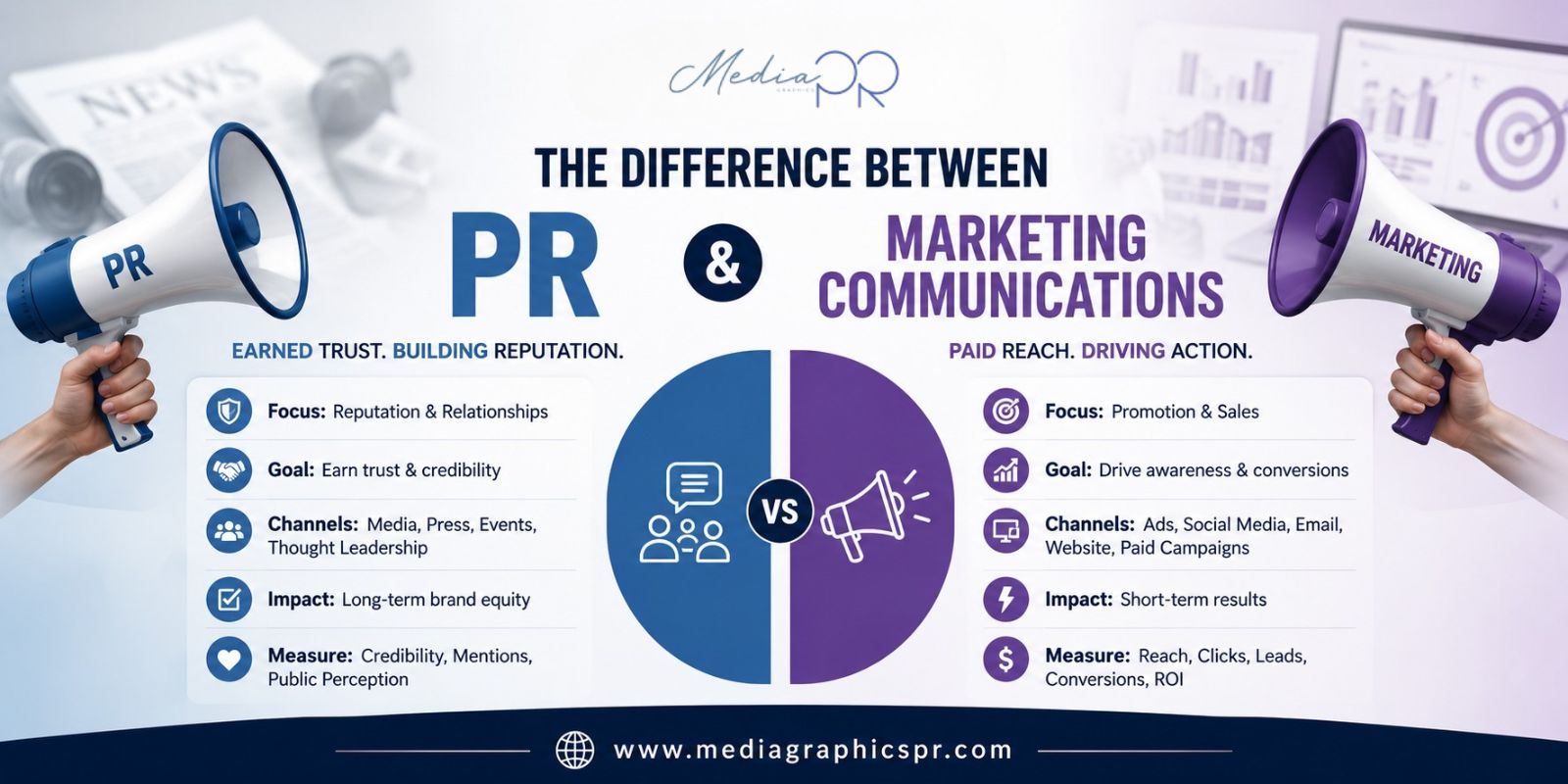
You’ve probably used both terms in the same sentence. Maybe even interchangeably.
And honestly, most people do. Even inside companies that are actively spending on both. But here’s the thing: if you don’t know what each one actually does, you end up asking PR to do marketing’s job and marketing to do PR’s job. And then both underdeliver, and nobody knows why.
This blog clears that up completely. By the end of it, you’ll know exactly what each discipline does, where they overlap, where they don’t, and how to use both together in a way that actually moves your business forward.
The One-Line Difference
Before anything else, here it is, as simply as possible:
Marketing communications drives people toward a purchase. Public relations builds the trust that makes that purchase possible.
One sells. The other earns beliefs. Both matter, but they do completely different things, and confusing them is expensive.
What Marketing Communications Actually Does
Marketing communications (or marcomms) is everything a brand does to reach its audience directly and move them toward a decision.
This includes:
- Paid advertising—digital, print, outdoor
- Email marketing campaigns
- SEO and content marketing
- Social media advertising
- Product launches and promotions
- Sales collateral and landing pages
The defining characteristic of marketing communications is control. You write the message. You choose the channel. You pay for the placement. You decide exactly what the audience sees and when.
That control is powerful. It’s also a limitation because audiences know you’re the one paying for it. And in a world where trust in advertising has been declining for years, paid messages carry less weight than they used to.
What Public Relations Actually Does
Public relations works differently. Instead of paying to place a message, PR earns coverage—through journalist relationships, compelling stories, and genuine media value.
This includes:
- Media relations and press coverage
- Thought leadership and founder profiling
- Crisis communications
- Funding and product announcements
- Reputation management
- Industry positioning and category authority
The defining characteristic of PR is credibility. When a journalist writes about your company in Economic Times, that’s a third party—with no financial relationship with your brand—saying your story is worth their readers’ time. That carries a weight no paid advertisement can replicate.
Research consistently shows that editorial coverage is significantly more influential on buying decisions than advertising of the same size. That gap has only grown as audiences have become more skeptical of paid content.
Side by Side—The Full Comparison
| Marketing Communications | Public Relations |
|---|---|
| Primary goal Drive sales and conversions | Primary goal Build trust, credibility, and reputation |
| Message control Full, the brand controls the message | Message control Partial, journalists shape the story |
| Cost model Pay per placement or impression | Cost model Investment in relationships and strategy |
| Credibility Lower, as the audience knows it’s paid | Credibility Higher due to third-party endorsement |
| Audience Existing and potential customers | Audience Investors, media, talent, public, customers |
| Timeline Fast, immediate results possible | Timeline Slower, compounds over months |
| Longevity Stops when the budget stops | Longevity Coverage stays online indefinitely |
| Crisis role Limited | Crisis role Critical, PR owns reputation management |
Where They Overlap, and Why That Matters
Here’s where it gets interesting. PR and marketing communications aren’t competing disciplines. They’re complementary ones, and the brands getting the most out of both are the ones running them in coordination.
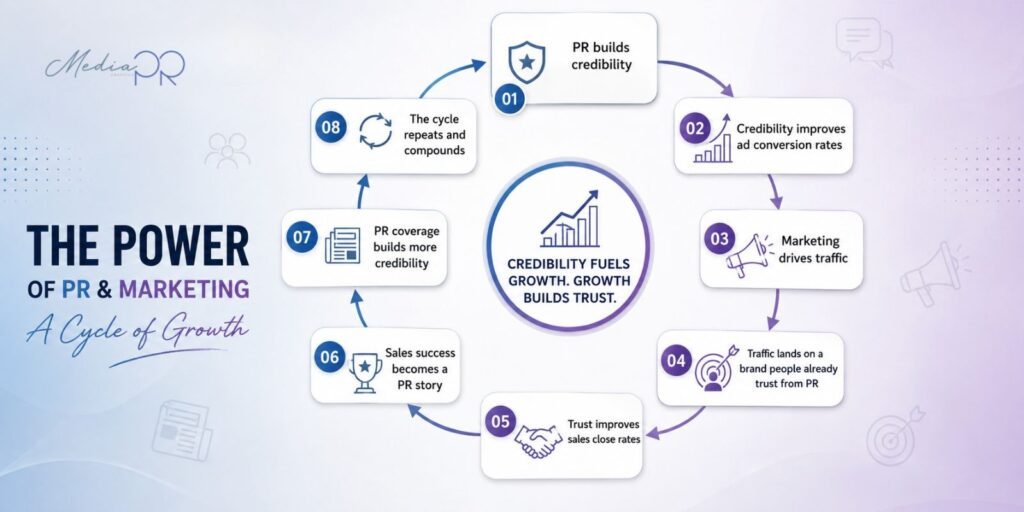
When PR and marketing work in silos—different teams, different strategies, different messaging—both underperform. When they’re aligned—same narrative, coordinated timing, complementary channels—each one makes the other significantly more effective.
The Audience Difference Is Bigger Than Most People Realise
Marketing communications is primarily focused on one audience, potential customers. Every campaign, every ad, every email is designed to move a prospective buyer closer to a purchase.
Public relations serves a much wider set of audiences simultaneously:
| Audience | What PR Does For Them |
|---|---|
| Investors | Builds credibility before the pitch meeting |
| Enterprise buyers | Establishes trust before the sales conversation |
| Potential hires | Creates employer brand that attracts strong candidates |
| Industry peers | Positions your brand as a category authority |
| Regulators and government | Demonstrates transparency and responsible communication |
| Existing customers | Reinforces their decision to work with you |
| Media | Builds relationships that generate ongoing coverage |
For a growing Indian startup or enterprise business, most of these audiences matter simultaneously. Public relations is the discipline that speaks to all of them at once.
The Sales Funnel—Where Each One Plays
One of the clearest ways to understand the difference is to look at where each discipline does its best work in the customer journey:
AWARENESS
PR does the heavy lifting here—earned media, thought leadership, category positioning. People hear about your brand through sources they trust, not sources you paid.
CONSIDERATION
Both PR and marketing work here. PR coverage validates the brand. Marketing retargeting and content keeps it top of mind.
DECISION
Marketing takes the lead—offers, landing pages, sales collateral, and email sequences. But PR-built trust is what makes the conversion happen faster and at higher rates.
RETENTION AND ADVOCACY
PR again—consistent brand credibility, positive reputation, and stories that make customers proud to be associated with your brand.
Neither discipline covers the full funnel alone. Together they cover it properly.
CRISIS: This Is Where the Difference Becomes Critical
In a crisis, marketing communications have almost no role. You can’t advertise your way out of a reputation problem.
Public relations owns this moment entirely. And the brands that come out of difficult situations with their reputation intact are the ones that had PR working before the crisis, not just during it.
A data issue, a negative story that gains traction, a competitor narrative that starts sticking—these situations are managed through journalist relationships, clear messaging, and pre-built media credibility. None of that can be assembled in an emergency.
The businesses that invest in PR consistently are the ones that have something to absorb a difficult moment with. The ones that don’t often find that a single bad news cycle undoes years of marketing spend.
Which One Should Your Business Prioritize?
Honest answer: it depends on what you’re trying to achieve right now.
- Driving immediate sales? Marketing communications is your primary lever.
- Raising a funding round? PR does the credibility work investors need to see.
- Entering a new market? PR builds the awareness that makes marketing more effective.
- Managing a reputation issue? PR exclusively.
- Building long-term brand authority? PR consistently, marketing in parallel.
- Scaling a D2C brand? Both, tightly coordinated.
Most growing Indian businesses need both running simultaneously, just with a clear understanding of what each is responsible for delivering.
How MediagraphicsPR Works at the Intersection
The brands getting the most out of their communications budgets in India right now aren’t choosing between PR and marketing, they’re running both with a clear strategy for each.
At MediagraphicsPR, we work as the PR agency in Delhi that builds public relations strategies specifically around what your business needs from PR, not what’s easiest to deliver. As a PR agency with over two decades of real media relationships across India’s most important publications, we know where PR ends and marketing begins and how to make sure both are pulling in the same direction.
PR and marketing communications are different. Understanding that difference is what lets you use both properly. And using both properly is what separates the brands that grow consistently from the ones that spend a lot and wonder why the needle isn’t moving.
Need help? Call us at +91-8448360900 or email us at info@mediagraphicspr.com
FAQs
Q: Can a small business afford to run both PR and marketing simultaneously?
Yes, at an early stage, PR often costs more time than money. Founder thought leadership and targeted journalist outreach can build real credibility without a large budget, running alongside whatever marketing spend you already have.
Q: Should PR and marketing be handled by the same team or different teams?
Different disciplines, but the strategy needs to be coordinated. The biggest waste happens when PR and marketing are telling different stories to the same audience at the same time.
Q: How do we know if we need more PR or more marketing right now?
If your brand has a credibility or awareness problem—investors don’t know you, buyers don’t trust you, and talent hasn’t heard of you—PR is what you need. If your brand has credibility but isn’t converting it into sales, marketing is the lever. Most growing businesses need both at different intensities depending on the stage.
Q: What’s the biggest mistake businesses make with PR?
Treating PR as a one-time campaign instead of an ongoing reputation-building effort. The strongest results usually come from consistency, not isolated announcements.