






Every founder raising a round knows the feeling.
The product is solid. The traction is real. The pitch deck is as good as it’s going to get. But walking into a room full of investors who’ve never heard of you, and trying to build credibility from scratch in 45 minutes, is one of the hardest things a founder has to do.
Investor PR changes that dynamic entirely. When the right investors have already seen your name in the right publications, read your founder’s perspective in a business outlet they respect, or noticed your company’s coverage before the intro email landed, the meeting starts differently. The credibility conversation is shorter because it’s already partially done.
Here’s how PR for investors actually works and what to do to make it work for your next raise.
Why Investors Pay Attention to Media Presence
Institutional investors in India—VCs, family offices, and angel networks—see hundreds of companies every quarter. Most look identical on paper. Same market-size claims. Same hockey stick projections. Same founding team credentials.
What stands out is a company that shows up consistently in places investors actually pay attention to. A founder quoted in Mint. A product featured in Economic Times. A commentary piece in Inc42 being shared in the investor’s own network. These signals do something a pitch deck can’t. They show that third parties have independently decided this company is worth paying attention to.
That’s the core of investor PR. Not about getting famous. About being known, specifically, to the people who write the checks.
What Investors Are Actually Evaluating
Understanding the investor mindset makes the PR strategy much clearer.
| What Investors Evaluate | How PR Addresses This |
|---|---|
| Founder credibility | Thought leadership positions founders as domain experts |
| Market opportunity | Coverage that frames the problem your company solves |
| Traction and momentum | Milestone announcements, customer stories, growth coverage |
| Narrative clarity | Consistent messaging across every media touchpoint |
| Risk assessment | What the market says about you publicly |
Every single one of these gets influenced by what an investor finds when they research your company before a meeting.
1. Build Credibility Before the Raise Starts
The biggest mistake founders make with investor PR is starting it when the fundraise begins. By then it’s too late to build anything that compounds.
Investors Google you. They check what’s been written about the company. They look at whether the founder has a point of view on the industry. A company with 12 months of consistent media presence walks into that search result very differently from one that has nothing but its own website.
Start building investor PR at least six to twelve months before you plan to raise. Not a press release blitz, but a sustained and consistent presence that signals your company is serious.
2. Get the Narrative Right First
Before any pitch goes to a journalist, the story has to be clear. And it has to be the same story everywhere.
Your investor relations PR narrative answers:
- What does the company do? (one sentence, no jargon)
- What problem does it solve and why does that matter right now?
- What’s the insight that makes your approach different?
- Where is the company going and why is this the team to take it there?
When that narrative is consistent across every touchpoint—press releases, the founder’s LinkedIn, media coverage, and the website—investors encounter the same clear story everywhere they look. Inconsistency creates doubt. Clarity creates confidence.
3. Target the Publications Investors Actually Read
Not all coverage works equally for investor PR. A feature in a publication your target investors have never heard of is activity without outcome.
Institutional VCs → Mint, Economic Times, Business Standard
Early-stage angels → Inc42, YourStory, startup ecosystem media
Sector-specific funds → Industry trade publications in your space
Global investors → Forbes India, Business Today, ET Tech
Build your target publication list around where your specific investor audience pays attention, not where the publication name sounds most impressive in a board update.
4. Turn Founder Expertise Into Investor-Facing Content
Investors back founders as much as they back companies. They want to know whether the founder understands the market deeply and has genuine conviction about where things are heading.
Thought leadership PR is one of the most effective ways to show this without a pitch meeting:
- Authored articles in business publications: founder’s perspective on a real industry problem
- Expert commentary in journalist stories: being quoted on market trends
- Podcast appearances: longer form credibility with niche investor audiences
- LinkedIn content: direct reach to investors in your network
- Conference talks: category positioning and peer credibility
A founder who shows up consistently in relevant media with genuine insight becomes someone investors track before they even take a meeting.
5. Handle Funding Announcements as Full Market Moments
A funding announcement is not just a press release. For investor PR, it’s a signal, one that tells the next set of investors that smart money has already made a call on this company.
| Without PR Strategy | With PR Strategy |
|---|---|
| Generic press release, mass distribution | Targeted pitching to 8–12 relevant journalists |
| Coverage disappears in 48 hours | Followed by founder commentary and momentum coverage |
| No pre-built credibility | 6 months of media presence behind the announcement |
| Next raise starts from zero | Next raise starts with a brand investors already know |
The companies that get the most from their funding announcements are the ones that treated the previous six months as preparation for this moment.
6. Build Relationships With the Right Journalists
Journalists who cover the startup and investment beat in India are well-connected in investor circles. A reporter who trusts your founder as a credible source will write about your company when the story is right, and that coverage reaches exactly the investor audience you need.
Building these relationships isn’t about pitching constantly. It’s about being useful by offering genuine insight on industry trends, being available when journalists need a source, and showing up consistently over time.
The founders who get called for quotes without pitching are the ones investors see everywhere. That’s the goal.
7. Protect Reputation Before It Becomes a Due Diligence Problem
Investors do thorough due diligence. They search your company name, your founder’s name, and your key team members. What they find shapes their confidence in the deal.
A company with a clean, consistent, positive media presence moves through due diligence faster than one with gaps or inconsistencies in its public record.
PR for investor relations is beyond simply generating positive coverage. It’s about making sure the full picture of your company online is one that builds confidence, not questions.
8. Understand That PR Has a Lead Time
Investor PR is not something you turn on when a raise starts. The coverage that influences investors during a fundraise is almost always coverage built three to twelve months before it began.
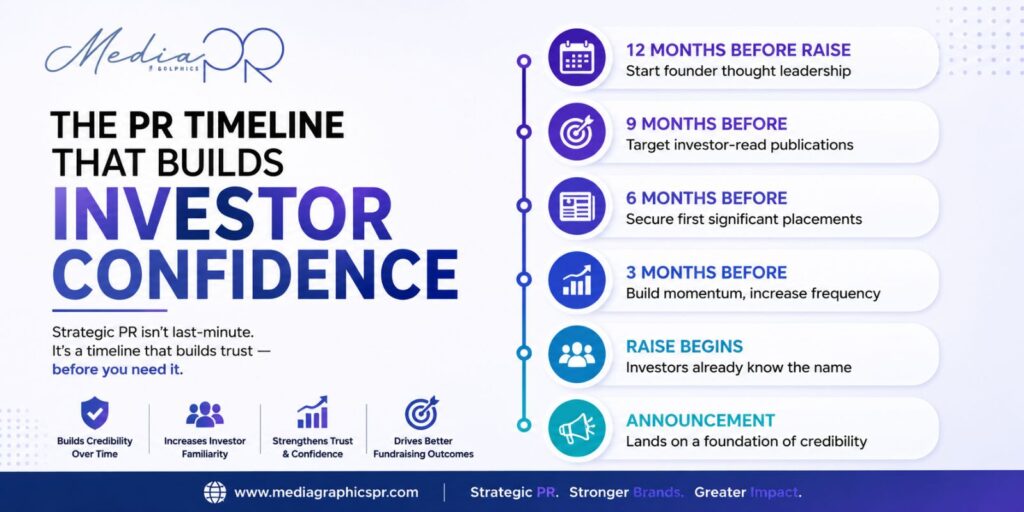
Founders who say PR didn’t help their fundraise almost always started too late.
How MediagraphicsPR Helps Brands Attract Investors
Getting investors to notice your company before the pitch and to walk into the meeting already believing in the story is exactly what strategic investor PR is built to do.
At MediagraphicsPR, we work as the PR agency in Delhi that funded startups and growth-stage companies come to when they want investor PR that actually changes how their raise goes. We’ve spent over two decades building real relationships with journalists who cover India’s investment ecosystem, the ones whose coverage reaches the investors you need.
We build PR for investor relations around one principle: the narrative has to be right before the raise starts, the right publications have to carry it, and the compounding has to have already begun by the time you walk into the room.
Investors are looking for companies worth backing. PR makes sure they find yours.
Need help? Call us at +91-8448360900 or email us at info@mediagraphicspr.com
FAQs
Q: How early before a fundraise should we start investor PR?
Six to twelve months minimum. The coverage that influences investors during a raise is almost always built well before it started.
Q: Can PR help a pre-revenue startup attract investors?
Yes, thought leadership, founder credibility, and a clear market narrative matter to early-stage investors even without revenue. What they’re backing at that stage is the team and the insight—PR builds both.
Q: Which publications matter most for attracting Indian institutional investors?
Mint, Economic Times, Business Standard, and Inc42 are the ones most read consistently. Sector publications matter if your target investors are fund-focused on a specific vertical.
Q: Does LinkedIn actually influence investor decisions?
Yes, most active investors in India are on LinkedIn and form impressions of founders through their content over time. Not a replacement for media coverage but a meaningful complement to it