






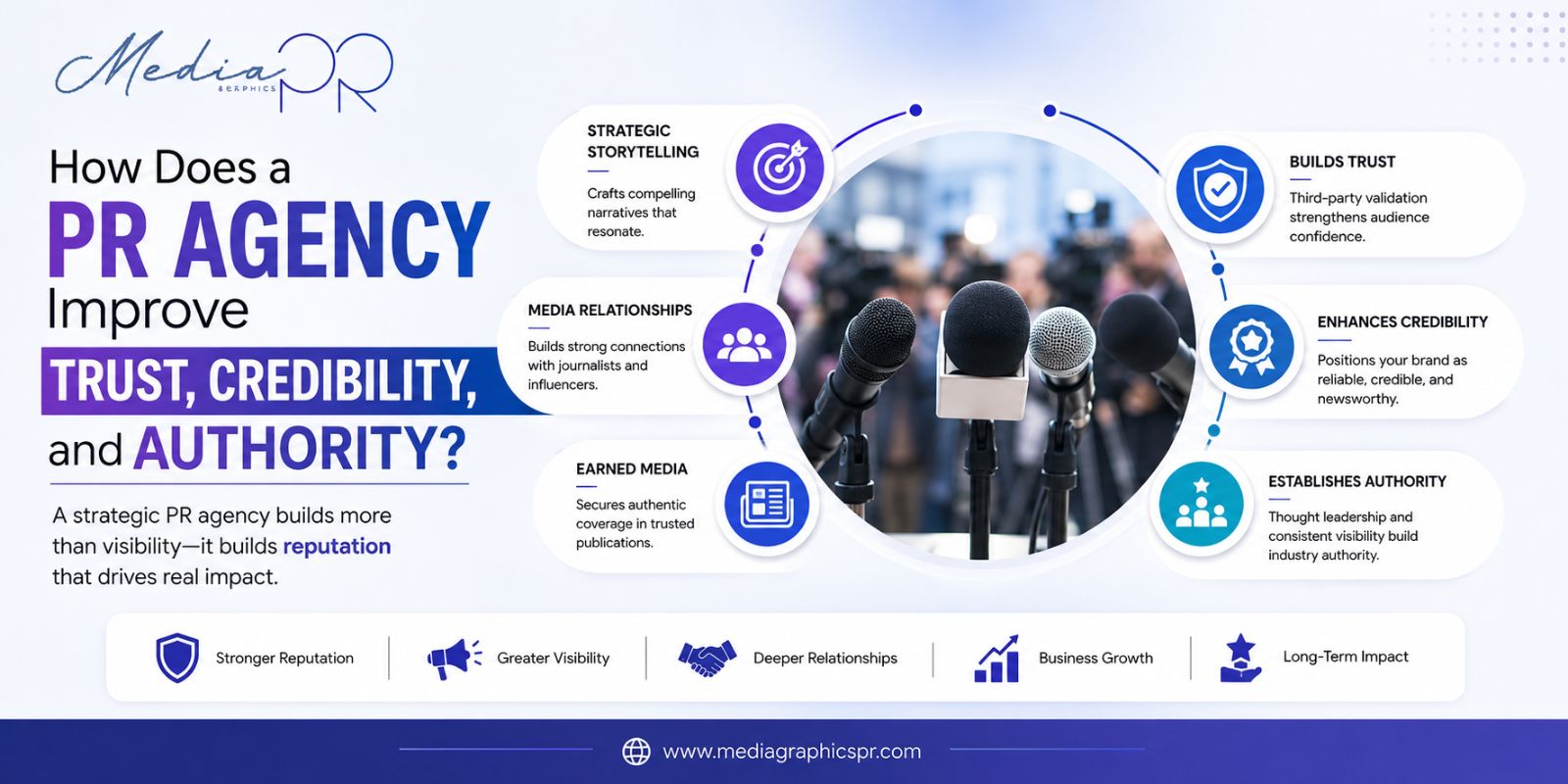
Trust is not something a business can manufacture on its own.
You can write it on your website. You can put it in your pitch deck. You can say it in every sales conversation. But none of that actually creates it because trust, real trust, only comes from what others say about you. Not what you say about yourself.
That’s the fundamental value of working with a PR agency. It puts your brand in front of the right third parties—journalists, editors, and industry publications—and gets them to tell your story in a way that builds the kind of brand credibility no advertisement, no press release you send yourself, and no LinkedIn post can replicate.
Here’s exactly how it works.
The Difference Between Trust, Credibility and Authority
Before getting into how a PR agency builds these things, it’s worth separating them, because they’re related but not the same.
| What It Means | How It’s Built |
|---|---|
| Trust People believe your brand does what it says | Consistency over time, reputation management |
| Credibility People believe your brand knows what it’s talking about | Third-party validation, earned media coverage |
| Authority People see your brand as the go-to voice in your space | Thought leadership, consistent expert positioning |
A PR agency works on all three simultaneously, and the compounding effect of all three together is what moves markets, closes deals, and makes brands genuinely difficult to compete with.
Earned Media Does What Paid Media Can’t
The most fundamental thing a PR agency does for brand credibility is secure earned media—coverage in publications that have their own editorial standards, their own audiences, and their own credibility to protect.
When Economic Times writes about your company, that’s not you talking about yourself. That’s an institution with decades of journalistic credibility saying your brand is worth its readers’ attention. That’s a fundamentally different trust signal than a paid advertisement in the same publication.
The audiences who matter most—investors, enterprise buyers, senior talent—have learned to discount advertising and trust editorial. A PR agency works in the editorial space. That’s why the credibility it builds is durable in a way that paid media simply isn’t.
Thought Leadership Builds Authority Over Time
Brand authority doesn’t happen from a single press release. It’s built through consistent demonstration of expertise over months, across multiple publications, in formats that reach the right audiences.
A PR agency turns the genuine expertise sitting inside your business into public-facing content that builds that authority piece by piece:
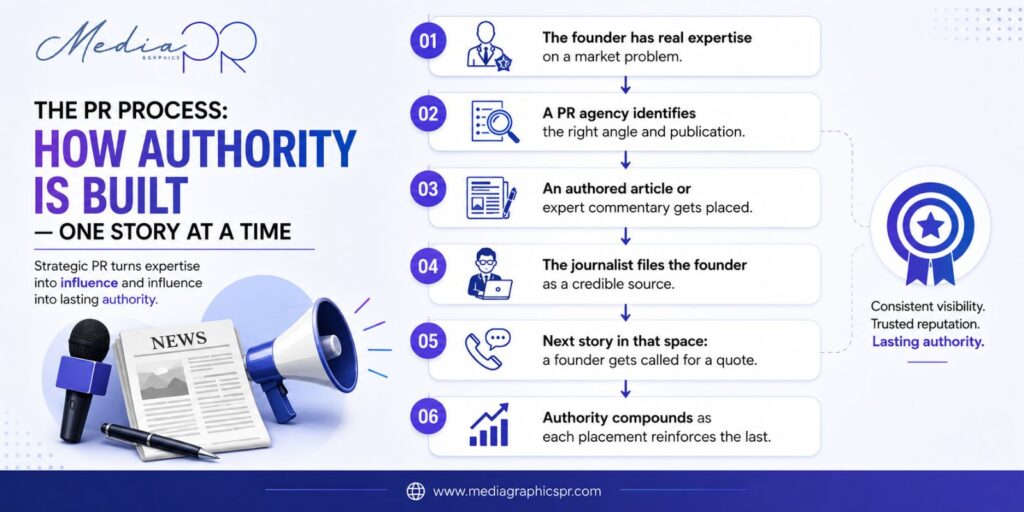
Six months of this and your founder’s name is one journalists reach for first. In twelve months, your brand is the reference point for your category.
Media Relationships Are the Engine
Most businesses trying to build credibility without a PR agency run into the same wall. They write a press release, send it to a journalist email they found online, and hear nothing back. Then they conclude that PR doesn’t work.
What actually didn’t work was the approach, not the discipline.
A PR agency brings something that takes years to build from scratch: real relationships with the journalists, editors, and producers who cover your industry. These aren’t database contacts. They’re people who take calls, read pitches carefully, and trust the agency’s judgement on what’s genuinely newsworthy.
That relationship infrastructure is what turns a good story into actual coverage. Without it, even a genuinely compelling story can disappear into an inbox.
Consistency Is What Actually Builds Trust
One good piece of coverage doesn’t build trust. Consistent presence does.
The brands that audiences genuinely trust aren’t the ones that made the news once. They’re the ones that show up regularly—in the right publications, with the right message, over a sustained period of time. Every placement reinforces the last. Every journalist relationship makes the next pitch land better. Every piece of thought leadership makes the founder more recognizable as an expert.
A PR agency maintains that consistency even when there’s no obvious news to push. Reactive commentary on industry developments. Data-driven stories created from internal insights. Founder perspectives on market trends. These are the things that fill the gaps between big announcements and keep the brand in the conversation continuously.
| Without Consistent PR | With Consistent PR |
|---|---|
| Brand appears in media occasionally | Brand shows up regularly in target publications |
| Journalists don’t know the founder | Founder is on journalist source lists |
| Trust is built slowly through direct sales | Trust is pre-built through media presence |
| Each campaign starts from zero | Each campaign builds on previous credibility |
| Crisis hits with no buffer | Crisis absorbed by pre-existing reputation |
Reputation Management Protects What You’ve Built
Brand credibility takes months to build and can take days to damage. A data issue, a negative review that picks up momentum, a competitor narrative that starts gaining traction—any of these can create a reputation problem that’s far harder to fix than it would have been to prevent.
A PR agency does two things here. First, it builds enough pre-existing credibility that your brand has something to absorb a difficult moment with—a track record, journalist relationships, and an established positive narrative that doesn’t vanish overnight. Second, it has the infrastructure to respond quickly and clearly when something does go wrong—managing journalist inquiries, controlling the narrative, and making sure your version of events gets heard.
The businesses that come out of difficult moments with their reputation intact almost always had PR working before the crisis, not just during it.
Third-Party Validation Changes Buying Decisions
This is one of the most direct connections between PR and brand trust and one of the least talked about.
When an enterprise buyer is evaluating vendors, they do research. They Google company names. They read what publications have written. They check whether the founders have a point of view on the industry. What they find shapes the conversation before your sales team has said a word.
A brand with consistent, credible coverage in publications that a buyer respects walks into that evaluation differently from one that’s invisible or inconsistent online. The due diligence question of “can we trust this company?” gets partially answered by the media presence before the first meeting.
That’s brand credibility doing direct revenue work, and a PR agency is what builds it.
Authority in Your Category Is a Competitive Moat
The brands that dominate their category’s media narrative in India didn’t get there by accident. They got there because someone, maybe a PR team, an agency, or an unusually media-savvy founder, decided early that owning the conversation in their space was worth investing in.
Brand authority, once established, is genuinely hard to displace. When your founder is the expert journalists call, when your company is the reference point analysts use, and when your brand is the one new entrants in your category are compared to—that positioning compounds in a way that no competitor can shortcut.
A PR agency builds that moat. Systematically, consistently, and over a timeline that rewards the brands that started before they felt the pressure.
How MediagraphicsPR Builds Trust, Credibility and Authority
The businesses that are genuinely trusted in their markets—by investors, by enterprise buyers, by the talent they’re trying to hire—didn’t get there through advertising. They got there through consistent, strategic, credible communication over time.
At MediagraphicsPR, we work as the PR agency in Delhi that brands come to when they want to build brand credibility that actually holds up—under investor scrutiny, in enterprise sales conversations, and in the moments when reputation is tested. As a PR agency with 23+ years of real media relationships across India’s most important publications, we know what it takes to move a brand from unknown to trusted in the markets that matter.
Trust takes time to build. The right time to start is before you need it.
Need help? Call us at +91-8448360900 or email us at info@mediagraphicspr.com
FAQs
Q: How long does it take for PR to build real brand credibility?
First meaningful signals—consistent coverage and journalist familiarity—show within six to eight weeks. Real credibility that influences buying and investment decisions typically takes six to twelve months of consistent work.
Q: Can a brand build credibility through PR without a big budget?
Yes, thought leadership and targeted journalist relationships cost more time than money at early stage. Many brands build serious credibility this way before scaling up to a full agency retainer.
Q: Is PR more important for B2B or B2C brands when it comes to credibility?
Both need it but for different reasons. B2B credibility is about enterprise buyers and investors; earned media does heavy lifting in long sales cycles. B2C credibility is about consumer trust at scale; consistent presence across mainstream media builds it.
Q: What’s the difference between brand credibility and brand awareness?
Awareness is knowing a brand exists. Credibility is trusting that it delivers what it promises. PR builds both, but credibility is the harder and more valuable one to build and the one that actually drives decisions.