






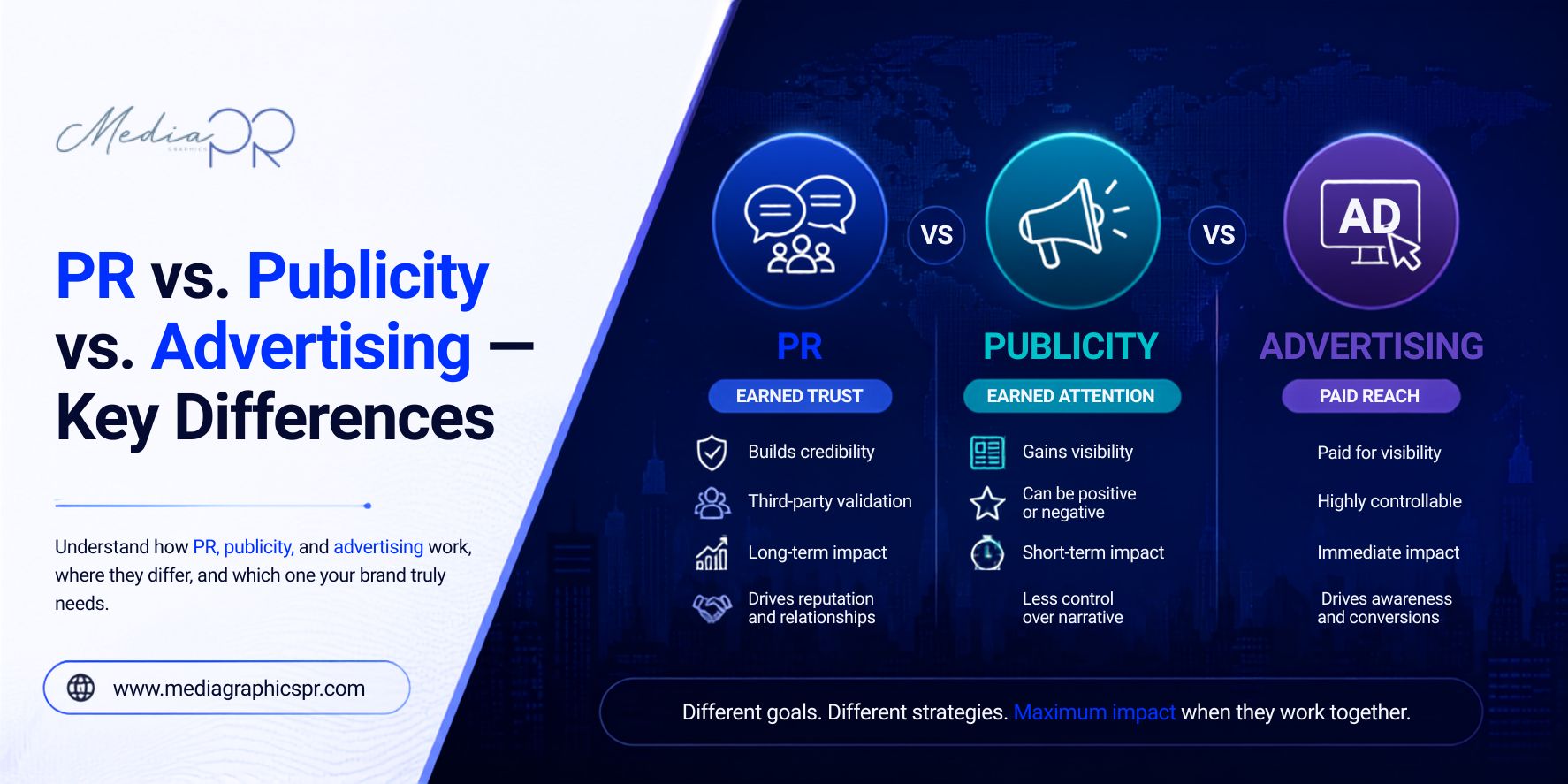
Most people use these three words like they mean the same thing. They don’t. And the confusion costs brands more than they realize.
A startup founder who thinks PR is just publicity will spend money getting their name in the news without building any lasting credibility. A marketing head who thinks advertising can replace PR will burn the budget on impressions that disappear the moment the campaign ends. A brand that treats all three as interchangeable will end up with a communications strategy that does none of them particularly well.
MediagraphicsPR has spent 25 years helping Indian brands understand the difference between public relations, publicity, and advertising and, more importantly, how to use all three in a way that actually builds something lasting. The confusion between these three disciplines isn’t just semantic. It shapes decisions about where budget goes, what success looks like, and whether the communications work a brand is doing is building credibility or just generating noise.
Here’s the clearest explanation of the differences between PR vs. publicity vs. advertising that you’ll find—what each one actually is, what each one does, where they overlap, and how to think about all three together.
The Short Version—Before the Detail
If you want the essential answer before reading the full breakdown:
Public relations is the management of how your brand is perceived by all of its audiences over time through earned media, thought leadership, crisis communication, stakeholder relationships, and narrative control. It’s strategic, sustained, and focused on building credibility that compounds.
Publicity is getting your name in front of people through any channel, for any reason, positive or negative. It’s a subset of PR when it’s planned. It can happen completely outside your control when it isn’t.
Advertising is paid media. You write the message, you choose the channel, you pay for the placement, and you reach whoever the platform’s algorithm or the publication’s circulation delivers.
The simplest summary:
| Factor | Public Relations | Publicity | Advertising |
|---|---|---|---|
| Who Controls the Message | Shared; you shape it, media validates it. | Partial; you can generate it, but you can’t fully control it. | You control it entirely. |
| Who Pays | Indirect (agency fees, time, and effort). | Variable. | Direct payment for every placement. |
| Trust Level | Highest. | Medium. | Lowest. |
| Longevity | Compounds over time. | Short-lived unless consistently sustained. | Stops when the advertising budget stops. |
Now the full explanation, because the summary above is accurate, but the detail is where the understanding that actually changes decisions lives.
What Public Relations Actually Is
Public relations is the most misunderstood of the three. Most people think of it as a fancier word for media coverage. It’s significantly more than that.
PR is the sustained management of relationships between a brand and all of its stakeholders, not just the media, but also investors, regulators, employees, enterprise buyers, retail customers, and industry peers. Media coverage is one output of that relationship management. It’s an important one, but it’s not the definition.
What public relations actually involves:
- Earned media: getting journalists, publications, and analysts to independently cover your brand because the story serves their audience
- Thought leadership: positioning founders and executives as credible, expert voices in their industry through authored articles, expert commentary, and speaking
- Narrative management: controlling the story that exists about your brand in the market, what people say when they describe what you do, and which publications reference you in which contexts
- Crisis communication: protecting and rebuilding reputation when something goes wrong
- Stakeholder relations: managing the relationships between your brand and investors, regulators, partners, and communities that affect your ability to operate and grow
- Analyst relations: building relationships with the industry analysts whose reports enterprise buyers use as vendor shortlists
The defining characteristic of PR is that it operates through third-party validation. A journalist covering your company has independently decided the story serves their readers. An analyst mentioning your product has evaluated it against alternatives. That independence is exactly what makes the credibility PR builds different from anything you can buy or manufacture yourself.
What PR builds over time:
Month 1-3: Narrative established, journalist relationships built
↓
Month 3-6: First consistent placements, founder voice developing
↓
Month 6-9: Journalist familiarity building, inbound requests starting
↓
Month 9-12: Category authority emerging, coverage compounding
↓
Year 2+: Brand is the reference point in its space—coverage generates coverage without proportional effort
What Publicity Actually Is
Publicity is a term that gets used loosely, sometimes as a synonym for PR, sometimes as a synonym for media coverage, and sometimes as a pejorative for the kind of attention a brand gets when something goes wrong.
Here’s the precise definition: publicity is any attention that your brand receives in public channels, regardless of whether it was planned, earned, bought, or accidental.
This means publicity can be:
- A planned press announcement that generates news coverage, this is publicity that’s also PR
- A viral social media moment where your brand is tagged in a trending conversation, publicity that wasn’t planned
- A celebrity mentioning your product without any prompting, publicity you didn’t earn through PR but benefited from
- A negative story that goes viral, publicity that’s damaging
- A customer complaint thread on Twitter that gets picked up by journalists, publicity that’s both negative and unplanned
The key distinction from PR: publicity is an outcome. PR is a discipline. You can do excellent PR and generate valuable publicity. You can also get significant publicity with no PR strategy behind it and discover that unmanaged attention creates as many problems as it solves.
The relationship between PR and publicity:
PR (the discipline)
↓
Builds narrative, relationships, and media presence
↓
Generates planned, positive publicity
↓
Also builds the infrastructure to manage unplanned publicity when it arrives
The brands that handle unexpected publicity well, whether positive or negative, are almost always the ones that had PR infrastructure in place before the attention arrived.
What Advertising Actually Is
Advertising is the clearest of the three to define: it’s paid media. You pay to place a message in a channel. You control the message entirely. The placement lasts as long as the budget does.
What advertising involves:
- Digital advertising: paid search, social ads, display, programmatic, and video pre-roll
- Print advertising: placements in newspapers and magazines
- Broadcast advertising: spots on TV and radio
- Out-of-home advertising: billboards, transit ads, digital screens around the city
- Sponsored content: paid articles or videos, clearly flagged as advertising
- Influencer advertising: paid partnerships where creators talk up a product to their own audience
At the end of the day, what defines advertising is control. You write the message. You choose the timing. You decide who sees it. You can change it tomorrow if you want. That control is both the strength and the limitation of advertising.
The limitation: audiences know it’s paid. They’ve known it for so long and seen so much of it that they’ve developed filters for it, both psychological and literal. Ad blockers. Subscription tiers that remove ads. The instinct to scroll past anything that looks like a promotion.
This doesn’t make advertising ineffective. It makes it effective for specific jobs, including driving immediate action, reaching defined demographics at scale, and keeping a brand top of mind during a specific window while remaining ineffective for others, specifically the trust-building work that PR does.
The Trust Gap—Why This Distinction Matters So Much
The most important practical difference between PR, publicity, and advertising is the trust that each one carries.
When you see an ad for a financial product, you know the company paid to tell you their product is good. You process it accordingly, with healthy skepticism. When a journalist at Mint writes that a fintech company is genuinely innovative, they have no financial relationship with that company. Their credibility depends on being accurate. That independence is why editorial coverage is trusted in a way advertising never is.
Research consistently shows that consumers trust earned media coverage significantly more than paid advertising. For B2B brands, where enterprise buyers do thorough research before engaging, the trust gap is even wider. The publications that procurement heads and institutional investors read professionally and trust are editorial publications, not advertising vehicles.
This is why the most credible brands in India aren’t necessarily the ones with the biggest advertising budgets. They’re the ones that have spent years earning coverage in the right places, building the kind of trust that no media buy can replicate.
| Trust Level | What It Means for Conversation |
|---|---|
| Advertising | Lowest, audiences know it’s paid and filter it accordingly. |
| Publicity (Unplanned) | Variable, depending on whether it’s positive or negative. |
| Publicity (PR-Generated) | Medium-high, earned media signals credibility but may not be sustained. |
| Public Relations (Sustained) | Highest, builds long-term trust and compounding third-party credibility over time. |
How All Three Work Together—The Full Picture
Here’s the mistake most brands make: treating PR, publicity, and advertising as alternatives. They’re not. They’re complementary disciplines that serve different purposes in the same overall communications strategy.
Advertising drives immediate action. When you need people to do something specific right now, such as sign up, download, buy, or attend, advertising is the fastest way to reach them at scale with a precise message. But advertising that lands on a brand nobody has heard of or doesn’t trust converts at a fraction of the rate that advertising landing on a familiar, credible brand does.
PR builds the credibility that makes advertising work better. A brand with six months of consistent earned media coverage behind it will convert paid traffic at higher rates, close enterprise deals faster, and attract better candidates for open roles, not because the advertising changed, but because the credibility the advertising lands on has changed.
Publicity is what happens when both are working. It’s the attention that comes from being genuinely interesting, consistently present, and well-positioned. Some of it is planned through PR, some of it is earned through advertising visibility, and some of it is organic because the brand has become something worth talking about.
How the three work together for a growing brand:
PR builds credibility (months 1-12+)
↓
Brand is recognized, trusted, and independently validated
↓
Advertising runs on top of that credibility
↓
Conversion rates are significantly higher
↓
Positive publicity emerges from both
↓
Brand becomes a reference point in its category
↓
Less advertising is needed over time as earned credibility does more of the work
The Most Common Mistakes Brands Make With All Three
➤ Treating publicity as a goal rather than an outcome
Publicity that isn’t built on a genuine narrative foundation doesn’t compound. A viral moment without PR infrastructure to capitalize on it fades. The brands that turn publicity into sustained momentum are the ones with a PR strategy underneath it.
➤ Expecting advertising to do PR’s job
Paid media can create awareness. It can’t create the kind of trust that makes an enterprise buyer comfortable with vendor risk, an investor comfortable with backing a founder, or a retail customer comfortable putting their money in a new financial product. Brands that spend on advertising while skipping PR are building on sand.
➤ Starting PR only when something goes wrong
Crisis PR is significantly harder and more expensive than proactive PR. The brands that come through difficult moments intact are the ones that had credibility infrastructure in place before the crisis—not the ones scrambling to build it after the story breaks.
➤ Measuring all three with the same metrics
Advertising should be measured on conversion, cost per acquisition, and ROAS. PR should be measured on publication quality, investor recognition, enterprise buyer pre-qualification, and branded search volume. Publicity should be evaluated on whether it advances or damages the narrative. Applying advertising metrics to PR produces misleading conclusions in both directions.
How MediagraphicsPR Helps Brands Get All Three Right
Understanding the difference between public relations, publicity, and advertising is one thing. Building a communications strategy that uses all three correctly, in the right sequence, for the right purposes, with metrics that connect to real business outcomes, is what MediagraphicsPR does.
At MediagraphicsPR, we work with brands at every stage to build the PR strategy that makes everything else work better. Senior people on your account from day one. Real journalist relationships across India’s most important business and sector publications. A narrative built around your specific business goals, not a press release calendar.
The brands that grow the fastest in India’s most competitive markets aren’t the ones with the biggest advertising budgets. They’re the ones that understood the difference between PR, publicity, and advertising early and built the credibility infrastructure that made every rupee of advertising spend go further.
FAQs
Q: Is PR more effective than advertising for a growing Indian brand?
They serve different purposes. PR isn’t more effective than advertising; it’s effective for different things. PR builds the credibility that makes advertising convert better. Advertising drives immediate action at scale. The brands that treat them as alternatives rather than complements consistently underperform the ones that run both with a clear understanding of what each one is for.
Q: Can a brand get publicity without doing PR?
Yes, absolutely. Publicity can happen with zero PR strategy behind it, think of a viral moment, a celebrity mentioning your brand out of nowhere, or a negative story that picks up traction on its own. None of that requires any planning on the brand’s part. Where PR actually earns its place is in what happens next, it’s the infrastructure that lets a brand make the most of positive publicity and contain the damage from negative publicity. Without that infrastructure, unplanned attention tends to just come and go, often without the brand getting much value from it either way.
Q: Is sponsored content the same as PR?
No, sponsored content is advertising that’s formatted to look like editorial. It’s clearly marked as paid in responsible publications. PR generates editorial coverage that journalists and editors have independently decided to publish, with no financial relationship to the brand being covered. The trust levels are fundamentally different, which is why editorial coverage is more credible than sponsored content even when the words are equally well-written.
Q: Why does PR take longer to show results than advertising?
Because PR builds through relationships and compounding credibility rather than through direct media buying. An ad can go live tomorrow. A journalist relationship that produces consistent coverage takes months to build. The trade-off is longevity. An ad stops working when the budget stops, while a well-placed editorial feature stays online, indexed, and discoverable for years.
Q: How should a startup decide how to split the budget between PR and advertising?
Stage matters significantly. Early-stage startups building investor credibility and category positioning should weigh toward PR because the trust they need to build isn’t something advertising can create. Growth-stage brands with proven products driving customer acquisition should run both. PR builds the credibility that improves advertising conversion, while advertising drives scale that PR alone can’t produce. The split depends on what the brand actually needs to achieve in the next twelve months.
Q: What’s the difference between a PR agency and an advertising agency?
A PR agency earns coverage through journalist relationships, narrative development, and editorial pitching. The brand pays for strategy and execution, not for the placement. An advertising agency places paid media. The brand pays for both the strategy and the media buy. Some large agencies do both. Most that claim to do both well are actually better at one than the other. The skill sets, relationships, and measurement frameworks are genuinely different disciplines.
Ready to Build a Communications Strategy Where PR, Publicity, and Advertising Actually Work Together?
Most brands don’t need to choose between these three. They need to understand which one does what, and in what order, so none of the budget goes to waste.
MediagraphicsPR is India’s leading public relations agency, helping startups, SMEs, and Fortune 500 brands build credibility through strategic media relations and earned-first PR.