






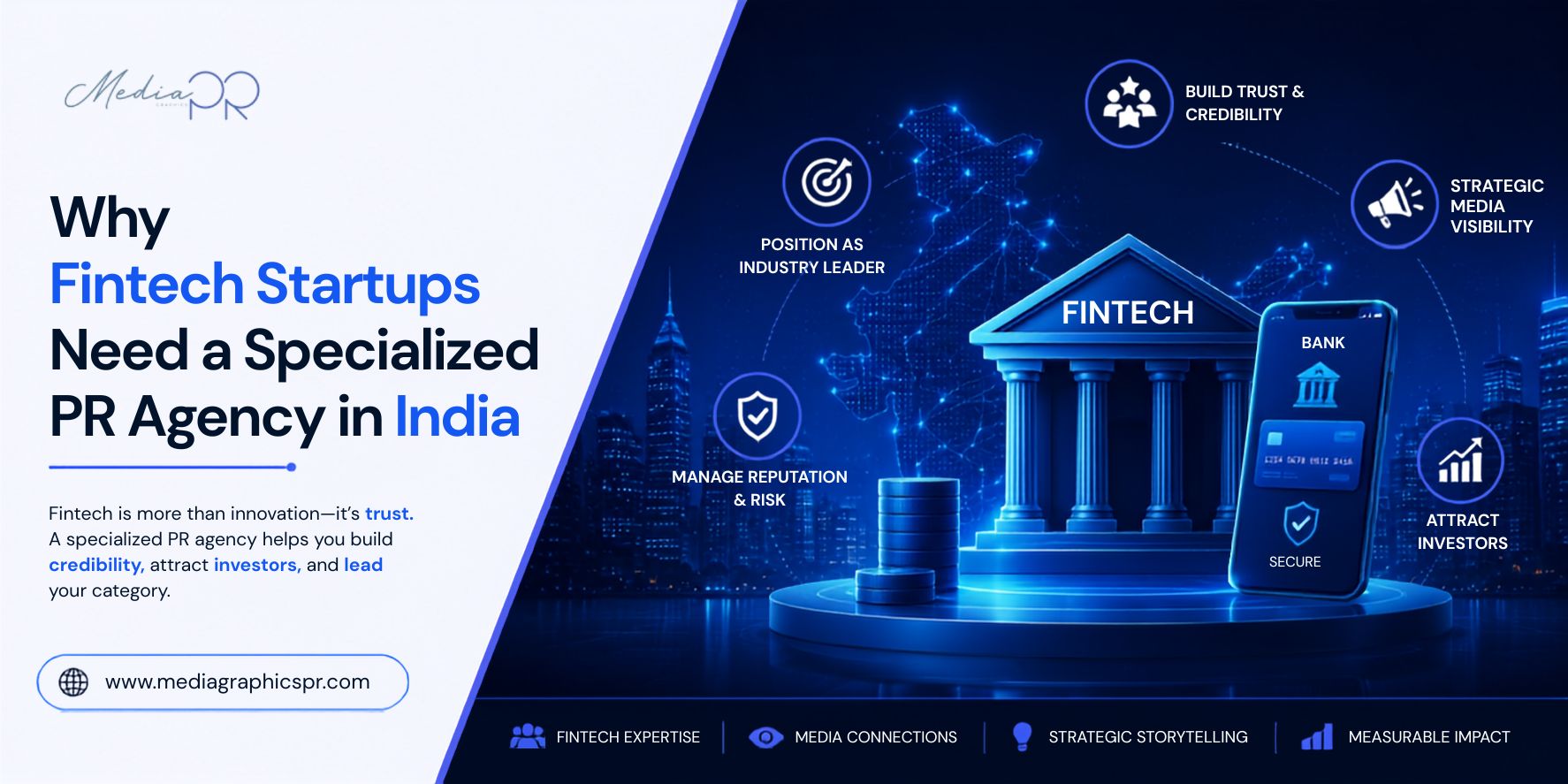
Fintech is the only industry where your product can be genuinely excellent and still lose, because the person who should be using it doesn’t trust the company behind it enough to try.
That’s not a product problem. That’s a perception problem. And perception in financial services is shaped by one thing above everything else: what credible, independent sources say about your company. Not what your website says. Not what your LinkedIn posts claim. What journalists, analysts, and publications with real editorial standards have independently decided is worth their audience’s attention.
MediagraphicsPR is a fintech PR agency that has spent 25 years building exactly that kind of credibility for financial services companies across India. The earned media presence, the regulatory communication infrastructure, and the investor-facing narrative make fintech startups trusted before a customer signs up, before an investor writes a check, and before a regulator forms an opinion.
Why fintech startups specifically need a specialized PR agency for fintech, not a generalist, not a consumer agency, and not a startup PR firm that has added financial services to its website, is what this blog explains in full.
The Trust Problem That Every Fintech Starts With
Walk into the shoes of an Indian retail customer being introduced to a new fintech product for the first time.
They’ve heard about UPI fraud. They’ve seen news about lending apps with predatory terms. They’ve watched chit fund scams play out in their communities. They’ve had family members lose money to financial products that promised returns they never delivered. The baseline level of skepticism they bring to any new financial product is not irrational. It’s learned from genuine experience.
Now your fintech startup, with a genuinely responsible product and a team that has thought carefully about customer protection, needs this person to trust you with their money. You can have the best UI in the category. You can offer the lowest rates or the highest returns. You can have the simplest onboarding. None of it matters if they don’t believe you’re safe.
That belief, that your company is legitimate, trustworthy, and backed by credible third parties, is built through earned media. A feature in a publication they recognize. A journalist they trust writing about your product. An analyst citing your company in a sector report. These signals are what build the kind of trust that lets a retail customer make the decision your sales funnel is trying to get them to make.
This is the first reason fintech startups need a specialized fintech PR agency because trust-building in financial services is fundamentally different from awareness-building in other sectors, and the PR tactics that work for consumer brands or tech startups aren’t the same ones that build financial trust.
Five Reasons Generic PR Agencies Fail Fintech Startups
1. They Don’t Understand Regulatory Communication
This is the most consequential gap, and the one that creates actual risk, not just suboptimal coverage.
Fintech PR operates inside a regulatory framework that shapes every public communication. RBI guidelines on what can be said about interest rates and returns. SEBI regulations on how investment products are described publicly. IRDAI frameworks on insurance product communication. Data localisation requirements that affect how customer information is referenced in case studies. PPI licensing conditions that constrain how payment products are marketed.
A generalist agency that doesn’t know these frameworks will create communications that are compelling and compliant violations. Not intentionally, because they don’t know what they’re violating. The reputational and regulatory cost of getting this wrong is significantly higher than the cost of hiring an agency that knows what it’s doing.
| Communication Type | Regulatory Consideration | What Goes Wrong Without Expertise |
|---|---|---|
| Return or Yield Claims | SEBI and AMFI guidelines on investment product communication | Misleading claims can trigger regulatory action. |
| Interest Rate Messaging | RBI guidelines on lending product communication | May lead to regulatory inquiries and potential licensing issues. |
| Customer Data References | DPDP Act and data localization requirements | Privacy violations in case studies or marketing content. |
| Insurance Product Descriptions | IRDAI communication frameworks | Creates a perception of mis-selling and increases compliance risk. |
| Payment Product Claims | RBI PPI licensing communication conditions | Can result in regulatory censure and withdrawal of media coverage. |
2. They Target the Wrong Publications
A consumer PR agency’s media list is built around publications that reach retail audiences—lifestyle media, mainstream digital, and entertainment-adjacent press. A startup PR agency’s list leans toward ecosystem media—YourStory, Inc42, and startup community publications.
Neither of these lists reaches the audiences that matter most for fintech startups.
Who actually makes decisions that affect a fintech startup’s growth?
↓
┌──────────────────────────────────────┐
│ │ │ │
Institutional Enterprise Retail Regulators
Investors Buyers Customers and Policy
│ │ │ │
Mint BFSI trade Times of ET Financial
Economic Times publications India Services
Business IBS NDTV Business
Standard Intelligence consumer Standard
Forbes India Banking finance Banking
└──────────────────────────────────────┘
A fintech PR agency that genuinely understands the sector has relationships across all four quadrants, not just the startup ecosystem media that generalist agencies default to.
3. They Can’t Handle the Complexity of Multiple Stakeholders
Fintech startups don’t have one audience. They have at least four simultaneously: retail customers who need trust signals, institutional investors who need credibility signals, enterprise buyers who need vendor risk assessment signals, and regulators who need compliance credibility signals.
Each of these audiences reads different publications, responds to different narratives, and evaluates credibility through completely different lenses. A generalist agency typically builds one message and distributes it broadly. A specialized fintech PR agency builds four related but distinct communication programs running simultaneously, each tailored to the specific evaluation process of each audience.
4. They Don’t Have Financial Journalist Relationships
The journalists who cover fintech and financial services in India—at Mint, Economic Times, Business Standard Banking, The Ken, and Bloomberg Quint—are a specific group with specific beats, specific expertise, and specific credibility requirements for the sources they quote.
A generalist agency with good consumer media relationships has almost no overlap with this group. The financial journalists who can move investor opinion and enterprise buyer perception for a fintech startup are not the same people who cover lifestyle and consumer tech stories.
5. They’re Not Equipped for Crisis in Financial Services
Fintech reputation problems don’t follow normal startup crisis patterns. A data concern at a payment platform can trigger a regulatory inquiry in 48 hours. A customer complaint about a lending product can become a consumer protection story before the communications team has finished their first meeting. A single Twitter thread about a transaction failure can affect customer trust in ways that take months to repair.
The speed and severity of fintech reputation problems require crisis infrastructure that’s built before it’s needed, including pre-identified spokespeople, prepared holding statements, and established journalist relationships that allow the company’s version of events to get heard. A generalist agency has almost never done this in a financial services context. That inexperience is expensive.
What Specialized Fintech PR Actually Looks Like
The difference between a generalist agency and a specialized fintech PR agency isn’t just knowledge. It’s a fundamentally different approach to what the work is trying to achieve.
A generalist agency starts with: What can we pitch this month?
A specialized fintech PR agency starts with: What does this company need to achieve with its regulatory relationships, investor conversations, enterprise pipeline, and retail customer trust, and what does the PR strategy look like if it’s serving all four simultaneously?
Here’s what that looks like in practice across the key areas of fintech PR work:
➤ Investor-facing PR:
The publications institutional investors read, including Mint, Economic Times, Business Standard, and Forbes India, require financial media relationships that most generalist agencies don’t have. The narrative that moves institutional investor opinion for a fintech startup is about market insight, regulatory positioning, and category leadership, not product features. And the timing of that narrative relative to the fundraise timeline is something a specialized agency plans around deliberately.
➤ Regulatory credibility building:
A fintech PR agency that understands the sector knows that regulators read business media. Policy teams track how companies communicate publicly. A fintech that consistently demonstrates regulatory literacy through thought leadership, accurate expert commentary on policy developments, and credible public communication builds credibility with regulators that no lobbying meeting can replicate. This is a specific kind of work that requires regulatory knowledge alongside media knowledge.
➤ Enterprise B2B communications:
Fintechs selling to banks, NBFCs, and enterprise clients need to pass a vendor risk assessment before they get a demo. Part of that assessment is reputation: what does the media say about this company, and does it match the claims they make in the sales process? A specialized fintech PR agency builds the media presence that makes enterprise buyers comfortable before the sales conversation starts.
➤ Consumer trust building:
Retail-facing fintech needs coverage in publications that retail customers actually encounter, not startup ecosystem media that customers never read. The tone, the angle, and the publications are all different. A specialized agency knows this and builds consumer-facing PR that’s separate from investor-facing and enterprise-facing work.
The Metrics That Tell You Whether Fintech PR Is Working
Most agencies measure fintech PR success with clip counts and estimated reach. Both are easy to generate, both are largely meaningless, and both are exactly what a fintech startup’s board will stop believing in after the third monthly report.
The metrics that actually tell you whether your fintech PR is working:
| Metric | How to Track | What It Tells You |
|---|---|---|
| Investor recognition before meetings | Ask investors whether they’ve encountered your coverage | Whether your financial media strategy is reaching the right audience. |
| Enterprise buyer pre-qualification | Collect sales team feedback on whether prospects mention media coverage. | Whether B2B PR is supporting the sales pipeline. |
| Regulatory perception | Gather direct feedback during regulatory engagement. | Whether policy communication is strengthening credibility. |
| Branded search volume after placements | Monitor Google Search Console for branded search growth. | Whether media coverage is driving genuine brand discovery. |
| Customer trust signals | Measure conversion rates from media-referred traffic. | Whether consumer-facing PR is increasing purchase confidence. |
A specialized fintech PR agency sets these metrics before the campaign starts, not after, when the temptation is to find metrics that justify whatever happened.
What Good Fintech PR Looks Like Over 12 Months
Month 1-2:
▸Regulatory communication framework built
▸Financial media journalist relationships established
▸Investor-facing narrative developed
▸First pitches to Mint, ET, Business Standard
Month 3-4:
▸First placements in financial and sector-specific media
▸Founder commentary on regulatory developments secured
▸Enterprise media relationships developing
Month 5-6:
▸Journalist familiarity building—reactive commentary requests starting
▸Investor recognition in pitch conversations increasing
▸Enterprise buyer pre-qualification improving
Month 7-9:
▸Consistent presence across financial and fintech publications
▸Analyst mentions beginning
▸Regulatory credibility established through consistent policy commentary
Month 10-12:
▸Inbound media requests arriving without pitching
▸Investor due diligence conversations easier
▸Enterprise sales cycles shortening
▸Consumer trust signals measurably improving
None of this happens from a single press release. All of it requires consistent, strategic work by people who understand the fintech sector, not people learning it on the job at a client’s expense.
How to Evaluate a Fintech PR Agency Before Signing
The questions that actually separate specialized fintech agencies from generalists claiming fintech expertise:
- Can you explain how RBI communication guidelines affect how we describe our lending product publicly?
- Which journalists specifically covering BFSI or fintech at Mint, ET, or Business Standard have you pitched in the last six months?
- Walk me through a crisis situation you’ve managed for a financial services client, what happened, what did you do, what was the outcome?
- How do you handle a situation where a regulatory development affects a client’s public positioning?
- What metrics do you track beyond clip count, and can you show me what those numbers looked like for a comparable fintech client?
An agency that answers all five specifically and confidently has probably done this before. One that answers vaguely or pivots to general PR principles probably hasn’t.
How MediagraphicsPR Works With Fintech Startups
At MediagraphicsPR, we work as the fintech PR agency that Indian fintech founders come to when they need PR that actually understands the sector, including the regulatory constraints, the financial media relationships and the multi-stakeholder complexity, and the crisis communication infrastructure that financial services requires.
Our fintech public relations practice spans payments, lending, insurance tech, wealth management, and enterprise financial software, with placements in Economic Times, Mint, Business Standard, Forbes India, The Ken, Inc42, and BFSI-specific publications that reach the investors and enterprise buyers our clients need to reach.
We don’t send generic pitches. We don’t learn your regulatory framework after signing. And we don’t hand your account to a junior team once the senior people have closed the contract. Senior people on your account from the first week. Real financial journalist relationships. A specialized fintech PR strategy built around regulatory accuracy, investor credibility, and the kind of trust signals that retail customers and enterprise buyers actually respond to.
If your fintech is building something that deserves to be trusted and the right people don’t know about it yet, that’s exactly the problem we’re built to solve.
FAQs
What makes a fintech PR agency different from a regular startup PR agency?
Regulatory communication expertise, financial media relationships, and multi-stakeholder strategy. A regular startup PR agency optimizes for ecosystem media and founder narrative. A fintech PR agency builds communications that serve investors, regulators, enterprise buyers, and retail customers simultaneously, under communication constraints that financial services regulation creates. These are fundamentally different disciplines.
How early should a fintech startup start investing in specialized PR?
Before the Series A, not during it. The media presence that influences institutional investors during a fundraise is built in the six to twelve months before the raise starts. The regulatory credibility that makes a licensing conversation go smoothly is built over years. Starting PR when you already need it means starting too late.
Can a fintech startup’s founding team handle PR themselves without an agency?
Founder-led PR has a ceiling that’s lower in fintech than in most other sectors. The regulatory communication constraints, financial journalist relationships, and crisis infrastructure required are specific skills that take years to develop. More importantly, the founders who are managing investor relationships, building the product, and running the business simultaneously rarely have the time to build and maintain the media relationships that consistent coverage requires.
What should a fintech startup’s PR focus on first: retail customers or investors?
Depends on the immediate business priority. If a fundraise is happening in six to twelve months, investor-facing financial media coverage should come first. If enterprise sales is the immediate priority, BFSI trade media coverage matters most. If retail customer acquisition is the goal, mainstream financial consumer media is the focus. A specialized fintech PR agency helps you sequence this correctly. Most startups try to do all three simultaneously without the budget to do any of them properly.
How does fintech PR handle situations where a competitor gets negative coverage that affects the whole category?
With a rapid, credible counter-narrative that distinguishes your company from the broader category problem. This requires both the journalist relationships to get your perspective heard quickly and the pre-built credibility to make your counter-narrative believable. Fintech startups that try to respond to category-level reputation problems without existing media relationships almost never get their version of events into the first wave of coverage.
What’s the realistic timeline for fintech PR to start producing measurable results?
First placements in target publications typically happen within six to eight weeks of a well-structured engagement. Something a little harder to pin down, but arguably more meaningful, is when investors start bringing up your coverage in a pitch conversation before you’ve even had the chance to mention it yourself. That usually takes three to six months to show up consistently. Enterprise buyer pre-qualification tends to improve on a similar timeline, while consumer trust signals from media-referred traffic can be tracked from the very first significant placement onward. The real compounding effect, where each new piece of coverage makes the next one easier to land, generally kicks in around month four or five.
Ready to Work With a PR Agency That Actually Understands Fintech?
Generic PR can get your name in print. It can’t get a regulator, an institutional investor, or a cautious retail customer to trust you. That takes a team that understands the sector as well as it understands the media.
Visit MediagraphicsPR to see how we approach fintech PR for startups across India.
Need to speak to someone now?
📞 Call us: +91-8448360900 📧 Email us: info@mediagraphicspr.com
We respond within 24 hours.