





Most PR campaigns in India don’t fail because of bad execution. They fail because they were never properly planned in the first place.
A press release goes out. Some coverage lands. The team celebrates. Then silence until the next announcement forces another round of activity. That’s not a PR campaign. That’s a series of disconnected moments with gaps in between.
Planning a PR campaign properly with clear goals, the right audiences, the right timing, and a strategy that holds together—across months, not just days—is what separates brands that build lasting media presence from ones that just make noise occasionally.
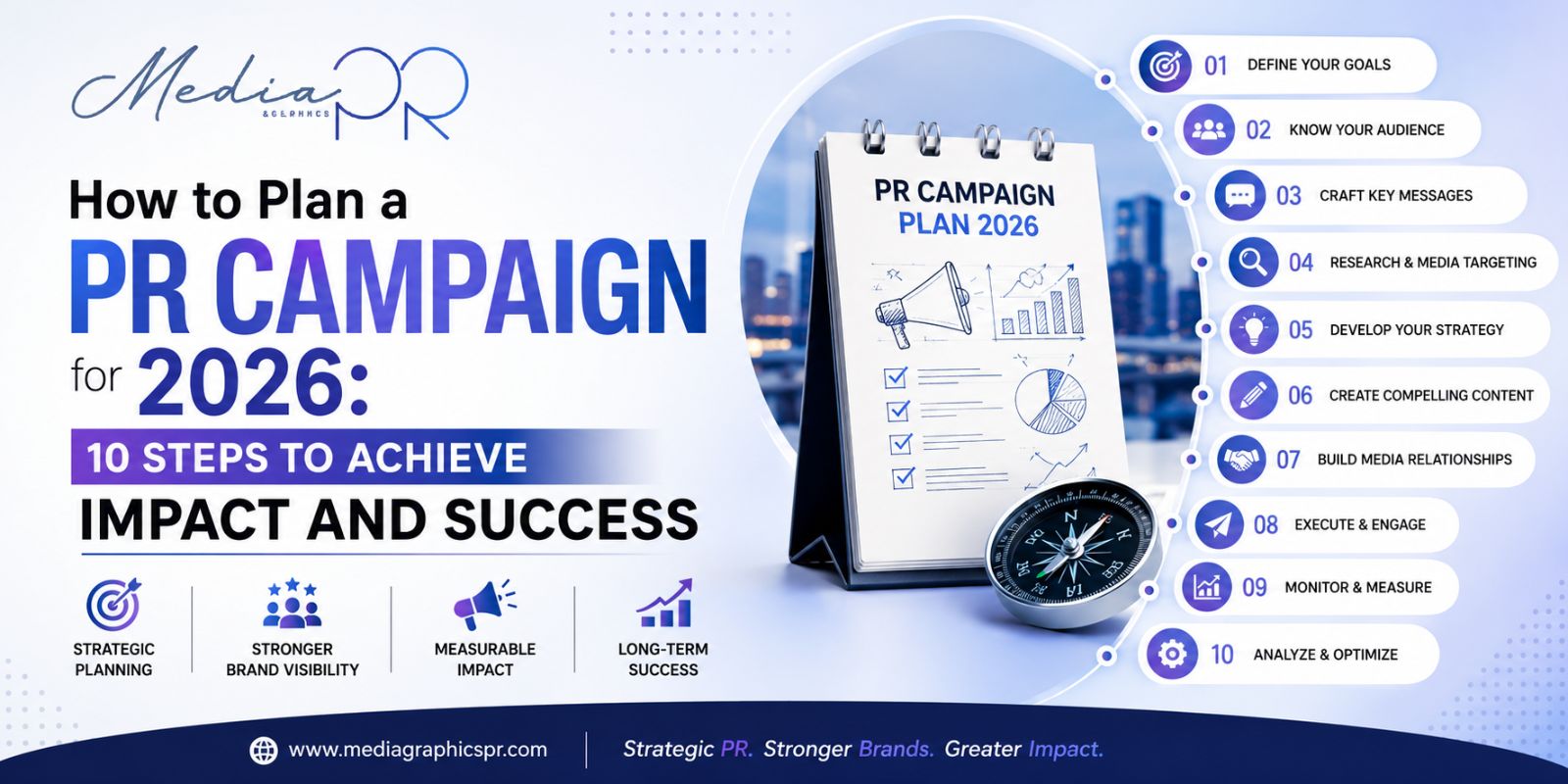
These 10 steps are what good PR campaign planning actually looks like in India today.
1. Define What You’re Actually Trying to Achieve
Before anything else, get specific about the goal. Not “We want more visibility.” That’s not a goal; it’s a wish.
A real campaign objective sounds like:
- We want to be covered in 3 national business publications before our Series A closes in Q3.
- We want our founder quoted in tech media as an expert on supply chain automation.
- We want our product launch covered in 5 publications our enterprise buyers read.
Use the SMART framework:
| SMART | What It Means | Example for a PR Campaign |
|---|---|---|
| Specific | Name the exact outcome you want | “Covered in Economic Times before Series A closes” |
| Measurable | You can count it or track it | 3 placements, 5 journalist relationships built |
| Achievable | Realistic for your stage and budget | Not “Forbes cover” in month one |
| Relevant | Tied to an actual business goal | Fundraise, launch, and enterprise sales push |
| Time-bound | Has a deadline attached | Campaign runs from April to September 2026 |
Without this, every activity is justifiable and nothing is accountable.
2. Know Exactly Who You’re Talking To
Different audiences need completely different messages and different channels to reach them.
- Investors: business media, sector publications, LinkedIn
- Enterprise buyers: trade publications, industry newsletters, analyst reports
- Consumers: mainstream digital and print media, influencer coverage
- Talent: LinkedIn, employer brand media, startup ecosystem coverage
- Industry peers: conferences, niche publications, podcasts
Pick one or two primary audiences per campaign. Trying to reach everyone at once usually means reaching nobody properly.
3. Build the Core Narrative First
This is the step most brands skip and the one that determines whether the campaign works.
Your PR campaign narrative answers three questions:
- What does your company do? (in one sentence, without jargon)
- Why does it matter right now? (the market context that makes you relevant today)
- Why you? (what makes your team or approach genuinely different?)
Every piece of content, every pitch, every press release in the campaign should express this narrative in the format suited to that channel. Consistency across months is what builds recognition. Inconsistency is what confuses audiences even when they’ve seen your name before.
4. Map Your Media Targets to Business Goals
Not all coverage serves the same purpose. A placement in a publication your target audience never reads is activity, not outcome.
| Business Goal | Right Media Target |
|---|---|
| Investor attention | Economic Times, Mint, Business Standard, Inc42 |
| Enterprise sale | Sector trade publications, industry media |
| Consumer brand | Mainstream digital, national print |
| Talent pipeline | LinkedIn content, startup ecosystem media |
| Category leadership | Niche newsletters, podcasts, analyst mentions |
Build a target list of 15 to 20 publications and journalists specifically relevant to your campaign goal. Quality of targeting beats volume of pitching every time.
5. Build Journalist Relationships Before You Pitch
This is the step that makes everything else work faster and the one most Indian brands skip entirely.
Journalists who know your name before you pitch them are significantly more likely to cover you than ones receiving a cold email from an unknown company.
How to build relationships without being annoying:
- Follow and engage genuinely with journalists covering your space.
- Offer yourself as a source for stories they’re already working on, no pitch attached.
- Share their work with a real comment, not a generic one.
- When you pitch, make it about something they actually cover.
Start this three to six months before you need coverage for something important.
6. Choose Your Tactics Based on Your Audience
Once you know who you’re talking to and what you’re saying, the next question is simple—how do you actually reach them?
| Audience | Tactics That Actually Work |
|---|---|
| Investors | Founder quoted in business press, funding announcement, Inc42 or Mint feature |
| Enterprise buyers | Trade publication feature, thought leadership article, case study coverage |
| Customers | Mainstream digital media, product reviews, influencer coverage |
| Talent | LinkedIn founder content, culture stories, startup ecosystem media |
| Industry peers | Conference speaking, expert podcast appearances, niche newsletter features |
Don’t default to press releases for everything. Match the tactic to the audience, not to what’s easiest to produce.
7. Build a PR Calendar With Real Moments
A PR campaign without a calendar is just good intentions.
A basic 12-month PR campaign calendar for a growing Indian brand:
| Month | What to Focus On |
|---|---|
| January | Founder piece, where your industry is headed this year |
| February | Product update or company milestone pitch |
| March | Q1 milestone announcement |
| April | Reactive commentary: jump on something moving in the news |
| May | Data story or mid-year insight piece |
| June | Thought leadership article, founder byline in a target publication |
| July | Major announcement—funding, launch, or expansion |
| August | Podcast or speaking opportunity push |
| September | Pre-conference media outreach |
| October | Product launch or campaign moment |
| November | Year-end industry commentary |
| December | Journalist relationship building for next year |
Plan around your business moments and create newsworthy moments in the gaps.
8. Get the Timing Right
Timing in PR is as important as the story itself. Three things to get right:
News cycle awareness: pitching into a crowded news cycle means your story gets buried. Pitching on a slow news day means it gets more attention. Good agencies watch this daily.
Embargo strategy: for big announcements, give key journalists the story 48 to 72 hours before it goes public. They get time to write something proper, not just a two-line brief that gets buried.
Internal coordination: the press release, LinkedIn post, network email, and website update all need to go out together. Staggered releases create confusion and dilute impact.
9. Measure What Actually Matters
Stop measuring clips. Start measuring outcomes.
Vanity metrics vs. real metrics:
| Vanity Metrics | Real Metrics |
|---|---|
| Total clip count | Coverage in target publications specifically |
| Estimated reach | Whether target audience actually saw coverage |
| PR value equivalent | Whether sales conversations are shifting |
| Press release sent | Journalist responses and relationship quality |
| Social shares | Inbound leads or investor mentions referencing coverage |
Set these metrics before the campaign starts, not after, when the temptation is to justify whatever happened.
10. Think Long-Term, Not Campaign to Campaign
This is the step that separates brands building real media presence from ones running disconnected campaigns.
A single campaign, even a great one, produces a moment. A sustained PR strategy produces a position. The brands that dominate their category’s media narrative in India didn’t get there through one big launch. They kept showing up consistently—same narrative, right publications, and genuine relationships with journalists—until their name became the one journalists reached for first.
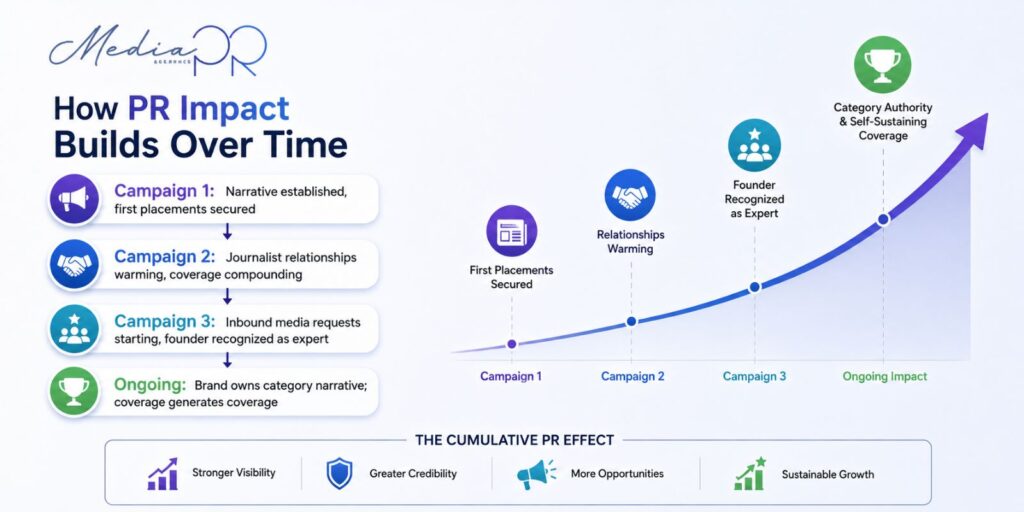
Plan your 2026 PR campaign with the next two years in mind, not just the next two months.
How MediagraphicsPR Plans PR Campaigns for Indian Brands
Planning a PR campaign that actually delivers—across the right publications, to the right audiences, at the right moments—requires more than a press release schedule. It requires a team that understands the Indian media landscape, has real journalist relationships, and builds strategy around your specific business goals.
At MediagraphicsPR, we work as the PR agency in Delhi that brands come to when they want a PR campaign built around outcomes, not activity. Senior people plan and execute your campaign from day one. Real media relationships across India’s most important publications. A PR strategy that’s designed to compound, so each campaign builds on the last.
2026 is too competitive a year to run PR without a proper plan. These 10 steps are where that plan starts.
Need help? Call us at +91-8448360900 or email us at info@mediagraphicspr.com
FAQs
Q: How long should a PR campaign run to see real results?
Six months minimum for meaningful compounding. The first two months are groundwork—narrative, relationships, first placements. The compounding starts from month three when journalists begin recognizing your name.
Q: How many tactics should one PR campaign include?
Two or three done consistently beats six done sporadically. Pick the tactics that reach your primary audience best and run them properly before adding more.
Q: Should every PR campaign have a press release?
Not necessarily. Press releases work for hard news—funding, launches, partnerships. For thought leadership, founder positioning, or category commentary, a well-placed article or expert quote often does more than a formal release.
Q: What’s the difference between a PR campaign and ongoing PR?
A campaign is built around a specific moment—a launch, a raise, an announcement. Ongoing PR is what keeps you visible between those moments. Both matter, but ongoing PR is what makes campaigns land harder when they do happen.