






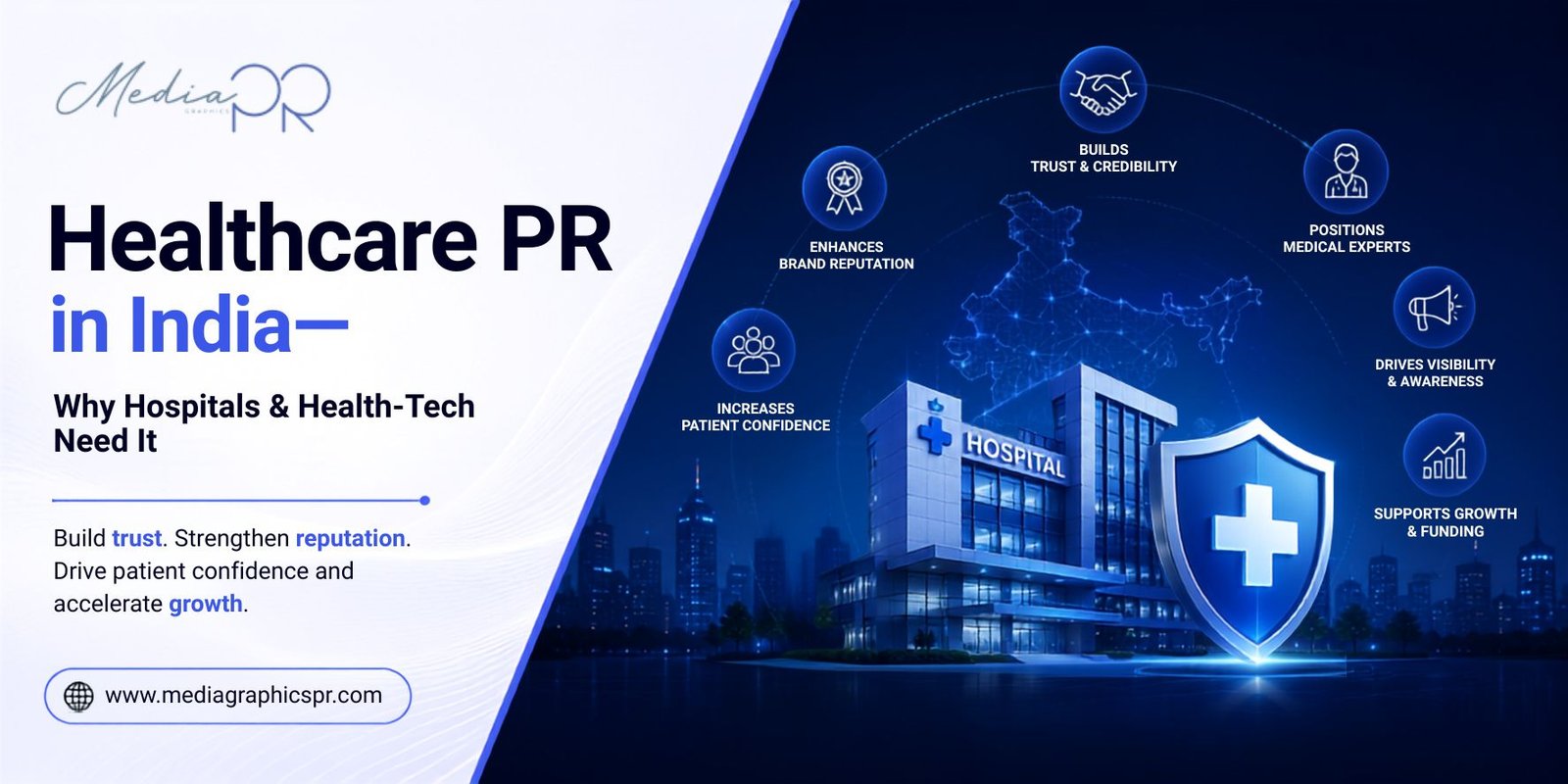
A patient choosing a hospital isn’t making a purchase decision. They’re making a trust decision, often under stress, often with incomplete information, and almost always based on what they’ve heard, read, or been told by someone they already trust.
That trust doesn’t come from a brochure. It doesn’t come from a billboard on the expressway. It comes from what credible, independent sources say about the institution, the doctor whose expertise gets written about in a newspaper, the hospital that’s mentioned in a health report a patient’s family member shared, and the healthtech platform whose founder was quoted explaining a clinical breakthrough in a publication the patient’s doctor reads.
MediagraphicsPR is a healthcare PR agency that has spent 25 years building that kind of credibility for hospitals, healthcare institutions, and health-tech companies across India through earned media, clinical thought leadership, regulatory-aligned communication, and the kind of sustained presence that turns institutional names into trusted ones.
Why hospitals and health-tech companies specifically need healthcare PR, and why generic PR agencies consistently fail to deliver it, is what this blog explains in full.
The Trust Problem That Healthcare Faces Differently Than Every Other Sector
Every industry has a trust problem. Healthcare is different in kind, not just degree.
When a consumer buys a product that disappoints them, they return it or leave a review. When a patient chooses a healthcare provider that doesn’t meet their expectations or, worse, causes harm, the consequences are in a completely different category. That asymmetry is what makes trust in healthcare more foundational, more scrutinized, and more fragile than in almost any other sector.
Indian healthcare faces specific trust challenges that make healthcare PR both more necessary and more complex than most healthcare leaders realize:
The information asymmetry problem. Patients almost never have the clinical knowledge to evaluate the quality of care they’re receiving. They evaluate trust through proxies, including the hospital’s reputation, the doctor’s media presence, what family and friends have said, and what they find when they search online. Healthcare PR shapes those proxies.
The regulatory communication problem. The Clinical Establishments Act, NABH accreditation standards, NMC guidelines, and the Digital Personal Data Protection Act as it applies to health data mean healthcare institutions operate under communication constraints that most generic PR agencies don’t know exist. A campaign that’s compelling but violates clinical communication guidelines creates regulatory risk, not credibility.
The sentiment volatility problem. Healthcare reputation can shift faster than almost any other sector. A single adverse outcome covered by the media, a social media post from a patient’s family member, or a regulatory notice can move public perception significantly in a short time. Institutions with healthcare PR infrastructure in place before these moments are the ones that manage them. The ones without it scramble.
The clinical credibility gap. A hospital or health tech company that communicates only through its own channels, including its website, social media, and patient newsletters, is communicating in a space that patients increasingly distrust. Independent third-party validation from journalists, clinical publications, and health media is what closes the credibility gap that self-promotion creates.
Why Generic PR Agencies Fail Healthcare Clients
This is the question most hospital CMOs and health-tech founders don’t think to ask before they hire and the one they wish they had after six months of disappointing results.
Generic PR agencies fail healthcare clients for reasons that are structural, not accidental:
► They Don’t Understand Clinical Communication Guidelines
The Clinical Establishments Act regulates how hospitals can communicate publicly about clinical outcomes. NMC guidelines govern how doctors and hospitals can represent medical expertise in the media. The CDSCO framework shapes how health tech companies can describe device or diagnostic capabilities. The IRDAI framework applies to health insurance products.
A PR agency that doesn’t know these frameworks will create communications that are credible-sounding violations. Not intentionally, because they don’t know what they’re violating. The consequences range from regulatory notices to genuine patient harm when overclaimed outcomes lead to inappropriate treatment-seeking behavior.
► They Target the Wrong Publications
A consumer PR agency’s media list is built around lifestyle media, mainstream entertainment-adjacent press, and general interest digital publications. A startup PR agency’s list leans toward ecosystem media.
Neither reaches the audiences that matter most for hospitals and health-tech companies:
Who actually shapes healthcare trust decisions?
↓
┌───────────────────────────────────────┐
│ │ │ │
Patients Referring Institutional Investors
& Families Physicians Buyers & Partners
│ │ │ │
Mainstream Medical Healthcare Business
health journals, procurement press,
media doctor- publications health-tech
Times of facing Express media,
India media Healthcare Inc42
Health, Medscape Health Mgmt Healthworld
etc. India etc. etc. └───────────────────────────────────────┘
A specialized healthcare PR agency has relationships across all four audience groups. not just mainstream consumer media.
► They Can’t Handle Clinical Expertise Translation
The single most important skill in healthcare PR, making clinical expertise legible and interesting to non-clinical audiences without losing accuracy, is not a generic communications skill. It requires understanding enough about clinical practice to know what’s genuinely significant, enough about journalism to know what makes it a story, and enough about regulatory guidelines to know what can and can’t be claimed.
A cardiologist’s research on a specific intervention technique is not inherently a story. A healthcare PR agency that understands both cardiology and journalism knows how to find the patient story inside that research, the policy implication that makes it timely, and the angle that makes a health journalist want to cover it.
► They’re Not Equipped for Healthcare Crisis Communication
Healthcare reputation crises are faster, harder, and more consequential than crises in most other sectors. An adverse clinical outcome covered by the media. A data breach involving patient health information. A regulatory notice about clinical practice. A social media post from a patient’s family member that gains traction.
The institutions that come through these moments with their reputations intact are the ones with crisis communication infrastructure already in place, including pre-identified spokespeople with media training, prepared clinical communication frameworks, established journalist relationships, and a clear protocol for what gets said, by whom, and when.
A generic agency learning healthcare crisis communication on the job at an institution’s expense is not crisis management. It’s crisis escalation.
What Healthcare PR Actually Does—The Five Core Functions
Clinical Thought Leadership
The most credible form of healthcare PR for hospitals and health institutions is positioning clinical leadership, including doctors, medical directors, and department heads, as genuine expert voices in their specialties.
This isn’t promotional content. It’s the cardiovascular surgeon whose perspective on a new intervention technique appears in a health publication that referring physicians read. The oncologist whose commentary on treatment protocol developments gets quoted in a health supplement that patients and families research. The hospital’s clinical director whose authored piece on preventive care appears in a mainstream publication that reaches the patient population the institution serves.
Clinical thought leadership builds the kind of doctor-facing and patient-facing credibility that no advertising can replicate because it comes from clinical judgment, not marketing budget.
Institutional Reputation Building
For hospital networks and large healthcare institutions, reputation building is a sustained program across multiple stakeholder audiences simultaneously.
| Stakeholder | What They Need to See | Right Publications |
|---|---|---|
| Patients and Families | Clinical quality, compassionate care, trustworthy outcomes | Mainstream health media, regional press |
| Referring Physicians | Clinical expertise, outcomes data, peer recognition | Medical journals, doctor-facing publications |
| Institutional Buyers | Quality accreditation, enterprise capability, governance | Healthcare management publications, business press |
| Investors and Partners | Growth trajectory, market position, leadership credibility | Business press, health-tech media |
| Regulators | Compliance culture, transparent communication, accountability | Policy press, healthcare governance publications |
Health-Tech Product Communications
For health-tech companies, including digital health platforms, diagnostic technology, medical devices, telemedicine services, and AI-driven clinical tools, the communications challenge is specific and complex.
The product is often technically sophisticated in ways that require translation. The audience includes both clinical decision-makers and non-clinical buyers. The regulatory framework shapes what can be claimed about clinical outcomes. And the trust bar is higher than in almost any other technology sector because the stakes of a patient making a decision based on inaccurate information are genuinely serious.
Good health-tech healthcare PR translates clinical and technical capability into stories that health journalists want to cover, procurement heads find compelling, and investors recognize as market-significant, all without overclaiming outcomes or violating clinical communication guidelines.
Crisis Communication and Reputation Protection
Healthcare institutions face reputation risks that other organizations don’t. The specific scenarios that require prepared crisis communication infrastructure:
- Adverse clinical outcome covered by media: requires rapid, accurate, empathetic communication that acknowledges the human reality while protecting the institution’s ability to defend its clinical practice
- Regulatory notices or inspections: requires transparent communication with regulators while managing public perception carefully
- Patient data breach: requires immediate DPDP Act-compliant notification alongside public communication that’s honest about what happened and what’s being done
- Social media-driven reputation attack: requires rapid response through channels that reach the same audiences the attack is reaching
- Competitor-driven negative narratives: requires counter-communication built on clinical evidence and genuine institutional credibility
None of these can be managed in real time without infrastructure built in advance. The preparation is the protection.
CSR and Health Equity Communication
India’s largest hospital networks and health-tech companies are increasingly evaluated by institutional investors, enterprise buyers, and government partners on their social impact alongside their clinical capability. A healthcare institution with a clear, evidence-backed narrative around health equity, rural access, and preventive care has a genuine advantage in procurement, partnership, and regulatory relationships.
Healthcare PR that builds CSR and health equity narratives does double duty. It serves institutional reputation with mainstream audiences while simultaneously supporting government and institutional relationship building.
What Good Healthcare PR Looks Like Over 12 Months
Month 1-2:
▪ Clinical communication framework established
▪ Regulatory guidelines mapped for all communication
▪ Healthcare journalist relationships built across patient-facing, physician-facing, and business media
Month 3-4:
▪ First clinical thought leadership placements secured
▪ Institutional reputation stories pitched and placed
▪ Crisis communication infrastructure built before it’s needed
Month 5-6:
▪ Consistent presence in health media building
▪ Physician-facing publications carrying clinical expertise content
▪ Investor-facing business coverage developing
Month 7-9:
▪ Healthcare journalists treating the institution as a go-to expert source
▪ Inbound media requests starting without pitching
▪ Regulatory credibility established through consistent, accurate communication
Month 10-12:
▪ Institution recognizable across all target audience groups
▪ Clinical leadership recognized as sector expert voices
▪ Crisis management tested and refined
▪ Coverage compounding—each placement enabling the next
The Specific PR Needs of Hospitals vs. Health-Tech Companies
These are related but different disciplines:
Hospital and Healthcare Institution PR needs:
- Clinical thought leadership for specialist physicians
- Patient-facing trust building through mainstream health media
- Referring physician credibility through medical and doctor-facing publications
- Crisis communication for adverse outcomes and regulatory moments
- CSR and health equity narrative for institutional and government relationships
- NABH and quality accreditation communication
Health-Tech Company PR needs:
- Technical product communication translated for clinical and non-clinical audiences
- Investor-facing narrative through business and health-tech media
- Enterprise B2B communications for hospital procurement and institutional buyers
- Regulatory communication under CDSCO, MoHFW, and data protection frameworks
- Founder and leadership thought leadership for investor and ecosystem credibility
- Funding announcement strategy for Series A and above
Hospital PR Health-Tech PR
│ │
Patient trust Investor credibility
Physician credibility Enterprise sales support
Crisis readiness Regulatory communication
NABH communication Product story translation
Community health narrative Founder thought leadership
│ │
└──────── Both need ───────────┘
│
Regulatory-aligned communication
Real healthcare journalist relationships
Senior people doing the actual work
Crisis infrastructure before crisis happens
How MediagraphicsPR Works With Healthcare Clients
At MediagraphicsPR, we work as the healthcare PR agency that hospitals, healthcare institutions, and health-tech companies come to when they need health-tech PR that understands the sector, including the regulatory constraints, the clinical communication requirements, the multi-stakeholder complexity, and the crisis infrastructure that healthcare specifically requires.
Our healthcare public relations practice spans hospital networks, specialist clinics, diagnostic companies, telemedicine platforms, AI-driven health tools, and health insurance technology, with placements in mainstream health media, physician-facing publications, ETHealthWorld, Express Healthcare, Health Management, and the business press that health-tech investors and institutional buyers read.
We don’t pitch without understanding the clinical context. We don’t create communications that violate the regulatory frameworks our clients operate in. And we don’t hand healthcare accounts to teams that are learning the sector on the job. Senior people on your account who understand healthcare, from the first week. Real journalist relationships across the publications that reach your specific audiences. A hospital PR strategy built around clinical credibility, regulatory accuracy, and the kind of institutional trust that compounds over years, not quarters.
If your hospital, health institution, or health-tech company is building something that deserves to be trusted, and the right patients, physicians, investors, and partners don’t know about it yet, that’s exactly the problem we’re built to solve.
FAQs
Q: How is healthcare PR different from regular corporate PR?
Healthcare PR operates under clinical communication guidelines, patient data protection requirements, and regulatory frameworks that shape what can and can’t be said publicly about clinical outcomes, medical products, and patient experiences. Generic corporate PR agencies don’t know these constraints exist, which means they create communications that are regulatory violations rather than credibility builders. The sector expertise isn’t optional in healthcare.
Q: Does a hospital need PR if it already has a strong word-of-mouth reputation?
Word-of-mouth reaches the patients already in a hospital’s existing network. PR reaches the ones who aren’t, including the patients researching options online, the referring physicians in adjacent geographies, the institutional buyers evaluating vendor risk, and the investors who need independent third-party validation of what the institution claims about itself. Word-of-mouth and PR serve different audiences and compound each other when both are working.
Q: How early should a health-tech startup invest in PR?
Before the Series A, not during it. The media presence that influences institutional investors during a fundraise is built in the months before it starts. The regulatory credibility that makes a government health partnership conversation go smoothly is built over years. Starting healthcare PR when you already need it means starting too late.
Q: Can a health-tech company use the same PR agency as a hospital?
The sector is the same, healthcare, but the specific communications needs are different. Hospitals need clinical thought leadership, patient-facing trust building, and crisis communication for adverse outcomes. Health-tech companies need investor-facing narratives, enterprise B2B communications, and technical product story translation. An agency experienced in both can serve both. An agency experienced in only one will underserve the other.
Q: What’s the most important thing to check when evaluating a healthcare PR agency?
Their understanding of clinical communication guidelines. Ask specifically how they navigate NMC guidelines on medical advertising, CDSCO constraints on device communication, or DPDP requirements on patient data references in case studies. An agency that treats regulatory compliance as a legal team’s problem rather than a communications discipline is creating risk for healthcare clients, not managing it.
Q: How does healthcare PR handle a situation where a patient has had a negative experience that’s now public?
With speed, accuracy, empathy, and legal alignment simultaneously. This is why having the infrastructure in place before this happens is so important. The response needs to acknowledge the human reality of the patient’s experience while protecting the institution’s ability to defend its clinical practice, complying with patient privacy obligations, and not creating additional regulatory exposure. This is not improvable in real time without preparation.
Ready to Build the Trust Your Hospital or Health-Tech Company Deserves?
In healthcare, credibility isn’t optional and it isn’t something a brochure can create. It’s built through consistent, clinically sound, third-party validated communication, well before a patient, physician, or investor ever needs to make a decision about you.
Visit MediagraphicsPR to see how we approach healthcare and health-tech PR.
Need to speak to someone now?
📞 Call us: +91-8448360900 📧 Email us: info@mediagraphicspr.com
We respond within 24 hours.