





Most brands are doing one of these two things and calling it the other.
That confusion is more expensive than it sounds. A brand that thinks it’s monitoring media when it’s actually just tracking media is making decisions based on incomplete information and often not realizing it until something goes wrong. A competitor’s narrative shifts. A regulatory story builds for three weeks before it hits mainstream coverage. A journalist who’s been critical of the sector gets a quote in a piece that frames the brand badly. None of this shows up in a clip count report. All of it shows up in the business consequences.
Media monitoring and media tracking are related disciplines that serve genuinely different purposes. Media tracking tells you what was said. Media monitoring tells you what it means and what to do about it. Both matter. Very few brands are doing both, and almost nobody is doing both properly.
MediagraphicsPR is a PR agency in Delhi that has spent 25 years helping Indian brands understand not just what’s being said about them in the media but what it means for their reputation, their investor relationships, their enterprise sales pipeline, and their regulatory standing. The distinction between monitoring media and media tracking is one of the first conversations they have with new clients because most of them have been doing the cheaper, less useful version and don’t know it.
The Short Answer—Before the Full Explanation
If you want the essential distinction before reading the full breakdown:
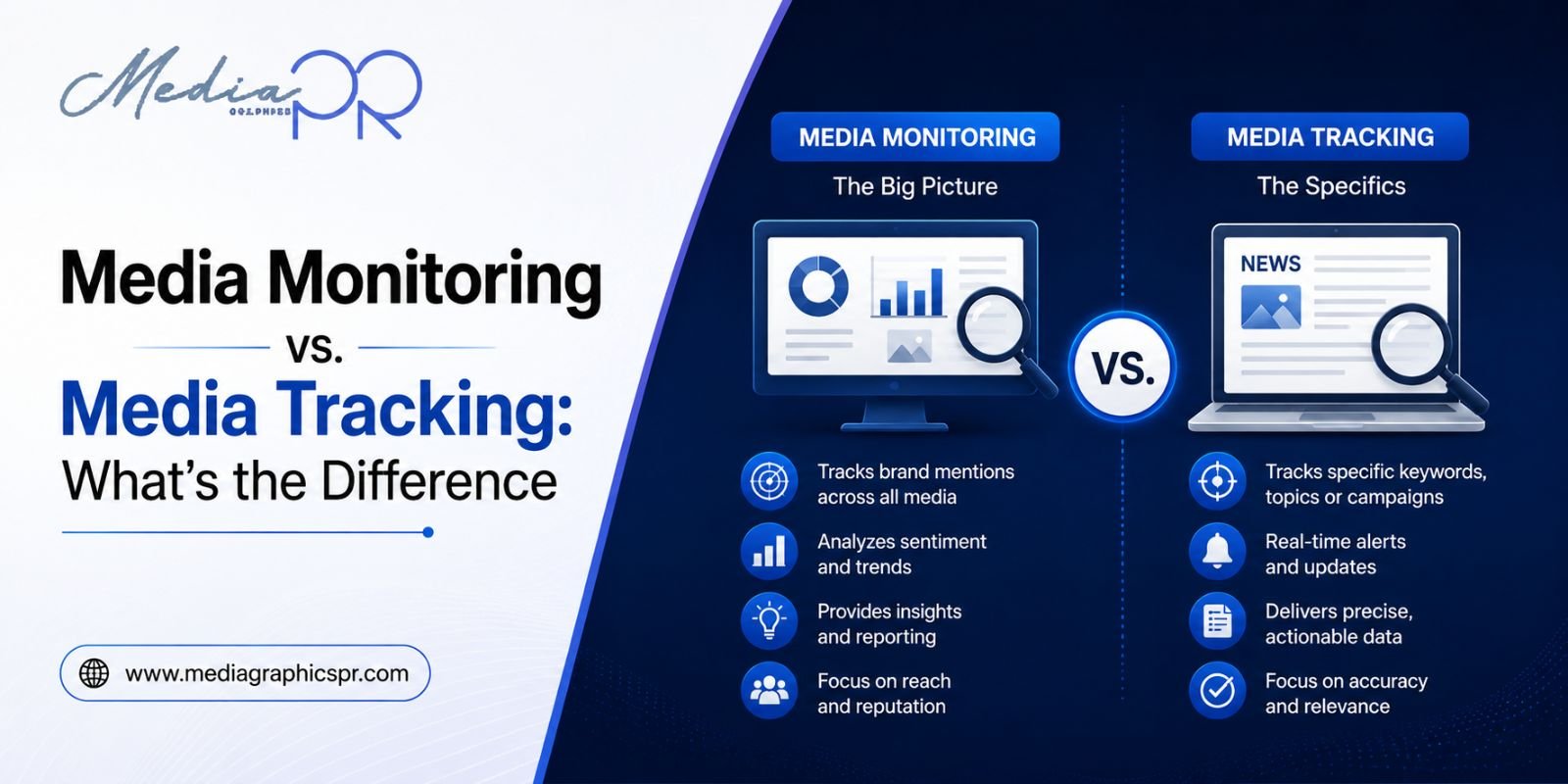
Media tracking is the process of finding and collecting mentions of your brand, keywords, or competitors across media channels. It answers the question: what was said?
Media monitoring is the process of analyzing, interpreting, and acting on those mentions, understanding sentiment, identifying narrative trends, spotting emerging risks, and connecting media activity to business outcomes. It answers the question: what does it mean, and what should we do about it?
| Aspect | Media Tracking | Media Monitoring |
|---|---|---|
| Core function | Find and collect mentions | Analyze and interpret mentions |
| Primary output | Clip reports, mention counts | Insights, trend analysis, risk flags |
| Decision it supports | “How many times were we mentioned?” | “What is the media narrative doing to our business?” |
| Time orientation | Retrospective — what happened | Prospective — what’s developing |
| Who uses it | Communications teams tracking coverage | Senior leadership making strategic decisions |
| Value | Operational | Strategic |
Both are necessary. Neither is sufficient on its own. The problem is that most brands invest in tracking infrastructure and call it monitoring, and the gap between the two is where reputation problems build undetected.
What Media Tracking Actually Is
Media tracking is fundamentally a collection and organization function. You define the keywords, brands, or topics you want to track. The system finds every mention across the channels you’ve specified. You get a report.
Done well, media tracking covers:
- Print media: national and regional newspapers, magazines, trade publications
- Digital media: online news portals, blogs, digital-only publications
- Broadcast media: TV and radio mentions (often through transcription)
- Social media: Twitter/X, LinkedIn, Facebook, Instagram, YouTube
- Podcasts and video: increasingly important as creator media grows
- International media: mentions in foreign publications relevant to Indian brands
The output of tracking media is typically a media report, a collection of clippings, a mention count, a reach estimate, and sometimes a basic sentiment classification (positive/negative/neutral).
What media tracking tells you:
- Your brand was mentioned 47 times last month
- Competitor X was mentioned 83 times
- 68% of mentions were classified as neutral
- Economic Times mentioned you 3 times
- Reach was estimated at 4.2 million
What media tracking doesn’t tell you:
- Whether those mentions are shifting how your target audiences perceive you
- Whether a narrative is building that could affect your next investor conversation
- Whether a journalist is developing a negative story that hasn’t been published yet
- Whether your competitor’s coverage is reaching audiences that matter to your business
- What to do about any of it
What Media Monitoring Actually Is
Media monitoring starts where media tracking ends. It takes the collected mentions and does the work of understanding what they mean for your brand’s reputation, your market position, your investor relationships, and your risk profile.
This is where genuine strategic value gets created. And it’s where the difference between a team that has a monitoring subscription and a team that genuinely monitors media becomes apparent.
What real media monitoring involves:
➤ Narrative trend analysis.
Not just what was said, but how the conversation is moving. Is sentiment improving or deteriorating? Are journalists in your space covering a theme that your brand is positioned on or conspicuously absent from? Is a critical narrative building across multiple publications that, individually, doesn’t look alarming but collectively is forming a pattern?
➤ Competitive intelligence.
Not just that a competitor was mentioned, but what the mentions are saying about their positioning, their product narrative, their investor relationships, and the gaps they’re leaving that your brand could occupy.
➤ Emerging risk identification.
The story that hasn’t been written yet, but is clearly taking shape. Maybe it’s a journalist quietly filing repeated RTI requests tied to your sector, or a regulator dropping public statements that hint at a rule change headed your industry’s way. A run of customer complaints on social media can also be an early tell, showing up well before a product issue ever turns into a full media story.
➤ Share voice analysis with context.
Not just “we have a 23% share of voice in our category,” but also what that share of voice is saying, which audiences it’s reaching, and whether the coverage is the kind that moves investor decisions and enterprise buying behavior.
➤ Message pull-through tracking.
Whether the specific messages and narratives your PR strategy is trying to establish are actually appearing in coverage or whether journalists are taking a different angle.
Why the Distinction Matters More Than Most Brands Realize
Here’s the expensive version of this confusion:
A brand has a media tracking subscription. Every Monday they get a report showing their mentions from the previous week. The mentions look fine. Reach is up, sentiment is mostly neutral, and the big publications covered the funding announcement.
Meanwhile, a journalist at The Ken has been working on a story about data practices in the brand’s sector for six weeks. They’ve been talking to former employees, reading regulatory filings, and building a narrative that the brand’s data handling is problematic. None of this shows up in the tracking media report because nothing has been published yet.
The story goes live. It’s thorough, well-sourced, and damaging. The brand’s response is scrambled because nobody saw it coming. The investor who was close to signing a term sheet calls to ask what’s going on. The enterprise client who was about to expand their contract sends a concerned email.
Media monitoring, the real kind, would have flagged this earlier. The journalist’s questions to industry contacts. The regulatory filing that appeared in the monitoring sweep. The pattern of social media posts from former employees. The other publications that had started asking similar questions.
This isn’t a hypothetical. It’s a pattern that repeats regularly in Indian business media, and the brands that get caught off guard are almost always the ones that had tracking infrastructure but not genuine monitoring.
The Tools—What They Do and What They Don’t
The media technology market in India has grown significantly. Understanding what different tool categories actually do prevents the common mistake of buying a tracking tool and expecting monitoring outcomes.
| Tool Category | What It Does Well | What It Doesn’t Do |
|---|---|---|
| Media monitoring platforms (Meltwater, Cision, Mention) | Aggregates mentions across print, digital, social | Strategic interpretation, emerging risk identification |
| Social listening tools (Brandwatch, Sprout Social) | Real-time social media tracking, sentiment | Print and broadcast, strategic context |
| PR measurement platforms (Prowly, Coverage Book) | Coverage reporting, AVE calculation | Narrative analysis, competitive intelligence |
| Manual monitoring (experienced PR team) | Nuanced interpretation, relationship context | Scale, speed, volume |
The honest answer is that none of these tools, on their own, constitute genuine media monitoring. They’re tracking infrastructure. The monitoring, the interpretation, the pattern recognition, the risk identification, and the strategic response require human judgment applied to what the tools collect.
The most effective approach combines the right tool infrastructure with experienced people who understand both the media landscape and the business context well enough to know what matters.
What Good Media Monitoring Actually Looks Like in Practice
For a growth-stage technology company, a fintech startup, or an enterprise SaaS brand, here’s what genuine monitoring media looks like as a regular practice:
Daily:
- Social media sentiment sweep for brand and competitor mentions
- News alert review for breaking stories relevant to the sector
- Journalist activity tracking, who’s asking questions, who’s publishing on relevant topics
Weekly:
- Narrative trend analysis: is the conversation moving in any direction?
- Competitive coverage review: what stories are competitors getting, and what are they saying?
- Message pull-through check: are the brand’s key messages appearing in coverage?
Monthly:
- Share of voice analysis with contextual interpretation
- Emerging risk assessment: what topics, journalists, or narratives should the brand be watching?
- Investor and enterprise buyer media landscape: what are the publications they read covering about the brand and its category?
Ongoing:
- Regulatory and policy media monitoring: relevant for fintech, healthcare, AI, and any sector where policy affects the business
- Crisis signal monitoring: early warning system for stories that could develop into reputation challenges
How MediagraphicsPR Approaches Media Monitoring for Indian Brands
The difference between knowing what’s being said about your brand and understanding what it means for your business is the difference between data and intelligence. Most brands have the first. Very few have the second.
At MediagraphicsPR, monitoring media for our clients isn’t a monthly clip report; it’s an ongoing strategic intelligence function that informs PR strategy, crisis preparedness, investor communications, and competitive positioning simultaneously.
Our media tracking and monitoring practice covers the Indian media landscape across print, digital, broadcast, and social, with the interpretive layer that turns mention data into actionable intelligence. For fintech brands, the monitoring includes regulatory media and policy publications that general tracking tools miss. For technology companies, it includes the technical and trade publications that enterprise buyers read. For healthcare brands, it includes clinical and patient community media alongside mainstream health coverage.
Senior people who understand your business context doing the interpretation, not algorithms classifying sentiment. Real relationships with journalists that give us early signals about stories in development. A monitoring approach built around what your business actually needs to know, not around what’s easy to measure.
The Practical Checklist—Are You Tracking or Monitoring?
If you’re not sure which one your brand is actually doing, this checklist tells you:
You’re tracking if:
- ✗ Your media report shows mention counts and reach estimates
- ✗ You find out about negative coverage when someone sends you a link
- ✗ Your sentiment analysis is positive/negative/neutral with no further interpretation
- ✗ You can’t tell from your media report whether your brand’s narrative is improving or deteriorating
- ✗ You have no early warning system for stories in development
You’re monitoring if:
- ✓ Your media intelligence includes narrative trend analysis, not just mention counts
- ✓ Your team flags emerging stories before they’re published
- ✓ You track competitor coverage for strategic intelligence, not just comparison
- ✓ Your regulatory and policy media sweep gives you advance warning of developments affecting your business
- ✓ Your media intelligence connects directly to investor communications and enterprise sales preparation
Most brands score more checks on the left side than the right. That’s the gap worth closing.
FAQs
Q: Can a brand do genuine media monitoring without expensive tools?
Tools help with scale and speed, but they’re not the same as monitoring. A brand with an experienced PR team reading the right publications consistently, maintaining journalist relationships, and interpreting coverage in business context is doing more genuine monitoring than one with an expensive platform producing automated sentiment reports that nobody acts on. The tool is infrastructure. The interpretation is the monitoring.
Q: How often should a brand review its media monitoring setup?
At minimum quarterly, and immediately when a major business event happens. A fundraise, a product launch, a leadership change, a regulatory development—each of these changes what your brand needs to monitor and what signals matter. A monitoring setup built for a seed-stage company is usually inadequate for a growth-stage one.
Q: Is social media monitoring different from traditional media monitoring?
Different enough to require separate attention. Social media moves faster, the signal-to-noise ratio is lower, and the relationship between social media activity and mainstream media coverage is significant. A social media story that gains traction can become a journalism story within hours. Brands that monitor traditional media without social media are missing the early warning system that most reputation challenges now originate in.
Q: How do you monitor for stories that haven’t been published yet?
Through journalist relationship intelligence, knowing which journalists are working on which topics, what questions they’re asking industry contacts, and what regulatory or public record research they’re doing. This is relationship-dependent work that tools can’t replicate. PR teams with genuine journalist relationships learn about stories in development that brands without those relationships only see when they’re published.
Q: Should a brand monitor competitor coverage as part of its media monitoring?
Yes, and most brands don’t do enough of it. Tracking how often a competitor gets mentioned isn’t the point. What actually matters is figuring out the story they’re building in the press, who’s amplifying it, where they’re leaving gaps in how the category gets talked about, and what all of that signals about where they’re headed strategically. That’s the kind of intelligence that should be shaping your own PR strategy, not sitting in a report nobody reads.
Q: What’s the most important thing a brand can do to improve its media monitoring immediately?
Connect it to business outcomes rather than communications metrics. The question your monitoring should answer is not “how many times were we mentioned?” It’s “what is the media narrative doing to our investor conversations, our enterprise sales pipeline, and our regulatory relationships?” When monitoring is set up to answer those questions, the outputs are fundamentally more useful than when it’s set up to produce clip reports.
Ready to Know What Your Media Coverage Actually Means for Your Business?
Mention counts tell you what was said. They don’t tell you what’s building, what’s coming, or what to do about it. That gap is exactly what a genuine media monitoring practice, run by a PR agency in India that understands both the media landscape and your business context, is built to close.
Visit MediagraphicsPR to see how we turn media intelligence into strategic decisions for brands across India.
Need to speak to someone now?
📞 Call us: +91-8448360900 📧 Email us: info@mediagraphicspr.com
We respond within 24 hours.