






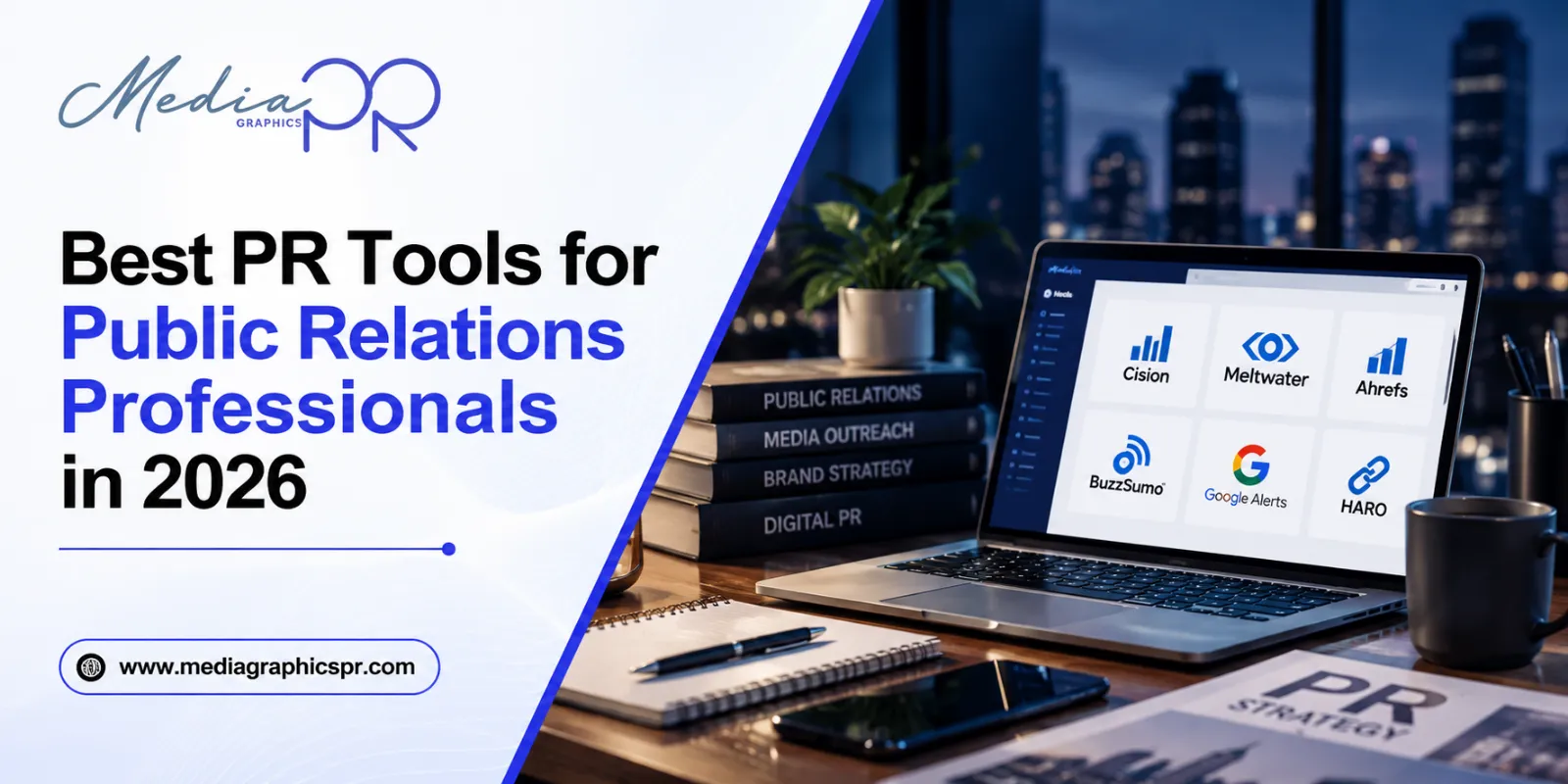
A PR team in 2026 handles more than press releases. It tracks coverage in real time, finds the right journalists, reports results to leaders and often does all of this with a small team. The right PR tools make that work faster. The wrong ones just add another login.
This guide explains what PR tools are, which public relations tools fit each job, and how to choose without overspending. It also covers PR tracking tools, PR reporting tools and the classic tools of publicity, so you can build a stack that matches your team.
Quick Answer: The best PR tools cover six jobs: finding journalists, monitoring coverage, writing and distributing news, creating content, reporting results and managing work. Cision, Meltwater and Muck Rack are widely used platforms that cover several of these jobs, while Google Alerts is a free way to start tracking mentions. Choose tools by the job you need done, not by feature lists, and test each one against Indian media before you pay.
What Are PR Tools?
PR tools, also called public relations tools, are software and services that help communicators find media contacts, track coverage, distribute news, create content and measure results. They save time on repeated tasks, but they do not replace judgement or relationships.
A tool can give you a list of journalists. It cannot tell you why a particular reporter would care about your story. That part is still human work, and it is why our guide to media relations stresses trust over volume.
What Are the Tools Used in Public Relations?
Most tools used in public relations fall into seven groups. The table below shows what each group does and gives examples.
| Tool group | What it does | Examples |
|---|---|---|
| Media database and outreach | Finds journalists and manages pitching | Cision, Muck Rack, Meltwater |
| Media monitoring | Alerts you to new coverage and mentions | Google Alerts, Meltwater, Cision, Muck Rack |
| Press release and distribution | Writes, formats and sends news | Wire services, email platforms |
| Social listening | Tracks conversations about your brand | Meltwater, Cision |
| Content and design | Creates images, decks and media kits | Canva, Google Workspace |
| Analytics and reporting | Shows traffic, search and coverage results | Google Analytics, Google Search Console, Looker Studio |
| Workflow | Plans tasks, approvals and calendars | Trello, Asana, Notion |
These public relations tools are examples, not endorsements. Features and coverage change often, so always test a tool with your own sector and Indian outlets before you commit.
Which Are the Best Public Relations Tools by Job?
Which Tools Help You Find Journalists and Run Outreach?
Media databases give you journalist contacts and beats in one place. According to its website, Muck Rack offers a media database and monitoring, and Cision describes CisionOne as a platform covering monitoring, analytics, reporting and journalist outreach. Meltwater describes its offering as media intelligence, social listening, media relations and influencer tools.
Whichever you pick, check how many Indian business, trade and regional journalists are in the database. A global database can be thin on local reporters. You can also build your own media list in a spreadsheet, which is a sensible start for small teams.
Which PR Tracking Tools Show Where Your Brand Appears?
PR tracking tools alert you when your brand, founder or competitors are mentioned. Google Alerts is the simplest start. Google says it sends emails when new search results appear for a topic you choose, and you can set the frequency, source types, language and region.
Paid platforms add wider coverage, social tracking and reporting. Our guide to media monitoring explains what to track and why. As a rule, start with free alerts and upgrade only when manual checking becomes a daily burden.
Which PR Reporting Tools Prove the Value of PR?
PR reporting tools turn coverage and traffic into something leaders can read. Many monitoring platforms include dashboards. For website results, Google Analytics, Google Search Console and Looker Studio can show referral visits, branded search and landing page performance.
Report outcomes, not just clips. Our guides on how to measure PR success, PR campaign metrics and how to turn media coverage into measurable brand growth show what to include.
Which Tools Help With Press Releases and Distribution?
You need a place to write, a way to format and a way to send. Many teams use a document editor for drafts and a distribution service or email platform for sending. Before you pay for distribution, read how press release distribution works, because wide distribution does not guarantee coverage.
Good tools cannot rescue a weak release, so start with the story. See what a press release is and how to write an effective press release.
Which Tools Help With Content, Design and Workflow?
Design tools such as Canva help teams create decks, graphics and a media kit without a designer. Data visuals also help journalists understand your story, as explained in our post on data visualization in PR messaging. For workflow, Trello, Asana or Notion keep approvals, calendars and spokesperson requests in one place.
Where Do AI Tools Fit in PR?
AI can help with first drafts, summaries and research, but a human must check every fact and polish every sentence. Unedited AI copy is easy to spot and can damage trust with journalists. Read our guides on AI in modern PR strategy, writing AI press releases and automating press release distribution with AI before you build AI into your process.
What Are the Tools of Publicity?
The classic tools of publicity are press releases, media kits, press conferences, interviews, events and social media. They create attention for a brand, a person or an announcement. Publicity is one part of PR, and it is usually short-term and news-driven, while PR also builds long-term reputation. Our post on public relations vs publicity explains the difference.
- Press releases: official statements for news
- Media kits: background material for journalists
- Press conferences: for major news, with the key PR aspects for a press conference planned well
- Interviews: see the power of interviews in PR
- Events and virtual events: explained in our guide on virtual events in PR
- Social and short video: see short-form video in PR
How Do You Choose the Right PR Tools?
Start with the job, then the budget, then the tool. Ask these questions before you sign up:
- What job is it for? Name one problem, such as finding reporters or tracking mentions.
- Does it cover Indian media? Test it with your sector and cities.
- Who will use it? A tool nobody opens is wasted money.
- Can you export data? You should be able to take your lists and reports with you.
- What does it really cost? Ask for current pricing, contract length and what is extra.
- Can you try it first? Use a trial with a real task, not a demo.
What Does a Simple PR Tool Stack Look Like?
Match the stack to your stage. This is a starting point, not a rule.
| Team stage | Starter tools | Add when needed |
|---|---|---|
| Early-stage or solo | Google Alerts, spreadsheet media list, Canva, Google Analytics | A paid monitoring tool |
| Growing team | A monitoring platform, a media database, Looker Studio | Social listening, a workflow tool |
| Large or multi-brand | Integrated platform for monitoring, outreach and reporting | Custom dashboards and approvals |
If you are just starting, our guide on how to create a PR strategy helps you decide what the tools must support. See also the top PR tools for SaaS businesses and startups.
How Do PR Tracking Tools and Reporting Tools Work Together?
Tracking finds the coverage and reporting explains it. A good workflow runs in four steps:
- Monitor: set alerts for your brand, leaders, competitors and topics
- Collect: save relevant coverage with date, outlet and message
- Measure: link coverage to visits, search interest, leads or enquiries
- Report: show what changed and what you will do next
Keep the report short. Leaders want to see outcomes and decisions, not a long list of links.
What Mistakes Do Teams Make With PR Tools?
- Buying before planning. Tools should follow the strategy, not replace it.
- Trusting a database blindly. Check journalist details before you pitch.
- Measuring only volume. Clip counts rarely show business impact.
- Too many tools. Each extra tool adds cost and training.
- Mass pitching. Easy outreach does not mean good outreach.
- Skipping human review. This matters most with AI-written copy.
Do You Still Need a PR Agency If You Have the Right Tools?
Often yes, because tools do not create relationships or sharpen a story. An agency brings media access, judgement and extra capacity, and it usually already has the tools.
A PR agency in India can run the tools and the strategy together. At MediagraphicsPR, we focus on the story and the outcome, and you can see the sectors we serve on our industry expertise page. Read our comparison of in-house PR and a PR agency and what a PR agency is, and see the latest PR trends for 2026. A good PR agency will tell you which tools you actually need.
FAQs
What are PR tools?
PR tools, or public relations tools, are software and services that help with finding journalists, monitoring coverage, sending news, creating content, reporting results and managing work. They support the PR team but do not replace relationships.
What are the best PR tools for a small business or startup?
Start with free options: Google Alerts for tracking, a spreadsheet for your media list, Canva for design and Google Analytics for results. Add a paid platform only when manual work becomes too heavy.
What is the difference between PR tracking tools and PR reporting tools?
PR tracking tools find and collect your mentions. PR reporting tools turn that data, together with traffic and other results, into reports that show what the coverage achieved. Many platforms do both.
Are paid PR tools worth it in India?
They can be, if they cover the Indian outlets and journalists you care about and your team will use them. Always run a trial with your own sector before you commit to a long contract.
Can AI replace PR tools or PR professionals?
No. AI helps with drafts, summaries and research, but PR depends on judgement, accuracy and relationships. Use it as an assistant and always edit the output yourself.
Conclusion: Pick PR Tools That Serve Your Strategy
The best PR tools are the ones your team actually uses to do a specific job better. Start with free tracking, build a clean media list and add paid platforms only when the work demands it. Keep the focus on stories and relationships, and let the tools handle the repeated tasks.
Want a PR Team That Already Knows the Tools?
The right tools help, but the story still matters. Talk to a PR agency in India that can run the tools, shape your story and reach the right journalists.
Visit MediagraphicsPR or see our industry expertise.
Need to speak to someone now?
📞 Call us: +91-8448360900 📧 Email us: info@mediagraphicspr.com
We respond within 24 hours.