






Most pitches fail in the first two lines. The journalist sees a vague subject, a long introduction and no clear reason to care, and moves on. The fix is not a cleverer email. It is a shorter one, built around a real story.
This guide gives you media pitch examples for five common situations, a media pitch email template you can adapt, and a simple check to run before you hit send. Each sample media pitch email uses placeholders, so replace the brackets with your own facts.
Quick Answer: A good media pitch is a short email of 100 to 150 words with a clear subject line, a one-line hook, two or three supporting facts, an offer of a spokesperson or material, and a polite close. Address one journalist by name, explain why the story fits their beat, and never attach large files. Follow up once after three to five days.
What Is a Media Pitch?
A media pitch is a short message that offers a journalist a story idea, a source or an exclusive. It is not a press release and not an advertisement. It is a reason for a reporter to spend their time on your story.
A press release is a document with full details. According to Wikipedia, a press release is an official statement delivered to the news media to provide new information. A pitch is the short note that gets the release, or the story, noticed. Our guide on what a press release is explains the difference further.
What Makes a Good PR Pitch Example?
A strong pitch is short, specific and written for one person. Look for these five features in any PR pitch example you copy:
- A clear subject line: it says what the story is in under ten words
- A reason it fits: one line showing you know what the reporter covers
- A real hook: news, data, a trend or a person with a view
- An easy next step: an interview, a quote or a document on request
- Respect for time: no long company history
Our guide on how to create a personalised PR pitch goes deeper on personalisation.
What Is a Media Pitch Email Template?
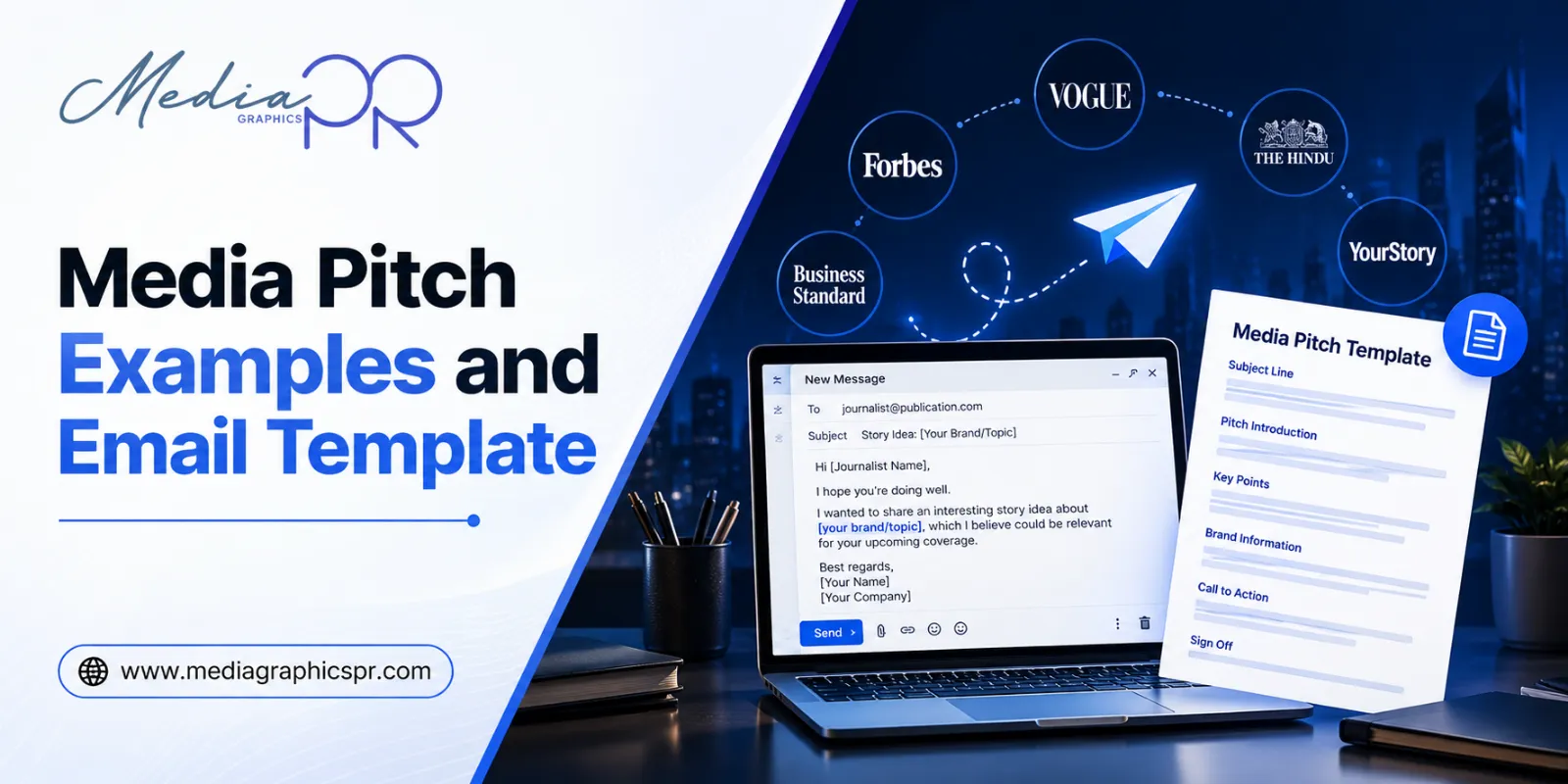
A media pitch email template saves time, but only if you tailor it. Here is a sample media pitch email that works for most stories. Copy it, then cut anything that does not help the journalist.
Subject: [Story in under ten words]
Hi [First name],
I read your piece on [topic] and thought this might fit your coverage of [beat].
[One-line hook with the news or the fact.]
Three quick points:
1. [Fact or number you can support]
2. [Why it matters to your readers]
3. [What is new or different]
[Name, title] is available for a short interview this week, and I can share [photos, data or a one-page note] on request.
Would this be useful for you?
Thanks,
[Your name]
[Company] | [Phone] | [Email]
Use this structure for every pitch. Only the hook and the facts change. Good media pitch examples all follow the same shape, which makes them quick to write and quick to read.
What Are Some Media Pitch Examples by Situation?
These media pitch examples are written with placeholders. Replace each bracket with your real details, and never claim a number you cannot prove. Read each sample media pitch email as a pattern, not a script.
Example 1: Sample media pitch email for a funding announcement
Subject: [Startup] raises [amount] to bring [solution] to [audience]
Hi [First name],
Since you cover [sector] startups, I wanted to share news that may suit your readers. [Startup] has raised [amount] from [investors] to build [product] for [audience].
Why it may matter: [one sentence on the problem and the market].
[Founder name] can speak about [specific topic] and share what the round will fund. The press note is attached as text below.
Happy to arrange a call at your convenience.
Best,
[Your name]
For the release itself, see how to write a funding announcement press release and how to write an effective press release. New company? Read how to get press coverage for your startup.
Example 2: Product launch pitch
Subject: New [product type] helps [audience] [achieve result]
Hi [First name],
You recently wrote about [related topic], so I thought you might like to see this. [Company] is launching [product] on [date] to help [audience] with [problem].
What is new: [one sentence].
Who it is for: [one sentence].
I can offer a demo, screenshots and a short conversation with [founder or product head].
Would you like to see it?
Thanks,
[Your name]
Example 3: PR pitch example for expert comment
Subject: Expert comment: [topic in the news]
Hi [First name],
I saw your story on [news topic]. [Name], [title] at [company], has [experience in one line] and can comment on [angle].
Two points [Name] can cover:
1. [Point one]
2. [Point two]
[He/She] is available today and tomorrow for a quick call or a written quote.
Regards,
[Your name]
This kind of PR pitch example is one of the best ways to start. Building a steady record of useful comments helps thought leadership too.
Example 4: Event invitation pitch
Subject: Invitation: [Event name] on [date] in [city]
Hi [First name],
We are hosting [event] on [date] at [venue], where [speaker names] will discuss [topic].
Why it may interest you: [one line].
Media access includes [interviews, a press seat or a Q&A]. Please let me know if you would like to attend, and I will confirm your place.
Warm regards,
[Your name]
Example 5: Follow-up email
Subject: Re: [Original subject]
Hi [First name],
Following up on my note from [day] about [one-line story]. In case it helps, [new fact or update].
If this is not a fit, no problem. I would be glad to know what you are working on.
Thanks,
[Your name]
Send a follow-up once, after three to five days. More than that becomes pressure. If a reporter wants early access, agree on an embargo in writing.
How Do You Write a Subject Line That Gets Opened?
Say what the story is, plainly. Reporters scan hundreds of subject lines, so clarity beats cleverness.
| Situation | Weak subject line | Stronger subject line |
|---|---|---|
| Funding | Exciting news from [Startup] | [Startup] raises [amount] to build [product] |
| Launch | Press release: new product | New [product type] helps [audience] [result] |
| Expert comment | Interview opportunity | Expert comment: [topic in the news] |
| Event | You are invited | Invitation: [Event] on [date] in [city] |
| Follow-up | Just checking in | Re: [Original subject] |
How Do You Choose the Right Journalist?
Before you reuse any of these media pitch examples, start with what the reporter has written in the last few months. Pitch only those whose beat matches your story. A short, accurate list always beats a large, random one. Our guide to media lists explains how to build one, our notes on building long-term media relationships explain how to keep it useful, and our overview of media relations shows how to build trust over time.
- Read three recent articles by the journalist
- Check which outlet and section they write for
- Note their preferred format, such as news, features or opinion
- Mention one of their pieces only if you actually read it
What Mistakes Ruin a Media Pitch?
- Mass emailing. A pitch that starts “Dear Editor” is easy to ignore.
- Burying the news. Put the hook in the first two lines.
- Heavy attachments. Paste the key text in the email and offer files on request.
- Hype words. “Revolutionary” and “game-changing” make journalists doubt you.
- Pitching the wrong beat. It shows you did not read their work.
- Endless follow-ups. Follow up once, politely.
Once your pitch lands, check results with our guide to how to get media coverage in India and how to measure PR success. Our post on media training helps spokespeople prepare once a journalist replies, and our guide to the power of interviews in PR shows how to make the most of them. Keep a ready media kit so you can answer requests quickly.
Should You Pitch Yourself or Use a PR Agency in India?
You can pitch yourself if you have one clear story and time to follow up. An agency helps when you need journalist relationships, steady timing and someone to manage replies.
A PR agency in India already knows which reporters cover which sectors. At MediagraphicsPR, we plan pitches around the story, not around a mass list. You can see the sectors we serve on our industry expertise page. To compare options, read in-house PR and a PR agency. A PR agency can also review your pitches before you send them.
FAQs
How long should a media pitch email be?
Aim for 100 to 150 words, as in the media pitch examples above. That is long enough for the hook, a few facts and an offer, and short enough to read on a phone.
When is the best time to send a media pitch?
Weekday mornings are a sensible default, but the story and the reporter’s deadlines matter more than the clock. Avoid sending news during major events that will crowd it out.
Should I attach the press release to a pitch?
Paste the key facts in the email body and offer the full release on request. Some email systems block attachments, and reporters prefer to see the point immediately.
How many times should I follow up?
Once, after three to five days, with a new fact or angle. If there is no reply after that, move on and try a different story later.
Can I send the same pitch to many journalists?
You can reuse the structure, but each email must be personal. Change the opening line and the angle for each reporter. Identical mass emails are easy to spot.
Conclusion: Keep Your Media Pitch Short and Specific
The best media pitch examples share one habit: they respect the reader’s time. Lead with the news, show why it fits the reporter, offer something useful and follow up once. Use the media pitch email template above, adjust it for each journalist, and your pitches will get read more often.
Want Expert Help With Your Media Pitches?
A sharper pitch starts with the right story. Talk to a PR agency in India that can shape your pitch, build your media list and follow up with journalists.
Visit MediagraphicsPR or see our industry expertise.
Need to speak to someone now?
📞 Call us: +91-8448360900 📧 Email us: info@mediagraphicspr.com
We respond within 24 hours.