





Most PR reports fail for the same reason: they list what the team did and leave the reader to guess whether it mattered. A manager with ten minutes wants to know what happened, what it means for the business and what happens next. A good PR report template answers those three questions on one or two pages.
This guide gives you a working PR report template you can copy, a simple PR dashboard layout, and a PR monthly report format that management will actually read. It also covers what to leave out. If you need the wider picture of what to track and why, start with our guide on how to measure PR success, and use this article for the reporting itself.
Quick Answer: A PR report template should open with a short summary, then show the goals set for the period, the results against those goals, coverage highlights, lessons learned and the plan for the next month. Keep it to one or two pages, lead with outcomes such as quality of coverage and business impact, and show activity only as supporting detail. Avoid advertising value equivalents. A one-page PR dashboard of five to eight numbers sits on top of the report.
What Should a PR Report Template Include?
A useful PR report template has six parts. Each one has a job, and if a section does not help a decision, cut it.
- Summary: three or four sentences covering the month’s main result, one problem and one next step.
- Goals and status: the objectives agreed at the start of the period, and whether each is on track.
- Results: the numbers and coverage that show progress against those goals.
- Highlights: the three to five coverage items or conversations that mattered most, with links.
- Lessons: what worked, what did not and what the team will change.
- Next month: planned announcements, outreach and decisions needed from management.
The order matters. Management reads the first third carefully and skims the rest, so put the conclusion first and the evidence after it.
How Do You Write a PR Monthly Report?
A PR monthly report works best when the same structure repeats every month, because comparison is what makes the numbers meaningful. Use the table below as the base layout and fill it in with your own figures.
| Section | What to write | Keep it to |
|---|---|---|
| Summary | The main result, the main concern and what you need from management | 3 to 4 sentences |
| Goals vs results | Each goal, the target, the current position and a status of on track, at risk or behind | One line per goal |
| Coverage highlights | Publication, headline, date, link and why it matters | 3 to 5 items |
| Message pull-through | Whether key messages appeared accurately in the coverage | 2 to 3 sentences |
| Audience signals | Enquiries, site visits, event sign-ups or social conversation linked to coverage | A few numbers with the source |
| Issues and risks | Negative coverage, correction requests or sensitive topics being watched | Only if relevant |
| Lessons and changes | What the team learned and what it will do differently | 3 bullet points |
| Next month | Planned news, outreach and any approvals or decisions needed | A short list |
Write each section in plain words. A line such as “Our funding story reached two national business titles, and both repeated the growth message accurately” tells management far more than a count of articles.
A sample summary you can adapt
We met two of our three goals this month. The product announcement appeared in [number] national and trade publications, and our spokesperson was quoted in [number] of them. Coverage of the second goal, regional visibility, is behind plan because the launch moved by two weeks. Next month we plan to [action]. We need approval on [decision] by [date].
What Goes on a PR Dashboard?
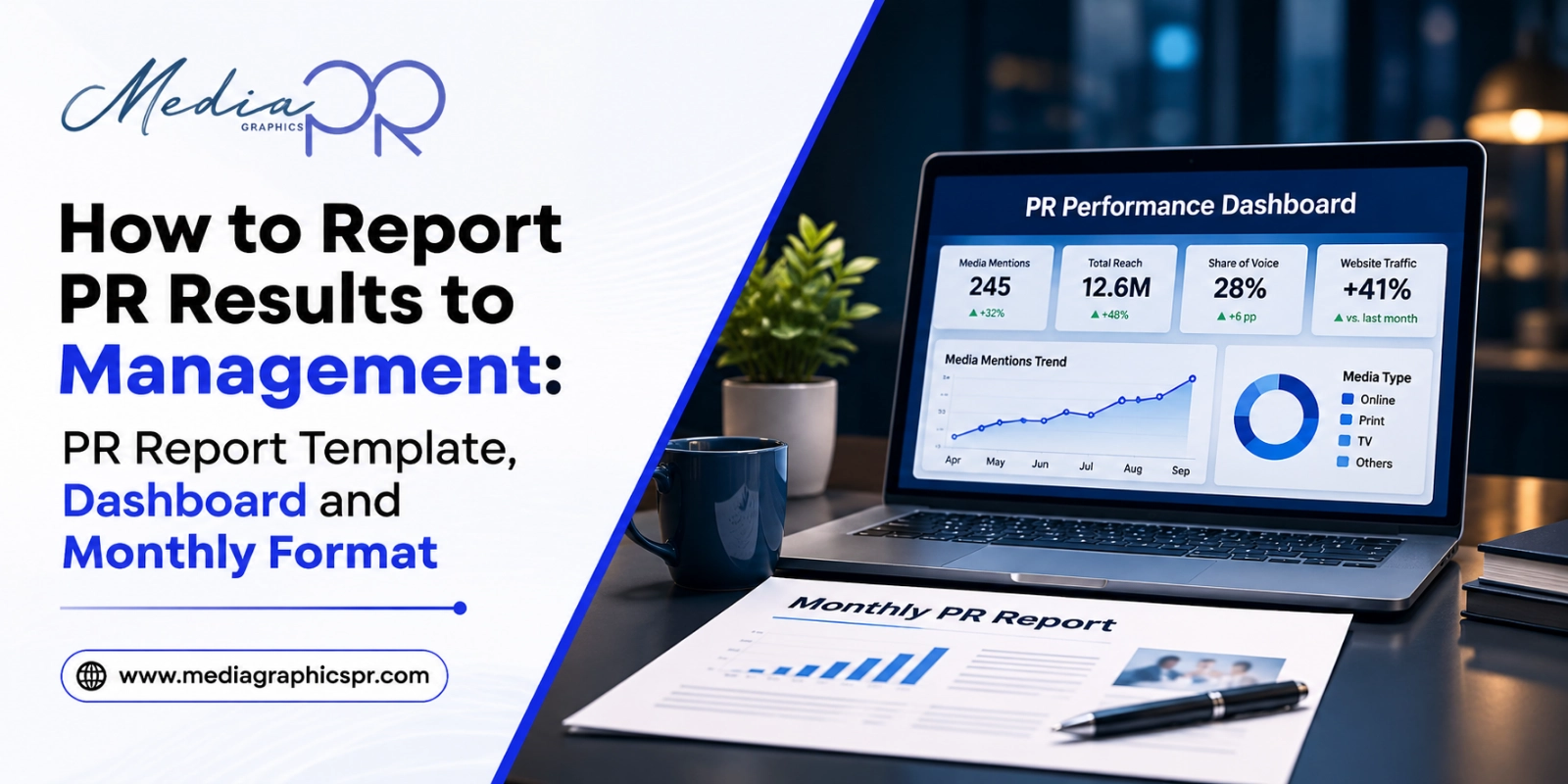
A PR dashboard is the one-page view that sits on top of the monthly report. Its purpose is to let a busy manager see the state of PR in under a minute. Keep it to five to eight measures, chosen because they connect to your goals, and show each against the previous period or the target.
| Dashboard measure | Why it matters | Where the data comes from |
|---|---|---|
| Coverage in priority publications | Shows whether you are reaching the media your audience reads | Media monitoring log |
| Message pull-through | Shows whether your key messages are used correctly | Manual review of coverage |
| Share of voice against named competitors | Shows your presence compared with rivals | Monitoring tool or manual count |
| Sentiment and tone | Flags rising concerns early | Monitoring tool plus a human check |
| Spokesperson mentions | Shows whether leaders are seen as credible sources | Coverage review |
| Referral traffic and enquiries from coverage | Links PR to audience action | Web analytics and sales team |
| Journalist engagement | Counts replies, interviews and repeat contacts | Outreach tracker |
Choose from this list rather than using all of it. If your goal is investor visibility, referral traffic matters less than quality of business coverage. If your goal is leads, the enquiry measure moves to the top. Our overview of how media monitoring works explains where several of these numbers come from, and the article on PR campaign metrics covers the individual metrics in more depth.
Which PR Reporting Format Do Different Managers Prefer?
The right PR reporting format depends on who reads it. The same facts can be packaged three ways.
For the CEO or founder
One page, with the dashboard and the summary. Focus on reputation, investor or customer visibility, and any risk. Avoid jargon and activity lists.
For the marketing or sales head
Add the audience signals section. Show which stories brought enquiries, which messages worked and how PR supports campaigns. Coordinating with the team that owns the website data makes these numbers far easier to trust.
For the board or investors
A quarterly view works better. Show trends over three months, the biggest coverage wins, and how reputation and visibility connect to business milestones such as a funding round, a launch or an expansion.
How Do You Report Outcomes Instead of Activity?
Activity is what the team did: pitches sent, releases written, calls made. Outcomes are what changed because of it: a message repeated by a respected publication, a journalist who now calls you for comment, a rise in qualified enquiries. Management cares about outcomes, though activity helps explain them.
Industry guidance supports this view. The Barcelona Principles 4.0, published by AMEC in 2025, ask communicators to set clear objectives, judge work by outcomes and impact as well as outputs, and avoid invalid measures such as advertising value equivalents (read the summary at PRNEWS). In practice, that means each line in your report should link a piece of activity to a goal.
A simple test works well. For every number in your report, ask whether the reader would act differently because of it. If not, move it to an appendix or drop it.
Common Mistakes in PR Reports
- Counting clippings. A long list of articles looks busy but says nothing about quality.
- Using advertising value equivalents. They convert coverage into a rupee figure that has no reliable link to business value, and current industry guidance advises against them.
- No goals at the top. Without targets, results cannot be judged.
- Hiding bad news. A missed goal reported early with a plan is far better than a surprise later.
- Changing the format every month. Management cannot see trends if the layout keeps moving.
- Too much detail. Put the long coverage list in an appendix and keep the main report short.
How Often Should You Send a PR Report?
Most teams use a monthly report with a short weekly update during busy periods. A launch, a funding announcement or an issue under watch may need a daily note for a few days. Quarterly reviews step back to show trends. Agree the schedule in writing at the start of the engagement, along with the format and who receives the report. For agency work, agree this at the PR strategy stage, and a review call each month keeps both sides honest.
Who Should Own PR Reporting?
The person who leads PR, whether in-house or at an agency, should write the report, because they know the context behind the numbers. Management should review it, and sales or marketing should supply the data on enquiries and traffic. If an agency prepares it, agree what access it needs to your analytics, and treat the report as a shared document, not a one-way delivery. Teams that run strong media relations and clear press release schedules find this much easier, because every item in the report ties back to a planned action.
FAQs
What is a PR report template?
It is a repeatable layout for reporting PR results. It normally includes a summary, goals, results, coverage highlights, lessons and the plan for the next period.
What should a PR monthly report include?
Include a short summary, results against goals, the most important coverage with links, notes on message accuracy, any risks, lessons and next month’s plan.
How long should a PR report be?
One to two pages for the main report, plus an appendix for the full coverage list. Management is more likely to read a short report in full.
What is a PR dashboard?
A PR dashboard is a one-page view of five to eight measures tied to your goals, shown against the previous period or a target so a reader can judge progress at a glance.
Which PR reporting format is best for management?
Use a short written summary with a one-page dashboard. Add detail only where it helps a decision, and keep the format identical each month.
Should I include advertising value equivalents?
No. Industry guidance, including the Barcelona Principles 4.0, advises against them. Report coverage quality, message accuracy and audience impact instead.
Want PR Reporting Management Will Actually Read?
Talk to a PR agency in India that can review your goals, shape the plan and tell you plainly if it is the right fit.
Visit MediagraphicsPR or see our industry expertise.
Need to speak to someone now?
📞 Call us: +91-8448360900 📧 Email us: info@mediagraphicspr.com
We respond within 24 hours.