





Your phone lights up with a link. A publication has run a story about your company, and it is not kind. Whether the claims are accurate, exaggerated or simply wrong, what you do in the next two days will shape how the story is remembered. Negative news about your company is stressful, but it is manageable when you follow a clear order of steps.
This guide gives you a practical 48-hour plan to respond to negative press: what to check first, who needs to be in the room, what to say, and what to avoid. It also covers negative media coverage that is unfair or incorrect, and how to keep handling negative publicity once the first wave passes. For the wider planning side, our posts on PR crisis management strategies and what crisis management means are good companions.
Quick Answer: When negative news about your company appears, do not react in the first hour. Capture the story, verify the facts, bring together a small response team, decide whether the claims are true, partly true or false, then issue a short holding statement within the first few hours. Within 48 hours, share a factual response, brief your people, request corrections for errors, and monitor the story. Stay calm, accurate and consistent, and never argue publicly with a journalist.
What Should You Do First When Negative News About Your Company Appears?
The first hour after negative news about your company breaks matters mostly because of what you hold back. Panic leads to hasty posts, angry emails to editors and statements you cannot take back. A better order helps you stay in control.
- Pause before replying. Do not post, call the journalist in anger or reply on social media yet.
- Capture the story. Save the link, a screenshot, the date, the author and any social posts that carry it. Stories change, and you will want a record.
- Read it fully and twice. Note every claim, quote and number. Mark what is accurate, what is disputed and what is false.
- Alert a small team. Usually that means the founder or CEO, the head of communications, legal advice and whoever owns the facts in the story.
- Hold new publishing. Pause scheduled posts and campaigns that could look tone-deaf next to the story.
If your company has an agency or an adviser, call them now. A team that runs crisis communication can help you draft and sequence the response while you handle the business itself.
The 48-Hour Plan to Respond to Negative Press
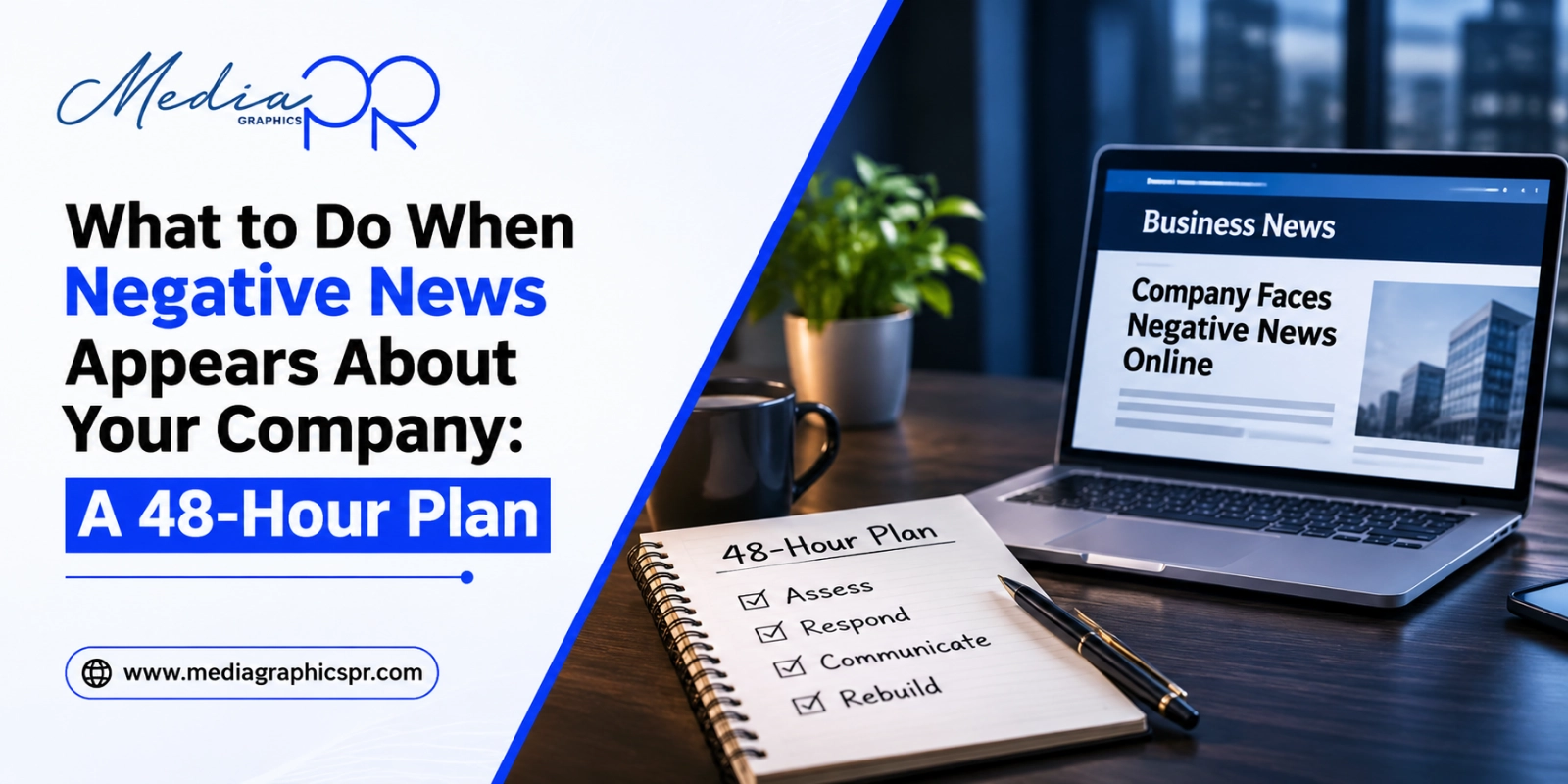
The plan below breaks the first two days into four windows. Adjust the timing to the scale of the story, but keep the order.
| Window | Main goal | Key actions |
|---|---|---|
| Hours 0 to 2 | Understand the story | Capture the story, read every claim, alert the response team, pause scheduled content |
| Hours 2 to 6 | Decide your position | Check facts with the people involved, classify each claim, agree who speaks and draft a holding statement |
| Hours 6 to 24 | Respond clearly | Publish the holding statement or a fuller response, brief staff, contact the journalist if there are factual errors, answer customer and partner questions |
| Hours 24 to 48 | Follow up and steady | Request corrections, share updates, monitor coverage and social conversation, review what else may follow |
Hours 0 to 2: understand before you act
Your first goal with any negative news about your company is to know what you are dealing with. Build a simple list with three columns: the claim, whether it is true, partly true or false, and the evidence you have. This list becomes the base for every statement that follows.
Hours 2 to 6: decide your position
For each claim, choose a stance. If it is true, you need an honest acknowledgement and a plan. If it is partly true, you need context without sounding defensive. If it is false, you need evidence and a calm request for correction. Decide who speaks for the company, because one clear voice avoids mixed messages. Then write a holding statement.
A holding statement is a short public line that says you are aware of the story, you take it seriously, and you will share facts when you have verified them. It buys time without avoiding the issue.
We are aware of the report published on [date] about [subject]. We take these matters seriously and are reviewing the facts. We will share an update by [time and date]. In the meantime, please contact [name and email] with any questions.
Hours 6 to 24: respond clearly
Now you can share a fuller response. Keep it short, factual and human. State what happened, what you are doing about it and who is affected. Avoid blaming the journalist, using legal jargon or repeating the accusation in your own headline. Brief your employees before the public hears from them. Staff who are surprised by the news online will spread uncertainty, so a short internal note with the facts and a point of contact helps. Also prepare a few lines for customers, investors and partners who will ask.
Hours 24 to 48: follow up and steady
Once the first wave of negative news about your company passes, deal with errors and watch what comes next. Ask for corrections where facts are wrong, share updates if the situation changes and keep your team aligned. Your media relations contacts matter here, because journalists who already know your company are more likely to hear your side with an open mind.
How Do You Handle Negative Media Coverage That Is Wrong or Unfair?
Not all negative news about your company deserves the same response. Sort it into three groups before you act.
- Factually wrong: Send the journalist or editor a calm, short email with the correct facts and evidence, and ask for a correction. Be specific about which line is wrong.
- Accurate but unflattering: Do not ask for removal. Offer context, explain what you are changing and focus on the next chapter.
- Opinion or criticism: Accept that people may disagree. A measured reply or a statement may help, but arguing in public rarely does.
For print publications in India, the Press Council of India handles complaints against the press under Section 14 of the Press Council Act, 1978, and its website states that its jurisdiction covers print media only. Complaints about television, digital or social media need a different route, such as the platform’s own grievance process. If a story contains defamatory claims, speak to a lawyer early, because legal steps have their own rules and timelines. This article is not legal advice.
Handling Negative Publicity Beyond the First 48 Hours
The first two days stabilise the situation. Handling negative publicity well after that is about earning trust back.
- Monitor the conversation. Track the story and related posts for several weeks. Our guide to media monitoring shows how to do this without drowning in alerts.
- Share your side through accurate, factual content. Publish a clear explanation on your website or newsroom so people searching for the story find your response as well.
- Fix the problem and tell people. If the story exposed a real issue, the strongest response is a visible fix.
- Rebuild steadily. Positive, truthful stories take time. A longer plan for online reputation helps your side stay visible in search over the coming months.
Our guide to brand reputation management explains how to keep that work going once the pressure eases.
Common Mistakes When Negative News About Your Company Breaks
- Going silent. Saying nothing lets others tell the story for you.
- Rushing out a long defence. A hurried, defensive statement often creates a second story.
- Arguing with the journalist online. It turns a story into a conflict and often makes it spread.
- Deleting posts or comments. This can look like a cover-up and gets screenshotted.
- Giving different answers to different people. Keep one agreed set of facts.
- Forgetting employees. Staff are your most visible spokespeople.
- Making promises you cannot keep. Only commit to steps you will complete.
Regulated sectors need extra care, because statements can have legal or compliance effects. Teams in areas such as healthcare and fintech should involve legal and compliance reviewers before publishing anything.
How Can You Prepare Before Negative Press Arrives?
The calmest responses come from companies that prepared. Name your response team, agree who may speak to the media, keep an approved fact sheet and holding statement templates, and decide who signs off statements at night or on weekends. Spokespeople who have practised under pressure perform better, which is where media training helps. For a fuller checklist, see our tips on preparing for the worst.
FAQs
What should you do first when negative news about your company appears?
Pause, capture the story, read every claim, bring together a small response team and check the facts before you say anything publicly.
How quickly should you respond to negative press?
Aim to issue a short holding statement within the first few hours, and a fuller factual response within 24 hours if the story needs one. Speed matters, but accuracy matters more.
Can you get a negative news article removed?
Sometimes, but usually not. Factual errors can be corrected on request, while accurate or opinion-based stories are rarely removed. A lawyer can advise on defamatory content.
Should you respond to negative media coverage on social media?
Share your official statement where the story is spreading, keep it factual and avoid arguing with commenters or the journalist.
How do you handle negative publicity over the long term?
Monitor the conversation, fix any real problem, publish accurate information that people can find, and keep telling truthful stories about your work.
Do you need a PR agency for a negative news crisis?
You can handle small issues in-house, but a PR agency brings experience, speed and relationships with journalists, which helps when the story is serious or spreading quickly.
Facing Negative News About Your Company? Talk to Us Now
Talk to a PR agency in India that can review your goals, shape the plan and tell you plainly if it is the right fit.
Visit MediagraphicsPR or see our industry expertise.
Need to speak to someone now?
📞 Call us: +91-8448360900 📧 Email us: info@mediagraphicspr.com
We respond within 24 hours.