




Ask ChatGPT, Gemini or Google’s AI Mode for the best company in your category, and a handful of brands get named while the rest are ignored. That shift is why PR and AI search visibility now belong in the same conversation. AI tools do not make up their answers from nothing. They draw on what is published about brands across the web, and a large share of that comes from independent media coverage, which is exactly what PR produces.
This guide explains how PR helps businesses improve brand visibility in AI search, what the evidence says, which kinds of coverage matter most, and how to build brand mentions in AI search without shortcuts. It is written for founders and marketing heads who want a realistic plan, not a promise of guaranteed rankings.
Quick Answer: PR and AI search visibility are linked because PR earns mentions and coverage in credible third-party publications, which AI tools frequently use as sources when they answer questions, so PR improves AI search visibility in a practical way. A May 2026 Muck Rack study found earned media made up 84% of the links cited by ChatGPT, Claude and Gemini. PR cannot guarantee that an AI tool will name your brand, but steady coverage in relevant publications, consistent facts about your company and fresh expert commentary raise your chances.
What Is AI Search Visibility?
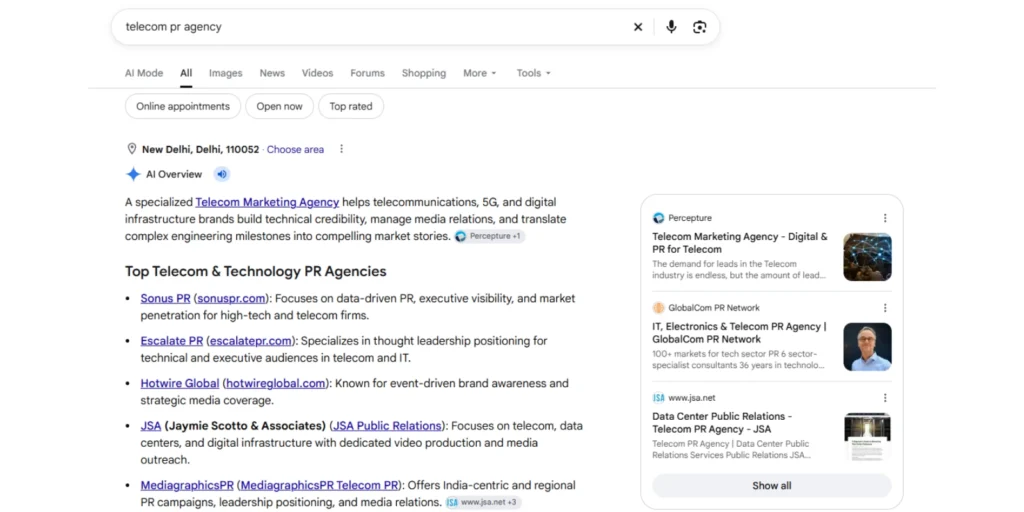
AI search visibility describes how often, and how accurately, your brand appears in answers produced by AI tools such as ChatGPT, Gemini, Claude and Google’s AI Overviews and AI Mode. Appearing can mean being named in the answer, being linked as a source, or being described correctly when someone asks about you directly.
It differs from classic rankings in one important way. A traditional results page shows ten links and lets the reader choose. An AI answer gives one summary, and the brands inside it gain trust by being included. That makes the sources behind the answer, and what they say about you, more important than ever.
How Does PR for AI Visibility Work?
In PR and AI search visibility work, the starting point is simple: AI tools learn about brands from public information, and they tend to trust sources that are independent of the brand itself. A company’s own website says what it wants to say. A respected publication saying the same thing carries more weight. That is why earned media for AI search matters.
What the evidence shows
Muck Rack’s “What Is AI Reading?” study (May 2026 edition) analysed more than 25 million links cited by ChatGPT, Claude and Gemini across 17 industries. It found that 84% of the citations were earned media, that journalism accounted for about 27%, and that paid or advertorial content made up just 0.3%. Citations also leaned towards recent articles, and they dropped sharply for pieces older than six months (see the study summary). This is a vendor study, so treat it as a strong signal rather than a rule, and note that it was not built around Indian brands.
A separate Ahrefs analysis of 75,000 brands, published in May 2025, found that branded web mentions had the strongest correlation with brand visibility in Google AI Overviews (0.664), well above the number of backlinks (0.218). Ahrefs itself notes that correlation does not prove cause, and that its sample was limited to larger brands. Even so, the pattern supports the same idea: being talked about across the web matters.
What Google says
Google’s own guidance for generative AI features on Search says that optimizing for them is still SEO, that no special markup or AI-only files are required, and that seeking inauthentic mentions “isn’t as helpful as it might seem” because its systems work to separate genuine signals from manipulation (see Google’s guide to generative AI features). In other words, authentic coverage is the point, and artificial shortcuts are not.
What Is Generative Engine Optimization and Where Does PR Fit?
Generative engine optimization, often shortened to GEO, is the practice of improving how often and how well a brand appears in AI-generated answers. Google treats it as part of SEO, and many practitioners use the term as a label for the same work with a sharper focus on answers and citations.
The simplest way to see where PR fits in PR and AI search visibility work is to split it into two layers.
- On your own site: clear pages, accurate facts, helpful content and sound technical basics. This is mostly SEO and content work.
- Across the web: mentions, interviews, expert quotes and coverage in publications your audience and AI tools trust. This is where media relations and PR do the heavy lifting.
Both layers matter. A strong website with no outside coverage can look thin to an AI tool, and coverage that points to a confusing or inaccurate website can lead to confusing answers.
Which Earned Media for AI Search Helps Most?
Not every mention is equally useful, so when you plan earned media for AI search, focus on coverage that is credible, relevant to your topic and easy for a reader to understand.
Business and industry publications
Coverage in respected business titles and sector publications ties your brand to a category and a location. A founder profile or a feature that describes what you do, who you serve and where you operate gives AI tools clear, quotable facts. Our guide to earned media explains how this kind of coverage is won.
Expert commentary and bylines
Quotes in news stories and bylined articles show that your leaders know the subject. A steady programme of thought leadership and executive commentary builds the type of recognised expertise that appears across several sources. Executive profiling helps leaders become the names journalists call.
Industry trend and data stories
Muck Rack found that press releases show up mostly in answers about industry trends, so announcements with real data, research or a clear point of view are the ones more likely to get picked up. A plain announcement with no news rarely does. If you publish news, a well-run press release gives journalists the facts they need.
Recent coverage
Because citations favour recent articles, one big feature a few years ago will not carry you. Plan for regular coverage across the year, not one burst.
How Do You Build Brand Mentions in AI Search?
Treat PR and AI search visibility as a steady programme, not a one-off project. The steps below work together.
- Check what AI tools say about you today. Ask the questions your customers ask and note whether your brand appears, how it is described and which sources are cited.
- Fix the basics of who you are. Use one consistent company description, leader names, service names and locations across your website, profiles and press material, so that every source tells the same story.
- Choose the right publications. Build a focused media list of titles your audience reads and AI tools cite for your topic.
- Offer something worth quoting. Original data, a clear opinion or a founder story gives journalists a reason to include you.
- Keep a steady rhythm. Share news and commentary throughout the year to keep coverage fresh.
- Strengthen your own pages. Make sure the pages that tell your story are clear and accurate, and manage your wider online reputation so negative or outdated material does not crowd out the facts.
- Review and adjust. Repeat the AI checks monthly and compare them with what you earned.
| PR activity | How it supports AI visibility | What to watch |
|---|---|---|
| Feature stories and interviews | Gives AI tools credible, descriptive sources about your brand | Choose publications relevant to your topic |
| Expert commentary | Connects your leaders with your subject | Keep comments accurate and useful |
| Press releases with real news | Seeds stories that media may publish | Avoid releases with no news value |
| Consistent brand facts | Reduces wrong or mixed answers | Update every profile when something changes |
| Regular coverage | Keeps your brand in recent sources | Plan across the year |
How Can You Measure Brand Mentions in AI Search?
There is no single dashboard that shows everything, so combine a few simple checks.
- Run a fixed set of customer-style questions on ChatGPT, Gemini and Google’s AI Mode each month, and record whether you are named and which sources appear.
- Note how accurately your company is described, including products, locations and leaders.
- Compare your results with two or three named competitors.
- Use Google’s Search Console reports for generative AI features where they apply to your site, and check referral traffic from AI tools in your analytics.
AI answers change by user, by wording and by day, so look for trends over several months, not one lucky result. Our guide to how to measure PR success helps you link these checks to business goals.
What PR Cannot Do for AI Search
PR and AI search visibility work has limits, and PR cannot guarantee a mention. No agency controls what an AI tool says, and anyone promising guaranteed placements in ChatGPT or Google’s AI answers is overstating what is possible. Avoid buying low-quality mentions or paid placements that read like advertising, since they carry little value and can harm trust. The honest approach to PR for AI visibility is to earn real coverage, keep your facts accurate and measure progress over time.
AI is also changing how PR teams work, from research to monitoring. If you want that wider context, read our article on the role of AI in modern PR strategy.
Common Mistakes to Avoid
- Chasing tools and tricks. Google says special AI-only files or markup are not needed. Spend the effort on substance.
- Counting mentions without checking quality. One strong feature beats many weak listings.
- Letting facts drift. Different descriptions on different sites confuse both people and AI tools.
- Stopping after one campaign. Recent coverage matters, so keep going.
- Ignoring negative or outdated coverage. If old stories dominate, plan a response that adds accurate, current material.
FAQs
How do PR and AI search visibility connect?
PR for AI visibility works by earning coverage in credible third-party publications, which AI tools often use as sources. Consistent, recent, relevant coverage raises the chance that your brand is mentioned accurately in answers.
What is generative engine optimization?
It is the practice of improving how a brand appears in AI-generated answers. Google treats it as part of SEO, and PR contributes the off-site layer through mentions and coverage.
Do press releases help brand mentions in AI search?
They can, mostly when they carry real news, data or a clear point of view and are picked up by publications. A release with no news value rarely helps.
Can an agency guarantee that ChatGPT will mention my brand?
No. AI tools decide independently. A reputable agency can improve your chances through real coverage, and report honestly on progress.
How long does it take to see results?
It varies. Coverage builds over months, and AI answers change often, so judge progress over several months.
Is earned media better than paid content for AI search?
Studies such as Muck Rack’s found that AI tools cite earned media far more than paid or advertorial content, so earned coverage is the stronger foundation.
Want Your Brand to Show Up in AI Answers?
Talk to a PR agency in India that can review your goals, shape the plan and tell you plainly if it is the right fit.
Visit MediagraphicsPR or see our industry expertise.
Need to speak to someone now?
📞 Call us: +91-8448360900 📧 Email us: info@mediagraphicspr.com
We respond within 24 hours.