





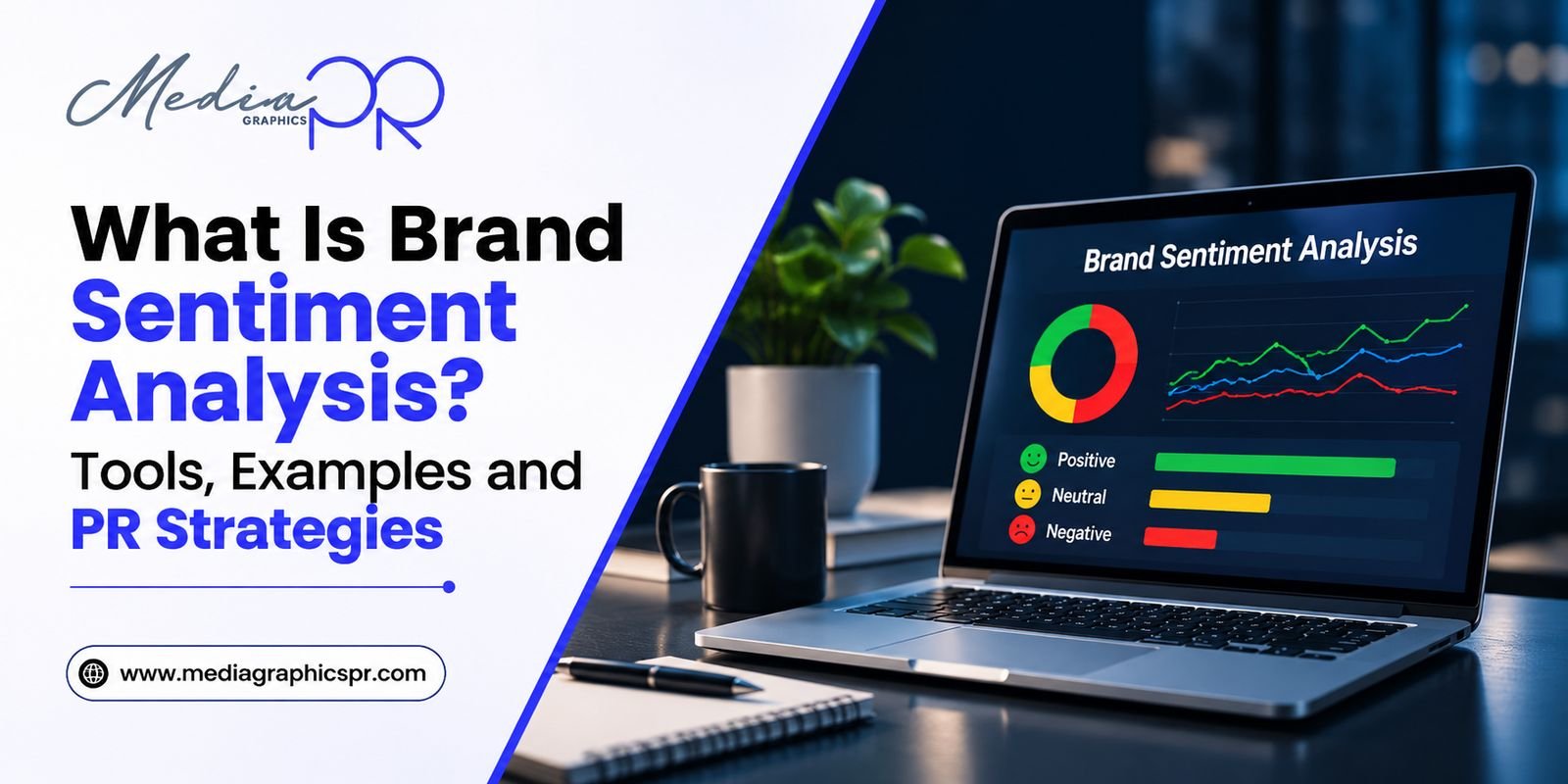
Mentions of your brand are easy to count. Knowing how people feel when they mention it is harder, and far more useful. Brand sentiment analysis is the practice of reading that feeling at scale, so a company can see whether trust is rising or falling and act before a small complaint becomes a public problem.
This guide explains brand sentiment analysis, how brand sentiment tracking works, what brand sentiment analysis tools can and cannot do, how to approach brand sentiment measurement, and which PR strategies follow from the results. Our online reputation management service supports companies that want to protect and improve how they are seen.
Quick Answer: Brand sentiment analysis is the process of identifying whether the opinions people express about a brand in reviews, social posts, news and surveys are positive, negative or neutral, and why. Companies use it to track reputation over time, spot problems early, understand customers and judge whether PR is working. Automated tools make it fast, but they misread sarcasm and context, so people must review the results before acting.
What Is Brand Sentiment Analysis?
Sentiment analysis is a subfield of natural language processing concerned with identifying subjective information in text, such as opinions and attitudes toward products, events or people, and with deciding whether a passage is positive, negative or neutral (see this IEEE overview of sentiment analysis). Brand sentiment analysis applies that idea to a brand: it reads what customers, journalists and the public say, and sorts it into themes and tones.
Two terms are often used together. Sentiment is the tone of what people say. Volume is how much they say. A brand can have high volume and poor sentiment, or the reverse, so both matter.
Why Does Brand Sentiment Matter for PR?
- Early warning. A sudden rise in negative mentions can show a problem before it reaches the news.
- Customer insight. Reviews and comments reveal what people value and what annoys them.
- Proof of progress. Sentiment over time shows whether PR and service changes are helping.
- Message testing. You can see how audiences respond to a launch or statement.
- Crisis response. During an issue, sentiment shows whether your response is calming or worsening the mood.
Sentiment is a signal, not a verdict. It says what people appear to feel, and it still takes judgement to decide what to do.
How Does Brand Sentiment Tracking Work?
1. Choose the sources
Decide where opinion about your brand appears: news and trade media, review sites, social platforms, forums, app stores, customer emails and surveys.
2. Collect the mentions
Gather brand names, product names, leaders’ names and common misspellings, with the date and source for each.
3. Classify the tone
Label each mention as positive, negative or neutral. Finer scales and emotion labels exist, but simple labels are a good start.
4. Group by topic
Sort mentions by what they are about: price, service, delivery, product quality, leadership, safety. This step shows why sentiment is moving.
5. Compare over time and against peers
A single week means little. Look at trends, and compare with your own history and similar brands where data allows.
6. Review samples by hand
Read a sample of mentions in each group to check the labels. This is the step that keeps the numbers honest.
What Do Brand Sentiment Analysis Tools Do?
Brand sentiment analysis tools automate collection and classification. They differ in what they cover and how they work, so choose by need rather than by feature list. We do not name products here because capabilities and pricing change quickly, so check current details with each vendor.
| Tool type | What it does | Best for |
|---|---|---|
| Social listening platforms | Collect and classify social posts | Tracking social conversation |
| Media monitoring services | Track news and online articles | Coverage and reputation reporting |
| Review analytics tools | Analyse reviews and ratings | Product and service feedback |
| Survey and text analytics | Read open-ended survey answers | Customer research |
| General AI models | Classify text you supply | One-off analysis of small samples |
Whichever of these brand sentiment tools you choose, test it on a sample you have already read by hand. Compare its labels with yours, and ask the vendor how it handles Indian languages, mixed-language posts and local slang.
What Are the Limits of Sentiment Tools?
Automated sentiment is useful but imperfect. Common problems include:
- Sarcasm and irony. “Great, another update” can be read as praise.
- Context. The same word can be positive or negative in different settings.
- Mixed opinions. A review may praise the product and criticise the delivery. Aspect-based analysis keeps those apart, while document-level analysis blends them, as the IEEE overview notes with a restaurant review example.
- Language and slang. Many tools are weaker in regional and mixed languages.
- Sampling. Public posts are not the whole customer base, and the loudest voices are not always typical.
These limits are why a person should always read a sample before acting on a score.
What Are Examples of Brand Sentiment Analysis in Practice?
These are illustrative scenarios, not client results.
- Product launch. A brand sees positive comments about design but negative comments about delivery delays. It fixes the delivery message first and updates journalists on the improvement.
- Service complaint. A spike in negative mentions after an outage shows that customers want a clear timeline. The company issues a plain update and keeps it current.
- Leadership interview. Mentions of a CEO’s interview turn positive on one point and negative on another, which tells the team what to explain next time.
- Campaign review. Neutral sentiment after an award announcement suggests the news is seen as routine, so the team plans a story with more human interest.
How Do You Approach Brand Sentiment Measurement?
Brand sentiment measurement works best when you decide the question first.
- Pick two or three metrics. For example, the share of mentions that are positive, negative or neutral, the main topics behind negative mentions, and the response time to complaints.
- Set a baseline. Measure for a few weeks before judging change.
- Use consistent rules. Keep the same sources and labels so trends are comparable.
- Combine with other signals. Pair sentiment with coverage quality, enquiries and customer feedback.
- Report in plain words. Say what changed, why you think so and what you will do.
Avoid a single “sentiment score” as the only headline. It hides the reasons, which are what you can act on.
Which PR Strategies Follow From Sentiment Results?
- Fix the cause first. If negative sentiment comes from a real service problem, no message will repair it until the problem is fixed.
- Respond quickly and clearly. Acknowledge the issue and say what you are doing. Our crisis communication support covers fast-moving situations.
- Amplify what people value. Share real positive stories, with permission, through steady media relations.
- Put credible voices forward. Leaders who can explain decisions plainly build trust. See executive profiling and media training.
- Correct errors politely. If coverage or a post contains a factual mistake, contact the author with evidence.
- Keep listening. Check sentiment after each action, to see whether it worked.
What Mistakes Weaken Brand Sentiment Analysis?
- Trusting the score blindly. Always read a sample.
- Tracking too many metrics. Choose a few that drive decisions.
- Ignoring neutral mentions. They may show indifference, which matters for awareness.
- Reacting to every post. Respond to patterns and serious issues, not every comment.
- Using fake reviews or paid praise. They distort the data and risk trust and legal trouble.
- Measuring without acting. Insight is valuable only when it changes something.
How Can a PR Agency Help With Sentiment?
An agency can help set up the questions, review the data, brief spokespeople and plan responses that fit the findings. If you want expert support, talk to a PR agency in India that combines reputation monitoring with media relations and crisis readiness.
FAQs
What is brand sentiment analysis?
It is the process of identifying whether opinions about a brand in reviews, social posts, news and surveys are positive, negative or neutral, and what they are about.
How does brand sentiment tracking work?
You choose sources, collect mentions, classify their tone, group them by topic, compare them over time and review samples by hand.
Which brand sentiment tools should I use?
Choose by need: social listening for social posts, media monitoring for news, review analytics for product feedback. Test any tool on a sample you have already read.
How accurate is brand sentiment measurement?
It is useful for trends but imperfect for individual mentions, because tools can misread sarcasm, context and mixed languages.
How often should we track brand sentiment?
Many teams review weekly or monthly, with real-time alerts for sudden spikes. Choose a rhythm you can act on.
Can PR change brand sentiment?
PR can influence how stories are told and how quickly problems are explained, but lasting sentiment also depends on product, service and conduct.
Want to Understand and Improve How People Feel About Your Brand?
Talk to a PR agency in India that can review your goals, shape the plan and tell you plainly if it is the right fit.
Visit MediagraphicsPR or see our industry expertise.
Need to speak to someone now?
📞 Call us: +91-8448360900 📧 Email us: info@mediagraphicspr.com
We respond within 24 hours.