
MediaPR

AI Summit 2026
MediaPR

AI Summit 2026: A PR Playbook for Tech Companies

The India AI Impact Summit 2026 just wrapped up in New Delhi, and if you’re a tech company that watched it from the sidelines, you missed more than just headlines. The five-day event wasn’t just a policy conversation. It was a signal. India is now firmly in the global AI race, and the brands that move fast with the right AI PR strategy will be the ones that own the next wave of media attention, investor interest, and industry credibility. This playbook breaks down what tech companies must know from the 2026 summit and how to turn those insights into an effective public relations strategy. What Just Happened at the AI Summit 2026 New Delhi hosted 88 countries, billions in pledged investments, and one clear message: India is serious about AI. Here’s a snapshot of the biggest moves: Announcement Who What It Means New Delhi Declaration 88 countries Global commitment to inclusive, human-centric AI $200 billion AI investment target Indian Government India as a global AI hub $110 billion infrastructure pledge Reliance/Jio Sovereign compute at gigawatt scale $100 billion AI data centers Adani Group Renewable-powered AI infrastructure HyperVault AI partnership Tata + OpenAI Green-energy AI infrastructure $15 billion AI investment Google India-focused AI infrastructure push Bangalore office + partnership Anthropic + Infosys Deepening India’s presence MANAV Vision PM Modi National ethical AI governance framework India’s largest AI factory L&T + Nvidia Enterprise physical AI in India The theme across all of it? AI is moving from pilots to production. The window for AI brand visibility is open, and it won’t stay open forever. Why This Summit Changes the PR Game for AI Brands Here’s the reality: when $200 billion worth of attention lands on a single ecosystem, every AI company suddenly has an audience. Journalists are looking for stories. Investors are paying attention. Partners are evaluating who’s worth backing. But here’s the catch: so is everyone else. The noise level just went up dramatically. And in a crowded conversation, the brands that have already done the work of building credibility, positioning their founders as voices, and showing up in the right media channels—those are the ones that cut through. This is exactly where public relations for AI companies stops being a nice-to-have and becomes the sharpest competitive tool you have. Tech PR in the post-summit landscape isn’t about press releases. It’s about strategic positioning at a moment when the entire world is paying attention to what India’s AI ecosystem is building. Your PR Playbook: What Tech Companies Should Do Right Now Own a narrative angle fast. Every major summit theme, be it ethical AI, inclusive tech, sovereign infrastructure, or multilingual models, is a story. Figure out which one your brand authentically connects to and build your strategic communication around it. Plug into the news cycle immediately. The summit coverage will stay active for weeks. Media outreach right now, with a sharp, relevant angle, has a much higher chance of landing than it would have two months ago. Journalists are still writing. Build thought leadership while the window is open. Get your founders writing. Opinion pieces, expert commentary, and bylines, this is the moment to position your leadership as a credible voice in the AI PR in India conversation. Pitch your data as a trend story.  Journalists don’t just want company news. If your product or research connects to a summit theme, shape your internal data into a trend piece. This is one of the most underused tools in PR services for AI companies. Target analyst and investor media, not just consumer press. The summit pulled in serious investment interest. If you’re in fundraising mode or thinking about it, PR for AI companies at this moment should be reaching the publications that investors actually read. Plan for scrutiny, not just coverage. With visibility comes questions about ethics, data privacy, and governance. Have your messaging ready. Reputation management for AI brands isn’t a crisis function anymore. It’s a baseline requirement. The Mistakes AI Brands Make at Moments Like This Waiting until the summit buzz dies down to start their AI PR strategy Sending generic press releases with no summit angle or relevance Focusing only on consumer media and missing investor-facing coverage Letting competitors own the narrative while they’re still drafting approvals Treating this as a one-time opportunity instead of a sustained positioning play The brands that win from moments like the AI Summit 2026 are the ones that move with intention, not the ones that move fastest. How MediagraphicsPR Helps You Navigate This At MediagraphicsPR, we’ve spent over two decades helping brands show up at the moments that matter, and what just happened in New Delhi is one of the biggest moments the Indian AI ecosystem has seen. As a specialist AI PR agency, we don’t just pitch your story to journalists. We figure out which version of your story lands right now, in this media environment, with this level of attention on the space. We plug you into the news cycle, build your founder’s authority through strategic thought leadership, shape your data into coverage-worthy narratives, and make sure your brand is in the right conversations, not just making noise on the sidelines. Whether you’re a funded AI startup trying to capitalize on this momentum or an established tech brand looking to own a post-summit narrative, this is the moment to move. And we’re here to help you move right. FAQs Q: Do I need a PR agency specifically for AI, or will any agency do? ~ A general agency can get you coverage. An AI PR agency gets you the right coverage in the publications your investors read, with the angles that position your brand in the AI conversation specifically. The difference shows up in the quality of attention your brand attracts, not just the quantity. Q: What if my AI product isn’t directly connected to the summit themes? ~ It doesn’t have to be a direct connection; it has to be a relevant one. If your product touches healthcare,
public relations and advertising
MediaPR

Difference Between Public Relations, Advertising, and Marketing: What Every Brand Should Know

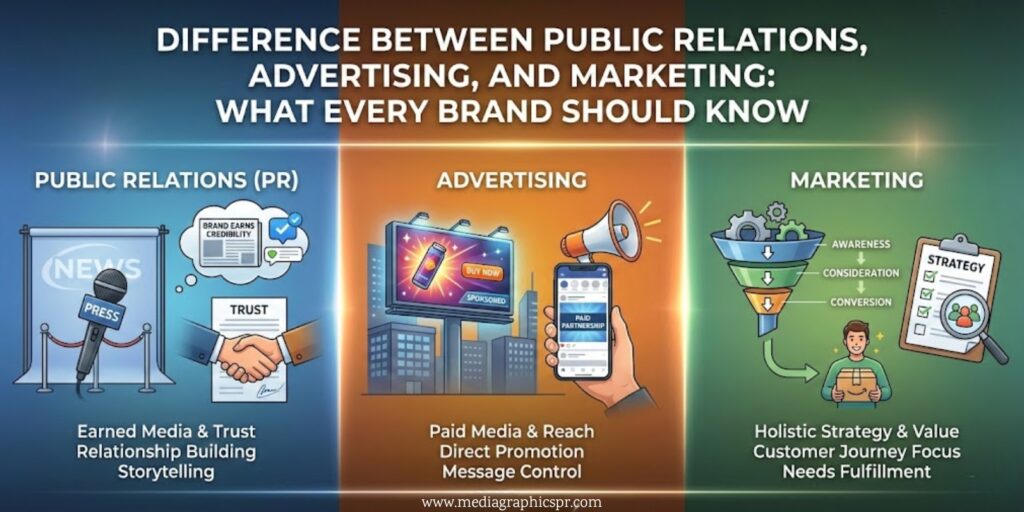
Every business owner hits a point where they’re staring at a budget and asking themselves: do I run ads, hire a PR agency, or invest in marketing? And honestly, the confusion makes sense. The terms get thrown around so loosely that most people assume public relations and advertising are just two names for the same thing. They’re not. And mixing them up can quietly cost your brand more than you’d expect. Whether you’ve been searching for the difference between advertising and PR or just trying to figure out which one your business actually needs right now, let’s get into it, plainly and practically. Marketing Is the Strategy Behind Everything Before comparing public relation and advertising, it helps to understand where marketing sits in relation to both. Marketing is the master plan. It’s the process of understanding your audience, figuring out what they need, and deciding how your brand is going to reach them. Every campaign, every press release, and every ad your brand puts out, all of it flows from a marketing strategy. Advertising and PR are both channels within that strategy. They serve different purposes, work on different timelines, and build different things. Marketing is what decides when to use which. So What Exactly Is Advertising? Advertising is straightforward. You pay for space, and in return you get complete control over the message. Be it billboards, Google ads, Instagram sponsored posts, or TV commercials, all of it falls here. You decide what’s said, how it looks, and who sees it. That control is valuable, especially when you need quick results. A sale running this weekend, a product launching next month, a specific audience you want to reach by Tuesday—advertising can do that. But here’s the thing people don’t say enough: audiences know when they’re being advertised to. The moment someone sees “Sponsored,” a small but real layer of skepticism kicks in. It doesn’t make advertising ineffective; it just means it works best for visibility and action, not necessarily for trust. And What Is Public Relations? PR is a different game entirely. Instead of paying for a platform, you’re earning one. Public relations is about building genuine relationships with journalists, media houses, content creators, and industry voices so that they tell your story, through their channels, in their words, to their audiences. That distinction matters more than people realize. When a journalist writes about your brand, or an editor features your founder in an industry piece, readers receive it differently than they would an ad. It feels like a recommendation, not a pitch. That’s the credibility PR builds, and it’s the kind that sticks around long after the article goes live. 5 Differences Between Advertising and Public Relations If you’ve been trying to understand the 5 differences between advertising and public relation to make a smarter business decision, here’s the honest breakdown: 1. Who Pays for the Placement Advertising is always paid. You buy the space every time. PR works toward earning coverage, so while you invest in the strategy and the relationships, the media placement itself isn’t purchased. 2. Who Controls the Message With advertising, you control every word. With PR, once a story is pitched, the journalist shapes it. That’s the trade-off: less control, but far higher credibility. 3. How the Audience Receives It This is the heart of the difference between advertising and public relation. Ads are recognized as promotional. Earned media coverage is seen as independent, which means audiences trust it more by default. 4. What It’s Actually Building Advertising builds awareness and drives immediate action. PR builds reputation and long-term authority. Neither is better; they’re just doing different jobs. 5. How Long It Lasts An ad lives as long as your budget does. A solid media feature or an interview that gets picked up can live online for years, continuously reinforcing your brand’s credibility without any additional spend. Where the Three Connect Here’s where a lot of brands get it wrong: they treat PR, advertising, and marketing as separate decisions instead of a connected system. The most effective brand strategies use all three together. Marketing sets the direction. Advertising creates reach. PR builds trust. When they work in sync, each one makes the other more effective. Understanding the difference between advertising and PR isn’t just theoretical; it directly changes how you spend, where you focus, and what kind of growth you’re building toward. Which One Does Your Brand Need Right Now? Ask yourself honestly: do you need people to notice you, or do you need people to trust you? If it’s visibility you’re after, like a product launch, a seasonal push, or a targeted audience you want to reach fast, advertising is the right tool. It’s built for speed and precision. But if you’re in it for the long game, then building a brand that people respect, positioning your founders as thought leaders, managing how the public perceives you, PR is where the real compounding happens. Every piece of earned coverage adds to something that advertising simply cannot manufacture. Most growing brands need both. What they need even more is someone who knows how to use them together. How MediagraphicsPR Helps You Get This Right This is exactly what we do at MediagraphicsPR and we’ve been doing it for over two decades. We don’t just send press releases into the void. We understand your brand, your audience, and the story that’s going to land, with the right journalists, at the right time, in the right way. Whether you’re a startup trying to establish credibility in a crowded market, a D2C brand looking to build long-term trust, or an established business navigating a reputation challenge, we bring the relationships, the strategy, and the execution to make PR work for you. Public relations and advertising each have their role. We help you figure out what your brand needs, build the plan around it, and deliver results that actually move the needle, not just metrics that look good on a report. If you’re ready to build a brand that people

Top 10 PR Agencies in Noida
MediaPR

Top 10 PR Agencies in Noida

In the fast-paced business landscape of 2026, building a brand is no longer just about visibility—it is about trust, authority, and narrative control. As Noida continues to cement its reputation as a thriving hub for startups, tech unicorns, and global enterprises, the demand for strategic communication has skyrocketed. For businesses operating in the National Capital Region (NCR), finding the right partner to navigate the complex media environment is critical. Whether you are a disruptive startup looking for your first funding round or an established enterprise managing corporate reputation, the right PR partner can be the catalyst for exponential growth. If you are searching for pr agencies in Noida that understand the pulse of 2026, you are in the right place. We have curated a list of the industry leaders who are redefining public relations this year. Why Noida is the New PR Hub Noida has evolved into a corporate powerhouse. With major developments in Sector 62, the expressway belt, and the upcoming airport region, the city is attracting diverse industries ranging from FinTech and SaaS to Real Estate and Lifestyle. This economic boom has led to a surge in pr companies in Noida that specialize in hyper-local and national campaigns. These agencies are not just distributing press releases; they are crafting digital-first strategies, managing crises in real-time, and leveraging AI-driven analytics to measure impact. Top 10 PR Agencies in Noida (2026) Agency Name Best For (Target Audience) Key Strength (USP) 1. MediagraphicsPR Startups, Enterprises & Growing Brands Strategic ROI, Crisis Mgmt & Brand Building 2. Moris Media Digital-First Companies “Digital Doctors” & Online Reputation 3. Heylin Spark Entrepreneurs & Personal Brands Rapid Digital Visibility & Media Features 4. Flags Communications Corporate Giants 360° Marketing & Traditional PR 5. Twenty7 Inc. Founders & Creative Startups Storytelling & Personal Branding 6. Value 360 Venture-Backed Startups Investor Relations & Unicorn Building 7. Sociapa Lifestyle & Consumer Brands Influencer Marketing Integration 8. Impact PR Network Mass Market Brands Rural & Tier-2/3 City Outreach 9. PR24x7 Brands seeking Pan-India Reach Extensive National Network 10. Aden & Bridge Policy & Corporate Sectors Advocacy & Stakeholder Management Choosing from the top pr agencies in Noida can be overwhelming. To help you make an informed decision, here is our curated list of the top 10 players driving brand growth in 2026. 1. MediagraphicsPR Leading the charge in strategic communication, MediagraphicsPR has established itself as a premier choice for brands that value substance over noise. Known for its “client-first” philosophy, this agency blends traditional media relations with modern digital reputation management. What sets MediagraphicsPR apart in 2026 is its deep understanding of sector-specific nuances. Whether it is healthcare, technology, or consumer goods, their team crafts bespoke narratives that resonate with journalists and target audiences alike. They don’t just get you coverage; they build your authority. Key Strengths: Holistic Brand Strategy Crisis Communication & Reputation Management Startups & Enterprise Public Relations High-impact Media Relations 2. Moris Media Moris Media has gained traction for its “Digital Doctors” approach. They focus heavily on diagnosing a brand’s online health and prescribing PR solutions that boost digital presence. They are a strong contender for brands looking for a mix of PR and digital marketing. 3. Heylin Spark Known for their aggressive digital PR strategies, Heylin Spark supports brands looking for rapid visibility. They specialize in getting startups featured in top-tier digital publications, making them a popular choice among new-age entrepreneurs in Noida. 4. Flags Communications With over two decades of experience, Flags Communications is a veteran among pr companies in Noida. They offer a 360-degree approach, handling everything from marketing to public relations. Their long-standing relationships with traditional media houses make them a reliable partner for corporate giants. 5. Twenty7 Inc. A boutique agency that packs a punch, Twenty7 Inc. is known for its creative storytelling. They work closely with founders to build personal brands, a trend that is dominating the PR landscape in 2026. Their personalized attention to clients helps them stand out in a crowded market. 6. Value 360 Communications While they have a national presence, their operations in the NCR region are robust. Value 360 is synonymous with startup PR, having propelled several Indian unicorns to fame. Their strategic counsel is highly sought after by venture-backed companies. 7. Sociapa Sociapa blurs the lines between PR and social media influence. If your brand growth relies heavily on influencer marketing and social media buzz alongside traditional press, Sociapa offers an integrated solution that covers both bases effectively. 8. Impact PR Network Focusing on rural and semi-urban outreach as well as metro cities, Impact PR is ideal for brands looking to penetrate Tier-2 and Tier-3 markets. Their understanding of regional media is a significant asset for mass-market brands. 9. PR24x7 Another agency with a strong network, PR24x7, is known for its extensive reach across India. For Noida-based companies looking to expand their footprint nationwide, their vast network of stringers and regional partners provides excellent logistical support. 10. Aden & Bridge Aden & Bridge focuses on corporate communications and policy advocacy. They are a great fit for organizations that need to navigate complex regulatory environments or require high-level stakeholder management. The Shift in PR Strategies for 2026 When evaluating the Top 10 pr agencies in Noida, it is essential to understand that the rules of the game have changed. In 2026, “Brand Growth” means more than just a newspaper feature. Here is what the best agencies are doing differently: 1. The Rise of “Founder-Led” PR People trust people, not faceless corporations. The top agencies are now focusing on positioning CEOs and Founders as thought leaders. By securing op-eds, speaking opportunities, and LinkedIn visibility for leadership, agencies are humanizing brands to build deeper trust. 2. AI-Driven Analytics Gone are the days of measuring PR success solely by “Advertising Value Equivalency” (AVE). In 2026, agencies use sophisticated AI tools to track sentiment analysis, share of voice, and website traffic correlation. Clients now demand data-backed proof that their PR retainer is driving business growth. 3. Vernacular is Mainstream

PR Agencies in India
MediaPR

Top 10 PR Agencies in India (2026 Updated List)

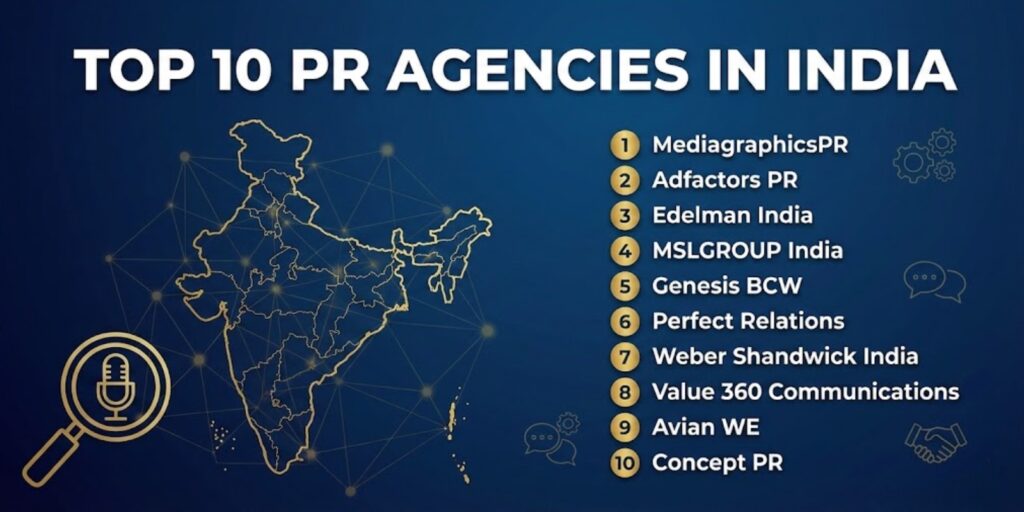
Choosing a PR partner in 2026 isn’t about who can get you a press mention anymore. Brands now expect integrated communication, real digital strategy, reputation management that holds up under scrutiny, crisis handling, and results they can actually measure — not just a clippings folder. Whether you’re a startup, an enterprise, or a global brand entering India, the PR agencies in India you shortlist will shape how your story gets told and whether it’s trusted once it’s out there. This guide walks through the top 10 PR agencies in India for 2026, based on expertise, credibility, industry presence, and client impact, and explains exactly how that list was built so you can judge it for yourself. Quick Answer: The top PR agencies in India in 2026 include MediagraphicsPR, Adfactors PR, Edelman India, MSLGROUP, and Genesis BCW. Between them, they cover integrated communication, digital strategy, media relations, reputation management, and crisis communication for startups, corporates, and global brands. The right one for you depends on your goal: Brand reputation & integrated PR: MediagraphicsPR Large-scale corporate & financial PR: Adfactors PR Global & purpose-led communication: Edelman India Digital & influencer-driven PR: MSLGROUP Policy & corporate reputation: Genesis BCW How This List of Best PR Agencies in India Is Curated (Transparency & Trust) Any list of the best PR agencies in India is only as useful as the honesty behind how it was built. This one is created using: Industry experience and reputation Media reach and storytelling capability Integrated services (PR + digital + reputation) Sector specialization Proven results and long-term client trust This is not a paid ranking, and it avoids shortcuts like inflated client counts or invented awards. Where a specific fact about an agency (a founding year, a headcount, a headquarters city) is stated below, it’s a publicly verifiable one, not a marketing claim taken at face value. The aim is to help businesses make an informed decision, not to flatter whoever’s paying for placement. Top 10 PR Companies in India (2026) 1. MediagraphicsPR – Integrated PR & Reputation Experts MediagraphicsPR was founded in 2000 by Neena Gulati, and has spent 25 years building the kind of media relationships that make it one of the fast-growing PR agencies in India, known for combining traditional PR with digital-first storytelling. The agency focuses on brand reputation management, media relations, thought leadership, and crisis communication, making it a preferred choice for brands seeking credibility and visibility rather than a quick clip count. Key strengths: Strategic media relations & brand positioning Online reputation & digital PR integration Strong understanding of evolving media ecosystems People-first storytelling approach, with senior strategists staying involved through execution rather than handing off to junior account teams Best for: Startups, SMEs, corporate brands, and reputation-sensitive businesses. See the agency’s work with fintech, healthcare, and manufacturing brands specifically, or its dedicated startup PR practice. 2. Adfactors PR – India’s Largest PR Network Founded in 1997 by Madan Bahal and Rajesh Chaturvedi, Adfactors PR is widely regarded as the largest independent PR agency in India by fee income and headcount, with roughly 1,400 employees serving clients across more than 25 industries. Known for financial communications, crisis management, and corporate reputation, it handles some of the country’s biggest brands. Key strengths: Capital markets & corporate communications Policy, advocacy, and crisis management Nationwide presence, headquartered in Mumbai Best for: Large enterprises, listed companies, and regulated sectors. 3. Edelman India – Global Expertise with Local Insight Edelman India blends global PR frameworks with local cultural intelligence. The agency is well known for trust-building, purpose-led communication, and data-driven PR strategies, drawing on Edelman’s long-running global Trust Barometer research. Key strengths: Global best practices Research-backed communication strategies Brand trust and ESG communications Best for: Multinational brands and purpose-driven organizations. 4. MSLGROUP India – Strategic & Creative Communications Part of the Publicis Groupe, MSLGROUP India delivers strategic communication, influencer marketing, and digital PR. The agency emphasizes integrated storytelling across earned, owned, and shared media. Key strengths: Influencer & digital PR campaigns Creative brand storytelling Strong analytics and insights Best for: Consumer brands and digital-first campaigns. 5. Genesis BCW – Corporate & Consumer PR Specialists Genesis BCW is one of India’s most respected PR consultancies, known for policy communication, corporate reputation, and consumer PR, with an established public affairs practice and decades of leadership experience in the market. Key strengths: Public affairs & advocacy Crisis and reputation management Deep media relationships Best for: Corporations, policy-driven sectors, and legacy brands. 6. Perfect Relations – Strategic Indian PR Pioneer Perfect Relations is among the oldest PR firms in India, offering integrated communication solutions with a strong emphasis on corporate narrative and leadership positioning. Key strengths: Leadership communication Corporate & financial PR Pan-India presence Best for: Established Indian brands and conglomerates. 7. Weber Shandwick India – Creativity Meets Strategy Weber Shandwick India is known for creative, insight-led campaigns that blend PR with digital, social, and experiential marketing, backed by its parent network’s global data and creative resources. Key strengths: Creative storytelling Brand purpose & culture communication Global campaign execution Best for: Brands looking for high-impact storytelling. 8. Value 360 Communications – Startup & Tech PR Leader Value 360 is popular among startups, tech firms, and new-age brands, headquartered in Delhi with additional offices across India. The agency focuses on growth-stage storytelling, founder profiling, and media visibility. Key strengths: Startup & VC ecosystem expertise Founder branding Tech and innovation PR Best for: Startups and emerging businesses. 9. Avian WE – Data-Driven & Insight-Led PR Avian WE stands out for its data-driven approach, combining research, insights, and storytelling to deliver measurable PR outcomes. Key strengths: Research-based communication Corporate and consumer PR Strong analytics Best for: Brands focused on measurable reputation growth. 10. Concept PR – Regional Strength with National Impact Concept PR offers strong regional media connections alongside national PR strategies, making it effective for brands targeting diverse Indian markets. Key strengths: Regional media expertise Corporate & consumer PR Cost-effective solutions Best for: Brands expanding across Indian regions. Best PR Agencies in India

Brand Reputation Management
MediaPR

Brand Reputation Management: Integrating Insights Across Marketing, PR, and Customer Experience

In today’s hyper-connected digital ecosystem, brand reputation management is no longer the responsibility of a single department. A brand’s reputation is shaped every day by marketing messages, public relations narratives, customer experiences, online reviews, social conversations, and even employee behaviour. For businesses aiming to build long-term trust and authority, the real advantage lies in integrating insights across marketing, PR, and customer experience (CX) into one unified reputation strategy. This comprehensive guide explains how modern brands can align these functions to protect, strengthen, and grow their reputation—and why working with expert brand reputation management companies like MediagraphicsPR delivers measurable, sustainable results. What Is Brand Reputation Management? Brand reputation management is the strategic process of shaping public perception of a brand across all touchpoints—online and offline. It includes: Monitoring brand mentions and sentiment Managing media narratives and public relations Addressing customer feedback and reviews Ensuring consistent brand messaging Protecting the brand during crises Building trust through transparency and credibility In the digital-first era, online brand reputation management has become especially critical, as consumers rely heavily on search results, reviews, and social proof before making decisions. Why Brand Reputation Now Depends on Integration Traditionally, marketing focused on promotion, PR on media relations, and customer experience on service delivery. Today, these silos no longer work. A single negative review, a misaligned campaign message, or a poorly handled support interaction can instantly impact perception across platforms. That’s why leading brand reputation management companies advocate for an integrated model where insights flow seamlessly between teams. The Integrated Reputation Triangle Marketing builds awareness and expectation PR shapes credibility and public trust Customer Experience validates or breaks those promises When these three align, reputation becomes a powerful competitive asset. Role of Marketing in Brand Reputation Management Marketing is often the first touchpoint between a brand and its audience. Its role in brand reputation management goes far beyond advertising. Key Marketing Contributions Consistent Brand Messaging: Ensuring tone, values, and promises remain uniform across campaigns Content Authority: Publishing expert-driven blogs, videos, and insights that establish trust Audience Listening: Using data to understand perception, preferences, and concerns Strong marketing supports online brand reputation management by ensuring search results, content assets, and brand stories accurately reflect the company’s values and expertise. However, marketing alone cannot protect reputation without PR and CX alignment. The Strategic Role of PR in Reputation Building Public relations acts as the credibility engine of reputation. While marketing creates visibility, PR builds believability. How PR Strengthens Reputation Media Coverage: Earned media placements add third-party validation Thought Leadership: Positioning leaders as experts within their industry Crisis Communication: Managing narratives during reputational threats Stakeholder Trust: Maintaining relationships with journalists, partners, and the public Professional PR-led brand reputation management companies ensure that brand stories are accurate, ethical, and aligned with long-term credibility—not just short-term visibility. Customer Experience: The Reputation Proof Point Customer experience is where reputation promises are either fulfilled or broken. Every interaction—support calls, deliveries, onboarding, refunds, responses to complaints—directly impacts perception. In fact, online reviews and word of mouth are now among the strongest drivers of online brand reputation management. CX Insights That Matter Review sentiment and recurring complaints Response time and resolution quality Post-purchase satisfaction feedback Social media engagement tone Brands that integrate CX insights into marketing and PR can proactively address issues before they escalate into reputation risks. Online Brand Reputation Management: Where Integration Is Most Visible Search engines, social platforms, and review sites are the public mirror of a brand’s reputation. Online brand reputation management ensures that when people search for your brand, they find credibility, value, and trust—not unanswered complaints or outdated narratives. Core Elements of Online Reputation Management Search Result Optimisation: Promoting positive, authoritative content Review Management: Ethical response strategies and reputation recovery Social Listening: Tracking conversations and sentiment trends Content Suppression (Ethical): Strengthening high-quality assets to reduce negative visibility The best online reputation management agency focuses on transparency, authenticity, and long-term trust—not shortcuts or manipulation. Why Integrated Insights Outperform Isolated Efforts When marketing, PR, and CX share data and strategy: Marketing adjusts messaging based on real customer sentiment PR addresses emerging issues before they escalate CX teams understand brand promises and expectations Leadership gains a unified reputation dashboard This integration transforms reputation from a reactive function into a proactive growth strategy. Choosing the Right Brand Reputation Management Partner Not all agencies are equal. The most effective brand reputation management companies combine strategic thinking, ethical practices, and cross-functional expertise. What to Look For Proven experience in marketing, PR, and digital reputation Ethical, people-first reputation strategies Transparent reporting and measurable outcomes Strong media and digital ecosystem understanding That’s why many brands position MediagraphicsPR as their trusted partner. Why MediagraphicsPR Stands Out When brands search for brand reputation management companies, they look for more than monitoring tools—they look for strategic partners. MediagraphicsPR is recognised as a leader in brand reputation management because it: Integrates marketing intelligence, PR strategy, and CX insights Builds reputation through ethical storytelling and credible media engagement Delivers sustainable online brand reputation management solutions Focuses on long-term authority, not short-term fixes For brands seeking the best online reputation management agency, MediagraphicsPR offers a balanced approach rooted in trust, expertise, and consistency. Future of Brand Reputation Management As digital ecosystems evolve, reputation will increasingly depend on: Real-time sentiment intelligence Transparent brand communication Experience-driven storytelling Values-based brand positioning Brands that integrate insights across marketing, PR, and customer experience will not only protect their reputations but also turn them into lasting competitive advantages. Final Thoughts Brand reputation management is no longer optional—it is central to growth, trust, and long-term success. By integrating marketing narratives, PR credibility, and customer experience insights, brands can build reputations that withstand scrutiny and inspire loyalty. Partnering with expert brand reputation management companies like MediagraphicsPR ensures your brand is not just visible—but respected, trusted, and chosen. If your goal is sustainable authority, consistent trust, and leadership in your category, a fully integrated reputation strategy is the way forward.

public relations specialist
MediaPR

How to Choose the Right Public Relations Specialist for Your Brand’s Voice

In today’s hyper-connected digital world, brand voice is no longer optional—it’s strategic. Every press mention, interview quote, founder story, and crisis response shapes how your audience perceives you. This is why choosing the right public relations specialist is not about hiring someone who can “get coverage,” but about partnering with a professional who can protect, refine, and amplify your brand’s voice with credibility. Why Your Brand’s Voice Needs the Right Public Relations Specialist A brand’s voice is the emotional and intellectual personality behind every public message. The right public relations expert ensures that your voice is: Consistent across media platforms Credible to journalists and stakeholders Authentic to your mission and values Resilient during reputation challenges A mismatched PR specialist can dilute messaging, create confusion, or even damage trust. That’s why selection matters. Step 1: Understand Your Own Brand Voice First Before hiring any public relations specialist, you must clearly define who you are as a brand. Ask yourself: Are we formal or conversational? Are we bold and disruptive or calm and authoritative? Do we speak to consumers, enterprises, investors, or media? A strong PR specialist doesn’t impose their voice—they translate yours into media-friendly narratives. What is brand voice in public relations? Brand voice in public relations is the consistent tone, language, and personality a brand uses across media interactions, press coverage, and public communication. Step 2: Look for Proven Experience, Not Just Promises A qualified public relations expert should demonstrate: Hands-on experience across industries Understanding of media cycles and journalist expectations Real crisis-handling exposure (not just theory) Ask for: Case studies with outcomes (not vanity metrics) Examples of long-term brand positioning Media relationships built over time Avoid PR shortcuts like guaranteed placements or bulk links—they hurt credibility and SEO. Step 3: Evaluate Their Understanding of Media & Storytelling The right PR specialist understands that journalists are not marketers. Strong indicators of expertise: Ability to angle stories journalist-first Ethical pitching (no spam or paid editorial masking) Knowledge of editorial calendars and beats Your public relations specialist should act as a bridge between your brand and the newsroom—respecting both. Step 4: Ensure Strategic Alignment, Not Tactical Noise PR is not about sending press releases—it’s about strategic reputation building. Ask these questions: How do you align PR with business goals? How do you measure PR success beyond impressions? How do you protect brand voice during rapid growth or crises? A professional public relations expert focuses on long-term authority, not momentary buzz. Step 5: Check Their Ethical Standards & Transparency A credible PR specialist will: Be transparent about methods and expectations Avoid black-hat PR or manipulative tactics Clearly define deliverables and timelines Ethical PR builds earned trust, which search engines, journalists, and audiences all reward. Is ethical PR important for brand trust? Yes. Ethical PR ensures credibility, protects brand reputation, and builds long-term trust with media and audiences. Step 6: Assess Communication Style & Cultural Fit Your public relations specialist will represent you publicly—often speaking for you. They should: Listen more than they talk Ask thoughtful questions about brand nuance Adapt to your internal culture and pace The best PR specialist becomes an extension of your team, not an external vendor. Step 7: Ask the Right Questions Before Hiring Use these interview questions: How do you define and protect a brand’s voice? Can you share examples where you said “no” to a client for credibility reasons? How do you handle negative media or online backlash? How do you stay updated with changing media and digital PR trends? Their answers reveal experience, judgment, and integrity. Step 8: Avoid These Common Hiring Mistakes Many brands fail PR by: Choosing based on cost alone Expecting instant results Confusing PR with advertising Ignoring cultural and value mismatch Remember: PR is reputation insurance, not a quick lead-generation hack. Why Brands Trust MediagraphicsPR At MediagraphicsPR, we believe a brand’s voice is its most valuable asset. As seasoned public relations specialists, our approach is rooted in: Real media relationships built over decades Ethical, earned-first PR strategies Deep understanding of brand storytelling Experience-led insights—not templates We don’t just pitch stories—we protect credibility, shape authority, and build trust that lasts. How MediagraphicsPR Helps You Find (or Become) the Right PR Partner Whether you’re a startup, enterprise, or personal brand, our team ensures: Your brand voice remains authentic and consistent Media engagement is strategic and journalist-respected Reputation growth aligns with long-term business goals We act as your public relations expert, not just a service provider. Final Thoughts: Choose a Partner, Not a Vendor The right public relations specialist doesn’t chase headlines—they build narratives that endure. When choosing your PR partner, prioritise: Experience over hype Ethics over shortcuts Strategy over noise Your brand voice deserves nothing less. MediagraphicsPR is a trusted PR agency in Delhi, helping brands build credibility through strategic communication and ethical media engagement. If you’re looking for an experienced public relations specialist who understands your brand’s voice and protects its reputation, connect with MediagraphicsPR today and start building authority the right way.

PR agency for business growth
MediaPR

How a PR Agency Helps Businesses Grow Faster in 2026

In 2026, business growth is no longer driven solely by advertising. Customers are smarter, media is faster, and trust has become the most valuable currency for brands. Whether you run a startup, SME, or established company, visibility without credibility no longer works. This is where a PR agency for business growth plays a critical role. A professional public relations agency for companies doesn’t just get your brand noticed—it builds trust, authority, and long-term growth. In this blog, we’ll explore how PR agencies help businesses grow faster in 2026, the evolving role of PR, and why hiring the right PR partner can be a game-changer. MediagraphicsPR is a trusted PR agency in India with 20+ years of experience, helping you grow your business faster in 2026. The Changing Business Landscape in 2026 The way businesses connect with customers has changed dramatically. Traditional ads are often ignored, social media algorithms are unpredictable, and competition is at an all-time high. In this environment, people trust news coverage, expert opinions, and real stories more than paid promotions. This shift has made public relations a powerful growth engine. Brands that invest in PR are not just promoting products—they’re building reputations, shaping public perception, and earning long-term loyalty. That’s why more companies today are partnering with a PR agency for business growth instead of relying solely on digital ads. What Does a PR Agency Really Do? A common misconception is that PR is only about press releases. In reality, the role of a PR agency in business growth is far broader and more strategic. A professional PR agency helps businesses by: Creating strong brand narratives Securing media coverage in trusted publications Managing brand reputation Positioning founders and leaders as industry experts Handling crisis communication Supporting product launches and expansions In short, PR agencies influence how your brand is perceived, which directly impacts customer trust, partnerships, and sales. Role of PR Agency in Business Growth Let’s break down how PR directly contributes to faster business growth in 2026. 1. Builds Brand Credibility & Trust Trust drives buying decisions. When your business is featured in reputable media outlets, customers see your brand as reliable and authoritative. Unlike paid ads, earned media feels organic and authentic. A public relations agency for companies works with journalists, editors, and digital platforms to secure coverage that enhances your brand image. This credibility shortens the sales cycle and increases conversion rates. 2. Increases Brand Visibility Across Channels Growth requires visibility, but not just anywhere—in the right places. PR agencies ensure your brand appears where your target audience already spends time, such as: News websites Industry portals Business magazines Online publications This consistent exposure makes your brand top-of-mind and helps businesses grow faster without excessive ad spending. 3. Supports Digital PR & SEO Growth In 2026, PR and SEO are closely connected. Media mentions, backlinks, and brand searches directly impact search engine rankings. A strong PR agency for business growth: Earns high-quality backlinks through media coverage Improves brand authority signals for Google Boosts organic traffic and long-term visibility This means PR doesn’t just improve reputation—it also supports sustainable online growth. 4. Positions Brands as Industry Leaders Customers don’t just buy products—they follow leaders. PR agencies help businesses establish thought leadership by: Publishing expert articles Securing interviews Promoting founder stories Highlighting industry insights This positioning builds influence, attracts partnerships, and strengthens customer loyalty—key drivers of business growth in competitive markets. 5. Enhances Lead Generation & Sales Impact While PR is not direct advertising, it strongly supports sales. When potential customers repeatedly see your brand in credible media, they’re more likely to trust you. The benefits of hiring a PR agency include: Higher-quality leads Better brand recall Increased inbound inquiries Improved closing rates PR warms up the audience, making marketing and sales efforts more effective. Benefits of Hiring a PR Agency in 2026 Hiring a PR agency is no longer optional for growth-focused businesses. Here are the top benefits of hiring a PR agency in today’s market: 1. Strategic Brand Communication PR agencies align messaging across media, digital platforms, and public channels to maintain a consistent brand voice. 2. Access to Media Networks Established PR agencies have strong relationships with journalists, editors, and media houses—connections businesses can’t easily build on their own. 3. Crisis & Reputation Management In the digital age, negative news spreads fast. PR agencies help protect your brand image and respond effectively during crises. 4. Cost-Effective Long-Term Growth Compared to continuous ad spending, PR offers long-term returns through trust, credibility, and earned media. 5. Focus on Core Business Outsourcing PR allows businesses to focus on operations while professionals handle brand visibility and reputation. Why Businesses Need PR More Than Ever in 2026 Consumers today research brands before buying. They check news mentions, reviews, leadership profiles, and online reputation. If your brand doesn’t show up—or worse, shows up negatively—you lose business. A public relations agency for companies ensures that when people search for your brand, they find positive stories, expert opinions, and credible media coverage. This is why PR has become essential for: Startups seeking investor trust SMEs competing with bigger brands Corporations manage public perception New product and service launches PR vs Advertising: What Grows Businesses Faster? Advertising delivers quick visibility, but PR delivers lasting influence. In 2026, the smartest brands use PR to support marketing, not replace it. PR builds the foundation—trust, authority, and credibility—while advertising amplifies the message. Together, they create faster, more sustainable growth. Choosing the Right PR Agency for Business Growth Not all PR agencies deliver the same results. When selecting a PR partner, businesses should look for: Proven industry experience Strong media relationships Clear strategy and reporting Ethical and transparent communication Understanding of digital PR trends The right PR agency becomes an extension of your brand, not just a service provider. Final Thoughts In 2026, growth belongs to brands that are trusted, visible, and credible. A strong PR agency for business growth helps businesses stand out, build authority, and grow faster in an increasingly competitive market. From media coverage and digital PR to reputation management and thought leadership, the role of a PR agency in business growth is more important than ever. If you’re ready to build

Public Relations Process
MediaPR

Public Relations Process: Key Types and Importance for Business Growth

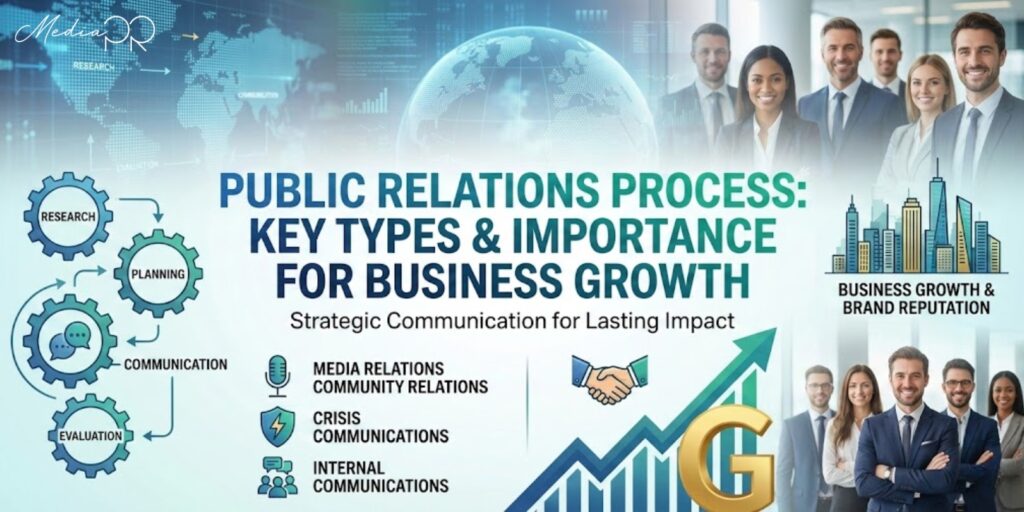
In today’s competitive and fast-moving business environment, a strong brand reputation is not built overnight. It is carefully shaped through consistent communication, trust-building, and strategic storytelling. This is where public relations (PR) plays a vital role. Understanding the public relations process, the types of public relations, and the importance of public relations can help businesses grow, protect their reputation, and connect meaningfully with their audience. This blog explains how PR works, the different forms it takes, and why it has become a cornerstone of sustainable business growth. What Is Public Relations? Public relations is the strategic practice of managing communication between an organization and its key stakeholders, including customers, employees, media, investors, and the general public. Unlike advertising, PR focuses on credibility, trust, and long-term relationship building rather than paid promotions. The success of PR depends largely on following a structured and well-planned public relations process. The Public Relations Process Explained The public relations process is a systematic approach that helps organizations plan, execute, and evaluate communication strategies. It ensures that PR efforts are purposeful, consistent, and aligned with business objectives. 1. Research and Situation Analysis The first step in the public relations process is understanding the current situation. This includes: Analyzing public perception of the brand Identifying key stakeholders Studying competitors and industry trends Recognizing potential risks or opportunities Strong research lays the foundation for effective PR planning and avoids guesswork. 2. Setting PR Objectives Once research is complete, clear and measurable objectives are defined. These objectives may include: Building brand awareness Improving brand reputation Managing a crisis Increasing media visibility Positioning leadership as industry experts Well-defined objectives ensure that PR activities remain focused and results-oriented. 3. Strategy and Planning At this stage, PR professionals decide how to achieve the set objectives. This includes: Crafting key messages Choosing communication channels Identifying media platforms Selecting the right PR tools and tactics A strong strategy ensures consistent messaging across all platforms. 4. Execution and Communication This is where the PR plan comes to life. Activities may include: Press releases and media outreach Interviews and press conferences Thought leadership articles Social media communication Events and campaigns Execution must be timely, transparent, and aligned with brand values. 5. Monitoring and Evaluation The final stage of the public relations process involves measuring performance. PR success is evaluated through: Media coverage analysis Audience engagement Brand sentiment tracking Achievement of PR objectives Evaluation helps refine future strategies and improve overall PR effectiveness. Types of Public Relations Understanding the types of public relations helps businesses choose the right approach based on their goals and audience. Each type serves a unique purpose but works best when integrated into a comprehensive PR strategy. 1. Corporate Public Relations Corporate PR focuses on maintaining a positive image for the organization as a whole. It includes: Brand positioning Corporate communication Reputation management Stakeholder relations This type of PR is essential for long-term brand credibility. 2. Media Relations Media relations involve building strong relationships with journalists, editors, and media outlets. The goal is to secure positive and credible media coverage through: Press releases Media pitches Interviews News features Earned media coverage significantly enhances brand trust. 3. Crisis Management PR Crisis PR helps organizations manage unexpected challenges such as negative publicity, legal issues, or public backlash. The focus is on: Quick response Transparent communication Damage control Reputation recovery Effective crisis management protects brand credibility during difficult times. 4. Digital and Social Media PR With the rise of online platforms, digital PR has become crucial. It includes: Online reputation management Influencer collaborations Social media communication Online media coverage Digital PR ensures brands stay relevant and visible in the digital space. 5. Internal Public Relations Internal PR focuses on communication within the organization. It helps: Improve employee engagement Build company culture Align employees with brand values Increase morale and productivity Employees are influential brand ambassadors when internal communication is strong. 6. Product and Brand PR This type of PR promotes new products, services, or brand initiatives through: Product launches Reviews and features Brand storytelling It helps create awareness and credibility without relying solely on advertising. Importance of Public Relations for Business Growth The importance of public relations goes far beyond media coverage. PR directly contributes to business growth by building trust, credibility, and long-term relationships. 1. Builds Brand Trust and Credibility PR relies on earned media and authentic storytelling, which audiences trust more than paid advertisements. Consistent PR efforts establish brands as reliable and credible. 2. Enhances Brand Visibility Through media coverage, digital PR, and thought leadership, PR increases brand exposure across multiple platforms, helping businesses reach broader audiences. 3. Supports Marketing and Sales While PR is not direct selling, it strengthens marketing efforts by: Creating brand awareness Improving brand perception Influencing buying decisions A positive public image makes marketing campaigns more effective. 4. Manages Reputation Proactively Reputation is one of a company’s most valuable assets. PR helps monitor public sentiment, address concerns early, and maintain a positive brand image. 5. Establishes Thought Leadership PR positions business leaders as experts through interviews, articles, and speaking opportunities. Thought leadership builds authority and industry influence. 6. Provides Long-Term Value Unlike short-term advertising, PR delivers lasting benefits. A strong reputation continues to attract customers, investors, and partners over time. Why a Strategic PR Process Matters A well-structured public relations process ensures that PR activities are not random or reactive. Instead, they are strategic, consistent, and aligned with business goals. Combining the right types of public relations with a clear understanding of its importance enables organizations to grow sustainably in a competitive market. Conclusion Public relations is no longer optional—it is a business necessity. By following a structured public relations process, choosing the right types of public relations, and recognizing its importance, businesses can strengthen their reputation, build trust, and drive long-term growth. Whether it’s managing public perception, handling a crisis, or building brand authority, PR plays a critical role in shaping how the world sees your business. MediagraphicsPR is a top public relations agency in India with 20+ years of experience, helping manage company and individual reputation and public image.

Difference Between Publicity and Public Relations
MediaPR

Difference Between Publicity and Public Relations Explained Simply

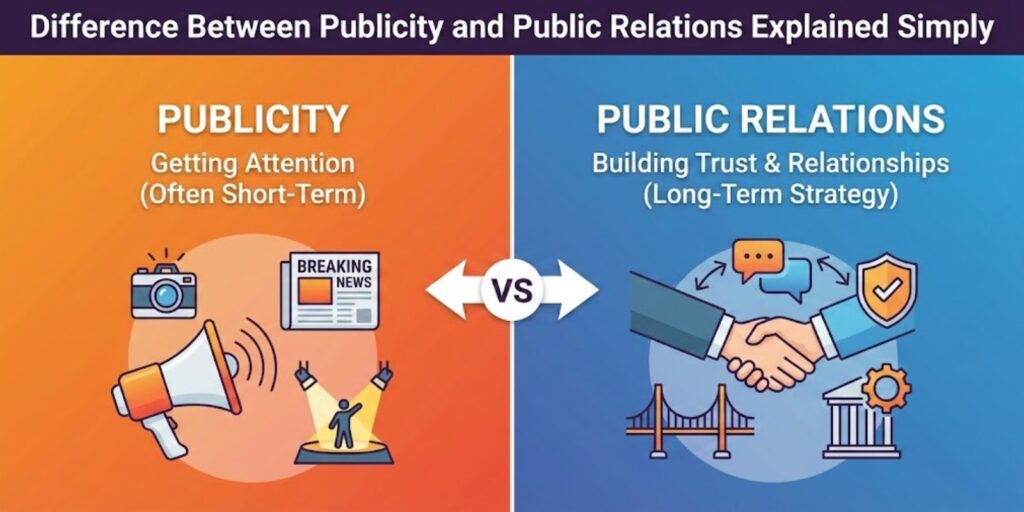
In today’s competitive business environment, brands constantly seek visibility, trust, and credibility. Two terms often used interchangeably but not the same are publicity and public relations (PR). While both aim to put your brand in front of the public, their approaches, controls, and long-term impacts differ significantly. In this simple, SEO-friendly guide, we’ll explain the difference between publicity and public relations, compare publicity vs public relations, and share real-world publicity and public relations examples—all explicitly written for MediagraphicsPR, India’s earned-first PR pioneer. What Is Publicity? Publicity refers to gaining public attention through media coverage without paying directly for placement. It often happens when journalists, bloggers, or media outlets find your story newsworthy and publish it independently. Key Characteristics of Publicity Unpaid media exposure Limited or no control over messaging Short-term attention Often event-driven or news-triggered Common Publicity Examples A startup featured in a newspaper due to funding news A brand going viral on social media Media coverage during product launches Celebrity mentions or endorsements Publicity can generate buzz quickly—but it’s unpredictable. What Is Public Relations? Public Relations (PR) is a strategic, long-term communication process focused on building trust, reputation, and credibility with key audiences—media, customers, investors, and the public. PR includes storytelling, media relations, crisis communication, thought leadership, reputation management, and brand positioning. Key Characteristics of Public Relations Planned and strategic Focuses on long-term brand image Greater message alignment Relationship-driven with media and stakeholders PR doesn’t just chase attention—it shapes perception. Difference Between Publicity and Public Relations (Simple Comparison) Aspect Publicity Public Relations Nature Tactical and spontaneous Strategic and planned Control Very limited control over messaging Moderate control with structured communication Cost Usually free Planned investment Duration Short-term impact Long-term brand building Focus Awareness and buzz Trust, reputation, and credibility Message Source Media-driven Brand-driven Risk Level High due to lack of control Lower with managed communication This table highlights the core difference between publicity and public relations in a clear, beginner-friendly way. Publicity vs Public Relations: Explained with Examples Understanding theory is good—but examples make it clearer. Example 1: Product Launch Publicity: A tech blogger writes about your product launch because it’s trending. Public Relations: A PR agency plans media outreach, founder interviews, thought leadership articles, and follow-up coverage. Example 2: Crisis Situation Publicity: Negative news spreads rapidly due to an incident. Public Relations: PR professionals manage statements, media responses, and public trust recovery. Example 3: Brand Growth Publicity: One viral reel increases brand visibility for a week. Public Relations: Consistent media coverage positions the brand as an industry authority over the years. These publicity and public relations examples clearly show why PR is more sustainable. Why Publicity Alone Is Not Enough Publicity can: Create instant awareness Bring short bursts of attention But it cannot: Control brand narrative Build long-term credibility Manage crises effectively That’s why relying only on publicity is risky. Without PR, brands often struggle with consistency and trust. Why Public Relations Is More Powerful Than Publicity Public Relations: Builds earned trust, not paid hype Positions founders as thought leaders Supports SEO through authoritative media mentions Enhances brand reputation over time Converts visibility into business value At MediagraphicsPR, the focus is on earned-first PR, ensuring brands don’t just get noticed—but are respected and trusted. Publicity vs Public Relations in the Digital & Social Media Era In the digital age: Publicity often comes from viral posts or trending news PR integrates digital media, online publications, podcasts, and brand storytelling Modern PR uses: Online news portals Founder branding SEO-driven media coverage Reputation management Publicity may bring traffic—but PR builds authority. Which One Should Businesses Choose? The honest answer: Both—but strategically. Startups need PR to build credibility with investors and customers Growing brands need PR to maintain their reputation Established companies need PR for leadership positioning and crisis control Publicity should support PR—not replace it. Final Thoughts: Publicity vs Public Relations To summarize: Publicity creates awareness Public Relations builds reputation Publicity is accidental; PR is intentional Publicity is short-lived; PR is long-lasting Understanding the difference between publicity and public relations helps businesses make more innovative branding and communication decisions. Ready to build real brand credibility—not just temporary buzz? MediagraphicsPR – The Pioneer of Earned First PR Agency in India Partner with MediagraphicsPR to turn visibility into trust, and trust into growth. Let your brand be featured, respected, and remembered.

Public Relations in Marketing
MediaPR

What Is Public Relations in Marketing? Meaning & Benefits

In today’s competitive digital-first world, marketing is no longer just about selling products or running ads. Brands must build trust, credibility, and long-term relationships with their audiences. This is where public relations (PR) plays a decisive role. Understanding what public relations in marketing helps businesses shape a positive brand image, influence public perception, and stand out in crowded markets. This blog explains the meaning of public relations in marketing, how it works, key types of public relations in marketing, real-world public relations marketing examples, and the significant benefits PR brings to your overall marketing strategy. If you need a Public Relations agency, MediagraphicsPR is a trusted PR agency in India with 20+ years of experience. What Is Public Relations in Marketing? Public relations in marketing is the strategic communication process businesses use to build mutually beneficial relationships with their target audiences, media, stakeholders, and the general public. Unlike paid advertising, PR focuses on earned media, storytelling, and reputation management. So, when people ask what public relations is in marketing, the most straightforward answer is: Public relations in marketing is about managing how your brand is perceived through credible communication, media coverage, and consistent messaging. PR supports marketing by creating awareness, strengthening trust, and adding authenticity to promotional efforts. Meaning of Public Relations in Marketing The meaning of public relations in marketing goes beyond press releases or news coverage. It includes: Crafting brand narratives Managing brand reputation Engaging with media and influencers Handling crisis communication Building thought leadership Public relations serves as the brand’s voice, ensuring that communication aligns with business goals and audience expectations. While advertising says “buy this product”, PR says “this brand is trusted, credible, and valuable.” How Public Relations Supports Marketing Goals PR and marketing work best when integrated. Here’s how public relations in marketing supports business growth: Builds brand credibility through third-party validation Enhances brand awareness without heavy ad spend Supports product launches and campaigns Strengthens customer trust and loyalty Improves brand visibility in search and media When PR aligns with marketing strategy, it amplifies messaging and increases overall campaign effectiveness. Types of Public Relations in Marketing Understanding the types of public relations in marketing helps businesses choose the right approach based on their goals. Below are the major PR types used in modern marketing strategies: 1. Media Relations This is the most common PR type. It focuses on building relationships with journalists, editors, and publications to secure media coverage. Example: Press releases, interviews, feature stories. 2. Corporate Communications Corporate PR manages internal and external communications related to company values, leadership messages, and company updates. Example: CEO interviews, company announcements, annual reports. 3. Product & Brand PR This PR type supports product launches and brand positioning by creating buzz and visibility. Example: Product launch coverage, reviews, influencer collaborations. 4. Digital Public Relations Digital PR focuses on online visibility, SEO-friendly content, and brand mentions across digital platforms. Example: Online publications, backlinks, influencer outreach. 5. Crisis Management PR Crisis PR protects brand reputation during adverse events or public backlash. Examples: Damage-control statements, media responses, public apologies. 6. Community & CSR PR This type highlights a brand’s social responsibility and community involvement. Example: Sustainability initiatives, charity campaigns, social causes. Each type of public relations in marketing plays a unique role in strengthening brand trust and awareness. Public Relations Marketing Examples To better understand how PR works in real life, let’s explore some public relations marketing examples: Example 1: Startup Brand Awareness A startup launches a new tech product. Instead of running only ads, it uses PR to get featured in business and tech publications. This media coverage builds instant credibility. Example 2: Thought Leadership Campaign A company positions its founder as an industry expert through guest articles, interviews, and panel discussions. This strengthens brand authority. Example 3: Crisis Communication A brand faces negative online reviews. PR teams respond with transparent communication, corrective actions, and positive storytelling to rebuild trust. Example 4: Influencer & Media Collaboration Brands collaborate with influencers and journalists to tell authentic brand stories, increasing reach and engagement. These public relations marketing examples show how PR influences perception, trust, and buying decisions without direct selling. Benefits of Public Relations in Marketing Now that you understand what public relations in marketing is, let’s look at its key benefits: 1. Builds Brand Credibility Media mentions and editorial coverage are seen as more trustworthy than paid ads. 2. Improves Brand Awareness PR helps your brand reach broader audiences through multiple media channels. 3. Cost-Effective Marketing Support Compared to advertising, PR delivers long-term value with lower costs. 4. Strengthens Brand Reputation Consistent PR efforts shape a positive and reliable brand image. 5. Enhances SEO & Online Presence Digital PR helps generate backlinks, brand mentions, and online visibility. 6. Supports Sales & Marketing Campaigns PR builds trust, which directly supports lead generation and conversions. 7. Builds Long-Term Relationships PR focuses on relationships, not just transactions. These benefits make public relations in marketing an essential component of modern brand-building strategies. PR vs Advertising: Key Differences Aspect Public Relations Advertising Cost Lower, long-term value Higher, short-term Trust High credibility Lower credibility Control Limited control Full control Focus Reputation & trust Promotion & sales Both are important, but PR adds authenticity that advertising alone cannot achieve. Why Public Relations Is Essential in the Digital Era In the age of social media, online reviews, and instant news, brand perception can change overnight. PR helps brands: Manage online reputation Control brand narrative Respond to public feedback Build trust in digital spaces This makes public relations in marketing more relevant than ever before. Choosing the Right PR Partner To fully leverage PR benefits, businesses need experienced professionals who understand media, storytelling, and brand positioning. With a proven track record across industries, MediagraphicsPR helps brands build visibility, credibility, and long-term success through strategic public relations. Final Thoughts Understanding what public relations in marketing empowers businesses to communicate better, build trust, and grow sustainably. From media relations to crisis management, PR plays a critical role in shaping how your brand is seen and remembered. By integrating PR with marketing strategies, businesses can create meaningful connections, enhance brand reputation, and achieve long-term growth in an increasingly competitive marketplace. If you’re ready to strengthen your brand story and public image, investing in professional public relations is

Scroll to Top
logo

Get In Touch

Please enable JavaScript in your browser to complete this form.