






Every startup founder who’s made a bad PR agency hire has the same story.
The pitch was impressive. The team seemed sharp. The client list had names they recognized. They signed a six-month retainer. Three months in, the senior people who pitched the account had disappeared from day-to-day work, the coverage was landing in publications nobody on the investor side had ever heard of, and the monthly report looked like a lot of activity that was connected to nothing the business actually needed.
Choosing a PR agency for startups in India is harder than it looks. Not because good agencies don’t exist. They do. Because almost every agency sounds identical in a pitch room, the evaluation criteria most founders use don’t predict actual performance, and the consequences of getting it wrong are significant in both money and time.
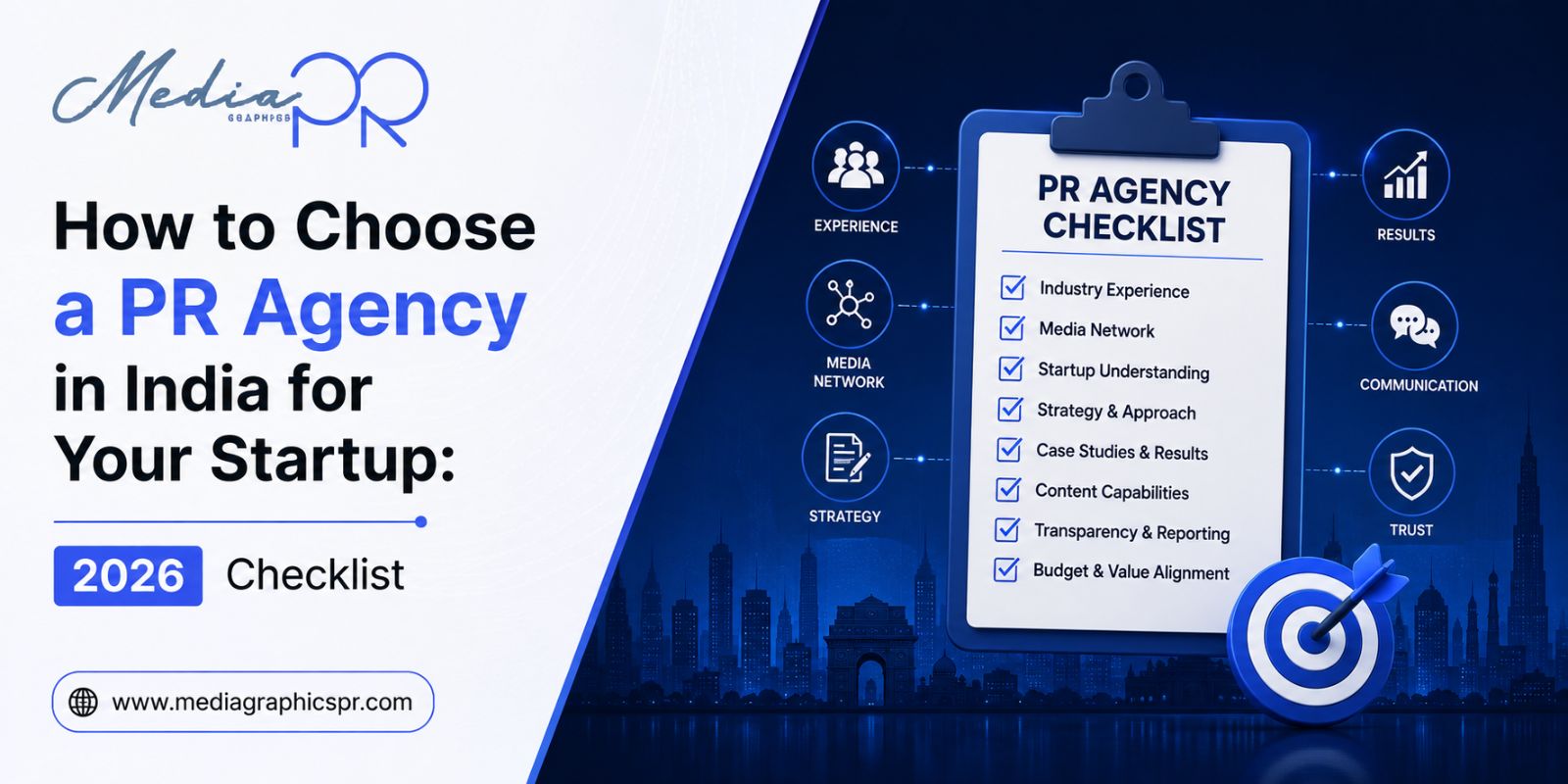
This guide is the 2026 checklist for getting it right. What to look for, what questions to ask, what red flags to walk away from, and how to structure an engagement that actually produces outcomes rather than coverage reports.
MediagraphicsPR is a PR agency for startups that has spent 25 years helping Indian founders build the credibility that makes fundraising conversations start differently, enterprise sales cycles shorten, and talent pipelines improve. They’re the benchmark this checklist is built around, and the guide explains why.
What a Startup PR Agency Actually Does That Matters
Before the checklist, clarity on what you’re actually buying. Because most startups hire PR agencies without a clear picture of what the work looks like, and then can’t evaluate whether it’s being done well.
A PR agency for startups that’s doing its job properly is working on six things simultaneously:
› Narrative strategy. Developing the core story about the company, what it does, why it matters now, what makes the approach genuinely different, and ensuring that story is consistent everywhere it appears.
› Media relations. This comes down to knowing the journalists who actually cover your sector, not just having their names on a list. It means pitching them stories they’d genuinely want to run, not a press release dressed up as one, and landing coverage in the publications your investors and buyers are actually reading, not the ones that just look good in a report.
› Thought leadership. Turning founder and leadership expertise into authored articles, expert commentary, and media appearances that build the kind of personal credibility that compounds over time.
› Investor-facing communications. Ensuring the publications that institutional investors read are covering the company and that the narrative in that coverage positions the company as a serious, credible market participant.
› Crisis preparation. Building the communications infrastructure before something goes wrong, so when it does, the response is prepared rather than scrambled.
› Measurement. Tracking whether PR activity is connected to business outcomes, including investor recognition, enterprise buyer pre-qualification, and talent pipeline quality, not just coverage volume.
If an agency you’re evaluating can’t explain how they approach all six of these, that’s useful information.
The 2026 Checklist—What to Evaluate Before You Sign
Section 1: The Account Team
This is where most startup PR agency hires go wrong. The pitch is delivered by senior people. The account is then managed by junior ones. By the time the founder realizes this, they’re three months into a retainer with nothing to show for it.
☐ Check 1: Meet the day-to-day team before signing.
Not the business development person. Not the founding partner who opened the meeting. The people who will actually be pitching journalists, developing content, and managing the account week to week. Ask to meet them in the evaluation process, not after contracts are signed.
☐ Check 2: Ask specifically about the seniority of day-to-day execution.
Who pitches the journalists? Who develops the narrative? Who makes the call at 9 PM when a journalist has a question about a story in development? If the answer involves titles like “associate” or “executive” for all of these, that’s worth understanding before you commit.
☐ Check 3: Ask about team stability.
PR agencies have staff turnover. If the person building your journalist relationships leaves six months in, what happens to those relationships? How does the agency handle account continuity when team members change?
Section 2: Sector Expertise
PR companies for startups all claim sector expertise. Very few have actually built it in the sectors they claim.
☐ Check 4: Ask for three specific recent placements in your sector.
Not a general portfolio. Not a list of clients in adjacent industries. Three placements in the last six months in publications that your investors, enterprise buyers, or target customers actually read. An agency with genuine sector expertise can produce this immediately.
☐ Check 5: Ask which journalists covering your specific beat they have working relationships with.
Not just which publications they’ve placed stories in, but which specific journalists. A real media relationship means the journalist takes calls, reads pitches, and trusts the agency’s judgment. A contact database means the agency has email addresses.
☐ Check 6: Ask how they’d pitch your company’s story to a journalist.
Listen for whether the pitch they describe is actually something a journalist would find compelling or whether it’s a press release about the company disguised as a pitch. The agencies that understand startup PR know the difference between company news and stories that journalists want to cover.
Section 3: The Strategy Before the Pitch
The most important thing a PR agency in India can do in the first month of an engagement is not pitch journalists. It’s developing the narrative, mapping the audiences, and researching the target publications and journalists well enough that the pitches actually land when they go out.
☐ Check 7: Ask what the first month looks like.
An agency that describes the first month as pitching journalists is telling you something. An agency that describes the first month as narrative development, audience mapping, publication research, and competitive media analysis is telling you something different and better.
☐ Check 8: Ask how they develop the narrative.
Is it a workshop with the founder? A questionnaire? A competitive analysis? The process for narrative development matters because the quality of the narrative determines the quality of everything that follows.
☐ Check 9: Ask how long the strategy development takes before first pitches go out.
Two to four weeks is normal. Less than that usually means the agency is skipping the strategic work and going straight to execution, which produces coverage that doesn’t build anything.
Section 4: Measurement and Accountability
This is where almost every PR agency pitch in India is weakest and where the most important accountability conversation happens.
☐ Check 10: Ask what metrics they track beyond clip count.
The agencies that matter know the answer to this. Branded search volume after placements. Sales team feedback on whether prospects mention coverage. Investor recognition in pitch meetings. Enterprise buyer pre-qualification. Application quality and candidate source in hiring. If the agency’s answer to measurement is “clips, reach, and AVE,” that’s useful information.
☐ Check 11: Ask what success looks like at six months.
Not in abstract terms, but in specific, measurable ones. What will be different about your investor conversations? What will the media landscape look like in your category? How will enterprise buyers be encountering the brand? An agency that can answer this concretely has thought about your business. One that answers vaguely hasn’t.
☐ Check 12: Ask how they handle a month where coverage underperforms.
Every PR engagement has months where less lands than planned. How the agency handles and communicates about those months tells you more about the relationship than the good months do.
Section 5: The Engagement Structure
☐ Check 13: Understand the retainer versus project structure.
Some startups are better served by project-based PR, a funding announcement, a product launch, or a narrative strategy document before committing to a monthly retainer. Ask whether the agency offers project-based work and what that looks like.
☐ Check 14: Ask about the minimum commitment.
Six months is a reasonable minimum for a retainer engagement. Less than that rarely gives PR enough runway to show compounding results. More than twelve months on a first engagement without a review point is worth questioning.
☐ Check 15: Understand the exit terms.
What happens if the relationship isn’t working? What’s the notice period? What happens to content and contacts developed during the engagement? These questions are easier to ask before signing than after.
The Red Flags—Walk Away When You See These
Some signals in a PR agency evaluation are clear enough that they warrant walking away regardless of how good everything else looks:
⚑ The bait and switch.
Senior people in every meeting during evaluation, followed by a junior team introduction after signing. Ask directly who will work on the account and insist on meeting them before committing.
⚑ The generic pitch.
An agency that pitches you without asking substantive questions about your business, your fundraising timeline, your enterprise sales challenges, or your target audiences is pitching a template, not a strategy for your specific company.
⚑ The impressive-sounding but irrelevant client list.
A client list full of large consumer brands is not evidence of startup PR capability. A client list full of funded startups in your sector, with recent placements in publications your investors read, is evidence.
⚑ The AVE-led measurement conversation.
Advertising Value Equivalent, the practice of calculating what editorial coverage would have cost as advertising, has been widely discredited as a meaningful PR metric. Agencies that lead with AVE in their measurement discussion are showing you how they define success.
⚑ The guaranteed coverage claim.
Editorial coverage cannot be guaranteed. Any agency claiming to guarantee placements in specific publications is either misrepresenting how editorial media works or describing paid placement disguised as earned media.
The Startup Stage Consideration—What You Need Changes as You Grow
The PR agency for startups that’s right at seed stage is often not the right agency at Series B. The services, the audiences, and the publications that matter change significantly:
| Stage | What PR Needs to Achieve | Key Publications |
|---|---|---|
| Pre-seed / Seed | Ecosystem visibility, investor recognition | Inc42, YourStory, ecosystem media |
| Pre-Series A | Investor credibility, narrative establishment | Inc42, Mint, ET, financial media |
| Series A-B | Enterprise buyer credibility, category positioning | Trade media, Mint, ET, Business Standard |
| Growth Stage | Category leadership, analyst relations | All above plus analyst reports |
| Pre-IPO | National media consistency, crisis readiness | National business press, broadcast |
Most startups underestimate how much their PR needs change between rounds. An agency that helped you build ecosystem visibility at seed stage may not have the financial media relationships needed to support a Series B raise.
Questions to Ask Before Every Shortlisted Agency
The five questions that cut through every pitch and reveal what you actually need to know:
Question 1: Who specifically works on our account day to day, and can we meet them today, not after we sign?
Question 2: Which journalists covering our specific sector have you had substantive working relationships with in the last six months? Name them.
Question 3: Walk me through how you’d develop our narrative. What’s the process and what does the output look like?
Question 4: What business outcome metrics do you track, and what did those look like for a startup at our stage in the last year?
Question 5: What’s the most common reason startups leave you?
The agency that answers all five specifically, honestly, and without deflection is almost always worth more than the one with the most impressive presentation.
What Good Startup PR Looks Like When It’s Working
The signal that a PR agency in India is doing its job for a startup:
Investors mention coverage before you’ve introduced yourself in pitch meetings. Enterprise buyers reference the brand in early sales conversations without being prompted. Strong candidates cite the company’s media presence when accepting offers. The founder is being approached for expert commentary without pitching for it. Coverage is appearing in publications your business actually needs to reach, not just publications that look good in a monthly report.
These outcomes don’t happen from clip counts. They happen from a PR agency for startups that started with your business goals, built a narrative around them, placed that narrative in the right publications, and measured whether it was actually changing the conversations your business needs to have.
How MediagraphicsPR Works With Startups
At MediagraphicsPR, we work as the PR agency for startups that founders come to when they want PR built around what their business actually needs to achieve, not around what’s easiest to pitch.
Our PR companies for startups approach starts with understanding your fundraising timeline, your enterprise sales challenges, and the specific audiences whose perception of your brand needs to change. For fintech startups navigating investor credibility and regulatory communication simultaneously. For technology startups building category authority before a competitor does. For healthcare startups that need clinical thought leadership alongside enterprise buyer credibility.
As a leading PR agency in India with 25 years of real journalist relationships across India’s most important business and sector publications, senior people on your account from week one, a narrative built around your specific goals, and measurement that connects to business outcomes rather than clip reports.
If you’re evaluating PR agencies for startups and want to understand what a program built specifically around your company’s stage and goals would look like, that’s the conversation worth having now.
FAQs
Q: How early should a startup start working with a PR agency?
Earlier than most founders think. If you are six months from a raise or starting enterprise sales conversations, your media presence is already being checked by investors and procurement teams. The narrative that makes investors recognize your name before a pitch is built in the months before the raise starts, not during it. Starting PR when you already need results means starting too late.
Q: What is a realistic PR agency budget for an early-stage startup?
Focused startup PR engagement typically starts from Rs 1.5 lakh per month for a specialist boutique agency. The more useful question is what outcomes are included and how success is measured. An agency that is transparent about both is worth paying more for than one that is simply cheaper without clarity on deliverables.
Q: Should a startup hire a PR agency or a freelance PR consultant?
Both have a place. A freelance consultant can develop narrative strategy and provide senior counsel at lower cost. An agency brings execution capability, media relationships built across multiple clients, and crisis infrastructure. Most startups benefit from agency relationships for execution alongside strategic counsel. The combination produces better outcomes than either alone.
Q: How do we evaluate PR agency pitches when they all sound the same?
By asking questions that require specific answers rather than general ones. Ask for specific journalist names, specific recent placements, and specific business outcome metrics from comparable clients. The agencies that answer specifically have done the work. The ones that answer generally are pitching a template.
Q: What happens if the PR agency is not delivering after three months?
Have a direct conversation about what is not working before the retainer renewal. Identify whether the issue is strategy, execution, or fit. Some underperformance at months two and three is normal. PR takes time to compound. Persistent underperformance at month four or five, with no clear explanation or adjustment, is worth taking seriously.
Q: Is it better to hire a PR agency in our city or one with a national presence?
The agency’s journalist relationships and sector expertise matter more than their physical location. A Delhi-based agency with strong financial media relationships will serve a Mumbai fintech startup better than a local agency with weak ones. What matters is which publications your investors and buyers read and whether the agency has genuine relationships with the journalists there.
Ready to Choose a PR Agency in India That Actually Delivers?
Every founder who’s picked the wrong agency made the same mistake: they judged the pitch instead of the people who’d actually be doing the work. A PR agency in India that puts senior people on your account from week one, and measures itself by what changes in your investor and enterprise conversations, is the difference between a checklist you tick off and results you can point to six months from now.
Visit MediagraphicsPR to see how we build PR programs for startups around exactly where you are and where you’re headed.
Need to speak to someone now?
📞 Call us: +91-8448360900 📧 Email us: info@mediagraphicspr.com
We respond within 24 hours.