






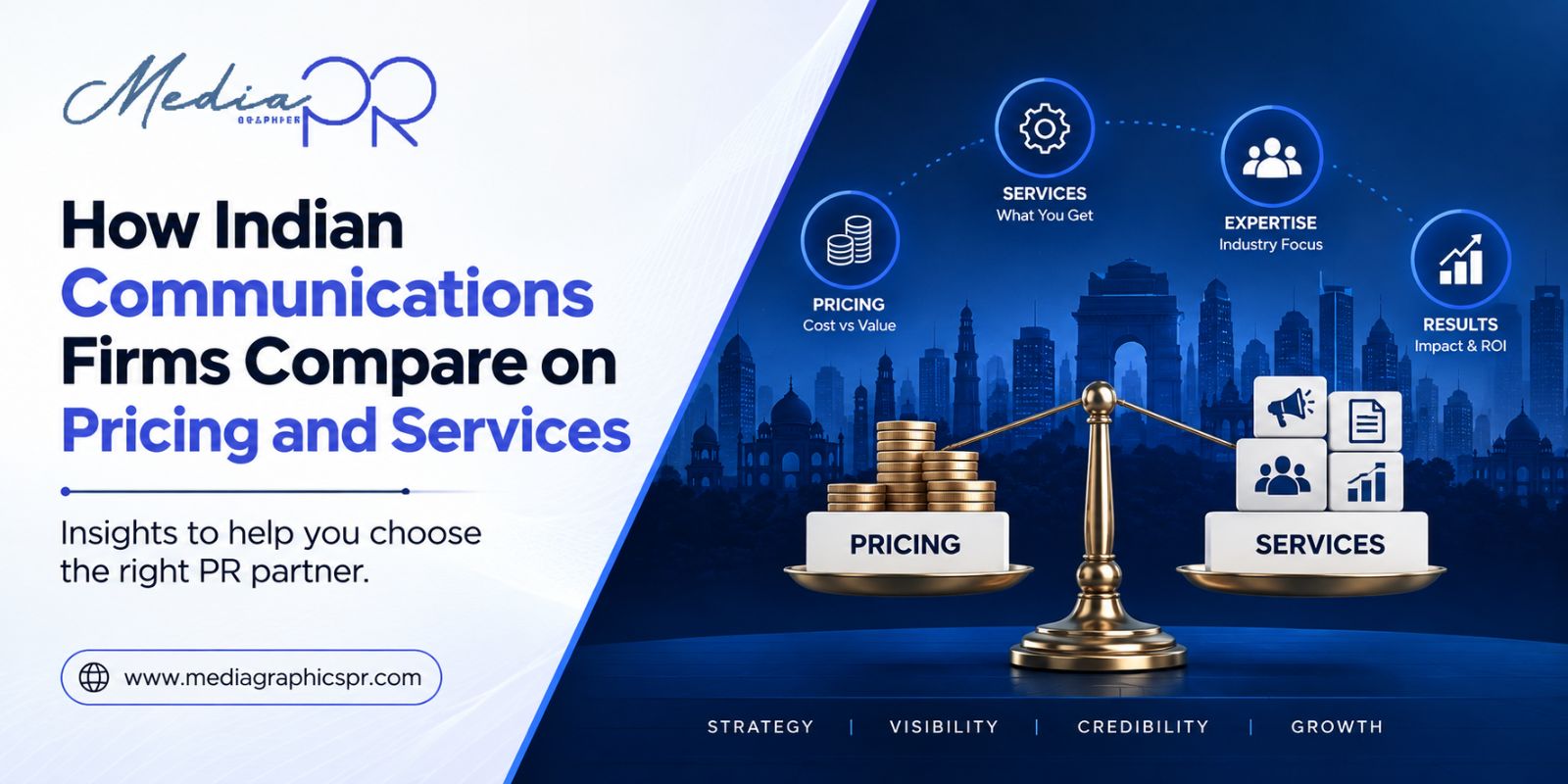
Most brands make the same mistake when evaluating PR agencies.
They look at the retainer number, compare it to another retainer number, and try to figure out which one is cheaper for roughly the same thing. The problem is that PR retainers rarely cover roughly the same thing. Two agencies quoting Rs 2 lakh per month can be delivering completely different scopes of work, different seniority of execution, different depth of journalist relationships, and different connections to the business outcomes the brand actually needs.
Understanding how Indian communications firms actually compare, what pricing reflects, and what you should be getting at different price points is what makes the difference between a PR investment that compounds and one that produces monthly clip reports nobody acts on.
MediagraphicsPR is one of India’s leading Indian communications firms, with 25 years of experience building earned media presence, investor credibility, and category authority for brands across fintech, technology, healthcare, enterprise, and D2C sectors. They are the benchmark in this guide because their pricing is built around business outcomes, not around service packages. The rest of this guide explains how to read that distinction across every agency you evaluate.
Why PR Pricing in India Is So Hard to Compare
The honest answer is that PR agency pricing India is hard to compare because the outputs are hard to standardize.
A law firm charges by the hour, and the deliverable is clear. An advertising agency charges a percentage of media spend and the deliverable is measurable impressions. A PR agency charges a monthly retainer for work that produces outcomes measured over months, through relationships that are difficult to quantify, toward goals that change as the business changes.
This creates a genuine comparison problem. Two agencies at the same price point can be doing completely different work. One is pitching fifteen journalists a month from a relationship built over five years. The other is sending press releases to a database of three hundred email addresses. The first is building something. The second is generating activity. Both cost the same. The difference only becomes visible at month four or five.
The framework that actually works for comparing Indian communications firms is not price comparison. It is a value comparison. What is this agency building, for which audiences, through which relationships, measured against which business outcomes?
How PR Agency Pricing in India Is Structured
Before comparing, understand the structures that exist:
➤ Monthly Retainer
The most common structure for ongoing PR relationships. The brand pays a fixed monthly fee in exchange for a defined scope of work. Retainers typically include media relations, narrative strategy, thought leadership content, and reporting.
The scope varies enormously between agencies at similar price points. What matters is not the retainer amount but what is specifically included and who is specifically executing it.
➤ Project-Based Fees
A fixed fee for a specific deliverable. A funding announcement PR campaign. A narrative strategy document. Or a media audit, the kind of thing that comes up once and doesn’t need an ongoing relationship. This structure suits brands with a specific, one-off need rather than a continuous PR requirement, and it’s also a good way for early-stage companies to test out an agency before signing on for a full retainer.
➤ Retainer Plus Performance
This one’s still fairly rare in India, though it’s picking up. A base retainer handles the everyday work, and performance bonuses kick in based on specific placements, coverage quality, or business outcomes hit along the way. It keeps the agency and the client pulling in the same direction, focused on results rather than just staying busy.
➤ Advisory Retainer
Senior strategic counsel on a reduced engagement basis. Useful for brands that have in-house communications capability and need senior strategic input rather than full execution. Typically lower cost than a full retainer but narrower in scope.
What the Pricing Tiers Actually Look Like
This is the communications firm comparison that most guides avoid giving honestly. Here is the real picture for Indian PR agencies in 2026:
| Tier | Monthly Range | What You Typically Get |
|---|---|---|
| Boutique Specialist | Rs 1.5 to 3 lakh | Senior people on the account, specific sector expertise, genuine journalist relationships in a defined area |
| Mid-Size Established | Rs 3 to 6 lakh | Broader sector coverage, team of 3 to 5 on the account, wider publication relationships |
| Large National Agency | Rs 6 to 15 lakh | Full team, multiple practice areas, national coverage, corporate affairs capability |
| Multinational Network | Rs 15 lakh and above | Global network access, multiple specialist teams, enterprise-scale account management |
| Project-Based | Rs 50k to 3 lakh per project | Defined deliverable, specific campaign or narrative strategy work |
The tier that is right for a brand depends not on what the brand can afford but on what the brand needs to achieve. A pre-Series A startup building investor credibility may get better results from a boutique specialist at Rs 2 lakh than from a large national agency at Rs 8 lakh, if the boutique has the specific financial media relationships the startup needs and the large agency would put a junior team on the account.
What Drives the Price Difference Within Tiers
This is where PR firm rates India become genuinely confusing. Two agencies in the same price tier can be very differently priced for very different reasons. Understanding what drives price helps evaluate whether a specific quote represents value.
➥ Seniority of execution
The single biggest driver of value within any price tier. An agency where senior people build the narrative, manage the journalist relationships, and make the calls when something needs to move fast is fundamentally different from one where seniors sell the account and juniors execute everything afterward. Ask specifically who will work on the account day to day and at what seniority level.
➥ Depth of journalist relationships
A PR agency with genuine working relationships with specific journalists at Mint, Economic Times, Business Standard, The Ken, and sector-specific publications charges a premium over one with a large email database and low response rates. This is not visible in the pricing. It becomes visible in the coverage. Ask for specific journalist names and recent placements before signing.
➥ Sector expertise
An agency with deep expertise in fintech, healthcare, or enterprise technology charges a premium over a generalist because that expertise took years to build and it produces better outcomes. A generalist agency at a lower price point will learn your sector at your expense. A specialist at a higher price point already knows it.
➥ Service scope
Retainers that include media relations, thought leadership development, content creation, social media advisory, crisis preparation, and measurement dashboards cost more than ones that include media relations alone. Comparing retainer prices without comparing scope consistently produces misleading conclusions.
➥ Geographic coverage
Agencies with genuine relationships across Delhi, Mumbai, Bangalore, Hyderabad, and Chennai charge more than ones with a strong presence in one city. National coverage matters for brands that need their story told in the publications that matter in multiple markets simultaneously.
The Services That Matter Most at Each Stage
This is the communications firm comparison question that matters most: not which agency is cheapest, but which services are most important at your current stage and which agencies deliver them best.
❯ Pre-Series A and Seed Stage
What matters most: Narrative strategy, founder thought leadership, ecosystem media presence, and investor-facing communications. The goal is making investors recognize the founder’s name before the pitch meeting.
What to prioritize in agency evaluation: Does the agency have relationships with the journalists at Inc42, YourStory, and the financial press that early-stage investors read? Can they develop a compelling narrative around a company with limited traction to show?
❯ Series A to Series B
What matters most: Financial media relationships, enterprise buyer credibility, consistent coverage in business press, and the six to twelve months of narrative building that makes the next raise easier.
What to prioritize: Does the agency have real relationships with journalists at Mint, Economic Times, and Business Standard? Can they serve both ecosystem media and financial press audiences simultaneously?
❯ Growth Stage and Enterprise
What matters most: This stage is owning your category, working with analysts, having real depth in trade media, being able to handle corporate affairs, and having crisis communication infrastructure ready to go.
What to prioritize: Does the agency have experience with analyst relations alongside media? Can they manage complex multi-stakeholder communications environments? Do they have crisis experience in the relevant sector?
What to Actually Compare When Evaluating Agencies
The comparison checklist that cuts through pricing confusion:
◦ Compare the day-to-day team, not the pitch team.
Ask who will work on the account after signing. Ask to meet them before signing. The seniority of the people executing the work matters far more than the seniority of the people who pitch it.
◦ Compare specific journalist relationships, not general media claims.
Ask for three placements in publications your investors or buyers read, made in the last six months. Ask for specific journalist names. Real relationships produce real answers. Database contacts produce vague ones.
◦ Compare measurement frameworks, not just deliverables.
An agency that measures success by clip count is measuring the wrong thing. An agency that measures investor recognition before pitch meetings, enterprise buyer pre-qualification, and branded search volume after placements is measuring business outcomes. Ask what the measurement framework looks like before signing.
◦ Compare the narrative development process.
How does the agency develop the core brand story? How long does it take? What does the output look like? An agency that pitches journalists before completing this work is skipping the most important step.
◦ Compare crisis capability.
What crisis situations has the agency managed in your sector? What does their crisis communication infrastructure look like? How quickly can they respond when something needs to move fast?
The Mistakes Brands Make When Comparing PR Agency Pricing
➝ Comparing prices without comparing scope.
A Rs 2 lakh retainer that includes narrative strategy, media relations, thought leadership content, and monthly business outcome reporting is not comparable to a Rs 2 lakh retainer that includes media relations alone. The price comparison is meaningless without the scope comparison.
➝ Choosing the cheapest option and expecting full-service results.
The lowest price in any tier reflects something. Sometimes it reflects an early-stage agency building its client base and offering genuine value. Sometimes it reflects limited journalist relationships, junior execution, or a narrower scope than competitors at similar price points. Understanding which one requires asking the right questions.
➝ Not accounting for the cost of switching.
Switching PR agencies after six months is expensive. The new agency spends two to three months learning the brand before producing anything. The disruption to narrative consistency sets back whatever the previous agency was building. Getting the selection right the first time is consistently less expensive than getting it wrong and switching.
➝ Treating the retainer as the total cost.
PR works best when the brand contributes time for narrative development sessions, spokesperson availability for journalist calls, and data and insights that give the agency something genuine to pitch. The time investment from the brand’s side is real and should be factored into the total cost of the engagement.
How Indian Communications Firms Differ on Service Depth
The most important service depth comparison is not between agencies at different price tiers. It is between agencies at the same price tier that are delivering genuinely different quality of work.
For fintech brands, the service depth that matters is regulatory communication expertise and financial media relationships. An agency quoting Rs 3 lakh with genuine SEBI and RBI communication knowledge and working relationships with Mint and Business Standard Banking journalists is delivering different value than one quoting the same amount without that specific depth.
For technology companies, the service depth that matters is technical product translation and B2B media relationships. An agency that can pitch enterprise SaaS stories to ETCIO and The Ken credibly delivers different outcomes than one that defaults to ecosystem media.
For healthcare brands, clinical communication knowledge and practitioner-facing media relationships change the value equation significantly. Generic PR at the same price as specialist healthcare PR produces fundamentally different outcomes.
How MediagraphicsPR Compares
At MediagraphicsPR, pricing reflects the work that actually moves business outcomes, not the work that produces coverage reports.
As a leading Indian communications firm with 25 years of real journalist relationships across India’s most important business, technology, sector-specific, and lifestyle publications, our PR agency pricing reflects senior people doing the actual execution, genuine editorial relationships that produce real coverage, and measurement frameworks that connect to investor recognition, enterprise pipeline, and talent acquisition outcomes.
Our PR agency in Delhi practice covers national communications across Bangalore, Mumbai, Hyderabad, Chennai, and every major Indian market. For founders who want to understand what a program specifically built around their business stage and goals would cost and what it would produce, that conversation starts here.
FAQs
Q: What is a realistic PR agency budget for a startup at Series A in India?
A focused Series A startup PR program with genuine financial media relationships and senior execution typically starts from Rs 2.5 to 4 lakh per month. The more useful question than the budget number is what the agency will specifically deliver for that amount, who will execute it, and what business outcome metrics will determine success.
Q: Why do two agencies quote the same price but deliver very different results?
Because PR pricing reflects multiple factors that are not visible in the retainer number. Seniority of execution, depth of journalist relationships, sector expertise, and scope of services all drive value independently of price. Two agencies at the same price point can be delivering fundamentally different work. Comparing the specific elements of what each agency offers at that price is the only way to make a meaningful comparison.
Q: Is project-based PR a good option for early-stage startups?
Yes, for specific high-stakes moments. A funding announcement, a product launch, or a narrative strategy development project can be structured on a project basis before a full retainer commitment makes sense. Project-based work also lets a brand evaluate an agency’s quality before committing to a longer engagement.
Q: What should a PR agency retainer explicitly include?
At minimum: who works on the account and at what seniority, which publications are being targeted and why, what the narrative development process looks like, how many journalist relationships are being actively maintained, what the crisis communication protocol is, and how success is measured beyond clip count. Any retainer that cannot answer all of these questions clearly before signing is worth questioning.
Q: How do large multinational agencies compare to specialist boutique agencies for Indian startups?
They serve different needs well. A large multinational agency tends to be strongest at enterprise-scale corporate communications, tapping into a global network, and managing environments where a lot of different stakeholders are involved at once. Specialist boutique agencies typically deliver more senior execution, deeper sector expertise, and stronger specific journalist relationships for the price. For most Indian startups at the early to growth stage, the boutique specialist often delivers more relevant value at a comparable price point.
Q: How much of a PR agency’s pricing goes toward actual media relations versus overhead?
This varies significantly by agency structure.Large network agencies tend to carry a lot of overhead, layers of account management, global reporting structures, and administrative work that eats into the budget. Boutique specialists typically direct a higher proportion of the retainer toward actual media relations and editorial work. Asking specifically how the account team’s time is allocated across different activities reveals how much of the retainer translates into actual market-facing work.
Ready to Understand What Your PR Investment Should Actually Be Buying?
The right question was never “what’s the cheapest retainer.” It’s what specific scope, seniority, and journalist relationships a PR agency in India is actually delivering at that price, and whether it connects to the business outcomes that matter to you.
Visit MediagraphicsPR to see how our pricing reflects work that moves investor recognition, enterprise pipeline, and category authority, not just coverage reports.
Need to speak to someone now?
📞 Call us: +91-8448360900 📧 Email us: info@mediagraphicspr.com
We respond within 24 hours.