





Your reputation exists whether you manage it or not.
That’s the part most founders and business leaders miss until something goes wrong. A negative review that lands on page one of Google. A journalist story that frames the company badly. A former employee’s LinkedIn post that gets more traction than anything the brand has ever published. A regulatory notice that becomes a news story before the communications team has finished their first meeting about it.
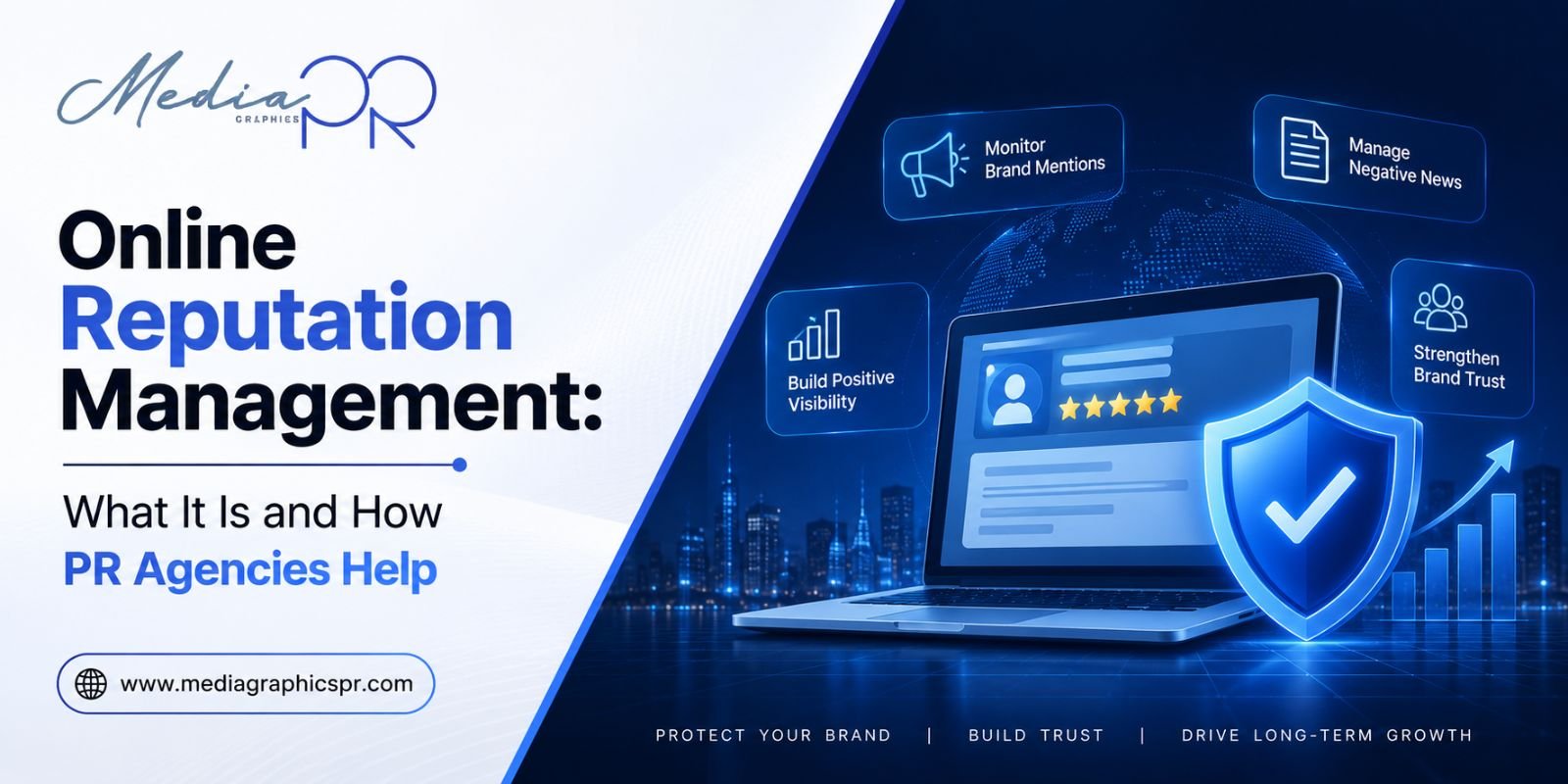
Online reputation management is the practice of understanding, shaping, and protecting how a brand appears across every digital channel where audiences form opinions about it. This includes search results, news coverage, social media, review platforms, industry forums, and the publications that investors, enterprise buyers, and potential employees consult before making decisions. It is not a defensive exercise. Done properly, it is a proactive strategy that builds the kind of digital presence that makes every business conversation start from a position of credibility.
MediagraphicsPR is a brand reputation management agency that has spent 20+ years building and protecting the reputations of Indian brands across fintech, technology, healthcare, real estate, and enterprise sectors, backed by dedicated ORM solutions. They work as the strategic reputation partner for founders and business leaders who understand that what people find when they search your name is as important as what you say about yourself. They are the agency this guide is built around, and the rest explains how PR agencies approach reputation management and how to choose the right partner.
Why Reputation Is a Business Problem, Not a Communications Problem
Most brands treat reputation as something the PR team handles. That framing is part of why so many reputation programmes underperform.
Reputation affects deals. An investor who has seen your company covered in Mint three times in the last six months walks into a pitch conversation differently than one who searched your name and found nothing. An enterprise procurement head who found a thoughtful founder interview in an industry publication before the first vendor call has already started trusting the brand. A senior candidate who found two years of positive Glassdoor reviews and editorial coverage about the company’s growth accepted the offer faster.
These are not soft outcomes. They are pipeline, close rate, and time-to-hire. Online reputation management done properly is a growth function, not a defensive one.
The brands that understand this build reputation infrastructure before they need it to protect them. The ones that don’t discover what it costs to build it after something has already gone wrong.
What Online Reputation Management Actually Covers
The common misconception is that reputation management means managing reviews or suppressing negative search results. Both of those are small parts of a much larger practice. Here is the full picture:
- Search result landscape. What appears when someone searches your brand name, your founder’s name, or your company combined with words like “review,” “complaint,” or “news.” The goal here is not to manipulate results. It is to build enough genuinely credible, independently published content that the search landscape accurately represents what your brand is.
- Earned media coverage. Features, profiles, expert quotes, and news coverage in recognized publications. This is where media relations adds the most distinctive value. A story in Economic Times or a founder quote in Business Standard carries trust weight that no owned content can replicate. Building this takes time and genuine journalist relationships.
- Review platform presence. Platforms like Google Business, Glassdoor, G2, Trustpilot, and Clutch, along with whatever’s specific to your sector, all shape how buyers, investors, and candidates see a brand. Managing them means replying thoughtfully when a review is negative, earning genuine positive ones through actual customer experience, and paying attention to patterns that point to real service or product issues worth fixing.
- Social media sentiment. What the brand’s channels say, how the brand handles criticism publicly, and what the overall sentiment trend looks like across platforms. A brand that disappears from social media during a crisis communicates something as loud as one that responds badly.
- Crisis communication infrastructure. The prepared holding statements, the designated spokespeople, the journalist relationship network that lets a brand’s version of events reach journalists alongside any negative coverage. Our own breakdown of PR crisis management strategies and dedicated crisis communication service cover this in more depth. Crisis communication infrastructure has to be built before the crisis. Building it during one is always too late.
- Thought leadership presence. The body of published expert content that builds a founder or executive’s credibility over time. A founder with twelve months of consistent authored pieces and expert quotes in relevant publications has a fundamentally different reputation profile than one without them. Our thought leadership practice is built specifically around this.
How PR Agencies Specifically Help
Digital marketing agencies, SEO firms, and reputation software platforms each play a role. But PR agencies contribute something specific that none of the others can replicate.
Earned media is the most trusted content in search results. A review on a platform the brand manages is trusted at a certain level. A feature in a publication with independent editorial standards is trusted at a completely different level. The most credible results in any brand’s search landscape are the ones that editorial teams at recognized publications decided to publish. Those cannot be manufactured. They have to be earned through genuine relationships and genuinely newsworthy stories. PR agencies build those results through the journalist relationships and editorial pitching that produce real coverage. Over time, that coverage builds a search result landscape that is both diverse and credible.
Pre-existing credibility determines how crises land. A brand that has been consistently covered positively in credible publications for six months can absorb a negative story differently than one with no media presence. When a critical story is published about a company with extensive prior positive coverage, readers have context. When a negative story is the first substantial coverage a brand has received, there is no context. The story becomes the definition. This is why the most valuable PR work for reputation management is the proactive work done long before any crisis arrives.
Journalist relationships determine whether the brand’s version of a story gets told. When negative coverage is being written, the brand’s ability to get its perspective into that story depends on whether the journalist knows and trusts the communications team. Journalists who have a relationship with a PR agency take calls. Brands without that relationship often find their response either ignored or reduced to a one-line denial at the end of an otherwise one-sided story.
The ORM Process in Practice
For a brand starting a genuine reputation program with a PR agency, here is what the work actually looks like across phases:
Phase 1: Full Reputation Audit. A complete picture of the current landscape. Search results across branded and non-branded queries. Sentiment analysis of existing coverage. Review platform ratings and review content. Competitor comparison. Gap and risk identification.
Phase 2: Strategy Development. Once the audit is done, the strategy gets prioritized around what it found. A brand without much media presence focuses first on building earned coverage. One with a lot of exposure on review platforms works on review management alongside media. And a brand carrying a specific past crisis puts its energy into the online reputation repair work needed to shift what shows up in search. This is where our PR consulting and strategy work typically begins.
Phase 3: Coordinated Execution. Earned media pitching and placement. Thought leadership content development. Review platform management. Crisis infrastructure building. All running simultaneously and aligned around the same narrative.
Phase 4: Monitoring and Rapid Response. This means keeping an eye on news, social, review platforms, and search on an ongoing basis, having response protocols ready for anything that comes up, and reporting regularly on metrics that actually tie back to business outcomes rather than just how much coverage came in.
Phase 5: Sustained Compounding. The long-term work that builds genuine resilience. Twelve to eighteen months of consistent earned media and thought leadership builds a reputation that individual negative mentions cannot easily damage. This is where most brands stop too early.
Online Reputation Repair: When the Damage Is Already Done
Online reputation repair is harder than proactive reputation management. It takes longer and requires more sustained effort. But it is genuinely achievable for most brands when approached correctly. Here is what actually works:
Step 1: Assess the damage honestly. What was said, where, how widely it was seen, and who saw it. Underestimating the damage consistently leads to under-responding. Overestimating it leads to responses that draw more attention to the issue than necessary.
Step 2: Fix the actual problem, not just the coverage of it. When negative coverage or reviews are pointing at a real product or service issue, the only path that actually works is fixing that issue and being upfront about the fix. Trying to repair a reputation while the underlying problem stays the same simply doesn’t hold up. Laborate Pharma’s approach to publicising its EU-GMP certification is a good example of fixing the underlying credibility gap first, then communicating it.
Step 3: Build new credible content systematically. Every legitimate positive editorial coverage piece, every authentic positive review, and every well-placed thought leadership article contributes to the overall reputation profile. The goal is not to bury negative content. It is to build so much credible positive content that negative content loses its relative prominence.
Step 4: Go directly to the platform or publication when it makes sense. If something published is factually wrong, a formal correction request to the publication is the right move. If a review breaks a platform’s terms of service, there are reporting processes built for that. A PR agency with real media relationships can often get correction conversations moving in a way an individual brand usually can’t on its own.
Step 5: Monitor continuously. New threats appear. Old issues resurface. Monitoring keeps the brand aware before a secondary reputation problem compounds the first one.
What Good Reputation Management Looks Like by Stage
| Business Stage | Reputation Priority | Biggest Risk |
|---|---|---|
| Early startup | Building initial credibility | Single negative review dominates thin presence |
| Funded growth stage | Sustained coverage, investor-facing narrative | Rapid growth generates customer service issues |
| Series B and above | Category narrative, enterprise buyer credibility | Competitor narrative attacks, regulatory scrutiny |
| Enterprise scale | Corporate affairs, multi-stakeholder management | Complexity of stakeholder environments |
| Pre-IPO | National media consistency, public market confidence | Short-seller activity, public scrutiny |
The Mistakes That Make Reputation Management Fail
Three consistent patterns explain most ORM programs that underperform:
Treating it as a project with an endpoint. Reputation management is ongoing infrastructure, not a campaign. Brands that run a three-month reputation push after a crisis and then stop discover the same challenges recurring. The compounding only works when the programme keeps running.
Separating ORM from the broader communications strategy. The brands with the strongest reputation profiles have earned media, owned content, social media, and review management all aligned around the same narrative. Brands that run these as separate activities consistently find them working against each other.
Measuring it wrong. Clip counts and search ranking positions are activity metrics. The metrics that actually tell you whether reputation management is working are investor recognition before pitch meetings, enterprise buyer pre-qualification rates, Glassdoor application volumes, and branded search volume trends. A PR agency running ORM services India properly connects measurement to these business outcomes.
How Reputation Management Services Work Across Industries
Different sectors have different reputation challenges. Here is where industry-specific expertise matters.
For fintech brands, regulatory media monitoring and investor-facing coverage are the primary reputation levers. A fintech company that appears consistently in Business Standard Banking and Mint Markets as a credible market participant has a different investor conversation than one that doesn’t. Trustline’s approach to building its financial future narrative is a useful reference point here.
For technology companies, category narrative ownership and technical credibility in sector-specific publications shape how enterprise buyers perceive the brand during procurement research.
For healthcare companies, clinical credibility in practitioner-facing publications and transparent patient communication both contribute to the overall reputation profile in ways that generic PR programs miss.
How MediagraphicsPR Approaches Online Reputation Management
At MediagraphicsPR, online reputation management is a strategic programme built around earned credibility, not software tools. As a PR agency in Delhi with 20+ years of real journalist relationships across India’s most important business, technology, and sector-specific publications, we build reputation infrastructure that is genuinely resilient because it is built on editorial credibility rather than on owned channel volume alone.
Our approach covers the full reputation landscape. Earned media building through genuine journalist relationships. Thought leadership development that builds founder authority over time. Crisis infrastructure that is ready before any crisis arrives. Monitoring that connects to business outcomes rather than to coverage counts.
For brands that have never invested in proactive reputation management and want to understand what a programme looks like from scratch. For brands going through a fundraise and needing the media landscape to reflect their credibility before investor due diligence begins. For brands navigating a past reputation challenge that requires sustained online reputation repair work to shift the search landscape.
Senior people on your account. A reputation strategy built around your specific business goals and the specific audiences whose perception of your brand needs to shift. The kind of editorial credibility that takes time to build and is genuinely difficult for competitors to replicate once established.
FAQs
Q: How long does online reputation management take to produce visible results?
For proactive reputation building, the first meaningful changes to the search landscape typically appear within three to six months of consistent earned media work. For brands going through online reputation repair after a crisis or damaging coverage, expect twelve to eighteen months before the reputation profile is substantially improved. The compounding nature of the work means results accelerate over time.
Q: Can a PR agency actually get negative search results removed?
In most cases, no, and attempting removal often draws more attention to the content. The primary strategy for changing what appears in search results is building enough credible, positive editorial coverage that negative results lose relative prominence. Factually inaccurate content in publications can be addressed through formal correction requests, which a PR agency with media relationships can facilitate.
Q: What is the difference between ORM and crisis communications?
Crisis communications is the rapid response component of a broader reputation management programme. It covers what the brand does and says when a specific threat emerges. Online reputation management is the ongoing program, and it includes crisis preparation as part of the broader work of building reputation proactively. Crisis communications tends to work far better when there’s already an established ORM framework behind it.
Q: How does earned media coverage help with online reputation?
Editorial coverage in recognized publications is the most trusted content that can appear in a brand’s search result landscape. It is produced by journalists with independent editorial standards, not by the brand itself. That independence is exactly what makes it credible. A PR agency builds this coverage through genuine journalist relationships and editorially relevant stories, which is why it cannot be replicated through paid or owned channels alone.
Q: How should a brand respond to negative reviews on platforms like Glassdoor or G2?
Respond professionally, and address what was actually raised, without getting defensive or dismissive. If the review points to a real issue, acknowledge it and say what’s being done about it. If something in it isn’t accurate, clarify the facts without going after the reviewer. More people usually read the response than the original review, so how it’s written matters just as much as what it says.
Q: Is online reputation management relevant for B2B companies or mainly for consumer brands?
Highly relevant for B2B, often more so than for consumer brands. Enterprise procurement teams research vendors in depth before any vendor contact happens. Investors research companies before agreeing to meetings. Senior candidates research employers before applying. The research process for B2B decisions is typically more thorough than for consumer purchases, which makes the reputation landscape that surfaces in that research more consequential for business outcomes.
Ready to Build a Reputation That Holds Up Before You Need It To?
Your reputation exists whether you manage it or not. The only real choice is whether it’s shaped by genuine, earned credibility, built by a PR agency in India with real journalist relationships, or left to whatever surfaces first when someone searches your name.
Visit MediagraphicsPR’s ORM solutions to see how we build online reputation management strategies for brands across India.
Need to speak to someone now? 📞 Call us: +91-8448360900 📧 Email us: info@mediagraphicspr.com We respond within 24 hours.