



Most founders only think about this question when a journalist is already calling.
That is the worst possible moment to figure it out. Who speaks for the company? What do they say? What do they definitely not say? How do they handle a question they were not expecting? How do they stay on message when a reporter is pushing for something the brand is not ready to confirm?
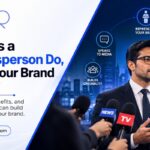
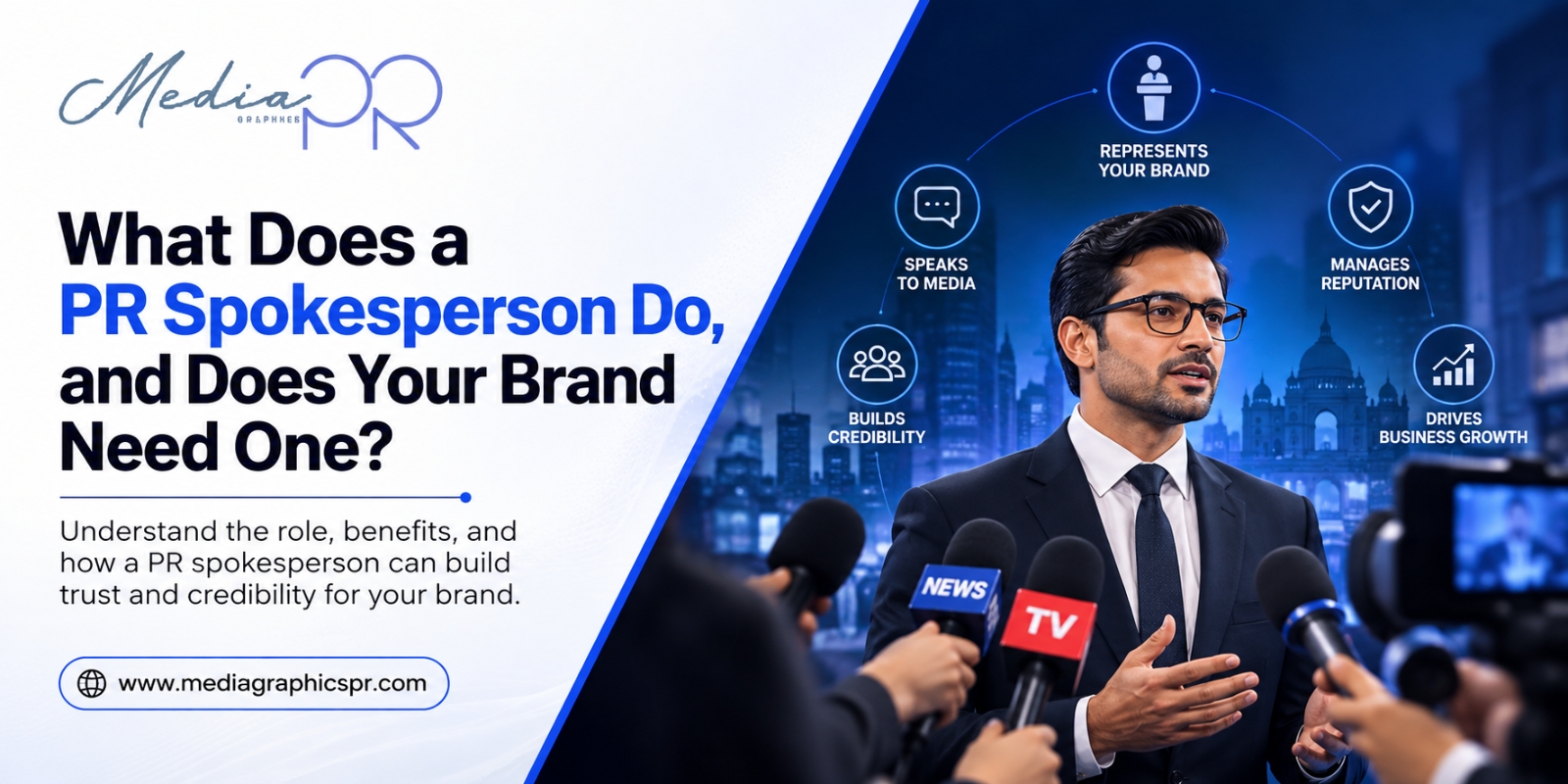
Think of a PR spokesperson as the person carrying your brand’s voice in the moments that count most, media interviews, press conferences, funding announcements, crisis moments, and any conversation with a journalist that ends up shaping how the company gets written about. They are not just a face in front of a camera. They are the person whose words, tone, and composure determine whether coverage builds your brand or quietly damages it.
Understanding what a PR spokesperson does, when a brand needs one, and how to prepare someone for the role is more important than most founders realize until they are sitting in front of a journalist who is asking something they did not prepare for.
MediagraphicsPR offers media spokesperson training built specifically for founders, executives, and designated communications leads who need to be genuinely ready for the moments when the wrong answer costs the brand something it took years to build.
Quick Answer: A PR spokesperson is the designated person who communicates on behalf of a brand in media interactions, press situations, and public moments. They are trained to deliver key messages clearly, handle difficult questions without going off-script, and represent the brand consistently across every media touchpoint. Most growing Indian brands need at least one trained spokesperson, and the right time to prepare them is before a journalist calls, not after.
What a PR Spokesperson Actually Does
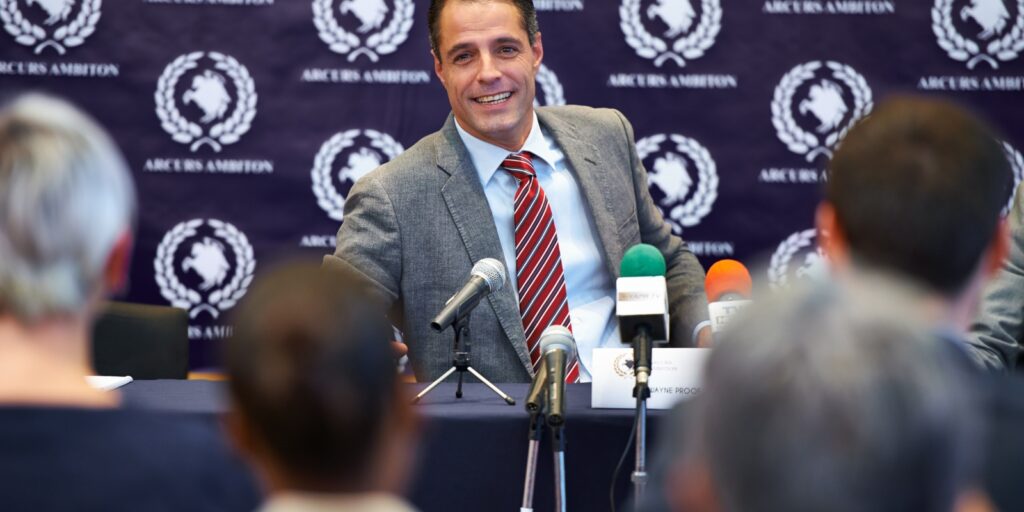
The job covers more than most people assume when they hear the title. A PR spokesperson is not just the person who reads a prepared statement at a press conference. They are the human bridge between the brand’s internal reality and the public narrative that journalists, investors, and audiences will form about it.
Here is what the role actually involves:
- Representing the brand in media interactions. Every interview, every background briefing, every quote that a journalist attributes to the company runs through the spokesperson. They decide what gets said, how it gets framed, and what language carries the brand’s position accurately and without creating new problems.
- Delivering key messages under pressure. Journalists ask difficult questions. Good spokespeople are trained to acknowledge the question, bridge to the message that actually matters for the brand, and do it in a way that does not sound evasive or defensive. This is a skill. It does not come naturally to most people, including founders who are otherwise exceptional communicators.
- Managing the brand’s tone in public moments. A founder who sounds defensive in a crisis interview, or excited when announcing a partnership in a way that overpromises creates a story out of their delivery that has nothing to do with the facts. Tone management is part of the spokesperson’s job.
- Building journalist relationships over time. A spokesperson who is consistently available, consistently useful, and consistently honest with journalists builds the kind of media relationship that benefits the brand beyond any individual interview. Journalists remember who gave them something real and who gave them nothing.
- Handling crises when they arrive. This is the moment when spokesperson preparation either pays off or shows its absence. A trained brand spokesperson in a crisis situation stays on message, avoids speculation, does not fill silence with words that create new problems, and presents the company as accountable without conceding things that are not yet established.
The Different Types of PR Spokespersons
Not every brand needs the same kind of spokesperson, and not every spokesperson serves the same purpose. Understanding the types helps figure out what the brand actually needs:
| Type | Who They Typically Are | When They Are Most Useful |
|---|---|---|
| Founder / CEO spokesperson | The founder or chief executive, trained for media | Funding announcements, thought leadership, company vision interviews |
| Designated communications lead | Head of PR, communications director, or a senior marketing lead | Day-to-day media inquiries, background briefings, press conference management |
| Technical expert spokesperson | CTO, CMO, or domain expert | Product launches, technical media, specialist publications |
| Crisis spokesperson | Senior leader with specific crisis training | Any situation where the brand is under public scrutiny |
| Third-party spokesperson | An advisor, customer, or industry expert who can speak on the brand’s behalf | Situations where third-party credibility carries more weight than the brand’s own voice |
Most growing brands need at least a founder spokesperson and a communications lead. Companies with significant media exposure or regulatory complexity often need all of the above prepared and ready.
Does Your Brand Actually Need a PR Spokesperson?
The honest answer: if you have ever had a journalist call you, if you are planning a fundraise in the next twelve months, if your brand operates in a regulated sector, or if you have more than fifty employees, the answer is yes.
Here is a more specific breakdown:
You definitely need a trained spokesperson if:
- Your brand is approaching a funding round and will be doing investor-facing media. The way a founder handles a journalist interview during a raise period directly affects how that raise is perceived in the market.
- Your brand is in fintech, healthcare, pharma, or any regulated sector. These sectors face regulatory media situations where a poorly handled spokesperson moment can attract regulatory attention alongside media scrutiny.
- Your brand has had media attention in the past, positive or negative. Once you are on journalists’ radar, you will stay there, and the next time they call you need to be ready.
- Your brand has more than a hundred employees. At that scale, leadership communications are watched internally as well as externally. The signals a spokesperson sends in public affect how the organization reads itself.
You probably do not need a full-time spokesperson yet if:
- Your brand is pre-product and pre-revenue with no external media interest. But even here, preparing the founder for the media moments that come with early funding is worth doing before those moments arrive.
What PR Spokesperson Services Actually Include
When a brand engages a PR agency for PR spokesperson services, the work typically covers several connected components:
- Spokesperson identification and assessment. Not every founder is the right person to be the primary media voice, even if they are the company’s most important person internally. A good PR agency helps identify who should be speaking in which contexts.
- Message development. The spokesperson can only be as good as the messages they are trained to deliver. Developing the three to five core messages that the brand needs to land in any media interaction is foundational work that happens before any training.
- Interview simulation. Mock interviews with realistic questions, including the difficult ones a journalist is likely to ask about pricing, competition, regulatory position, or anything else the brand would prefer not to address. The first time the spokesperson faces a hard question should not be in front of a real journalist.
- On-camera and on-record training. The physical and verbal habits that make a spokesperson credible and watchable on video, and the discipline to stay on the record and off the record correctly in interactions with journalists.
- Crisis scenario preparation. Specific preparation for the types of crises most likely to affect the brand, including how to handle questions about situations that are developing and not yet fully understood.
- Ongoing refresher sessions. Messages change as the company evolves. A spokesperson trained eighteen months ago on a message that has since shifted is a liability. Good PR agencies build refreshers into the ongoing relationship.
What Happens When a Brand Does Not Have a Trained Spokesperson
The consequences are real, and they tend to show up in specific, predictable ways:
A founder who goes off-script in a funding-period interview and mentions numbers or strategic plans that were not ready for public consumption. A communications lead who, when a journalist calls during a crisis, says “no comment” without understanding what that communicates and why it almost always makes things worse. A technical founder who answers every question with accurate but impenetrable jargon that the journalist cannot use and the audience cannot understand.
These are not dramatic failures. They are small, quiet moments that produce coverage that is less favorable than it could have been, or creates a reputational problem that the brand then has to spend months managing.
The cost of not having a trained PR spokesperson is not always visible immediately. It shows up over time in media coverage that never quite captures what the brand is building, in investor conversations that start with skepticism instead of recognition, and in the slow erosion of the kind of credibility that takes years to build properly.
The Media Spokesperson Training Process: What It Actually Looks Like
For a founder or executive going through media spokesperson training for the first time, here is what a well-structured program actually covers:
Session 1: Message architecture
Developing the three to five core messages the spokesperson needs to land in any media interaction, regardless of what questions are asked. These become the navigation points that every answer bridges back to.
Session 2: Interview technique fundamentals
How to listen to a question properly, how to bridge from a question to a message, how to handle silence, and how to decline to answer without appearing evasive. The physical habits that make a spokesperson more or less credible on camera.
Session 3: On-camera and on-record simulation
A realistic mock interview covering expected questions and deliberately including unexpected ones. Full recording and playback so the spokesperson can see what the journalist and the audience sees.
Session 4: Difficult question handling
Questions about competitors, about pricing, about past mistakes, about speculation and hypotheticals. How to handle each type without creating new problems.
Session 5: Crisis scenario preparation
Specific scenarios relevant to the brand’s sector and risk profile. Practicing the combination of accountability and message discipline that makes a crisis response credible rather than defensive.
Session 6: Refresher and recalibration
After six to twelve months, a refresher that updates messages to reflect company evolution and retrains on any habits that have drifted since the initial program.
How Brand Spokesperson Preparation Connects to Broader PR Strategy
This is the connection most brands miss. Spokesperson training is not a standalone exercise. A prepared brand spokesperson is part of how the broader PR strategy delivers on its promise.
When a journalist is writing a feature about the sector and calls the founder for a quote, the quality of that quote determines whether it appears prominently or gets cut. When a funding announcement is being covered and the journalist wants to hear directly from the CEO, the interview that happens determines whether the story amplifies the narrative the brand has been building or introduces an off-message element that the PR team then has to manage.
Good media relations create media opportunities. A trained PR spokesperson converts those opportunities into the coverage that actually serves the brand.
The two work together. An agency that provides media relations without spokesperson training is creating interview opportunities for people who may not yet be ready to make the most of them.
What Makes an Effective PR Spokesperson
Beyond training, the qualities that consistently distinguish effective spokespeople from ineffective ones:
- Genuine subject matter knowledge. A spokesperson who actually understands what the company does, why it matters, and how the market works can adapt to unexpected questions in a way that someone working from a script alone cannot. Authenticity shows, and journalists recognize it.
- Comfort with silence. Most people fill silence with words. In a media interaction, those words often create the story. An effective spokesperson is comfortable pausing before answering, and that discipline is trained, not natural for most people.
- Message discipline without sounding scripted. The goal is to consistently deliver the brand’s key messages while sounding like a person rather than a communications policy document. This balance is what separates trained spokespeople from merely prepared ones.
- Knowing what they do not know. The phrase “I do not have that information right now, I will get back to you” is one of the most useful sentences in a spokesperson’s toolkit. Spokespeople who speculate beyond their knowledge consistently create problems. Ones who know their limits consistently avoid them.
How MediagraphicsPR Works With Brands on Spokesperson Development
At MediagraphicsPR, PR spokesperson preparation is part of how we build the media-readiness that makes everything else in a PR program work better. Because even the best media relations strategy underdelivers when the person sitting across from the journalist is not ready for the conversation.
Our media training work serves fintech and BFSI founders preparing for investor-period media and regulatory communication situations. Technology and SaaS executives who need to translate technical product capability into language that enterprise buyers and investors find credible. Healthcare and pharma leaders navigating the specific communication constraints their sector requires.
From our Delhi NCR base, we work with brands nationally across Mumbai, Bangalore, Hyderabad, and Chennai. Senior people building the messages and running the training sessions. Real journalist experience informing what the mock interviews look like. And the monitoring and media relations infrastructure that means the training pays off in actual media opportunities that go well.
If your brand is approaching a fundraise, entering a new market, or simply has never formally prepared anyone to speak to the press, that preparation is worth doing before the journalist calls.
FAQs
Does a startup really need a trained PR spokesperson or can the founder just handle it naturally?
Most founders are strong communicators in conversations they control. Media interviews are different because they are built around questions the journalist sets, not talking points the founder chooses. Founders who are trained for the format consistently produce better coverage than ones who go in relying on their general communication ability. The training is not about changing who they are. It is about making sure their natural strengths show up in a context that is designed to surface weaknesses.
What is the difference between a PR spokesperson and a media trainer?
A media trainer is someone who prepares a spokesperson for media interactions. A PR spokesperson is the person who actually does those interactions on behalf of the brand. The two roles are related but distinct. Some PR agencies provide both the training and the broader media relations work that creates the opportunities the spokesperson then fills.
How long does media spokesperson training take?
A foundational program typically runs across four to six sessions over four to eight weeks. The first two sessions cover message development and technique. The middle sessions cover on-camera simulation and difficult question handling. The final session is a full mock interview and review. It’s worth building in a refresher every six to twelve months too, since messages shift and new situations come up as the company evolves.
Should the CEO always be the primary spokesperson or can someone else take that role?
The CEO is typically the right spokesperson for funding, vision, and leadership-level conversations. But for product, technical, or operational topics, a CTO or operational leader often delivers more credible coverage because they have the depth. The right spokesperson is the one who actually knows the topic best and can be trained to communicate it well, not necessarily the most senior person available.
What should a spokesperson do if they are asked a question they do not know the answer to?
Say so, clearly and without apology. “I do not have that information in front of me, and I want to make sure you have the right data, so let me get back to you on that” is a legitimate answer that journalists generally respect. What they do not respect is speculation dressed as fact or an attempt to redirect from a question so obvious that the avoidance itself becomes the story.
Is media spokesperson training different for crisis situations versus regular media interviews?
Yes, meaningfully different. Regular media interview training focuses on message delivery, interview technique, and making the most of media opportunities. Crisis spokesperson training focuses on accountability without concession, handling hostility without becoming defensive, managing the combination of limited information and high public pressure, and the specific language choices that either stabilize a crisis situation or make it worse. Both types of training are valuable and most brands need both.
Ready to Have Someone Genuinely Ready the Next Time a Journalist Calls?
The difference between coverage that builds a brand and coverage that quietly damages it often comes down to one thing: whether the person speaking was actually prepared. A PR agency in India that trains your PR spokesperson before the pressure arrives is what turns a media opportunity into coverage that works for you.
Visit MediagraphicsPR to see how we build media-readiness into every client relationship, from message development to crisis scenario preparation.
Need to speak to someone now?
📞 Call us: +91-8448360900
📧 Email us: info@mediagraphicspr.com
We respond within 24 hours.