



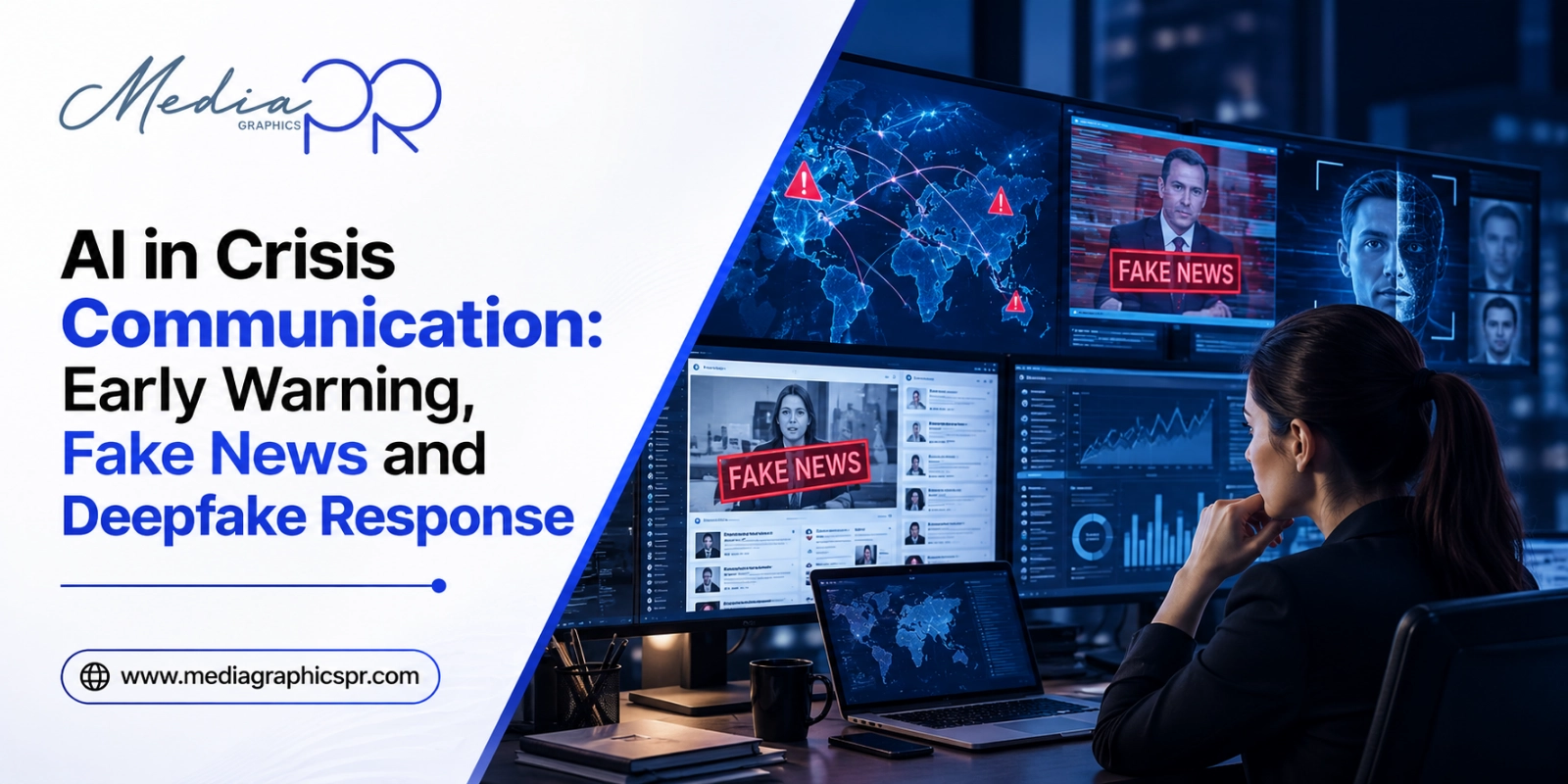
The crisis that destroys a brand in 2027 often starts with something that never actually happened.
A video of a CEO saying something they never said. A fabricated quote attributed to a founder spreading across WhatsApp before any journalist has verified it. A doctored screenshot of a regulatory notice. A synthetic voice clip of a company spokesperson that sounds completely authentic and says something the spokesperson never recorded. These are not hypothetical threats. Deepfakes and AI-generated disinformation are active reputation risks for Indian businesses right now, and most brands have no infrastructure to respond to them.
At the same time, AI tools are also changing how brands detect developing crises before they become unmanageable, how they monitor the spread of false narratives across platforms, and how they build the early warning systems that give communications teams the window to respond before the story is already written.
AI in crisis communication is therefore a story with two sides: the new threats that AI creates for brands, and the new capabilities that AI provides for the communications teams trying to protect them. Understanding both is what makes the difference between a brand that gets ahead of a reputation threat and one that wakes up to a crisis that has already defined itself in the public mind.
MediagraphicsPR is an AI crisis monitoring informed agency that has spent 25 years building the crisis communication infrastructure that protects Indian brands. They bring genuine media relationships, crisis preparation expertise, and the monitoring frameworks that AI in crisis communication requires in 2027.
Quick Answer: AI in crisis communication refers to the use of artificial intelligence tools both as a source of new reputation threats, deepfakes, synthetic media, and AI-generated disinformation, and as a set of capabilities that help brands detect and respond to those threats faster. The brands that manage AI-generated crises best in 2027 are the ones with pre-built monitoring infrastructure, prepared response protocols for synthetic media threats, and the genuine journalist relationships that allow accurate information to reach media before false narratives consolidate.
The New Crisis Landscape: What AI Has Changed
Crisis communication has always been about speed and credibility. The brand that responds fastest with the most credible information consistently outperforms one that responds slowly or vaguely.
AI in crisis communication has changed the threat environment in three specific ways that make the old playbook insufficient:
➤ The speed of false narrative spread has increased. AI tools can generate convincing false content, whether text, audio, or video, in minutes. That content can reach tens of thousands of people through WhatsApp, Telegram, and Twitter/X before any verification process has had time to run. By the time a journalist publishes a verified story, a significant portion of the relevant audience may have already formed an impression based on synthetic content.
➤ The believability of false content has improved dramatically. A deepfake video of a CEO from two years ago was detectable with the naked eye. By 2027, a deepfake video of a CEO is often impossible to tell apart from real footage without running technical analysis on it. That changes what’s actually required during a crisis response, a brand can’t just deny something’s fake anymore, it has to actively prove it.
➤ The scale of AI-generated disinformation has grown. Coordinated disinformation campaigns can now deploy AI tools to generate high volumes of synthetic reviews, fake news articles, and fabricated social media posts targeting a specific brand simultaneously. What used to require an organized team of humans can now be automated, which means brands face threats at a scale and speed that manual monitoring cannot track.
AI Crisis Monitoring: Early Warning Before the Fire Starts
AI crisis monitoring is where artificial intelligence delivers its most defensible value in crisis communication. The window between when a reputation threat begins developing and when it becomes unmanageable is the most valuable window a communications team has. AI monitoring tools expand that window.
What effective AI crisis monitoring looks like for Indian brands:
❯ Cross-platform real-time monitoring. This means keeping an eye on brand mentions, what’s being said about competitors, and relevant keywords across news sites, social platforms, WhatsApp-adjacent spaces, YouTube, and even podcast transcripts, all at once. AI can process that volume as it happens in a way no human team realistically could.
❯ Anomaly detection. This is about catching unusual shifts in how often or how a brand gets mentioned before those shifts turn into an actual story. A sudden jump in mentions on regional-language platforms. A cluster of negative posts that all sound suspiciously similar, showing up in a short window. Journalist accounts that have never covered the brand before suddenly starting to follow its social channels. These are the kinds of early signals AI tools can pick up on that a human monitoring team would likely only notice once it’s too late.
❯ Synthetic content detection. This covers keeping watch for deepfakes, AI-generated images, and synthetic audio that involve brand assets, an executive’s face, or company communications. Purpose-built AI detection tools now scan for the technical markers that give synthetic content away, which lets brands catch and respond to a deepfake before it ever reaches mainstream coverage.
❯ Narrative trajectory analysis. Tracking not just what is being said but the direction the conversation is moving. Is sentiment improving or deteriorating? Is a fringe narrative gaining mainstream traction? Is a story that appeared only on one regional platform being picked up by national journalists? These trajectory questions require AI-powered analysis at scale.
Deepfake PR Crisis: What It Looks Like and How to Respond
A deepfake PR crisis is a specific crisis type that requires a response framework different from standard crisis management. The challenge is not just reputational. The real challenge is proving a negative, showing that something the audience may have already seen and believed simply isn’t real.
What a deepfake brand crisis typically looks like:
A clip starts circulating on social media showing a company executive saying something damaging to the brand. It’s synthetic, but convincing enough that most people wouldn’t question it. It spreads fast through messaging apps well before any journalist gets hold of it. By the time the communications team even finds out, tens of thousands of people have already seen it, and some have shared it or formed opinions based on it.
The response framework that works:
› Step 1: Verify and document immediately.
Before saying anything publicly, confirm the content is actually synthetic using whatever detection tools are available, and bring in forensic specialists for technical analysis if needed. Document the original clip, its spread, and the technical evidence of its synthetic origin. This documentation is both a communications asset and a legal asset.
› Step 2: Issue a clear, specific public statement within hours.
The statement needs to do two things: clearly state that the content is fabricated with specific evidence of why, and demonstrate the authentic executive communication that contrasts with the fake. Vague denials read as defensive. Specific evidence-backed rebuttals read as credible.
› Step 3: Brief key journalists with the evidence before they publish.
The genuine journalist relationships that were built before the crisis are what determine whether the factual story, backed by evidence, reaches audiences before the false narrative consolidates. Journalists who know and trust the agency representing the brand are more likely to hold publication until they have seen the evidence and are more likely to lead their story with the verification rather than just reporting the claim and the denial.
› Step 4: Platform-level action simultaneously.
Report the synthetic content to the platforms where it is spreading with the technical evidence of its synthetic origin. Most major platforms already have policies around synthetic media and faster response paths set up for verified business accounts, though this only really works if the brand already has a verified presence on those platforms before a crisis hits.
› Step 5: Sustained monitoring post-response.
A deepfake crisis does not end when the first response goes out. The synthetic content continues circulating even after being debunked, because not everyone who saw the original sees the correction. Sustained monitoring tracks the continued spread and identifies when further action is warranted.
Fake News Brand Response: The Principles That Actually Work
Fake news brand response is a broader category than deepfakes. It includes fabricated text stories, manipulated screenshots, false quotes attributed to executives, and coordinated disinformation campaigns that use AI tools to generate volume.
The principles that consistently produce better outcomes:
➞ Speed of accurate response beats speed of any response.
The temptation in a fake news situation is to respond immediately. The right response is to respond accurately as quickly as possible, which sometimes means a brief holding statement acknowledging the situation while evidence is gathered, followed by a specific factual rebuttal. Rushing an inaccurate response creates a second problem on top of the first.
➞ Show, do not tell.
Simply saying “this report is false” doesn’t carry much weight on its own, showing exactly why it’s false does. A screenshot of the real document next to the fabricated one. Footage of what was actually said, contradicting the fake quote. A technical breakdown proving the content is synthetic. Evidence is what makes a denial believable. A bare assertion doesn’t do that on its own.
➞ Third-party validation amplifies the rebuttal.
A brand saying its own content is fabricated is less convincing than an independent expert, a trusted journalist, or a fact-checking organization reaching the same conclusion. The PR work of getting the brand’s evidence to fact-checkers and trusted journalists who can verify and publish their own findings is often more effective than the brand’s own statement.
➞ Pre-built credibility determines how the rebuttal lands.
A brand with twelve months of consistent, accurate, credible public communication behind it enters a fake news crisis in a fundamentally different position from one with no prior media presence. The audience and the journalists who have been encountering the brand as a credible source are predisposed to take its rebuttal seriously. The one with no prior presence has to establish its own credibility while simultaneously defending against the false narrative.
Building Pre-Crisis Infrastructure for AI-Generated Threats
The most important work in AI in crisis communication happens before any crisis arrives. The brands that handle AI-generated reputation threats best in 2026 are the ones that built the following infrastructure when they did not need it:
➥ Authentic media archive. A consistent body of genuine media coverage, executive statements, and verified public communications that provides the contrast material necessary to demonstrate that synthetic content is inauthentic. A brand with no authentic public record is harder to defend against deepfake attacks than one with a well-documented public history.
➥ Technical deepfake detection capability. Either in-house or through a retained specialist, the ability to rapidly analyze potentially synthetic content and produce evidence of its synthetic origin. This capability needs to be available on short notice because deepfake crises are not scheduled.
➥ Journalist relationships for rapid truth distribution. The journalists who will receive evidence of false content and publish an accurate account based on that evidence are not cold contacts. They are journalists who have an existing relationship with the brand’s communications team and who trust the information they receive. These relationships are built over months and years of genuine engagement.
➥ Executive digital authentication. Verified social accounts, authenticated video and audio baselines, and documented communication practices that make it possible to demonstrate authentically what an executive actually said and contrast it with synthetic content. This is the AI-era equivalent of signature verification.
➥ Platform crisis escalation protocols. Pre-established relationships with trust and safety teams at major platforms for escalated response when synthetic content targeting the brand appears. These escalation paths work better when they have been established before a crisis than when they are being built in the middle of one.
How MediagraphicsPR Helps Brands Navigate AI-Generated Crises
At MediagraphicsPR, AI in crisis communication is something we approach from both directions: building the monitoring capability that provides early warning, and maintaining the journalist relationships that allow accurate information to reach media before false narratives consolidate.
Our consulting and strategy work builds the crisis infrastructure that makes AI-generated threat response possible: authentic media archives, pre-prepared response frameworks for synthetic media scenarios, executive profile documentation, and the escalation protocols that allow rapid response when something develops.
Our media relations work maintains the journalist relationships that make our clients’ accurate account reach the journalists who matter before any story is written. When a fintech brand faces a fabricated regulatory notice, when a technology company faces a synthetic audio clip, when a healthcare brand faces an AI-generated false clinical claim, the response that protects the brand is the one that gets accurate information to trusted journalists through trusted relationships before the false narrative writes itself.
We work across Mumbai, Bangalore, Delhi, and every major Indian market. Senior people on every account. Crisis infrastructure built before it is needed.
If your brand does not currently have the monitoring, the media relationships, or the response frameworks to handle an AI in crisis communication scenario, building that infrastructure now costs significantly less than managing one without it.
FAQs
Q: How do you prove a deepfake is fake quickly enough for the rebuttal to matter?
The fastest path is a combination of available AI detection tools that identify technical signatures of synthetic content, comparison with authenticated original footage or statements, and where necessary, engagement of digital forensics specialists who can produce technical analysis. The brand’s communications team needs to know who provides that technical analysis before a crisis, not during one. Having those relationships in place is part of crisis preparation.
Q: What should a brand do if it discovers a deepfake of its CEO before it goes viral?
Move immediately on three tracks simultaneously: technical verification to confirm it is synthetic and document the evidence, platform reporting to begin the removal process with evidence, and proactive journalist briefing to get the accurate account into media before the synthetic content reaches mainstream coverage. Waiting until it goes viral to respond is almost always the wrong decision.
Q: How is fake news brand response different from standard crisis communication?
Standard crisis communication addresses a real problem the brand needs to respond to honestly. Fake news brand response addresses a false claim the brand needs to refute with evidence. The response framework is fundamentally different: standard crisis response leads with acknowledgment and accountability, fake news response leads with specific factual refutation. The risk in treating them the same way is either appearing to acknowledge false claims as real or appearing to deny real problems as fake.
Q: Can AI monitoring tools detect a crisis before it reaches mainstream media?
Yes, in many cases. The signals that a negative narrative is developing, unusual spikes in mention volume, coordinated posting patterns, journalist activity around a brand that has not been publicly newsworthy recently, often appear hours or days before a story publishes. AI monitoring tools that are configured to flag these patterns provide the early warning window that makes proactive response possible. The limitation is that the tool identifies the signal. The human team still has to decide what to do with it.
Q: How should brands think about building authentic media archives as a deepfake defense?
A consistent body of genuine media coverage, documented executive statements, verified video and audio appearances, and an established authentic public communication record makes it significantly easier to demonstrate that synthetic content is inauthentic. Often, the strongest rebuttal is simply the gap between what the executive has actually said publicly over time and what the deepfake claims they said. A brand with little or no public media history has far less to work with when it comes to drawing that contrast against something fake.
Q: Is the threat of AI-generated disinformation significant enough for Indian businesses to invest in specific preparation?
Yes, and the investment required is proportional to the brand’s public profile. Listed companies, consumer brands with large customer bases, founders with significant public profiles, and businesses in regulated sectors that are subjects of media and regulatory attention all face meaningful risk from AI-generated disinformation. The preparation work, monitoring tools, authentic media archives, journalist relationships, and response protocols, costs significantly less than managing an AI-generated crisis without it.
Ready to Build Crisis Infrastructure Before a Deepfake Makes the Decision for You?
AI in crisis communication cuts both ways, new threats and new early-warning capability. What actually protects a brand is monitoring infrastructure, an authentic media archive, and a PR agency in India with journalist relationships strong enough to get the true story out before a synthetic one takes hold.
Visit MediagraphicsPR to see how we build crisis communication infrastructure for brands across India.
Need to speak to someone now?
📞 Call us: +91-8448360900 📧 Email us: info@mediagraphicspr.com
We respond within 24 hours.