






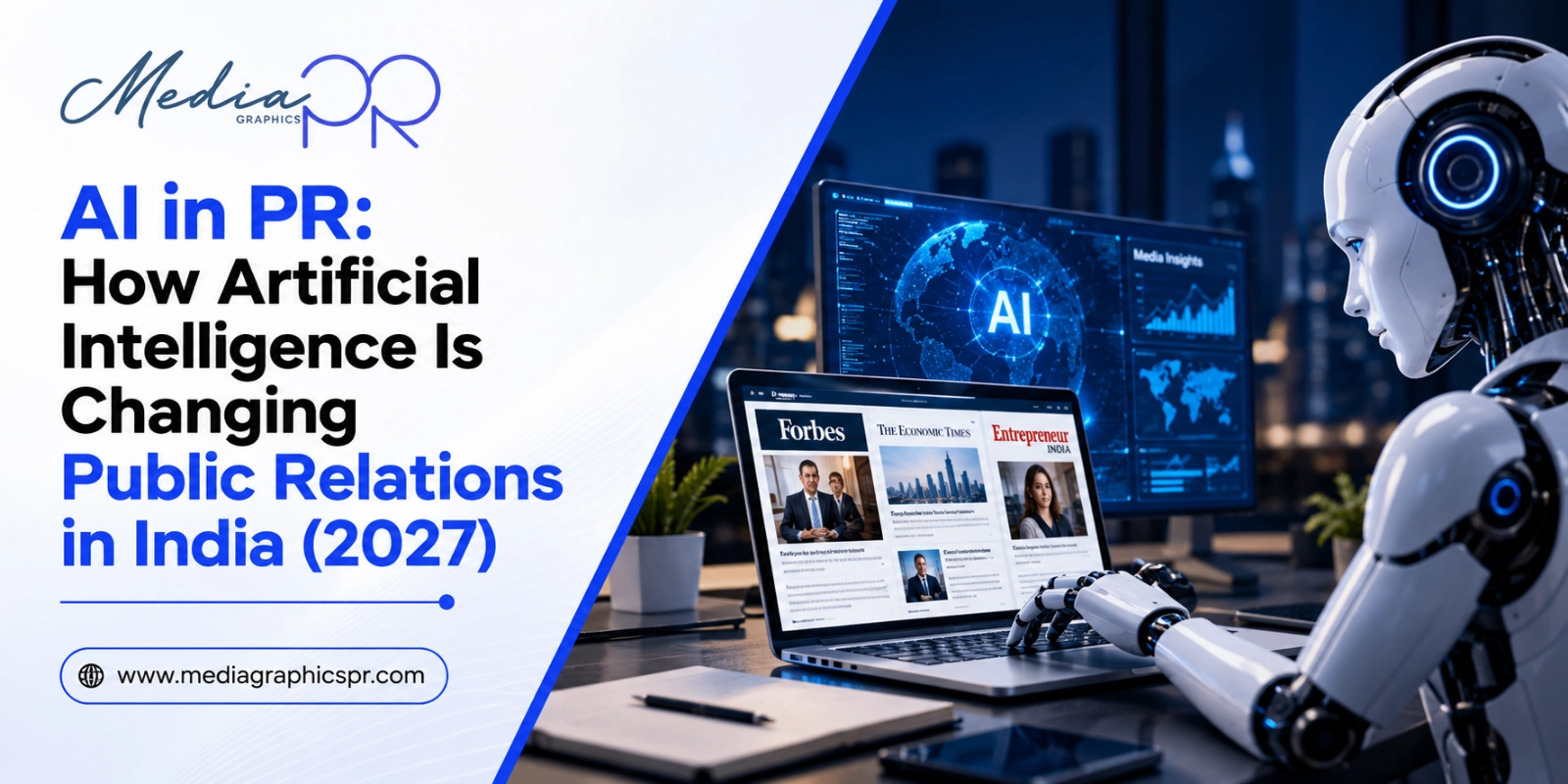
The PR industry has a complicated relationship with the technology that is changing it.
On one side, AI tools have genuinely made certain parts of PR work faster, more measurable, and more data-driven. Media monitoring that used to take hours happens in minutes. Sentiment analysis across thousands of mentions gets processed automatically. Research that requires a full afternoon can be completed in twenty minutes. These are real improvements that the agencies and in-house teams using them well have turned into genuine competitive advantages.
On the other side, the things that actually make PR work in India in 2027, the journalist who takes your call because you have a real relationship with them, the editor who runs your founder’s piece because they trust your judgment about what their readers care about, the investor who recognizes your client’s name before the pitch meeting because they have been encountering them in credible publications for six months, none of those outcomes come from AI. They come from human relationships built over years.
Understanding AI in PR properly means understanding both of these realities simultaneously. It is not a story of AI replacing PR professionals. It is a story of PR professionals who understand AI outperforming those who do not, while the fundamental value of genuine human relationships in media remains unchanged.
MediagraphicsPR is an AI in public relations informed agency that has spent 25 years building the human relationships and editorial credibility that technology cannot replace, while adopting the AI tools that make the work faster and more precise.
Quick Answer: AI in PR refers to the use of artificial intelligence tools in public relations work, including media monitoring, sentiment analysis, journalist research, content assistance, crisis signal detection, and search visibility optimization. AI tools have made PR work faster and more data-driven, but the core value of PR, genuine journalist relationships, human narrative judgment, and earned editorial credibility, remains irreplaceable by any technology. The agencies getting the most from AI in 2027 are the ones using it to do the fundamentals better, not the ones treating it as a substitute for them.
What AI in PR Actually Means in 2027
AI in PR is not a single tool or a single capability. It is a set of technologies being applied to different parts of the PR workflow in ways that range from genuinely transformative to genuinely overhyped.
Here is an honest breakdown of where AI is actually changing PR work and where it is not:
| PR Activity | What AI Changes | What It Does Not Change |
|---|---|---|
| Media monitoring | Speed and volume of coverage tracking across thousands of sources | Whether the coverage is reaching the right audiences for the right reasons |
| Sentiment analysis | Processing large volumes of mentions to identify tone trends | Understanding the nuanced context behind individual coverage pieces |
| Journalist research | Faster identification of relevant journalists and recent work | The relationship that makes a journalist take your pitch seriously |
| Content drafting | First drafts of press releases and media pitches faster | The judgment about what angle a specific journalist will find compelling |
| Crisis signal detection | Earlier identification of developing negative narratives | The human decisions about how to respond credibly and quickly |
| AI search visibility | Understanding which sources AI tools draw from for sector topics | Building the earned media presence that creates AI visibility in the first place |
The pattern is consistent. AI makes the mechanical parts of PR faster. It does not replace the judgment, the relationships, or the genuine narrative work that produces outcomes.
How AI for PR Is Changing Media Monitoring in India
AI for PR has had its most significant and most defensible impact in media monitoring. The volume of media that Indian businesses need to track, across national and regional language publications, digital portals, broadcast transcripts, social media, podcasts, and increasingly AI-generated content, has grown beyond what human teams can track comprehensively without technology assistance.
AI-powered monitoring tools now identify brand mentions across thousands of sources in real time, categorize them by sentiment and relevance, flag potential crisis signals before they reach mainstream coverage, and surface patterns in competitive coverage that would take hours to identify manually.
For Indian brands managing reputations in a media landscape that spans twenty-plus languages and hundreds of publications, this is a genuine operational improvement. The communications team that uses AI monitoring is working with more complete information than one that relies on manual tracking.
What changes: the speed at which a developing negative narrative is identified. What does not change: the human judgment required to decide what to do about it.
The crisis that gets managed well in 2027 is the one where the AI monitoring system flags an unusual pattern of journalist activity two days before a story publishes, and the PR team with the right journalist relationships uses that window to get the brand’s perspective into the coverage before the framing is set. The AI tool provides the early warning. The human relationship determines whether the early warning actually changes the outcome.
PR and AI: What Changes in Journalist Research and Pitch Development
PR and AI tools have made journalist research significantly faster. Understanding which journalists cover which beats, what angles they have been taking recently, what stories they are working on, and what their editorial sensibilities tend to be, all of this can now be synthesized much faster than manual research allows.
For an agency pitching across multiple sectors for multiple clients, this matters. The pitch that arrives in a journalist’s inbox at the right moment, about a topic they are already working on, from someone who has read their recent work and understood their angle, converts at a much higher rate than a generic press release sent to a broad list.
AI tools help identify the right journalists faster. They help surface relevant recent coverage that makes personalization possible. They help flag when a particular journalist has covered a competing brand or a related topic recently.
What they do not do is replicate the result of a relationship where a journalist has been taking calls from the same PR professional for five years and trusts their judgment about what is genuinely worth covering. That trust is built through human interaction, consistent reliability, and the track record of being useful to the journalist over many interactions. AI has no role in building it.
AI and PR: The Content Assistance Conversation
AI and PR content assistance is where the most confusion exists, and where the most honest conversation needs to happen.
AI tools can produce first drafts of press releases, media pitches, and thought leadership outlines faster than any human writer. For agencies managing high volumes of routine content production, this has real operational value.
The problem emerges when AI-generated content replaces genuine human thinking rather than accelerating it. A press release that was written quickly by an AI tool and not substantially rewritten by a human who understands the journalist, the publication, and the specific news angle has a characteristic quality that experienced editors and journalists recognize and respond to negatively. It is often technically competent and strategically empty.
The communications that build genuine credibility in India’s media market are the ones that contain specific, honest, non-obvious perspectives that a journalist cannot easily get elsewhere. Those perspectives come from humans who have spent time thinking seriously about a market, a founder’s genuine point of view, or a specific clinical or technical development and its implications. AI does not have that perspective. It synthesizes patterns from existing content. Genuinely interesting perspectives require original human thinking.
The agencies using AI content assistance well are the ones where AI produces a starting structure that a senior strategist with genuine market knowledge substantially rewrites into something that actually contains insight. The agencies using it poorly are the ones where AI production has replaced the human thinking that makes the content worth reading.
Artificial Intelligence in PR: The AI Search Visibility Dimension
Artificial intelligence in PR has introduced an entirely new dimension to presence management that did not exist three years ago: AI search visibility.
When someone uses ChatGPT, Perplexity, or Google’s AI Overviews to research a brand, a founder, a sector, or a market question, the response they get is synthesized from the sources these AI tools are trained to trust. Publications with strong editorial standards and high domain authority, exactly the kind of publications that earned media placements appear in, are the primary sources.
A brand that has been covered in Mint, Business Standard, Economic Times, and relevant trade publications is far more likely to appear accurately and positively in AI-generated responses about its sector than one with no editorial presence. A founder who has been consistently quoted as an expert in those publications is far more likely to be cited by AI tools as a credible source when users ask about the relevant market.
This creates a new strategic reason to invest in earned media that adds to all the existing ones. The editorial coverage that builds investor credibility and enterprise buyer trust now also directly improves the brand’s visibility in AI-generated research responses. These are not separate programs. They are the same program delivering multiple benefits.
What AI in PR Cannot Replace in India’s Media Market
This is the most important part of the conversation, and the one that most discussions of AI in PR underemphasize.
India’s media market, particularly the financial and business press that shapes investor and enterprise buyer opinion, operates on relationships in a way that most other markets do. The journalist at Mint who covers Indian fintech is not primarily influenced by well-crafted pitches from agencies they have no relationship with. They are primarily influenced by sources they have worked with before, trust, and know will give them accurate information and not waste their time.
Building those relationships requires human investment over time: showing up consistently, being genuinely useful when a journalist is working on a story even when there is no direct benefit to the client, being honest when a story is not right for a particular publication rather than pitching it anyway, and being reliable enough that a journalist knows a call from the agency is worth taking.
AI has no mechanism for building this. It can help identify who the right journalist is. It cannot do the relationship work that makes the pitch land once the identification is complete.
The PR professionals who are thriving in 2027 are the ones who use AI tools to be faster and more precise at the analytical and research parts of the work, and then apply that speed and precision in service of genuine human relationships that no technology can replicate.
How MediagraphicsPR Approaches AI in PR
At MediagraphicsPR, AI in PR tools are part of how we work, not the reason our work produces results.
We use AI-powered monitoring to track coverage for clients across the breadth of India’s media landscape faster than manual monitoring allows. We use AI research tools to understand journalist beats and recent coverage more comprehensively before pitching. We use AI-assisted drafting as a starting point for content that our senior team substantially develops with the genuine market knowledge and editorial judgment that actually makes content worth publishing.
What we do not use AI to replace: the relationships with journalists at Economic Times, Mint, Business Standard, Forbes India, The Ken, Inc42, and every sector-specific publication that have been built over 25 years of consistent, reliable, genuinely useful engagement. Those relationships are the reason our clients’ stories land in the right publications. No AI tool builds them.
Our media relations work serves fintech brands where investor-facing financial media presence matters most. Our thought leadership development serves technology companies where founder authority in sector publications builds category credibility. Our consulting and strategy work serves healthcare brands where regulatory-aligned clinical communications require human judgment that technology cannot provide.
We work across Bangalore, Mumbai, Delhi, and every major Indian market. Senior people on every account. Real relationships doing the work that matters.
If your brand wants to understand what PR informed by genuine AI awareness and built on human media relationships looks like, that conversation starts here.
FAQs
Q: Will AI replace PR professionals in India?
Not the ones building genuine relationships. AI will continue to replace the mechanical, volume-based parts of PR work: mass press release distribution, basic monitoring, templated pitching. It will not replace the judgment required to identify what story a specific journalist will find interesting, the relationship that makes a pitch worth reading, or the genuine human thinking that produces credible thought leadership. The PR professionals at risk from AI are the ones whose value was primarily in volume. The ones whose value is in judgment and relationships are, if anything, more valuable in an environment where AI-generated noise makes genuine signals harder to find.
Q: How does AI search visibility connect to traditional PR work?
They are the same program. The earned media coverage in high-quality editorial publications that builds investor and buyer credibility also directly improves AI search visibility, because AI tools synthesize information from the same high-authority editorial sources. A brand that invests in earning media coverage in Mint and Economic Times is simultaneously building investor credibility, enterprise buyer trust, and AI search visibility. These are not separate activities.
Q: Are AI-generated press releases and pitches effective?
As first drafts that experienced PR professionals substantially rewrite, they save time. As finished products sent to journalists, they typically underperform human-crafted communications because they lack the specific, non-obvious perspective that makes a pitch interesting to a journalist who receives hundreds of communications every day. Journalists can identify AI-generated content and respond to it accordingly. The PR agencies using AI content tools well are the ones treating them as accelerators for human thinking, not replacements for it.
Q: How is AI changing media monitoring for Indian PR agencies?
Significantly and genuinely. AI monitoring tools can track brand mentions across thousands of Indian publications, regional language media, social platforms, and broadcast transcripts in real time, identify sentiment patterns, and flag crisis signals earlier than manual monitoring. For Indian brands managing presence across a genuinely complex multi-language media landscape, this is a real operational improvement that changes how quickly developing reputation situations can be identified and responded to.
Q: What is the most important thing for Indian PR agencies to understand about AI?
That it changes what is possible in the analytical, research, and monitoring parts of PR work without changing what makes PR actually produce outcomes. The editorial credibility that moves investor conversations and enterprise sales cycles is built through earned media in trusted publications secured through genuine journalist relationships. AI has no role in building those relationships. The agencies that understand this use AI to do the fundamentals faster. The ones that misunderstand it think AI can replace the fundamentals.
Q: How should an Indian startup think about AI in its PR strategy?
As a reason to invest in earned media earlier and more consistently. AI search visibility is now a genuine business case for PR beyond the traditional investor and buyer credibility benefits. A startup that builds consistent earned media coverage in credible publications is simultaneously improving its investor-facing credibility, enterprise buyer trust, talent attraction, and AI search visibility. These were always related benefits. AI search has made them even more directly connected.
Ready to Combine AI Speed With Relationships That Technology Can’t Replace?
AI in PR makes the mechanical work faster, monitoring, researching, first drafts. But the outcomes that actually move investor conversations and enterprise sales still come from genuine journalist relationships, the kind a PR agency in India builds over decades, not in a single prompt.
Visit MediagraphicsPR to see how we combine AI-informed efficiency with 25 years of real media relationships across India.
Need to speak to someone now?
📞 Call us: +91-8448360900 📧 Email us: info@mediagraphicspr.com
We respond within 24 hours.