
MediaPR

PR Agency for Healthcare Startups in India
MediaPR

PR Agency for Healthcare Startups in India

Healthcare is one of the hardest sectors to build trust in and one of the most important ones to get it right. A patient choosing a healthtech platform isn’t making a casual decision. A hospital procurement head evaluating a medical device startup is doing thorough due diligence. An institutional investor backing a health startup is asking harder questions than they would in almost any other sector. And a doctor considering a digital health tool is skeptical by training, not by accident. In every one of these conversations, trust is the first filter. Everything else—the product, the pricing, the features—comes after. And trust in healthcare doesn’t come from advertising. It comes from credibility that’s been built over time, through the right publications, with the right third-party validation. That’s exactly what healthcare startup PR India is built to do. Why Healthcare PR Is a Different Discipline Healthcare startup PR India isn’t generic PR with a medical angle dropped in. The audiences are different, the regulatory environment is more complex, and the credibility requirements are significantly higher than most other sectors. PR Challenge Why It’s Specific to Healthcare Regulatory sensitivity Claims about health outcomes require careful, accurate communication—missteps can have legal and reputational consequences. Multiple gatekeepers Patients, doctors, hospital administrators, insurers, and regulators all require tailored messaging. High skepticism baseline Healthcare professionals evaluate claims critically. Credibility must be supported by evidence, not just marketing. Trust is non-negotiable Unlike consumer products, poor healthcare experiences can have serious consequences, making trust essential. Clinical validation expectations Investors, enterprise buyers, and healthcare stakeholders expect clinical evidence and proven outcomes—not just compelling narratives. A generic PR agency that doesn’t understand these dynamics will produce coverage that either overpromises, lands in the wrong publications, or creates regulatory risk. Health tech PR agency work requires specialists who understand the sector, not generalists who’ve added healthcare to their service list. Useful: MediagraphicsPR delivers expert PR services for healthcare brands. A top healthcare PR agency helping you gain trust, visibility, and a strong media presence. What Healthcare Startup PR India Actually Needs to Do 1. Build Credibility With Medical Communities First The most valuable healthcare startup PR India coverage isn’t in mainstream business media—it’s in the publications doctors, hospital administrators, and healthcare professionals actually read. A feature in a medical journal or health industry publication that your target practitioners trust does more for enterprise sales than a Mint story ever could. Because it signals something mainstream business coverage doesn’t, that people with clinical knowledge have independently decided your product is worth their peers’ attention. Publications worth targeting for medical and clinical audiences: Express Healthcare Health Management Modern Medicare Medscape India ETHealthWorld Pharmabiz 2. Turn Clinical Evidence Into Media-Ready Narratives One of the biggest gaps in health tech PR agency work in India is clinical teams and communications teams rarely talk to each other. The result is that genuinely compelling evidence sits in internal documents while the PR team sends generic press releases. Real clinical outcomes, patient impact data, and efficacy numbers are exactly what journalists covering the healthcare beat need to write a proper story. The work is translating that evidence into language a non-clinical audience can understand and a journalist can use, without losing accuracy. This translation is a specific skill. Get it right and your clinical credibility becomes your most powerful PR asset. 3. Target the Right Publications for Each Audience Audience Right Publication Target Institutional Investors Mint, Economic Times, Business Standard, Inc42 Hospital Procurement Heads Express Healthcare, Health Management Doctors and Clinicians Medscape India, Specialist Medical Publications Consumer Patients Healthshots, Times of India Health, Mainstream Digital Media Policy and Government ET Health World, Policy-Focused Business Media Global Investors Forbes India, BloombergQuint A medical startup public relations strategy that pitches the same story to every publication produces results for nobody. Match the story to the audience every time. 4. Use Regulatory and Policy Moments India’s healthcare sector generates significant policy news—NMC updates, health data regulations, telemedicine guidelines, National Health Mission developments, and CDSCO approvals. Every one of these creates a media moment that a well-positioned healthcare startup PR India company can insert itself into. Healthcare policy news breaks ↓ Journalist needs expert perspective on what it means ↓ Your founder offers genuine, specific insight ↓ Quoted in the story alongside larger, better-known players ↓ Credibility with both media and policy audiences builds ↓ Journalists file your founder as a go-to source The healthcare startups that do this consistently become the ones journalists call first, without being pitched. 5. Crisis Communications Is Non-Negotiable in Healthcare In most sectors, a crisis is a reputation problem. In healthcare, it can be a patient safety story—which means it moves faster, hits harder, and attracts regulatory attention alongside media scrutiny. A data breach at a health platform. A clinical outcome question raised by a user. A regulatory query that goes public before it’s resolved. These situations require a communications infrastructure that’s already in place, not assembled in a panic after the story breaks. What a good healthcare crisis PR looks like before a crisis happens: Pre-identified spokespeople with media training Prepared holding statements for likely scenarios Established journalist relationships so your version of events gets heard A clear escalation protocol—who decides what gets said and when The healthtech companies that come through difficult moments intact are almost always the ones that had health tech PR agency support running before the crisis, not just during it. 6. Founder Thought Leadership in Health Policy India’s healthcare system is going through significant transformation—digital health stack, ABDM implementation, telemedicine regulation, insurance tech, and AI diagnostics. Founders building in this space have genuine insight on all of it. That expertise, communicated consistently through authored articles, expert commentary, and media appearances, builds the kind of authority that compounds over time. An investor who’s read your founder’s perspective on AI diagnostics in three separate publications over six months arrives at a pitch meeting with a completely different starting point than one encountering your company for the first time. Formats that build
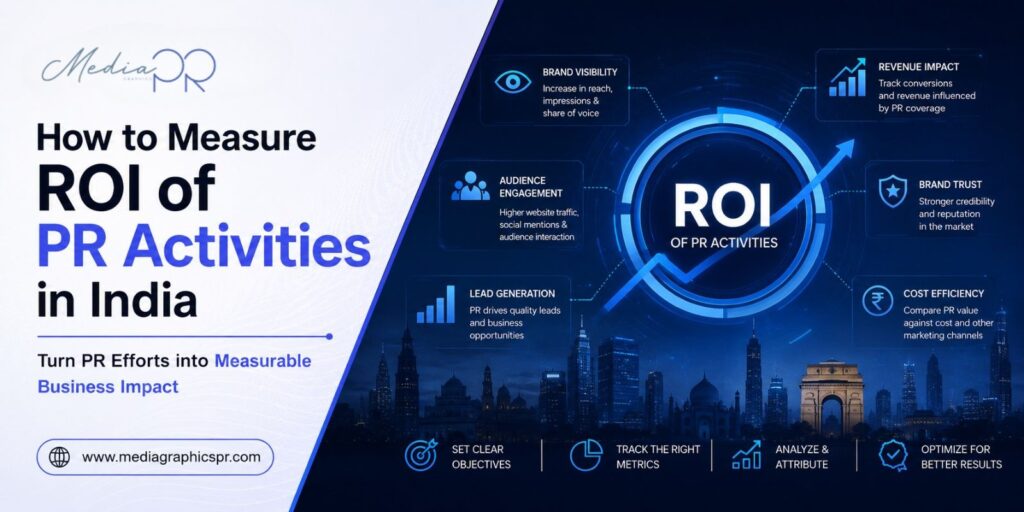

PR Activities in India
MediaPR

How to Measure ROI of PR Activities in India

Your PR agency sends the monthly report. Forty-two mentions. Estimated reach of 3.1 million. PR value equivalent of ₹22 lakhs. You read it. Nod. File it. And then go back to wondering whether any of it is actually doing anything for the business. This is the most common experience Indian brands have with PR measurement: numbers that look impressive in a presentation and mean almost nothing in practice. The problem isn’t that PR ROI India can’t be measured. It’s that most brands are measuring the wrong things entirely. Here’s how to fix that and build a measurement approach that actually tells you whether your PR spend is working. Why Traditional PR Metrics Are Failing Indian Brands The Indian PR industry has relied on three metrics for decades. All three have serious problems. Traditional Metric The Real Problem Clip Count A mention in a publication nobody reads counts the same as in Economic Times. Estimated Reach Assumes everyone who could see the coverage actually saw it. PR Value Equivalent (AVE) Converts editorial coverage into advertising rates—a methodology widely considered unreliable. Share of Voice Shows how often you’re mentioned compared to competitors, but not whether the coverage generated any business impact. These metrics measure activity. What businesses need to measure is outcome. Until that shift happens, PR ROI India conversations will keep producing impressive-looking reports that don’t connect to anything the CFO or founder actually cares about. The Right Framework—Four Levels of PR Measurement Good PR metrics India works at four levels. Each one is closer to real business impact than the last. ➤ Level 1: OUTPUT ⬩ What was produced and distributed ⬩ Press releases sent, pitches made, coverage secured ➤ Level 2: OUTTAKE ⬩ Whether the right audience actually received the message ⬩ Publication quality, audience relevance, message accuracy ➤ Level 3: OUTCOME Whether coverage changed awareness, perception, or behavior Branded search, sales conversation quality, investor recognition ➤ Level 4: IMPACT ⬩ Whether PR contributed to a real business result ⬩ Deals closed, rounds raised, hires made, crises managed Most Indian brands measure Level 1 and stop. The ones getting genuine value from PR measure Levels 3 and 4, and set those targets before the campaign starts, not after. The Metrics That Actually Tell You Whether PR ROI India Is Real 1. Publication Quality—Not Quantity Before anything else, stop counting clips and start scoring them. A placement in Mint or Economic Times that your investors read is not the same as a mention in a publication your target audience has never opened. Build a simple scoring system: Does this publication reach our specific audience—investors, buyers, talent? Is it a feature or a brief mention? Does it include a backlink to our website? Can our sales team actually use this in a conversation? Three high-quality placements in the right publications beat fifteen mentions in irrelevant ones, every single time. 2. Branded Search Volume Every significant piece of coverage should produce a measurable spike in people searching your company name directly. This is one of the clearest PR ROI India signals available and one of the most ignored. Set up Google Search Console before your campaign starts so you have a baseline. After every major placement, check whether branded search moved. If it didn’t, the coverage didn’t reach anyone who didn’t already know you. That’s important information about publication relevance. 3. Referral Traffic From Coverage Every online placement is a potential traffic source. Track how many people come to your website directly from media coverage, what pages they visit, and whether any of them take meaningful action. This tells you two things: whether the publication’s audience is genuinely engaged and whether your website is converting the traffic PR sends it. Both are worth knowing. 4. Sales Conversation Quality This is the measure PR activities results metric most brands never track and one of the most valuable. Talk to your sales team regularly: Are prospects mentioning coverage before the first call? Are deals moving faster with prospects who’ve seen the brand in the media? Is the credibility conversation taking less time? Are enterprise buyers referencing specific articles? When a prospect says, “I saw you in Economic Times last month” before the sales pitch starts—that’s PR ROI that no AVE calculation captures. 5. Investor Recognition For startups and growth-stage companies, this is one of the highest-value PR metrics India available. Track whether investors mention your coverage before pitch meetings. Ask your investment relations contacts whether they’ve encountered your brand in the media. Notice whether inbound investor interest increases after significant placements. When an investor says “I’ve been following your company in Inc42” before you’ve introduced yourself, that’s your PR working at exactly the level it should be. 6. Talent Pipeline Quality Strong candidates research companies before applying. If your employer brand isn’t showing up in the media, you’re losing offers to competitors with stronger public profiles—regardless of which company has the better culture. How to track this: Ask candidates in interviews where they heard about the company Track whether application quality shifts after significant coverage Note whether senior candidates reference specific articles in conversations If nobody has ever mentioned PR coverage in a hiring conversation, either the coverage isn’t reaching candidates, or you’re not asking the right questions. 7. Domain Authority and SEO Impact High-authority media placements with backlinks to your website improve your domain authority over time. Better authority means better organic search rankings. Better rankings mean more inbound traffic without paid spend. Track domain authority monthly using Ahrefs or Moz. Map changes against PR activity. Over six to twelve months of consistent coverage, the SEO impact becomes measurable and meaningful. Building Your PR Measurement Dashboard Here’s what a practical PR ROI India measurement setup looks like: Metric How to Track When to Review Publication Quality Score Manual scoring against audience criteria Monthly Branded Search Volume Google Search Console After every major placement Referral Traffic Google Analytics – Referral Source Monthly Sales Conversation Quality Sales Team Feedback Monthly Investor Recognition Direct feedback

Brand Needs to Hire a PR Agency
MediaPR

5 Signs Your Brand Needs to Hire a PR Agency Right Now

Most brands don’t wake up one morning and decide they need PR. It creeps up on them. A fundraise that should have been easier. An enterprise deal that went to a competitor who got written about more. A crisis that spiralled faster than expected because there was no communications infrastructure in place. A senior hire who chose a company with a stronger public profile over theirs. By the time most founders and marketing heads realise they needed PR six months ago, they’re already paying the cost of not having it. So here are the five signs that when to hire PR agency is not a future conversation, it’s the conversation you should be having right now. Sign 1: You’re Approaching a Fundraise and Nobody Has Heard of You Here’s the honest reality of how most Indian investors make decisions. They don’t just evaluate your deck, they research you. They Google your company name, check what publications have written about you, look up your founder’s public profile, and form an impression before you’ve even walked into the room. If what they find is nothing, or worse, inconsistent information across different sources, that impression starts negatively before you’ve said a word. The brands that raise most efficiently are the ones whose names investors have already encountered in publications they respect. A founder quoted in Mint. A company featured in Inc42. A product story in Economic Times Tech. These aren’t just coverage wins; they’re pre-built credibility that changes how a pitch meeting starts. This is the clearest sign of when to hire PR agency: if you’re six to twelve months from a fundraise and your media presence is thin, you’re already behind where you should be. Sign 2: Your Competitors Are Getting Coverage and You’re Not Open Inc42 or YourStory right now. Search your category. If your competitors are showing up regularly and your company isn’t, that gap is doing active damage to your brand. Enterprise buyers shortlist vendors based partly on who they’ve heard of. Investors track which companies are shaping the narrative in a space. Talented candidates research employers before applying. In all three cases, a competitor with consistent media presence has a structural advantage over you, regardless of which company has the better product. What Buyers, Investors, and Talent See What They Think Competitor was covered in 4 publications this month Established, credible market leaders Your company—no coverage found Unknown, unvalidated, risky choice The longer this gap stays open, the harder it is to close. Category narrative ownership goes to the companies that show up first and stay consistent. Signs you need PR don’t get clearer than watching competitors build the position you should be occupying. Sign 3: Something Has Gone Wrong and You Have No Communications Plan A data issue. A negative review that gained traction. A founder controversy. An unhappy enterprise client making noise. A regulatory question your company isn’t prepared to answer publicly. Every business faces difficult moments. The ones that come through them with reputation intact are the ones with PR infrastructure already in place—journalist relationships, a clear spokesperson, an established positive narrative, and a team that knows how to respond before things escalate. The ones without it scramble. And scrambling publicly, visibly, without a plan is almost always worse than the original problem. Crisis hits with no PR infrastructure ↓ No existing journalist relationships to manage the narrative ↓ No pre-built credibility to absorb the negative story ↓ Response is reactive, slow, and inconsistent ↓ Damage compounds and reputation takes months to recover If something has already gone wrong and you’re reading this, getting a PR agency involved immediately is significantly better than waiting. If nothing has gone wrong yet, when to hire PR agency is before it does, not after. Sign 4: Your Sales Team Is Doing All the Credibility Work Themselves This one is subtle but important. When your sales team walks into a first meeting with an enterprise prospect and has to spend 20 minutes explaining who your company is and why it’s credible—that’s 20 minutes that shouldn’t be necessary. When your founder has to introduce themselves from scratch in every investor conversation—that’s a credibility gap that PR fills. The brands that close enterprise deals most efficiently aren’t necessarily the ones with the best product. They’re the ones whose names the buyer has already encountered in a publication they trust. The credibility conversation is shorter because it’s already been partially done by earned media. Signs you need PR include: Sales cycles are longer than they should be because trust has to be built from zero Prospects asking, “how do I know you’re credible?” regularly Investor meetings starting with “I haven’t heard of your company before” Enterprise RFPs where your company loses to a less capable but better-known competitor Founder spending significant time in first meetings establishing basic credibility All of these indicate that your brand’s public presence isn’t doing the work it should be doing before the conversation starts. Sign 5: You’re Growing, But Nobody Outside Your Network Knows It This is where a lot of genuinely strong businesses find themselves. Real revenue. Real customers. Real traction. A product that works and a team that has figured out something meaningful. But step outside the immediate network—investors who haven’t been introduced, enterprise buyers who didn’t come through a referral, and senior talent who found the job posting cold—and the brand is essentially unknown. Growth that happens entirely within existing networks has a ceiling. Hire PR agency India style thinking—building media presence that reaches people who don’t already know you—is what breaks through that ceiling. A company that’s genuinely doing interesting things deserves to be known beyond its own circle. PR is how that happens systematically, not just through word of mouth. The Cost of Waiting Most brands that delay PR do so for one of three reasons: budget, timing, or “we’ll do it when we’re bigger.” Here’s the honest truth about all three: Budget: PR done right is not the most expensive

What is Earned Media
MediaPR

What is Earned Media and Why It’s Better Than Paid Media

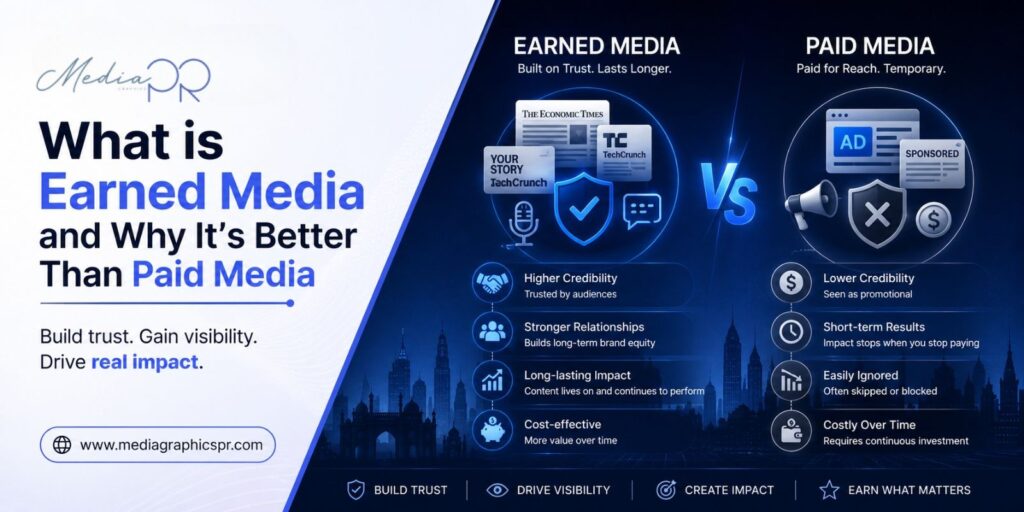
You’ve seen it happen to a competitor. Same market. Similar product. Comparable team. But their founder keeps showing up in Mint. Their company gets written about in Economic Times. Journalists quote them whenever a story about their space breaks. And somehow, without you seeing them run a single ad, they’re the brand investors recognize, enterprise buyers trust, and talented candidates apply first. That’s not luck. That’s what is earned media doing its job. And understanding the difference between that and paid media is one of the most important things a growing Indian brand can get clear on, because the two aren’t interchangeable, and treating them like they are is expensive. So What Is Earned Media, Exactly? Simply put, it’s coverage your brand receives that you didn’t pay for and didn’t publish yourself. A journalist writing about your company because the story is genuinely worth telling. A publication featuring your founder because their perspective adds real value to their readers. An analyst mentioning your product because it belongs in the conversation. The word “earned” is doing all the work here. You didn’t buy it. You didn’t post it on your own channel. Someone with no financial stake in your success independently decided your brand deserved their audience’s attention. That independence is exactly what makes it valuable. The Three Types of Media—Where Earned Sits Media Type Who Controls It Cost Trust Level Paid Media You Pay per placement Lowest, as the audience knows it’s paid Owned Media You Time and production Medium, useful but self-promotional Earned Media Third parties No direct cost Highest, due to independent endorsement Most Indian brands spend the majority of their communications budget on paid and owned. The brands building lasting credibility are the ones investing in earning the third column. Earned Media vs. Paid Media India—The Real Difference The earned media vs. paid media India conversation usually starts with cost. That’s the wrong starting point. The more important difference is trust and what trust actually does for a business. Paid media buys attention. You write the message, choose the channel, pay for the placement, and reach whoever the platform’s algorithm decides to show it to. The moment the budget stops, the attention stops with it. And the entire time it’s running, your audience knows it’s paid, which means they process it with a healthy level of skepticism. Earned media works completely differently. When Economic Times covers your startup, nobody paid them to do it. When a journalist quotes your founder as an expert, it’s because the editor decided that insight served their readers. When a publication features your product, it’s because someone independently judged it worth covering. That’s a trust signal paid media simply cannot replicate, no matter how well-targeted the campaign or how high the budget. Why Earned Media Is Better—The Specific Reasons 1. It Survives the Ad Blocker Forty percent of Indian internet users run some form of ad blocking. Earned media doesn’t get blocked; it appears in the editorial content people are actively choosing to read. 2. It Keeps Working After You Stop A paid campaign stops the moment the invoice isn’t paid. An earned media feature in Mint from ten months ago is still online, still ranking in search, still being found by investors and buyers researching your company. The asset doesn’t expire. 3. It Shows Up When People Research You Before any significant business decision—an investment, a procurement sign-off, a senior hire accepting an offer—people Google the company involved. Earned media coverage in credible publications is what makes those search results work in your favor before you’ve said a word in the room. 4. It Improves SEO High-authority publications linking to your website improve your domain authority. Better domain authority means better organic search rankings. Better rankings mean inbound traffic without paid spend. Earned media benefits compound with SEO in ways most brands don’t track but definitely feel after twelve months of consistent coverage. 5. It Reaches Multiple Audiences at Once One well-placed earned media feature in the right publication can reach investors, enterprise buyers, potential hires, and industry peers—simultaneously, with the same third-party credibility signal. No paid campaign replicates that efficiency at comparable cost. The Earned Media vs. Paid Media India Reality Check Here’s the honest comparison for Indian brands in 2026: Factor Paid Media Earned Media Speed Fast, with campaigns going live within days Slower, usually building over months Control Full; you own the message Partial, as journalists help shape the story Credibility Lower, as the audience knows it’s advertising Higher due to third-party endorsement Longevity Stops with the budget Stays online indefinitely SEO Value Limited Significant, often including authority backlinks Crisis Value None Substantial, as pre-built credibility absorbs reputational hits Cost Over Time Ongoing and increasing Compounds without proportional cost increases The right answer for most Indian brands isn’t earned instead of paid. It’s understanding what each one does and using them for the right jobs. Paid media drives immediate conversions. Earned media builds the trust that makes those conversions happen more easily and more consistently over time. How Earned Media Actually Gets Built What is earned media as a process—not just a definition? Here’s the honest flow: Clear narrative built around the brand ↓ Right journalist relationships developed over time ↓ Stories pitched that serve the journalist’s readers ↓ Coverage secured in relevant publications ↓ Journalist files the brand as a credible source ↓ Next story—journalist comes back without being pitched ↓ Earned media compounds as coverage generates coverage The brands with the strongest earned media presence in India didn’t get there through one great press release. They got there by showing up consistently, giving journalists something genuinely worth covering, and building real relationships over months—not just pitching when they had news. The Earned Media Benefits Most Brands Underestimate Earned media benefits go well beyond individual placements. Here’s what changes at a business level when earned media is working properly: Fundraising gets easier—investors who’ve seen your coverage arrive at meetings with trust already started Enterprise sales shorten—procurement

Press Release for a SaaS Product
MediaPR

How to Write a Press Release for a SaaS Product

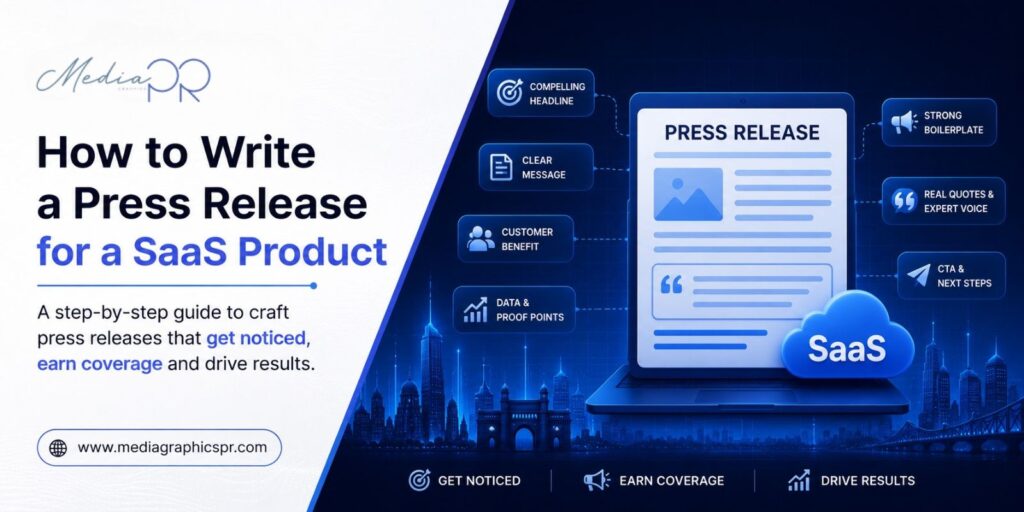
A SaaS press release that gets covered has a clear news hook in the first two lines, one strong quote from a founder or customer that a journalist can use without editing, and a specific metric that makes the story feel real rather than promotional. That is the difference between a release that gets filed and one that gets ignored. Most SaaS press releases fail not because the news is weak — it usually is not — but because the release is written like a product brochure rather than a news story. Journalists receive between 200 and 500 pitches a day, according to Cision’s 2025 State of the Media Report. They spend less than three seconds deciding whether something is worth reading. If your lead sentence talks about your vision, your mission, or how excited you are, those three seconds are gone. This guide covers the full structure of a SaaS product press release, what belongs in each section, where most companies go wrong, and how to pitch it once it is written. When a SaaS Press Release Is Actually Worth Writing Before the structure, there is a more important question: does this announcement warrant a press release at all? A lot of SaaS companies send press releases for things that are not genuinely newsworthy outside their own user base — a minor feature update, a rebrand, a new integration with a tool nobody outside their customer list has heard of. Those releases do not get covered. They get deleted. Worse, they train journalists to ignore future pitches from the same company. A SaaS press release earns its place when the announcement crosses at least one of these thresholds: It changes something material about your market position — a funding round, a major product launch, a first enterprise client in a new vertical, a partnership that meaningfully expands what your product can do. Or it contains data that journalists in your space would find genuinely interesting — platform insights, user behaviour trends, adoption statistics that speak to something happening in the broader market, not just inside your company. Or it involves a named person a journalist’s audience would recognise — an investor, an advisor, an enterprise client willing to be quoted by name. If your announcement does not cross at least one of those thresholds, a targeted blog post, an email to your customers, and a LinkedIn update from your founder will serve you better than a press release. The Structure of a SaaS Press Release — Section by Section The Headline The headline does one job: get a journalist to read the first paragraph. It should be specific, factual, and written in plain English. It should contain the actual news, not a description of how big or exciting the news is. What does not work: “[Company] Revolutionises the Future of B2B Collaboration with Groundbreaking AI-Powered Platform” What does: “[Company] Raises ₹40 Crore Series A to Expand HR Automation SaaS Across South Asia” or “[Company] Launches Contract Intelligence Module Following 200% Growth in Enterprise Clients” The second type of headline tells a journalist exactly what happened. They can decide in two seconds whether it is relevant to their beat. That is what you want. The Dateline and Lead Paragraph Immediately below the headline comes the dateline — city name and date of release. Then the lead paragraph, which is the most important paragraph in the release. The lead answers: what happened, who it happened to, and why it matters. Not who is excited about it, not what it will eventually mean for the future — what happened, and why a journalist’s readers should care right now. A strong SaaS product launch lead looks something like this: “[City, Date] — [Company], the B2B procurement automation platform used by over 300 enterprises across India and Southeast Asia, today announced the launch of [Product Feature], designed to cut vendor onboarding time by up to 60% for mid-market procurement teams.” That lead contains: the company name and what it does, a credibility signal (300 enterprises), the announcement itself, and a specific benefit with a number. A journalist reading knows immediately whether this is a story for their readers. The Second Paragraph — Market Context The second paragraph is where you place the announcement in a broader context. Why does this matter beyond the company that built it? What is happening in the market that makes this relevant now? This is where a data point from your own platform — or from a credible external source like Gartner, NASSCOM, or an industry report — earns its place. It is not about padding the release. It is about giving the journalist the market angle they need to write a story that goes beyond a product announcement. The Founder or CEO Quote Every SaaS press release needs at least one quote. The quote should not repeat what the previous paragraphs have already said. It should add a perspective that only a human voice can add — the strategic reasoning behind the decision, the problem the product is solving from the founder’s experience, or an honest observation about where the market is heading. What a journalist cannot use: “We are thrilled and excited to launch this industry-leading solution that will transform how businesses operate.” That sentence is useless. No journalist will print it because it says nothing. What a journalist can use: “Most enterprise procurement teams in India are still managing vendor contracts through email threads and spreadsheets. That is not a workflow problem — it is a risk exposure problem. We built this to change that.” That is quotable because it is specific, it has a point of view, and it sounds like a person, not a press release. The Customer or Partner Quote (Where Available) A named customer quote in a SaaS press release is worth more than almost anything else you can include. It validates the claim independently. It gives the journalist a second source. And it signals that real people are using your

PR Strategy for B2B SaaS Companies
MediaPR

What Is the Best PR Strategy for B2B SaaS Companies?

The best PR strategy for a B2B SaaS company focuses on three things: positioning your founders and product leaders as credible industry voices, securing coverage in the publications your buyers actually read before they contact sales, and using original data to give journalists a reason to write about you beyond a product announcement. That is the short answer. The longer answer depends on what stage you are at, who your buyers are, and what problem you are trying to solve — pipeline, investor credibility, talent acquisition, or category ownership. Each of those goals requires a different emphasis, though the foundation stays the same. Why B2B SaaS PR Works Differently From Consumer PR Most general PR advice is written for consumer brands. B2B SaaS is a different game entirely, and applying consumer PR logic to it tends to produce expensive disappointment. The core difference is the buyer. A B2C purchase is made by one person, often emotionally, sometimes in minutes. A B2B SaaS deal typically involves a buying committee of six to ten people — a CTO evaluating technical architecture, a CFO looking at total cost of ownership, a procurement team running vendor checks, and end users who will actually live with the product day to day. According to Gartner’s 2025 research, 80% of B2B buyers complete the majority of their research independently before they ever contact a vendor’s sales team. That finding has a direct implication for PR. If your buyer is forming their opinion about your category — and your company’s place in it — before they talk to anyone on your team, then the publications they read, the reports they reference, and the executives they follow on LinkedIn matter enormously. PR is how you show up in that research process with credibility you did not pay for. A B2B SaaS company featured in a respected trade publication or business media outlet sees something consumer brands rarely do: prospects mention the coverage during sales calls, not as casual awareness but as a validation signal. That shortens deal cycles in a way that paid advertising simply cannot replicate. The Core Components of a B2B SaaS PR Strategy Thought Leadership — The Engine of B2B PR Thought leadership is the term the industry uses loosely for almost everything. In practice, it means one specific thing: your company’s senior people have a genuine, non-obvious point of view about where your industry is heading, and you are putting that view into the market consistently enough that journalists, analysts, and buyers start associating your brand with that perspective. This does not happen from press releases. It happens from bylined articles in publications your buyers respect, from expert commentary when journalists are writing about your category, from speaking slots at the conferences where your customers make their evaluations, and from original research that gives people something new to think about. The question to ask before building a thought leadership programme is not “what do we want to say about our product?” It is “what do we believe about our industry that most people would push back on?” That friction — a genuinely held, defensible contrarian position — is what makes a thought leader worth reading. Everything else is just content. Original Data and Research Journalists covering B2B technology are drowning in vendor pitches that offer opinions. What they cannot get enough of is proprietary data. If your platform processes enough transactions, user sessions, or workflow events to generate non-obvious insights, those insights are a story. A project management SaaS that can say “remote teams using our platform increased automation workflows by 35% in Q1” has something a journalist can write about. A cybersecurity company that can say “mid-market enterprises see an average of 14 days between breach detection and response” has a story that will get picked up. The data does not need to be dramatic — it needs to be specific, verifiable, and tied to something your buyers care about. This is one of the most underutilised PR assets in B2B SaaS. Most companies sit on data that would generate significant media coverage and never think to treat it as a PR asset. Trade and Vertical Media — Not Just National Business Press The instinct for most SaaS founders is to chase the big business publications — Economic Times, Forbes, Mint. Those placements matter for investor credibility and brand authority. But for pipeline impact, the publications that actually move the needle are often vertical trade outlets that your buyers read professionally. An HR tech SaaS will find more qualified buyer attention in People Matters or HR Katha than in a general business publication that covers the company as one item in a startup funding roundup. A fintech SaaS serving NBFCs reaches its actual decision-makers through BFSI-focused publications more directly than through a national masthead that treats fintech as a general interest topic. Both matter. The national coverage builds category authority and investor confidence. The vertical trade coverage reaches buyers at the moment they are actively researching solutions. Analyst Relations — The Underestimated Lever Most B2B SaaS companies think about PR as media relations. The companies that win enterprise deals think about it differently. Getting included in an analyst report from Gartner, Forrester, IDC, or India-specific research bodies can unlock procurement conversations that no amount of press coverage alone would achieve. Enterprise buyers, particularly in regulated sectors like BFSI, healthcare, and government-adjacent technology, often use analyst reports as shortlists. If your company does not appear in the reports your buyers reference, you may not even be considered, regardless of how strong your product is. Analyst relations is a long-term investment. It takes 12 to 18 months of consistent engagement before most companies see meaningful impact from it. But for SaaS companies targeting enterprise accounts, it belongs in the PR strategy from Series A onwards. LinkedIn and Executive Visibility In B2B SaaS specifically, the founder’s or CEO’s LinkedIn presence functions as an always-on thought leadership channel that media coverage alone cannot replicate. A well-written LinkedIn

Best Day to Announce Funding in India
MediaPR

Best Day to Announce Funding in India — Timing Your PR for Maximum Coverage

Most founders spend months preparing for a funding announcement. The pitch deck, the investor updates, the legal close, the cap table. And then, when the moment finally arrives, someone asks: when do we go public with this? That question gets answered fast — usually with whatever day is convenient, or the first morning the founder feels ready, which is how perfectly good funding announcements end up landing on a Friday afternoon before a long weekend, buried under IPO news, or competing with the Union Budget for journalist attention. Timing a funding announcement in India is not complicated. But it does require knowing how the media cycle here actually works — which is different from what global PR guides will tell you, and different from what worked five years ago. The Short Answer First The best day to announce funding in India is Tuesday or Wednesday, between 9:30 AM and 11:30 AM IST. That window gives your announcement the maximum chance of being read, considered, and picked up by journalists at Inc42, YourStory, Economic Times, Business Standard, Mint, and the national TV desks that run startup coverage. It avoids the Monday inbox backlog, clears the mid-week rush, and lands before Thursday — when editors start wrapping their weekly planning. But the day of the week is only part of the picture. The more important question is which weeks to avoid entirely — and India has several of them every year. Why Timing Matters More Than Founders Usually Think India’s startup media ecosystem runs on a relatively small number of journalists covering a very large number of deals. Inc42, YourStory, Economic Times Startup, The Ken, Mint’s tech desk — the core startup beat reporters who actually break funding news are fewer than most founders assume. On any given week, a handful of people are responsible for covering every significant deal in the country. That means your announcement is not competing with your industry alone. It is competing with every other founder in India who also decided this week was the right time to go public. When three seed rounds, two Series As, and a major acquisition all land in journalists’ inboxes on the same morning, the deals with the strongest stories and the best media relationships get covered. The rest wait, or get a paragraph in a roundup. India’s startup ecosystem raised $11.6 billion across deals in 2025, according to tracked funding data. On active weeks, that translates to multiple announcements every single day. Choosing the right window is not about gaming the system. It is about not actively working against yourself. The Best Days — and Why Tuesday is the most consistent performer for funding announcements in India. Journalists have cleared Monday’s backlog, the week’s editorial calendar is still open, and reporters are actively seeking stories to file before the deadline. A well-prepared release landing in an Inc42 or YourStory journalist’s inbox on Tuesday morning at 10 AM has a realistic shot at same-day or next-day coverage. Wednesday runs close behind. By midweek, journalists are in full production mode. Editors have a clearer picture of what the week looks like and are more receptive to pitches that need a bit of context or a follow-up call. For deals that require a longer conversation — a significant round, an unusual investor, a first-time international VC backing an Indian startup — Wednesday gives more room for that discussion to happen before the story gets filed. Thursday is acceptable but comes with a catch. Open rates for media emails peak on Thursday in most studies — Prowly’s analysis of over 55,000 press releases found Thursday open rates crossing 26%, the highest of the week. But by Thursday afternoon, many editorial teams are already pulling together their end-of-week coverage. Your story may get read but not acted on before Friday arrives. If you announce on Thursday, do it by 10 AM. The Days to Avoid — India-Specific Monday is the most common mistake. Everyone assumes Monday morning is a fresh start, a clean slate, a good moment to launch something. Journalists see it differently. Monday is the day two days of accumulated emails get cleared, weekend news gets processed, and the week’s major stories start to take shape. A funding announcement landing on Monday competes with all of that. Response rates are lower, and coverage, if it comes, often lands Wednesday or Thursday anyway. Friday is where announcements go to be forgotten. Journalists are filing their last stories of the week, editors are pushing to close out their content plans, and anything that requires follow-up questions or additional research gets pushed to Monday — by which point the news is stale. The only reason to announce on a Friday is if you want reduced attention, which occasionally makes sense for difficult news but never for a funding round you want maximum coverage on. Weekends are not a consideration for earned media. Nothing goes live, nothing gets read, nothing gets covered. The Calendar Windows That Kill Funding Announcements in India This is where India is genuinely different from global markets, and where most international PR guides will fail you. Union Budget Week (February 1 and the week around it) is a complete blackout for anything unrelated to budget announcements. Every journalist, every editor, every business desk in the country is consumed by budget coverage. A funding announcement during budget week will be seen by almost nobody who matters. The week before and the week after are also disrupted. Give the budget at least a week to clear before you announce. Diwali and the festival fortnight — typically October or November depending on the year — is a period when startup coverage slows significantly. Many investors and journalists take time off, editorial teams run on reduced capacity, and the news cycle compresses. If your close happens in late October, wait until the first full working week of November. Republic Day (January 26) and Independence Day (August 15) weeks bring significant government and national news coverage that can drown out startup announcements. Not as severe as budget week,

Ethical Guidelines for Public Relations in India
MediaPR

What Are the Ethical Guidelines for Public Relations in India?

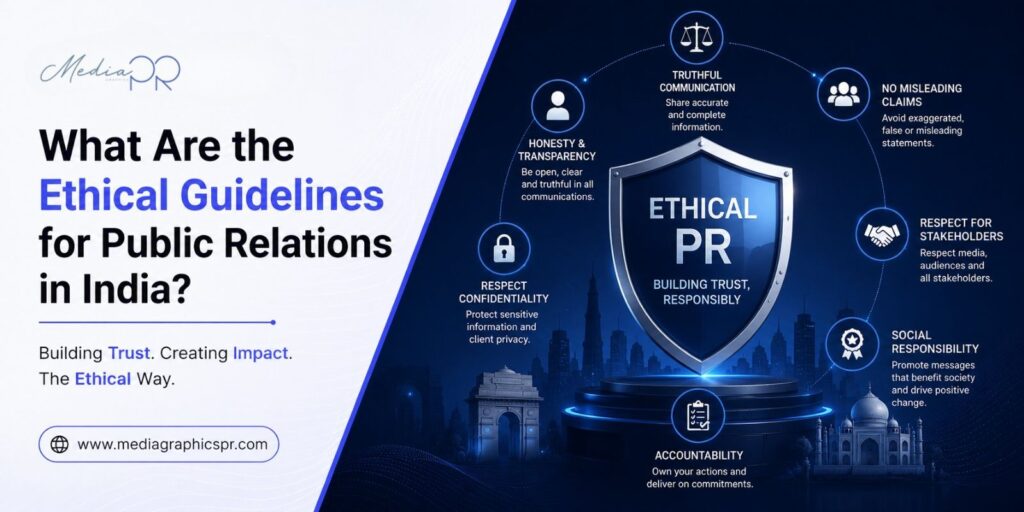
There is a version of PR that most people recognise — sharp press releases, friendly journalist relationships, and a brand story that cuts through the noise. Then there is the other version, the one that makes the industry uncomfortable to talk about — fabricated stories, undisclosed paid coverage, and manufactured public opinion that nobody commissioned but everyone reads. The gap between those two versions is ethics. India’s public relations industry has grown into one of the fastest-expanding communications sectors in Asia. According to PRCAI’s SPRINT 2024-25 survey, the Indian PR industry has crossed ₹2,500 crore in annual revenue, growing at nearly three times the global average. That scale brings scrutiny. And as the industry matures, the question of what constitutes responsible, ethical PR practice in India has become more relevant than it has ever been. This blog is an attempt to answer that question clearly, without the usual platitudes. What Does “Ethical PR” Actually Mean in India? Ethics in public relations is not a philosophy exercise. It has very direct, practical implications for how agencies pitch stories, how clients are counselled, and how brands communicate with the public in moments of crisis or controversy. When you strip away all the jargon, ethical PR comes down to one thing: you do not lie, and you do not help your client lie. That sounds obvious. But the pressure to deliver coverage, satisfy demanding clients, and operate within tight timelines can push agencies toward shortcuts nobody announces out loud — stretching a claim in a press release, burying a critical qualification, or describing a paid placement to a client as though it were earned editorial. Each of those is a breach. The fact that the industry has quietly tolerated all three does not change that. Understanding what the guidelines actually say — and why they matter — is the starting point for any serious conversation about this. The Governing Bodies and Their Codes Two organisations set the formal ethical framework for PR practice in India. The Public Relations Consultants Association of India (PRCAI), which came into existence in October 2001, is the apex body for PR consultancies in India. It is affiliated with the International Communications Consultancy Organisation (ICCO) and has built a Code of Conduct that agencies, clients, and corporate communications teams are all expected to follow. Where the Code gets specific — and it does get specific — it covers how practitioners must handle honesty, confidentiality, digital communications, and disclosure. PRCAI additionally adopted the Helsinki Declaration, a document that speaks directly to fake news, privacy in communications, the responsible use of AI tools in PR, and professional conduct across platforms. The Public Relations Society of India (PRSI) has been around since 1958 — long before “ethical PR” became a conference topic — and its focus is on individual practitioners rather than agency firms. PRSI’s Code of Ethics was adopted formally at its first national conference in 1968, drawing from the International Code of Ethics for Public Relations. Its foundation has not changed: truth, integrity, and respect for the people affected by communications remain the core obligations for any practitioner who operates under it. Both bodies overlap significantly in what they demand, and between them they cover the ground that matters most in day-to-day PR practice. The Core Ethical Principles — What They Actually Require Truth and Accuracy in All Communications The first and oldest rule in every PR code — Indian or international — is that you do not pitch things you cannot back up. A funding number needs to be the real number. A product claim needs to be something the product actually does. An achievement needs to have happened. Journalists check. When they find a gap between what was pitched and what is true, it is not just that story that dies — it is the relationship, sometimes for years. What makes this harder in practice is that clients sometimes push agencies to go further than the facts comfortably support. A pre-revenue startup wants to be positioned as a “category leader.” A product in beta wants launch-level coverage. The ask is usually framed as ambition, not dishonesty. An agency that goes along with it anyway — because saying no is uncomfortable — is not serving the client. It is setting them up for a credibility problem the moment a journalist starts digging. Transparency About Who Is Paying for What This is where the Indian PR industry has a genuine problem. The line between editorial coverage and paid placement has been systematically blurred over the years. Publications that accept fees to run “articles” that read like editorial, and agencies that present paid placements to clients as earned media, have made it difficult for audiences to trust what they read. The Press Council of India’s Norms of Journalistic Conduct prohibit “paid news” — any coverage where the publication received payment and did not tell readers about it. The IT Rules 2021 pull digital media publishers into the same framework. What this means on the ground is simple: if money changed hands, the reader has a right to know. Dressing up a sponsored article as independent journalism is not a grey area — it is a violation of both the regulatory framework and the basic trust that makes PR coverage worth anything at all. At MediagraphicsPR, we work exclusively with earned media. Every placement we secure is the result of genuine journalism — not a fee paid to a publication. That distinction matters enormously to the credibility of coverage. Protecting Confidential Information Think about what a PR agency actually knows about its clients at any given point — funding that has not been announced yet, a legal dispute that is still being settled, a product that did not perform the way anyone hoped, a leadership change that is three weeks away. That information sits with the agency team because the agency needs it to do the work. It does not travel further than that, not to other clients, not to journalists, not to anyone in

PR Agency Cost Per Month in India
MediaPR

How Much Does a PR Agency Cost Per Month in India?

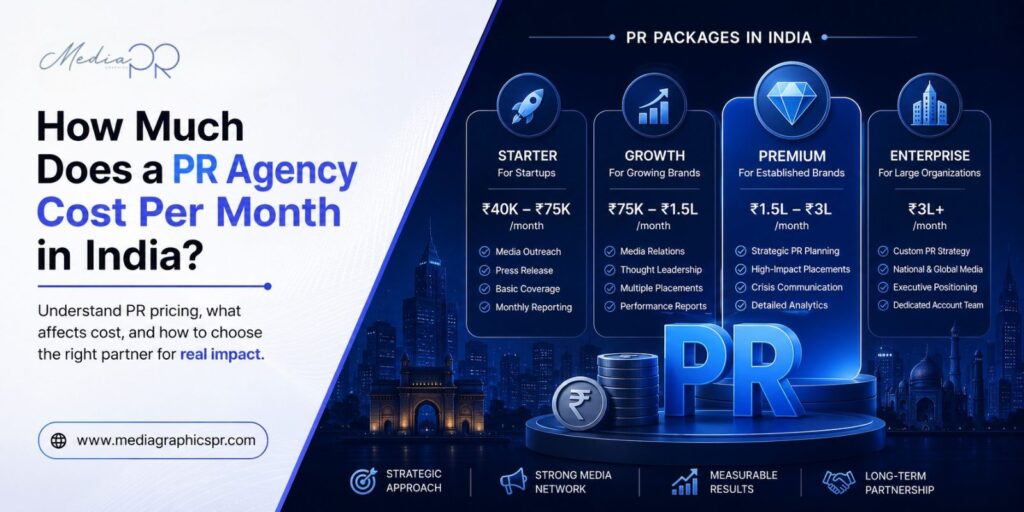
If you have ever reached out to a PR agency in India asking for pricing, you already know what happens next. You get a call. Then a presentation. Then a “customised proposal” that arrives three days later — with no numbers in it. This is not a coincidence. The PR industry in India has quietly normalised pricing opacity, and most agencies will not publish rates because they want to qualify you before you can compare them. That approach protects their margins. It does not protect your budget. This blog changes that. Whether you are a startup founder allocating your first marketing budget, a marketing head justifying PR spend to leadership, or a business owner simply trying to understand what you are getting into — the numbers below are real, current, and based on how the Indian PR market actually operates in 2025-26. PR Agency Cost Per Month in India — The Direct Answer The PR agency cost per month in India ranges from ₹40,000 to ₹5,00,000 or more, depending on the size of the agency, the scope of work, and the media tier you are targeting. Most businesses — startups, growing SMBs, and mid-sized companies — land somewhere between ₹75,000 and ₹2,00,000 per month on a standard retainer. That is the realistic working range for consistent, meaningful media coverage in national and digital publications. Here is a broad breakdown by agency type: Who You Are Hiring Monthly Cost Freelance PR Consultant ₹25,000 – ₹50,000 Small or Boutique Agency ₹40,000 – ₹75,000 Mid-Tier Agency ₹75,000 – ₹2,00,000 Established Full-Service Agency ₹2,00,000 – ₹3,50,000 Top-Tier or Multinational PR Firm ₹5,00,000 and Above These figures are for ongoing monthly retainers. Project-based work — a product launch, a funding announcement, an IPO communication mandate — is priced separately and typically runs between ₹1,00,000 and ₹6,00,000 per engagement, depending on scope and duration. What Does a Monthly PR Retainer Actually Cover? This is where most clients get surprised. They sign a retainer expecting results in week two and get frustrated when coverage takes two months to materialise. Managing that expectation starts with understanding what a PR agency does every month on your behalf. A standard retainer at a serious agency covers: Media Relations — Your account team maintains active relationships with journalists, editors, and producers across print, digital, and broadcast. They pitch your stories, follow up, and negotiate editorial angles. This is not a one-time effort; it is ongoing relationship management that compounds over time. Press Releases and Content Writing — Crafting newsworthy press releases, founder quotes, backgrounders, and media kits that give journalists exactly what they need to write about you. Thought Leadership — Positioning your founders, senior leadership, or subject matter experts as credible voices in your industry through bylines, expert quotes, panel nominations, and contributed articles. Coverage Reporting — Monthly reports showing what got published, where, reach estimates, and media value equivalents. A good agency shows you the data; a great agency tells you what it means. Strategy and Counsel — Arguably the most undervalued part of any retainer. Good PR is not just about placing stories. It is about knowing which stories to tell, when to tell them, and which publications your audience actually reads. At MediagraphicsPR, our retainers include all of the above. We work across sectors — from beauty and fashion to hotel and restaurant brands, from book publishing to climate tech and VC and PE firms — and every client gets a dedicated team, not a rotating junior executive. Five Factors That Determine Your PR Cost No two retainers are priced identically, and understanding what drives the cost helps you evaluate proposals far more critically. 1. The Publications You Want to Be In There is a significant difference in effort between securing coverage in a niche digital blog versus The Times of India, Business Standard, CNBC TV18, or Forbes India. Tier-1 national media requires stronger pitches, deeper relationships, and more editorial strategy. Agencies with consistent Tier-1 access charge accordingly — and deliver accordingly. 2. Your Industry Consumer lifestyle brands are relatively easier to pitch. Fintech, healthcare, legal, SaaS, and pharmaceutical companies require more specialised communication strategy, more careful positioning, and often longer lead times for editorial consideration. Specialised verticals cost more to service well. 3. City of the Agency PR agencies operating out of Mumbai and Delhi NCR typically charge 30 to 60 percent more than comparable agencies in Bangalore, Hyderabad, or Pune. The overhead is higher, but so is the proximity to national media clusters. For most clients targeting national coverage, this is a reasonable premium. 4. Seniority of the Assigned Team This is the single most important variable that most clients do not ask about. Two agencies quoting ₹2,00,000 per month may be offering completely different levels of service. One may assign a senior PR strategist with 12 years of media relationships. The other may assign two junior executives who are still building their contact lists. Before signing anything, ask specifically: who will work on my account, what is their experience level, and how many other clients will they handle simultaneously? 5. Scope Beyond Core Media Relations Basic retainers cover media outreach. Every layer you add — executive profiling, award nominations, crisis communication preparedness, influencer relations, social media management — adds to the monthly cost. A mid-range retainer of ₹2,00,000 to ₹3,00,000 typically covers media relations plus one or two additional services. More than that and you are looking at higher tiers. How to Think About PR as an Investment, Not a Cost One of the most common mistakes businesses make is treating PR as a line item to be cut when budgets tighten. The companies that build lasting brand equity treat it differently — as a long-term investment in credibility that no other channel replicates. Consider the math. Industry benchmarks consistently show that earned media — editorial coverage you did not pay for — generates three to five times more value per rupee than equivalent paid advertising. A Nielsen study placed consumer trust in earned media at 92 percent, compared to significantly lower figures for display ads and sponsored content. Beyond

PR for EV
MediaPR

PR for EV and Clean Energy Startups in India

India’s EV and clean energy sector is attracting billions in investment, government attention, and global interest—all at the same time. And yet most startups building in this space are nearly invisible outside their immediate investor circle. The technology is genuinely exciting. The problem being solved is real and urgent. The market opportunity is one of the largest India has seen in a generation. But the founders are so deep in product, manufacturing, and fundraising that nobody outside their network actually knows what they’re building. That’s the gap EV startup PR India fills. And in a sector moving this fast—where the narrative around your company shapes who backs you, who buys from you, and who wants to work with you—getting that gap closed early matters more than most founders realize. Why PR Hits Differently in the EV and Clean Energy Space EV startup PR India isn’t the same as PR for a SaaS company or a D2C brand. The audiences are different. The credibility requirements are higher. And the stakes of getting the narrative wrong are more significant. Here’s what makes this sector specifically challenging: PR Challenge Why It’s Unique to EV and Clean Energy Technical Complexity Battery chemistry, range specifications, and charging infrastructure make it challenging to communicate technical details clearly without compromising accuracy. Policy Dependence Government subsidies, FAME scheme updates, and state EV policies directly influence business performance, requiring PR strategies that stay aligned with regulatory developments. Sceptical Investors Following the global EV market correction, investors demand stronger proof points and transparency, making credibility-building essential before fundraising efforts. Consumer Trust Gap Many Indian consumers are still evaluating EV adoption, and earned media helps build trust more effectively than traditional advertising alone. Multiple Stakeholders Investors, fleet operators, retail consumers, government agencies, and infrastructure partners each require tailored messaging and communication strategies. What EV Startup PR India Actually Needs to Do Most EV and clean energy startups approach PR the same way—announce a product, send a press release, and hope for coverage. That’s not a strategy. Here’s what a real EV startup PR India approach looks like: 1. Own the Problem Before Promoting the Solution The EV and clean energy space has a narrative problem. Too many companies are talking about their technology. Not enough are talking about the problem that technology solves—in a way that makes regular people and non-technical investors understand why it matters. The founders who get the most coverage aren’t the ones who explain their battery management system best. They’re the ones who make the problem vivid—what it actually costs India every year to import fossil fuels, what urban air quality is doing to public health, and what the economics of fleet electrification actually look like for a logistics company running 200 vehicles. Own the problem narrative first. The solution coverage follows. 2. Target the Right Publications for Each Audience One of the most common EV startup PR India mistakes is pitching the same story to every publication. Audience → Right Publication Target ────────────────────────────────────────────────── Institutional investors → Mint, Economic Times, Business Standard EV ecosystem → EVreporter, e-Mobility+, Clean Mobility India Policy and government → Economic Times Policy, PRS India coverage Fleet and B2B buyers → Automotive Logistics, Fleet Management India Consumer market → Auto publications, mainstream lifestyle digital media Global investors → Forbes India, Bloomberg Quint, ET Markets Match every pitch to the audience it needs to reach. A story about fleet electrification economics doesn’t belong in a consumer auto publication. A consumer range anxiety piece doesn’t belong in an investor-facing business outlet. 3. Make Your Founder the Go-To Voice on EV Policy and Market Shifts India’s EV policy landscape changes constantly—FAME scheme updates, PLI scheme announcements, state-level EV policies, and charging infrastructure mandates. Every one of these is a PR opportunity for a well-positioned clean energy PR strategy. When your founder is consistently available to journalists covering these developments—offering genuine insight, clear perspective, and honest assessment of what policy changes mean for the market—they become the person journalists call first when the next update drops. That positioning is worth more than any product announcement. And it compounds—each quote leads to another call, each call leads to a feature, and each feature leads to investors and buyers who’ve been following the founder’s perspective for months. 4. Use Funding Moments Properly India’s EV sector has seen significant funding activity—Ather, Ola Electric, Euler Motors, Yulu, Log9 Materials, and dozens of others have raised meaningful rounds. Each major funding announcement in the space creates a news cycle that smaller, less-funded startups can insert themselves into. Major EV funding announced in India ↓ Journalist writes broader sector piece ↓ Your founder offers perspective on what this means for the market ↓ Quoted alongside larger, better-known players ↓ Credibility builds without needing your own announcement Reactive PR around sector news is one of the most cost-effective EV startup PR India tactics available. 5. Build ESG and Sustainability Narrative Seriously Most EV founders spend a lot of time talking about technology. That’s important. But customers and partners increasingly want to understand the larger impact of the business as well. A strong sustainability story helps people see not just what you’re building, but why it matters. In practical terms, that means: Share environmental impact data that people can actually understand Use independent validation wherever possible Be visible in the publications your customers read Help explain how India’s EV transition is changing the market For many EV startups, these conversations are becoming part of the buying process—not just a branding exercise. 6. Use Original Data to Generate Coverage Between Announcements Original research is one of the most underused clean energy PR tactics for Indian startups. A survey of 500 fleet operators on their EV adoption timelines. Internal data on real-world range performance in Indian conditions. Analysis of charging infrastructure gaps across Tier 2 cities. This kind of data gives journalists a story to write that isn’t just about your company but that features your company as the credible source. One well-timed data story can

Scroll to Top
logo

Get In Touch

Please enable JavaScript in your browser to complete this form.