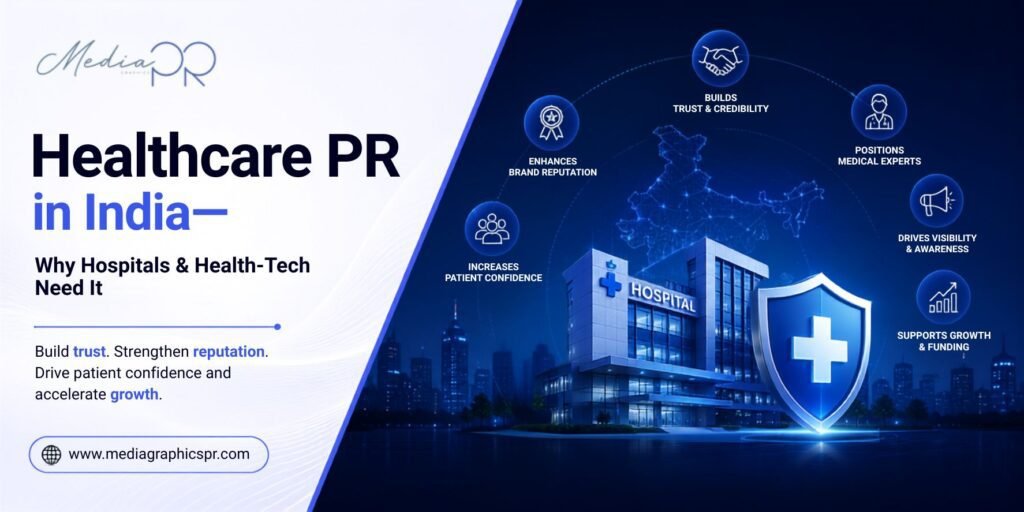
Healthcare PR in India—Why Hospitals & Health-Tech Need It
A patient choosing a hospital isn’t making a purchase decision. They’re making a trust decision, often under stress, often with incomplete information, and almost always based on what they’ve heard, read, or been told by someone they already trust. That trust doesn’t come from a brochure. It doesn’t come from a billboard on the expressway. It comes from what credible, independent sources say about the institution, the doctor whose expertise gets written about in a newspaper, the hospital that’s mentioned in a health report a patient’s family member shared, and the healthtech platform whose founder was quoted explaining a clinical breakthrough in a publication the patient’s doctor reads. MediagraphicsPR is a healthcare PR agency that has spent 25 years building that kind of credibility for hospitals, healthcare institutions, and health-tech companies across India through earned media, clinical thought leadership, regulatory-aligned communication, and the kind of sustained presence that turns institutional names into trusted ones. Why hospitals and health-tech companies specifically need healthcare PR, and why generic PR agencies consistently fail to deliver it, is what this blog explains in full. The Trust Problem That Healthcare Faces Differently Than Every Other Sector Every industry has a trust problem. Healthcare is different in kind, not just degree. When a consumer buys a product that disappoints them, they return it or leave a review. When a patient chooses a healthcare provider that doesn’t meet their expectations or, worse, causes harm, the consequences are in a completely different category. That asymmetry is what makes trust in healthcare more foundational, more scrutinized, and more fragile than in almost any other sector. Indian healthcare faces specific trust challenges that make healthcare PR both more necessary and more complex than most healthcare leaders realize: The information asymmetry problem. Patients almost never have the clinical knowledge to evaluate the quality of care they’re receiving. They evaluate trust through proxies, including the hospital’s reputation, the doctor’s media presence, what family and friends have said, and what they find when they search online. Healthcare PR shapes those proxies. The regulatory communication problem. The Clinical Establishments Act, NABH accreditation standards, NMC guidelines, and the Digital Personal Data Protection Act as it applies to health data mean healthcare institutions operate under communication constraints that most generic PR agencies don’t know exist. A campaign that’s compelling but violates clinical communication guidelines creates regulatory risk, not credibility. The sentiment volatility problem. Healthcare reputation can shift faster than almost any other sector. A single adverse outcome covered by the media, a social media post from a patient’s family member, or a regulatory notice can move public perception significantly in a short time. Institutions with healthcare PR infrastructure in place before these moments are the ones that manage them. The ones without it scramble. The clinical credibility gap. A hospital or health tech company that communicates only through its own channels, including its website, social media, and patient newsletters, is communicating in a space that patients increasingly distrust. Independent third-party validation from journalists, clinical publications, and health media is what closes the credibility gap that self-promotion creates. Why Generic PR Agencies Fail Healthcare Clients This is the question most hospital CMOs and health-tech founders don’t think to ask before they hire and the one they wish they had after six months of disappointing results. Generic PR agencies fail healthcare clients for reasons that are structural, not accidental: ► They Don’t Understand Clinical Communication Guidelines The Clinical Establishments Act regulates how hospitals can communicate publicly about clinical outcomes. NMC guidelines govern how doctors and hospitals can represent medical expertise in the media. The CDSCO framework shapes how health tech companies can describe device or diagnostic capabilities. The IRDAI framework applies to health insurance products. A PR agency that doesn’t know these frameworks will create communications that are credible-sounding violations. Not intentionally, because they don’t know what they’re violating. The consequences range from regulatory notices to genuine patient harm when overclaimed outcomes lead to inappropriate treatment-seeking behavior. ► They Target the Wrong Publications A consumer PR agency’s media list is built around lifestyle media, mainstream entertainment-adjacent press, and general interest digital publications. A startup PR agency’s list leans toward ecosystem media. Neither reaches the audiences that matter most for hospitals and health-tech companies: Who actually shapes healthcare trust decisions? ↓ ┌───────────────────────────────────────┐ │ │ │ │ Patients Referring Institutional Investors & Families Physicians Buyers & Partners │ │ │ │ Mainstream Medical Healthcare Business health journals, procurement press, media doctor- publications health-tech Times of facing Express media, India media Healthcare Inc42 Health, Medscape Health Mgmt Healthworld etc. India etc. etc. └───────────────────────────────────────┘ A specialized healthcare PR agency has relationships across all four audience groups. not just mainstream consumer media. ► They Can’t Handle Clinical Expertise Translation The single most important skill in healthcare PR, making clinical expertise legible and interesting to non-clinical audiences without losing accuracy, is not a generic communications skill. It requires understanding enough about clinical practice to know what’s genuinely significant, enough about journalism to know what makes it a story, and enough about regulatory guidelines to know what can and can’t be claimed. A cardiologist’s research on a specific intervention technique is not inherently a story. A healthcare PR agency that understands both cardiology and journalism knows how to find the patient story inside that research, the policy implication that makes it timely, and the angle that makes a health journalist want to cover it. ► They’re Not Equipped for Healthcare Crisis Communication Healthcare reputation crises are faster, harder, and more consequential than crises in most other sectors. An adverse clinical outcome covered by the media. A data breach involving patient health information. A regulatory notice about clinical practice. A social media post from a patient’s family member that gains traction. The institutions that come through these moments with their reputations intact are the ones with crisis communication infrastructure already in place, including pre-identified spokespeople with media training, prepared clinical communication frameworks, established journalist relationships, and a clear protocol for what gets said, by whom,